Night train trip
Classic Egypt: Pyramids, Nile Valley and Red Sea
by Felix Gillen
- 13 Days / 12 Nights
- Cairo → Hurghada
The route connects the three major chapters of an Egypt trip: Pyramids and museums in Cairo and Giza, the temples of the Nile Valley from Aswan to Luxor, and finally, swimming and snorkeling in the Red Sea. Cairo and Aswan are linked by a sleeper train, Aswan and Luxor by a roughly three-hour day train, and from Luxor, a bus takes you to Hurghada in four to five hours.
At a glance
- Duration
- 13 Days / 12 Nights
- Stops
- 4 · Cairo → Hurghada
- Arrival
- Flight · Kairo (CAI)
- Departure
- Flight · Hurghada (HRG)
- Nights on a night train or ferry
- 1
- Best Time to Go
- October to April
4 stops
Why This Route?
No domestic flights or return leg: A night train saves a hotel night, and an open-jaw flight ends your trip relaxed by the sea.
Hidden Gems
- Sunset from the Corniche in Aswan
- Kom Ombo and Edfu as stops en route from Aswan to Luxor
- Ibn Tulun Mosque in Islamic Cairo
Getting there and back
Open jaw: start and end are in different places
- Arrival
- Flight · Kairo (CAI)From Cairo Airport, no Metro goes to the city center; take a taxi or a pre-booked transfer.
- Departure
- Flight · Hurghada (HRG)Return flight from Hurghada, many direct connections to Europe.
Itinerary
Cairo
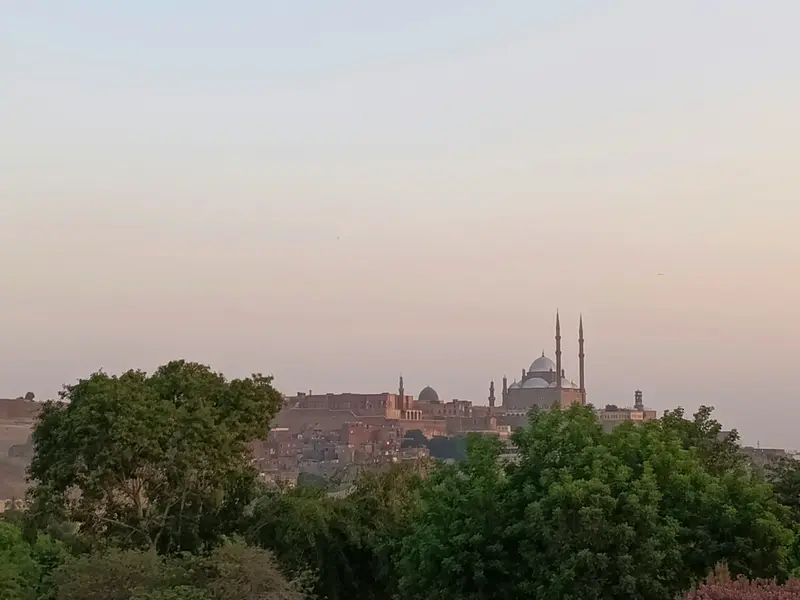
The capital on the Nile is for most travelers the gateway to the Pyramids of Giza on the western outskirts. Historic Cairo, a UNESCO World Heritage site since 1979, stretches from the Khan el-Khalili bazaar and the Al-Azhar Mosque in Islamic Cairo to the Citadel of Saladin; in the south, Coptic Cairo is home to the city's oldest churches. On Tahrir Square, the Egyptian Museum continues to display one of the largest collections of ancient Egyptian art, and in the Fustat district, the National Museum of Egyptian Civilization houses the royal mummies.
Giza Pyramids and Grand Egyptian Museum, Islamic Cairo, Egyptian Museum. On the evening of the third day, continue by sleeper train to Aswan.
5 Sights
3 Restaurants
Culture in Cairo
A Thousand Years of City HistoryThe Fatimids founded Cairo in 969 under their commander Jawhar al-Siqilli. Historic Cairo, encompassing Fustat, the Ibn Tulun Mosque, the Citadel, and the Fatimid core, has been on the UNESCO World Heritage list since 1979. The Al-Azhar Mosque was begun in 970 and completed in 972; its affiliated university is considered one of the oldest continuously operating in the world.Bazaar and Coffee HousesThe Khan el-Khalili Bazaar was established by Jaharkas al-Khalili, the stable master of Sultan Barquq, between 1382 and 1389; Café El Fishawy has existed since 1773. In a traditional coffee house (Ahwa), you'll find tea in a glass, water pipe, dominoes, and backgammon, and no one urges you to leave. Naguib Mahfouz immortalized the district with his novel "Midaq Alley" (1947).Ramadan and OperaBefore Ramadan, Fanous—lanterns made of brass and colored glass, handcrafted in the old city—hang everywhere. The current opera house on Gezira Island in the Nile, a gift from Japan, opened in 1988; the old Khedivial Opera House from 1869 burned down in 1971.
Night train
Sleeper train by Abela (formerly Ernst Watania), Train 86 daily: departs Cairo Upper Egypt Station (Bashtil) 19:45, departs Giza 20:15, arrives Luxor 06:10, arrives Aswan 09:25, approx. 13.5 hours; dinner and breakfast in the compartment. The sleeper train no longer departs from Cairo Ramses.
Aswan
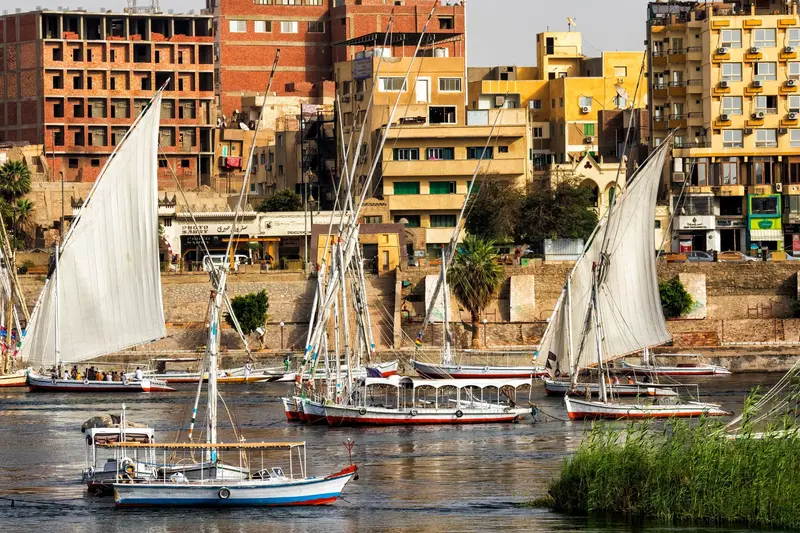
Aswan is located on the East Bank of the Nile at the First Cataract, the southernmost point of Egypt's railway network, and is the gateway to the Isis Temple of Philae and the rock temples of Abu Simbel. The city, with around 370,000 inhabitants, is quieter than Luxor; islands like Elephantine, granite rocks in the river, and the rock tombs on the West Bank define its character.
Philae, Felucca ride, day trip to Abu Simbel (3 to 3.5 hours each way or flight)
8 Sights
2 Restaurants
Nubia and the Ancient Border City
Nubian HeritageAswan is the gateway to Nubia. When the High Dam was completed in 1970, a large part of the Nubian settlement area was submerged in Lake Nasser; the Nubian Museum documents this lost culture. You can reach Nubian villages by ferry, such as Siou and Koti on Elephantine or Gharb Aswan on the west bank.Ancient Border CityOn Elephantine lay the ancient city of Abu, at the southern edge of Pharaonic Egypt. Its governors were buried in the rock tombs of Qubbet el-Hawa on the west bank, and obelisks were quarried in the granite quarries on the east bank. Philae, Elephantine, the quarry with the Unfinished Obelisk, and the Monastery of St. Simeon have been UNESCO World Heritage sites since 1979.
Luxor
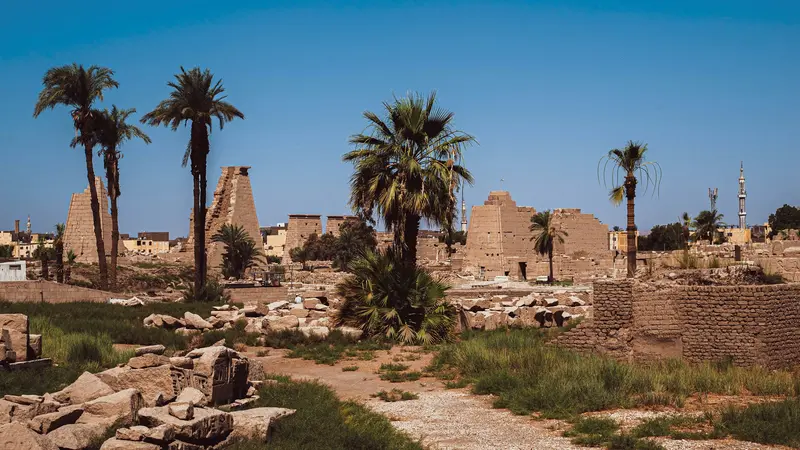
The city on the Nile's east bank occupies the site of ancient Thebes and is often hailed as the world's largest open-air museum. At its heart are Luxor Temple and, connected by the almost three-kilometer-long Avenue of Sphinxes, the vast Karnak Temple Complex. Across the river, on the West Bank, are the Valley of the Kings and the mortuary temples; most visitors stay on the East Bank and cross by ferry in the mornings.
Arrival by train in about 3 hours; Karnak, Luxor Temple, West Bank with Valley of the Kings
4 Sights
3 Restaurants
Culture in Luxor
Ancient ThebesLuxor is built on the site of ancient Thebes, the city of the god Amun and capital of Egypt during the Middle and New Kingdoms, around 700 kilometers south of Cairo. "Thebes with its Necropolis" has been a UNESCO World Heritage site since 1979. The Hypostyle Hall of Karnak alone comprises 134 columns across around 5,000 square meters.From the Opet Festival to the MoulidDuring the ancient Opet Festival, the sacred barque of the Theban gods was carried from Karnak to Luxor Temple. In the temple courtyard, since the 13th century, stands the Abu al-Haggag Mosque with Sheikh Yusuf Abu al-Haggag's tomb. His three-day Moulid, ending 15 days before Ramadan, involves boats carried in procession around the temple, reminiscent of the Opet Festival.Sound and Light ShowA Sound and Light Show has run in Karnak since 1972 in the evenings; times and languages vary with the season.
Hurghada
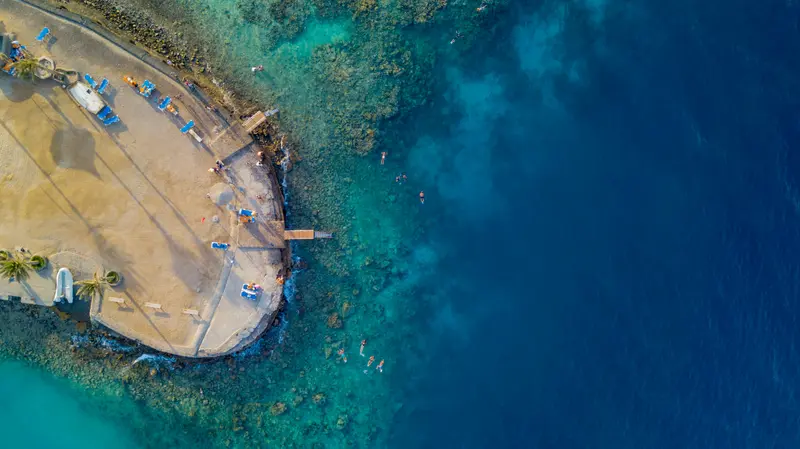
From a fishing village, officially founded in 1905, it has become since the 1980s one of Egypt's most visited resorts, attracting over nine million annual visitors. The city spans 36-40 kilometers along the coast: north is the original El Dahar district with its bazaar; south, Sakkala with its marina; and behind, the long hotel zone. Off the coast lie the protected Giftun Islands with reefs for snorkeling.
4-5 hour bus ride from Luxor; Snorkeling at Giftun Islands, El Gouna
5 Sights
2 Restaurants
Culture in Hurghada
From Fishing Village to Seaside ResortIn the late 19th century, fishermen from the Ababda people settled on the coast, and Hurghada was officially founded in 1905. In 1913, a British-Egyptian company discovered oil in the area; since the 1980s, the city has grown with tourism; in 2023, approximately 214,000 people lived here.Life with the ReefThe coral reefs off the coast are the foundation of tourism. The conservation organization HEPCA, founded in 1992, laid mooring buoys so that boats no longer have to anchor, and asks visitors not to touch anything and not to collect or buy shells or corals.
Plan this route as your trip
All stops, trains and nights go into your trip planner. You adjust dates and places to stay afterwards.
This route is a suggestion from our research. Please check timetables, times in port, opening hours and prices before you book – what your tour operator or carrier says is what counts.
Fernweh is a free travel guide and trip planner: routes researched by people, taken over in one click, used day by day on the road. More about Fernweh
4 stops
Route Summary
Duration13 Days
Stops4 Places
TypeCulture