City trip · Canada
Québec City in three days
by Felix Gillen
- 4 Days / 3 Nights
Three days in the only walled city north of Mexico: the Upper Town with cathedral, château and citadel, the Lower Town by the river with the ferry to Lévis and the former working-class district of Saint-Roch, and finally the Plains of Abraham and the residential streets of Montcalm. Québec is small enough to explore on foot, but steep: stairs, a funicular and a few buses connect the upper and lower town. You eat Québec country cooking, market cuisine in a bistro and lunch in the neighbourhood's market hall.
At a glance
- Duration
- 4 Days / 3 Nights
- Stops
- 1
- Arrival
- Flight · Québec (YQB)
- Best Time to Go
- June and September to mid-October: mild, and in autumn the maples change colour
More on when to go
July and August are crowded, but bring the Festival d'été on the Plains. Winter is very cold and snowy, yet with the Carnaval in February and the toboggan run on the Terrasse Dufferin it is a trip in its own right.
1 stop
Why This Route?
The old town is beautiful and in season it is full; if you start early and head out in the afternoon, you still get to enjoy it. The route gives each day one level of the city, takes you onto the river on the commuter ferry and into Saint-Roch and Montcalm, the neighbourhoods where Québec lives and eats.
Hidden Gems
- The Promenade des Gouverneurs runs from the Terrasse Dufferin along the cliff up to the Plains, with views of the river and hardly anyone around
- RTC bus 800 goes to the Chute Montmorency, a waterfall 30 metres higher than Niagara Falls
- In the Saint-Jean-Baptiste district outside the walls, steep stairs such as the Escalier Lavigueur lead down to Saint-Roch, lined with homes instead of souvenir shops
Getting there and back
Round trip, returning to where you started
- Arrival
- Flight · Québec (YQB)There are no direct flights to Québec from Germany, Austria or Switzerland; you usually change in Montréal or Toronto. From the airport RTC bus 80 runs to Saint-Roch in the city centre; tickets are available around the clock from the machine in the terminal. Often easier: fly to Montréal (YUL) and take VIA Rail from Gare Centrale, a good three hours to the Gare du Palais at the foot of the old town.
- Departure
- Flight · Québec (YQB)To the airport again on bus 80 from Saint-Roch. By train to Montréal from the Gare du Palais; book VIA Rail early.
Day by day
Day 1: Upper Town: cathedral, Château and Citadel
- Basilique-Cathédrale Notre-Dame de QuébecFrom the Gare du Palais station walk up the Côte du Palais; bishops and governors of New France lie in the crypt.
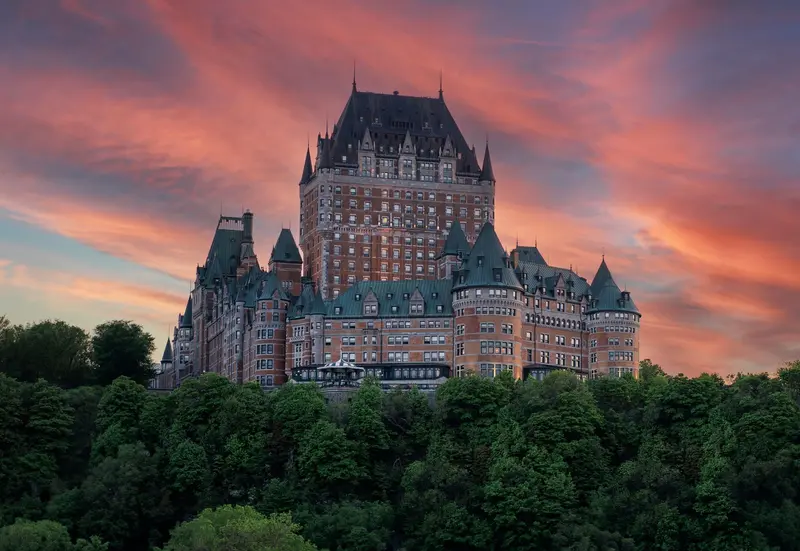
- Château FrontenacYou may enter the lobby without a room; for the hotel's history there are guided tours with a ticket.
- Dufferin TerraceThe wooden boardwalk along the cliff; at its end the stairs of the Promenade des Gouverneurs lead up to the Citadel.
- Citadelle de QuébecWith a guided tour in French or English, plus the museum of the Royal 22e Régiment.
- Aux Anciens CanadiensIn the Maison Jacquet from 1675–76, a restaurant serving traditional Québec cooking since 1966; daily noon to 9 pm, book ahead.
- Bar Ste-AngèleA small jazz bar on Rue Sainte-Angèle to end the evening.
Day 2: Lower Town, ferry and Saint-Roch
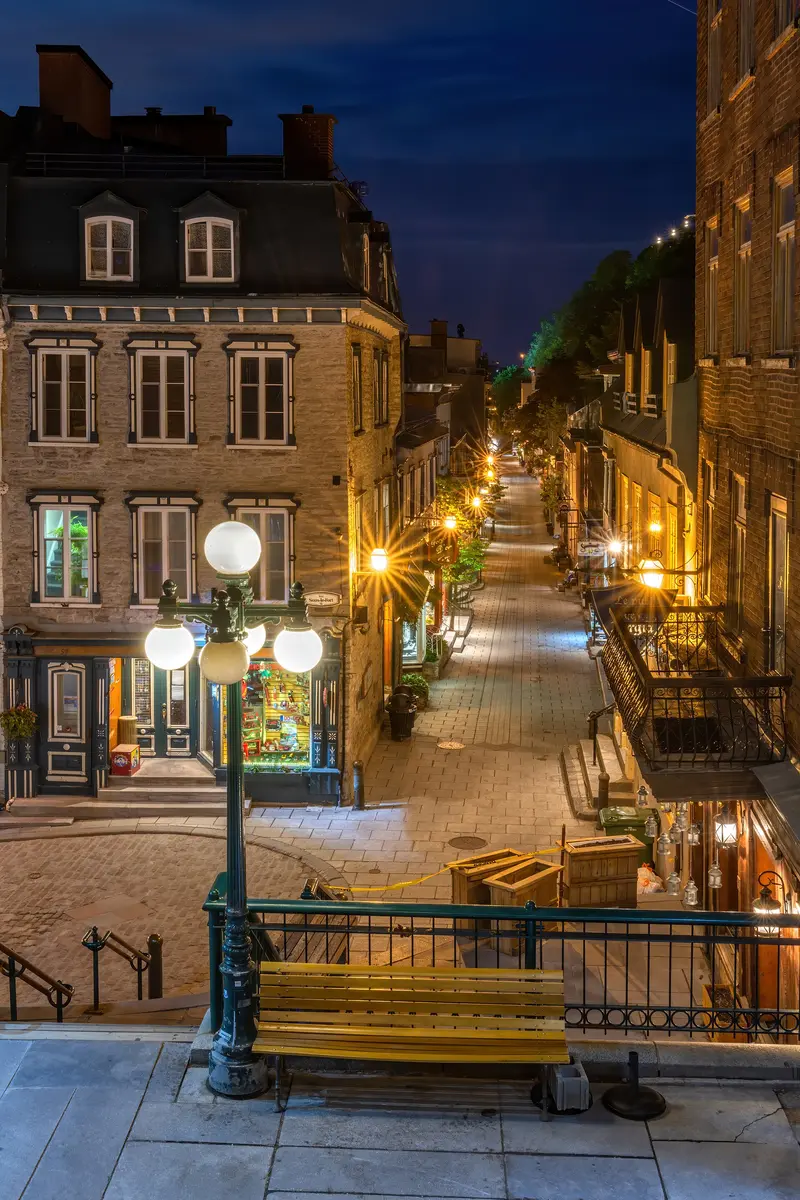
- Quartier Petit ChamplainDown the Escalier Casse-Cou; before ten the lanes are almost yours alone.
- Place Royale and Notre-Dame-des-VictoiresChamplain founded the city here in 1608; the small church from 1688 is the oldest stone church in North America.
- Musée de la civilisationThe exhibition on the First Nations and Inuit is the reason to come.
- Sautéed RabbitRabbit for lunch, as a pie or a poutine; book ahead.
- Traverse Québec–LévisWith the commuters to Lévis and back, about 12 minutes each way; no reservations, departures by timetable.
- Saint-Roch and Rue Saint-JosephOn foot along Rue Saint-Paul into the former working-class district with workshops, cafés and the large Église Saint-Roch.
- Le Clocher PenchéMarket cuisine in the bistro on Rue Saint-Joseph, Tuesday to Saturday from 5:30 pm; book ahead.
- Bar Le SacrilègeUp the stairs to Saint-Jean-Baptiste: beer from Québec microbreweries.
Day 3: Plains of Abraham, Montcalm and departure
- Plains of AbrahamIn the morning the neighbours come here with dogs and prams; the view of the river is wide open.
- National Museum of Fine Arts of Quebec (MNBAQ)On the edge of the park, Tue–Sun 10 am–5 pm; closed on Mondays outside summer. Québec art from the 17th century to today, and Inuit art.
- Halls Quarter (Halles du Petit Quartier)Lunch on Avenue Cartier: bread from Borderon et Fils, cheese and snacks from the neighbourhood market hall.
- Rue Saint-Jean in the FaubourgThrough the Saint-Jean-Baptiste district back towards the Porte Saint-Jean: delis, bookshops and houses with wooden balconies, then down to the station or to bus 80.
Itinerary
Québec City
Québec City, founded in 1608 by Samuel de Champlain, is the capital of the province of Québec and one of the oldest cities in North America. Its walled old town above the St. Lawrence River is a UNESCO World Heritage site; French is the everyday language here.
Stay in a small Auberge inside the walls or in the Saint-Jean-Baptiste quarter right outside: people still live there, and the Old Town is ten minutes away. Take RTC buses using an Opus card or a ticket via the Nomade app; most places are walkable. French is the everyday language here, much more than in Montréal; a Bonjour and Merci are essential. Prices are without tax; around 15 percent is added at the register, and 15 to 20 percent for tips in restaurants.
9 Sights
8 Restaurants
Culture & History
Québec City, the capital of the province of Québec, is a vibrant testament to a rich and complex history deeply rooted in the French colonial era. Here, you'll encounter a unique blend of European charm and North American resilience, reflected in every alleyway and building.
French Heritage and the Old Town
Québec City's historic Old Town, a UNESCO World Heritage site since 1985, forms the heart of its cultural and historical legacy. Here, you'll experience one of North America's best-preserved fortified cities. The city's history began in 1608 with its founding by Samuel de Champlain as the first permanent French settlement in North America. This heritage continues to shape its architecture, language, and way of life to this day.
The Upper Town (Haute-Ville) perches atop Cap Diamant, housing magnificent buildings such as the Château Frontenac and the Notre-Dame de Québec Basilica-Cathedral.
In the Lower Town (Basse-Ville), you'll find the picturesque Place Royale, the birthplace of French America, along with the charming Rue du Petit Champlain with its historic houses and artisan workshops.
The architectural diversity reflects the city's various eras, from the French colonial period to British rule.
Fortifications and Military History
Québec City's military history is closely intertwined with its fortifications, which protected the city from attackers for centuries. The Fortifications of Québec are the only remaining city walls in North America north of Mexico and offer a striking glimpse into the defensive strategies of past eras.
The Citadel of Québec, an active military base and the official residence of the Governor General of Canada, is an excellent example of a star-shaped fortress and can be visited.
The Plains of Abraham, now an extensive urban park, was the scene of the decisive 1759 battle between French and British troops that sealed the fall of New France. Here, you can retrace the steps of these events and experience history firsthand.
The numerous gates, bastions, and cannons along the walls recount the strategic efforts made to secure this vital trading post.
Cultural Identity and the French Language
Québec City's cultural identity is inseparable from the French language and Franco-Canadian culture. Here, you'll immerse yourself in a predominantly French-speaking environment that distinctly sets it apart from other North American cities. This cultural distinctiveness is a central aspect of your travel experience.
The Musée de la civilisation (Museum of Civilization) offers in-depth insights into the history and ethnology of the province of Québec, from its Indigenous peoples to contemporary society.
Cultural life is shaped by festivals, art galleries, and a profound awareness of its own heritage, expressed in music, gastronomy, and daily life.
Although English is understood in tourist areas, an effort to use a few French phrases is highly appreciated by locals and allows for a more authentic interaction.
Plan this route as your trip
All stops, trains and nights go into your trip planner. You adjust dates and places to stay afterwards.
This route is a suggestion from our research. Please check timetables, times in port, opening hours and prices before you book – what your tour operator or carrier says is what counts.
Fernweh is a free travel guide and trip planner: routes researched by people, taken over in one click, used day by day on the road. More about Fernweh
1 stop
Route Summary
Duration4 Days
Stops1 Places
TypeCulture