Fernweh: Home
ExploreGuideDestinationsMy tripsMy trip
de|en
All Places & RegionsRound tripsNight trains in EuropeAll highlightsAbout FernwehFAQPrivacy PolicyImprint
Download on the App StoreGet it on Google Play
ExploreGuideDestinationsMy tripsMy trip
    • Places & highlights
    • Tours
    • Eat & drink
    • Getting around
    • Accommodation
    • Nearby
    Abu Simbel

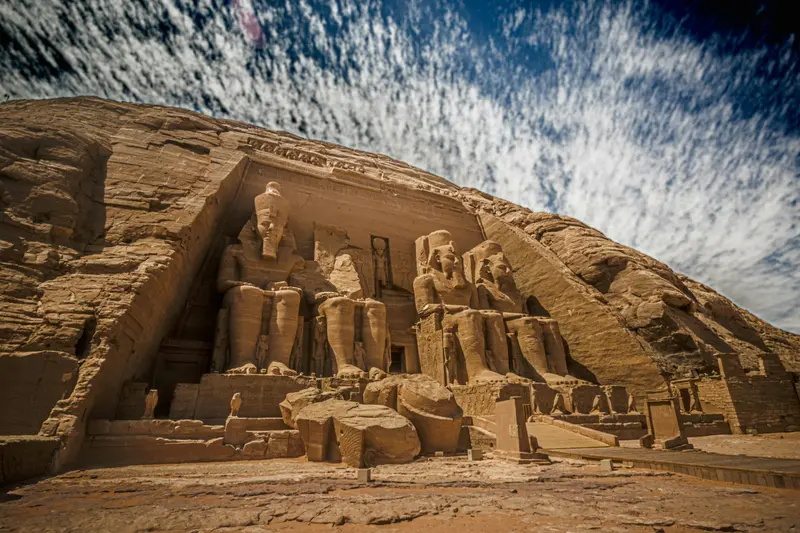
    Photo by Michael Starkie on Unsplash

    Egypt

    Abu Simbel

    Point of Interest

    The two rock temples of Ramses II on the shore of Lake Nasser are among Egypt's most impressive structures: In front of the Great Temple sit four colossal statues of the pharaoh, approximately 20 meters high; alongside it is the temple of…

    by Felix Gillen

    1. Home
    2. Destinations
    3. Egypt
    4. Aswan and Nubia
    5. Abu Simbel
    The two rock temples of Ramses II on the shore of Lake Nasser are among Egypt's most impressive structures: In front of the Great Temple sit four colossal statues of the pharaoh, approximately 20 meters high; alongside it is the temple of his consort Nefertari. To save them from the reservoir, both temples were dismantled in the 1960s and re-erected on a higher site by 1968. Abu Simbel is located approximately 300 road kilometers southwest of Aswan, near the border with Sudan.
    Egypt travel guideRound trips in EgyptPlan a trip with Abu Simbel

    Contents

    • Places & highlights
    • Tours
    • Eat & drink
    • Getting around
    • Accommodation
    • Nearby

    Sights in Abu Simbel

    Discover the most important sights and attractions

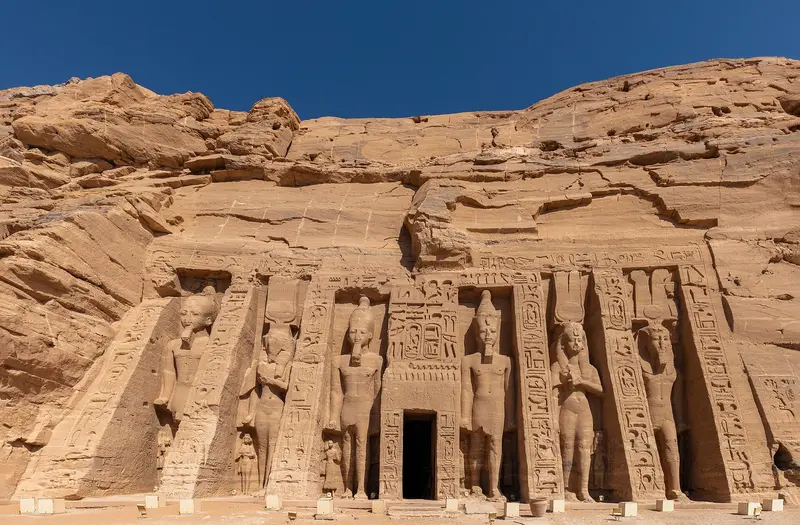
    Little Temple of Hathor and Nefertari

    Diego Delso / Wikimedia Commons / CC BY-SA 4.0, mod.

    Historic Landmark

    1Little Temple of Hathor and Nefertari

    Beside the Great Temple, Ramses II had a smaller rock temple built for the goddess Hathor and his chief consort Nefertari. It too was relocated in the 1960s.
    Open in Google Maps
    Great Temple of Ramses II.

    Photo by Thomas K on Unsplash

    2Great Temple of Ramses II.

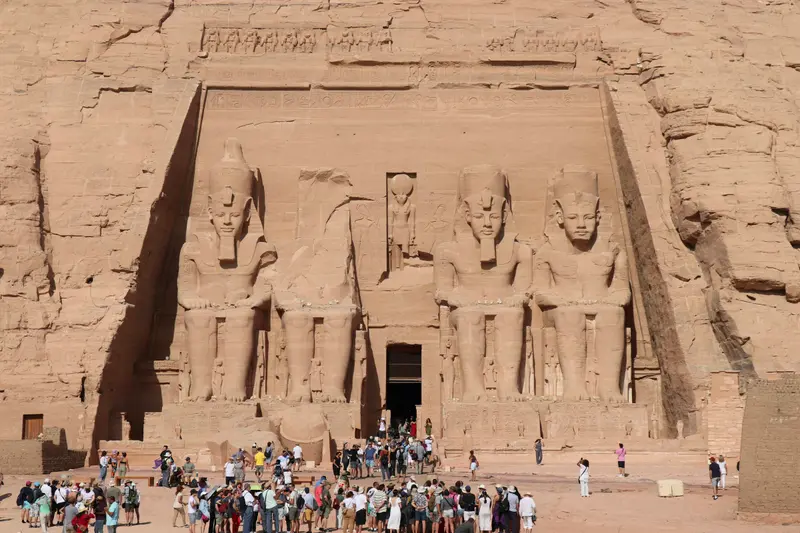
    Ramses II had the temple carved out of the mountain for about 20 years, starting around 1264 BC. Four seated colossal statues of the pharaoh, about 20 meters high, guard the entrance. On February 22nd and October 22nd, the rising sun penetrates the inner sanctuary, illuminating the statues of the gods, with only Ptah remaining in shadow; these days are particularly crowded. The temple was dismantled due to Lake Nasser and rebuilt at a higher location in 1968.
    Open in Google Maps

    Tours & experiences in Abu Simbel

    Search tours for Abu Simbel on GetYourGuide* (Affiliate link)On GetYourGuide, with reviews from other travellers

    * Affiliate link: if you book through it, we earn a small commission. The price stays the same for you.

    Restaurants in Abu Simbel

    Getting there and visiting

    Getting thereBy road it is about 300 km through the desert from Aswan, roughly three to three and a half hours each way. Excursions leave very early, often around 4 am, usually in an escorted convoy; IDs are checked at checkpoints.Alternatively, EgyptAir flies year-round from Aswan to Abu Simbel airport in about 25 to 30 minutes.VisitingAllow about two to two and a half hours for both temples.On 22 February and 22 October, when the sun reaches the sanctuary, it is very crowded; book tours and accommodation early.Abu Simbel lies in the far south near the border with Sudan. Check the current UK FCDO Travel Advice for Egypt before you travel.

    Accommodations in Abu Simbel

    Find perfect stay in Abu Simbel

    Booking.com* (Affiliate link)
    Search Hotels
    Agoda* (Affiliate link)
    Search Hotels
    Airbnb
    Vacation Rentals

    * Affiliate link: if you book through it, we earn a small commission. The price stays the same for you.

    Nearby

    Aswan

    Aswan

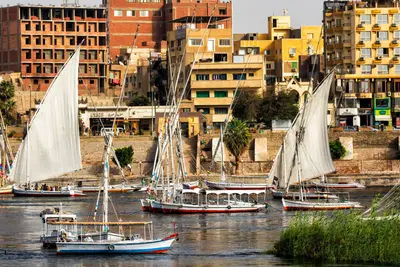
    Aswan is located on the East Bank of the Nile at the First Cataract, the southernmost point of Egypt's railway network, and is the gateway to the Isis Temple of Philae and the rock temples of Abu Simbel. The city, with around 370,000 inhabitants, is quieter than Luxor; islands like Elephantine, granite rocks in the river, and the rock tombs on the West Bank define its character.

    Eyup Sayar·Pexels

    Aswan and Nubia

    Aswan and Nubia

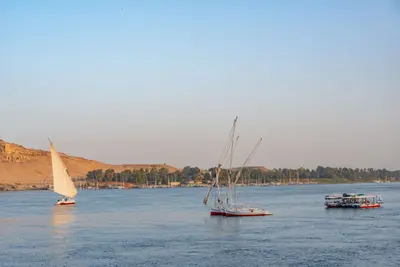
    Southern Egypt begins at the First Nile Cataract near Aswan, where granite rocks and islands divide the river, and feluccas sail between Nubian villages. From here, you can reach the Temple of Isis at Philae and the rock temples of Abu Simbel on Lake Nasser, both part of the UNESCO World Heritage site "Nubian Monuments from Abu Simbel to Philae" (1979). On the way to Luxor, you'll find the Ptolemaic temples of Kom Ombo and Edfu.

    Diego F. Parra·Pexels

    Luxor

    Luxor

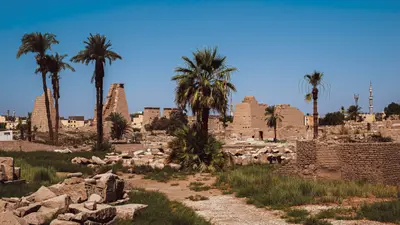
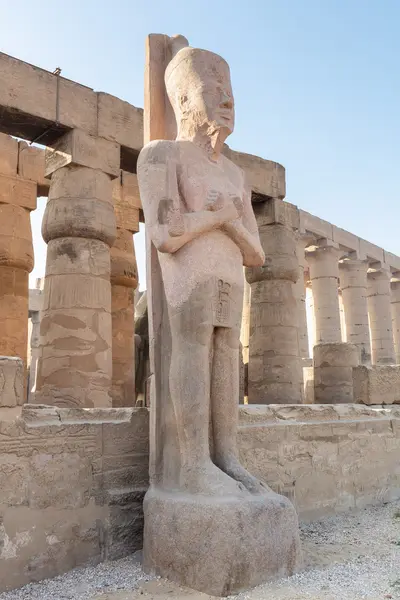
    The city on the Nile's east bank occupies the site of ancient Thebes and is often hailed as the world's largest open-air museum. At its heart are Luxor Temple and, connected by the almost three-kilometer-long Avenue of Sphinxes, the vast Karnak Temple Complex. Across the river, on the West Bank, are the Valley of the Kings and the mortuary temples; most visitors stay on the East Bank and cross by ferry in the mornings.

    2H Media·Unsplash

    Luxor & Nile Region

    Luxor & Nile Region

    Ancient Thebes was located on the Nile in Upper Egypt. Its temples and necropolises have been a UNESCO World Heritage site since 1979, designated as 'Ancient Thebes with its Necropolises': on the East Bank, Karnak and Luxor Temple; on the West Bank, the Valley of the Kings, the Valley of the Queens, and the great mortuary temples. The city of Luxor is the starting point for all explorations.

    Diego Delso·CC BY-SA 4.0

    West Bank of Luxor (Thebes West)

    West Bank of Luxor (Thebes West)

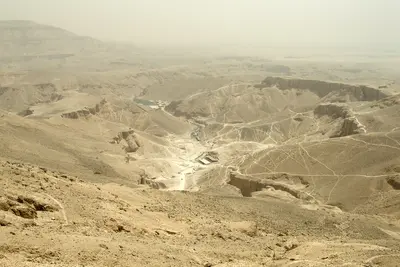
    On the West Bank of the Nile opposite Luxor, the rulers of the New Kingdom built their tombs and mortuary temples. Over 60 tombs are known in the Valley of the Kings, including the tomb of Tutankhamun, discovered by Howard Carter in 1922. Also here are the Mortuary Temple of Hatshepsut, Medinet Habu, the Valley of the Queens, and the Colossi of Memnon. At sunrise, hot air balloons float over the landscape.

    Vyacheslav Argenberg·CC BY 4.0

    Your next steps

    Abu Simbel is in Egypt. Ways to carry on from here.

    • More in Egypt

      Highlights, areas, routes and the best time to travel for all of Egypt.

      Egypt travel guide
    • Round trips in Egypt

      Ready-made routes through Egypt, with stops, nights and a map.

      See the routes
    • Plan a trip with Abu Simbel

      The Guide asks about season, length and who is coming, and suggests a trip with Abu Simbel.

      Plan the trip

    Sources & method

    • Photos: Wikimedia Commons, Unsplash. Each photo carries its credit.
    • Place data such as addresses and ratings comes from Google Maps.
    • The content is based on web research from public, traceable sources. How the content is made · The role of AI