Fernweh: Home
ExploreGuideDestinationsMy tripsMy trip
de|en
All Places & RegionsRound tripsNight trains in EuropeAll highlightsAbout FernwehFAQPrivacy PolicyImprint
Download on the App StoreGet it on Google Play
ExploreGuideDestinationsMy tripsMy trip
    • Places & highlights
    • Tours
    • Eat & drink
    • Getting around
    • Accommodation
    • Round trips
    • Nearby
    Terelj and Tsonjin Boldog

    Photo by Tuguldur Baatar on Unsplash

    Mongolia

    Terelj and Tsonjin Boldog

    Point of Interest

    The Gorkhi-Terelj National Park, or Terelj for short, begins about 55 kilometers northeast of Ulaanbaatar and is accessible by paved road, even with a regular car.

    by Felix Gillen

    1. Home
    2. Destinations
    3. Mongolia
    4. Terelj and Tsonjin Boldog
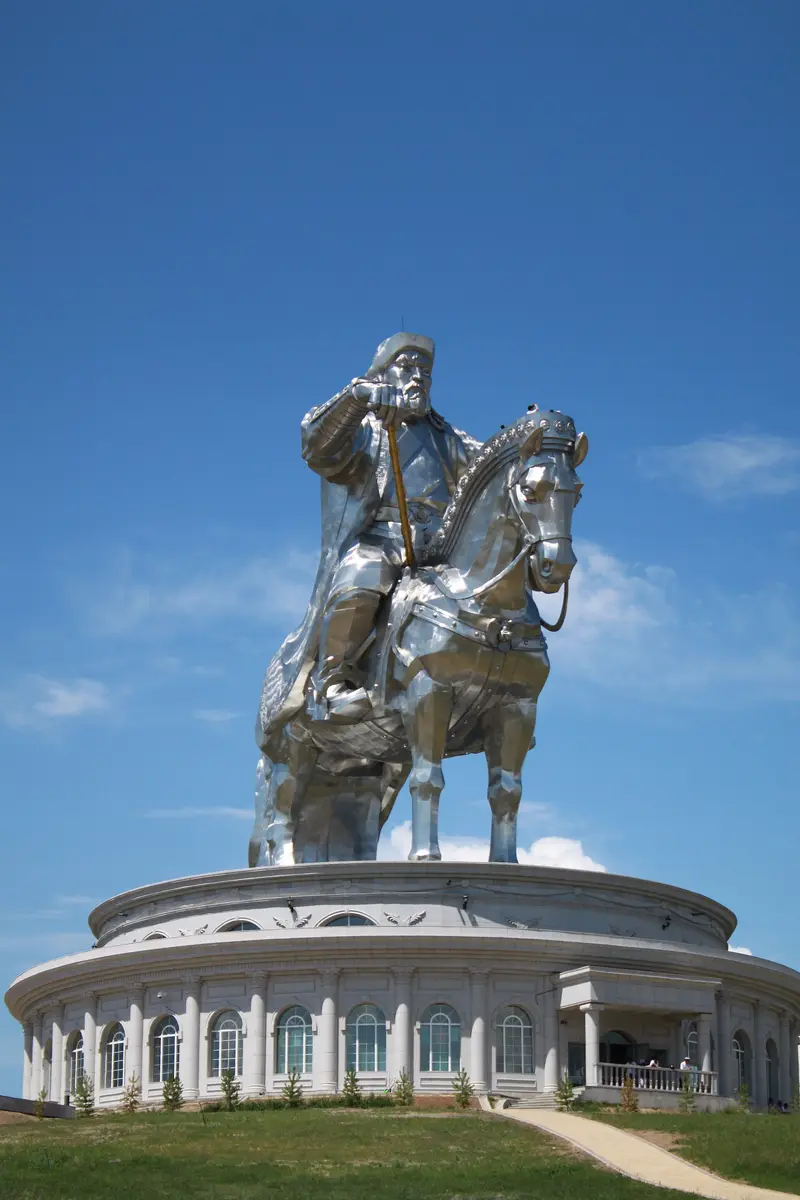
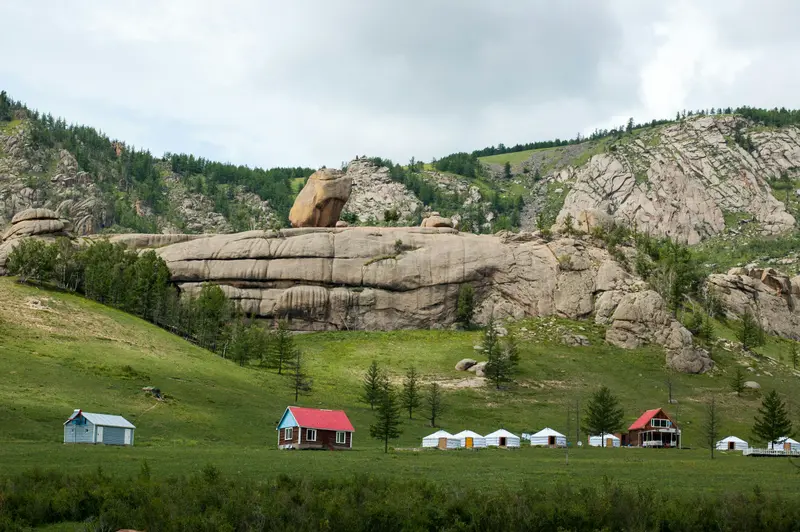
    The Gorkhi-Terelj National Park, or Terelj for short, begins about 55 kilometers northeast of Ulaanbaatar and is accessible by paved road, even with a regular car. Granite rock formations like Turtle Rock and river valleys define this area, protected as a national park since 1993; in summer, hiking, horse riding, and river paddling are enjoyed, and in winter, cross-country skiing is popular.On the way, you'll find the 40-meter-high Chinggis Khaan Equestrian Statue at Tsonjin Boldog, approximately 54 kilometers east of Ulaanbaatar. Both can be combined as a day trip or with an overnight stay in a yurt camp in the park.
    Mongolia travel guideSee the round tripPlan a trip with Terelj and Tsonjin Boldog

    Contents

    • Places & highlights
    • Tours
    • Eat & drink
    • Getting around
    • Accommodation
    • Round trips
    • Nearby

    Sights in Terelj and Tsonjin Boldog

    Discover the most important sights and attractions

    Attraction

    1The Turtle Rock (Melkhii Khad)

    A granite monolith in Gorchi-Tereldsch National Park, shaped by erosion into the form of a turtle. The rock is located near the park road, approximately six kilometers past the park gate.
    Open in Google Maps
    Genghis Khan Equestrian Statue (Tsonjin Boldog)

    Chinneeb / Wikimedia Commons / CC BY 4.0, mod.

    2Genghis Khan Equestrian Statue (Tsonjin Boldog)

    The 40-meter-high stainless steel equestrian statue was privately funded and erected in 2008. It stands on the road from Nalaikh to Erdene by the Tuul River, approximately 54 kilometers east of Ulaanbaatar. An elevator and stairs lead to a viewing platform in the horse's head. In the base, a museum displays artifacts from the era of the Xiongnu and the Mongolian Empire.
    Open in Google Maps

    Tours & experiences in Terelj and Tsonjin Boldog

    Search tours for Terelj and Tsonjin Boldog on GetYourGuide* (Affiliate link)On GetYourGuide, with reviews from other travellers

    * Affiliate link: if you book through it, we earn a small commission. The price stays the same for you.

    Restaurants in Terelj and Tsonjin Boldog

    Arrival and Tips

    Getting ThereAn asphalted road leads to the park, about 1.5 hours from Ulaanbaatar.Bus line XO4, according to Wikivoyage, departs Ulaanbaatar at 12 PM and 4 PM.A round-trip taxi to the equestrian statue costs around 80,000 Tögrög (Lonely Planet).AdmissionAn entrance fee of a few thousand Tögrög is charged at the park gate, though enforcement is inconsistent.The equestrian statue is open daily from approx. 10 AM to 6 PM (operator info); entrance fees vary widely, so check on-site.

    Accommodations in Terelj and Tsonjin Boldog

    Find perfect stay in Terelj and Tsonjin Boldog

    Booking.com* (Affiliate link)
    Search Hotels
    Agoda* (Affiliate link)
    Search Hotels
    Airbnb
    Vacation Rentals

    * Affiliate link: if you book through it, we earn a small commission. The price stays the same for you.

    Round trips with Terelj and Tsonjin Boldog

    Ulaanbaatar, Gobi, and Karakorum in 11 days

    Ulaanbaatar, Gobi, and Karakorum in 11 days

    The circuit links the capital with Terelj National Park, the South Gobi by domestic flight, Hustai's Przewalski horses, and the Orkhon Valley World Heritage site with Karakorum. Travel is with a driver and 4x4; the Gobi is reached by flight to Dalanzadgad.

    11 Days
    6 stops

    Uuganbayar Otgonbayar·Pexels

    Nearby

    Ulaanbaatar

    Ulaanbaatar

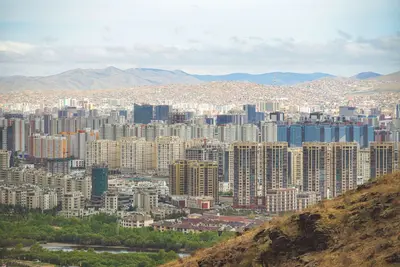
    Around half of Mongolia's population, about 1.7 million people, lives in Ulaanbaatar. For travellers the capital is the arrival point and the starting point of almost every trip across the country. Around Sükhbaatar Square you find the Government Palace, the State Opera and the main museums, to the west Gandan Monastery, and in the south the Winter Palace of the Bogd Khan and the Zaisan Memorial with its view over the city.You can explore the centre on foot; for the sights in the south take a bus or taxi. In winter the city's air is heavily polluted by smog. For current health and safety advice, see the UK FCDO travel advice linked on the country page.

    Uuganbayar Otgonbayar·Pexels

    Hustai National Park

    Hustai National Park

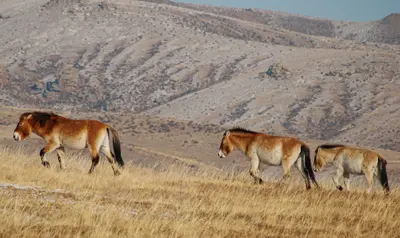
    In Hustai National Park (Khustain Nuruu), about 100 kilometers southwest of Ulaanbaatar, Przewalski's horses, known as Takhi in Mongolian, live here again. The first 16 animals arrived in 1992; by 2000, a Dutch foundation had brought a total of 84 Takhi in five transports. Today, several hundred wild horses live here.Designated a protected area in 1993, the 506 sq km territory became a national park in 1998. The drive is approx. two hours total: asphalt to the turn-off, then gravel. Lonely Planet suggests an overnight stay to observe the horses.

    Tengis Galamez·Unsplash

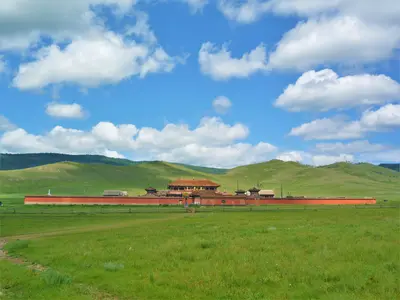
    Amarbayasgalant Abbey

    Amarbayasgalant Abbey

    Amarbayasgalant Monastery, located in the Iven Valley in Selenge Aimag, was built between 1727 and 1736 at the command of Emperor Yongzheng and completed under Qianlong. It was intended as Zanabazar's final resting place, whose remains were transferred here in 1779, and is dedicated to Maitreya.From Ulaanbaatar, it's about 360 kilometers, mostly on asphalt via Darkhan, with the final 35 kilometers on a dirt track north of the Darkhan-Erdenet road. Expect five to seven hours of driving; after rain, the track becomes significantly worse.

    Bogomolov.PL·public domain

    Orkhon Valley

    Orkhon Valley

    The Orkhon Valley Cultural Landscape has been a UNESCO World Heritage site since 2004. Spread across approximately 1,220 square kilometers of grassland along the Orkhon River are Turkic memorial sites from the 6th and 7th centuries, the Uighur capital of Khar Balgas, the remains of the imperial capital Karakorum, the Erdene Zuu Monastery, and the Tövkhön Hermitage. The valley begins approximately 360 kilometers southwest of Ulaanbaatar.The starting point is the town of Kharkhorin, which you can reach mostly on asphalt roads. To reach the Orkhon Waterfall and Tövkhön, you will need a 4x4 vehicle, as the tracks become muddy after rainfall in July and August.

    Jonashtand·CC BY-SA 4.0

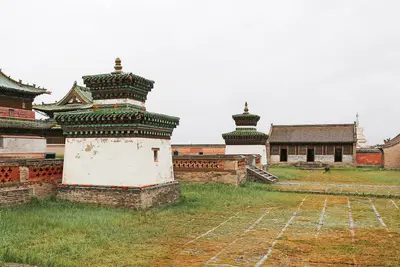
    Kharkhorin (Karakorum)

    Kharkhorin (Karakorum)

    Kharkhorin is located near the remains of Karakorum, which Ögedei, son of Chinggis Khaan, began to develop into the capital of the Mongol Empire from 1235 with walls and a palace. Little remains of the city, but next to it stands Erdene Zuu Monastery, founded in 1585 and, according to UNESCO, the oldest surviving Buddhist monastery in Mongolia. The Karakorum Museum displays finds and a model of the city around 1250.The site is the most important stop in the Orkhon Valley World Heritage Site and is about 360 kilometers from Ulaanbaatar, a good six to seven-hour drive, mostly on asphalt.

    Bernard Gagnon·CC0

    Your next steps

    Terelj and Tsonjin Boldog is in Mongolia. Ways to carry on from here.

    • More in Mongolia

      Highlights, areas, routes and the best time to travel for all of Mongolia.

      Mongolia travel guide
    • Round trips with Terelj and Tsonjin Boldog

      One route passes through Terelj and Tsonjin Boldog, with stops, nights and a map.

      See the round trip
    • Plan a trip with Terelj and Tsonjin Boldog

      The Guide asks about season, length and who is coming, and suggests a trip with Terelj and Tsonjin Boldog.

      Plan the trip
    Sources & method

    • Photos: Wikimedia Commons, Unsplash. Each photo carries its credit.
    • Place data such as addresses and ratings comes from Google Maps.
    • The content is based on web research from public, traceable sources. How the content is made · The role of AI