Fernweh: Home
ExploreGuideDestinationsMy tripsMy trip
de|en
All Places & RegionsRound tripsNight trains in EuropeAll highlightsAbout FernwehFAQPrivacy PolicyImprint
Download on the App StoreGet it on Google Play
ExploreGuideDestinationsMy tripsMy trip
    • Places in the region
    • Culture
    • Getting around
    • Nearby
    Pakse and Bolaven Plateau

    Laos

    Pakse and Bolaven Plateau

    Region

    Pakse, at the confluence of the Mekong and Sedon, is the gateway to Southern Laos.

    by Felix Gillen

    1. Home
    2. Destinations
    3. Laos
    4. Pakse and Bolaven Plateau
    Pakse, at the confluence of the Mekong and Sedon, is the gateway to Southern Laos. East of it, the Bolaven Plateau rises to over 1,500 meters, featuring coffee plantations around Paksong, the country's coffee capital, and powerful waterfalls like Tad Fane and Tad Yuang.A roughly 374-kilometer loop over the plateau is popular with motorcyclists. While the falls are fullest during the rainy season, the dry season from November to February is more pleasant for travel.
    Laos travel guidePlan a trip with Pakse and Bolaven Plateau

    Contents

    • Places in the region
    • Culture
    • Getting around
    • Nearby

    More places in Pakse and Bolaven Plateau

    Wat Phou

    Wat Phou near Champasak, 45 kilometers south of Pakse, is a Khmer temple complex on the slopes of Phou Kao, the core of the UNESCO World Heritage Site Champasak Cultural Landscape. UNESCO states the landscape was systematically planned over 1,000 years along a 10-kilometer east-west axis from river to mountaintop.The Vat Phou Festival takes place at the complex in February. Come early in the morning for the climb to the upper sanctuary via the old stairs.

    Coffee and Waterfalls

    Coffee Capital PaksongThe Bolaven Plateau lies at over 1,500 meters in altitude. Paksong, about an hour from Pakse, is considered Laos' coffee capital, where Bolaven Arabica grows.WaterfallsTad Fane plunges as a twin waterfall over 100 meters, about 38 kilometers from Pakse. Tad Yuang received an ASEAN award for sustainable tourism in 2022 and has viewpoints at the top, middle, and foot of the falls.

    Practical

    Getting TherePakse has an airport where the e-visa is valid. You can reach the Plateau with a driver or rented motorbike; Tad Fane is about 40 minutes and Tad Yuang about 45 minutes from Pakse.The Bolaven LoopThe famous loop across the Plateau is about 374 kilometers long and starts at Tad Pha Suam.The Foreign Office advises against overland journeys at night.The falls have the most water during the rainy season, but roads can be difficult to navigate then.

    Nearby
    Ubon Ratchathani

    Ubon Ratchathani

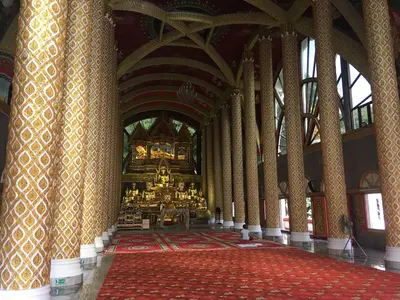
    Ubon Ratchathani is the largest city in eastern Isan, located near the border with Laos and on the Mun River. It is an administrative and university city, relying less on tourism and more on its role as a regional hub.City temples include Wat Thung Si Muang, featuring a wooden scripture library set on stilts in the middle of a pond, and Wat Nong Bua, whose white chedi is modeled after the Bodhgaya stupa in India. The National Museum, housed in a former royal residence, showcases the region's history.Ubon is best known for its Candle Festival (Hae Thian Phansa) in July, marking the start of Buddhist Lent: City temples commission large wax relief sculptures, which are then paraded through the city center. Accommodation is scarce during this period.The surrounding area features Pha Taem National Park with prehistoric rock paintings high above the Mekong, and the water-eroded rock pools of Sam Phan Bok, exposed during low water levels. The cooler dry season from November to February is the most pleasant time to visit.

    Christophe95·CC BY-SA 4.0

    Si Phan Don (4000 Islands)

    Si Phan Don, the 4,000 Islands, is the Mekong's riverine landscape at the border with Cambodia, where the river divides into countless channels, islands, and rapids. Here you'll find the Khone Phapheng Falls, according to the tourism authority, Southeast Asia's largest waterfalls by water volume, and the tranquil islands of Don Det and Don Khon.On Don Khon, the bridge of the former French island railway leads over to the Li Phi Falls, easily reachable by bicycle. From Pakse, you can get there by minibus and boat in about two to three hours. During the rainy season, many islands are flooded; the best time to visit is November to February.
    Preah Vihear

    Preah Vihear

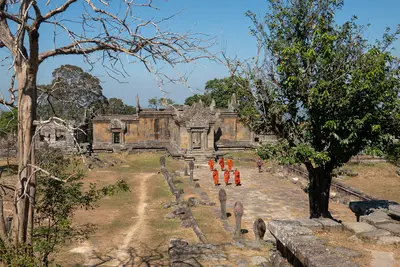
    The temple lies directly on the border with Thailand, within the area where the UK FCDO advises against all but essential travel (within 20 km of the land border). According to AP (March 2026) and Cambodianess (July 2026) it is closed to visitors because of war damage and unexploded ordnance; no reopening date has been set.Prasat Preah Vihear is a Shiva sanctuary built mainly in the first half of the 11th century on a cliff of the Dangrek Mountains and has been a UNESCO World Heritage Site since 2008. Its sanctuaries line up along an axis of about 800 m that climbs by stairs and paths to the cliff edge overlooking the Cambodian plain.

    PsamatheM·CC BY-SA 4.0

    Koh Ker

    Koh Ker

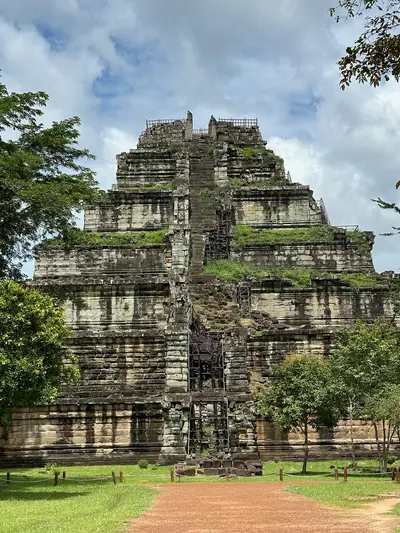
    Koh Ker is a remote temple city of the Khmer Empire, around 80 km northeast of Angkor, and a UNESCO World Heritage site since 2023. King Jayavarman IV founded the capital Lingapura here in 921, which was the sole royal seat from 928 to 944; it is known for its unique sculptural style and monolithic giant blocks; the main temple is Prasat Thom.The site is located in Preah Vihear Province, but well outside the border warning zone of the Foreign Office. From Siem Reap, the drive takes about one and a half hours or longer; many visitors combine Koh Ker with Beng Mealea.

    Lohen11·CC BY 4.0

    Huế

    Huế

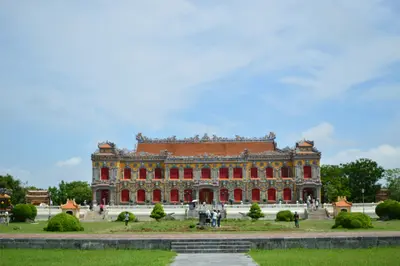
    Located on the Perfume River in Central Vietnam, Huế served as the national capital from 1802 to 1945 under the Nguyễn Dynasty. You visit for the Citadel with the Imperial City and the upstream Imperial Tombs, which have been a UNESCO World Heritage site since 1993.The Citadel, housing the Imperial City and the Forbidden Purple City, is located on the north bank of the river, while buildings from the French colonial era stand on the south bank. Along the upper Perfume River, the imperial tomb complexes are spread out, along with temples such as the Thiên Mụ Pagoda, the city's landmark. You should plan at least two full days for the Imperial City and the tombs.Huế boasts its own unique cuisine, rooted in the imperial court: spicy and served in small portions. The most famous dish is Bún bò Huế, a beef noodle soup. Since 2025, Huế has been a centrally administered city, encompassing the area of the former province of Thừa Thiên Huế.

    Aman Shrivastava·Unsplash

    Your next steps

    Pakse and Bolaven Plateau is in Laos. Ways to carry on from here.

    • More in Laos

      Highlights, areas, routes and the best time to travel for all of Laos.

      Laos travel guide
    • Plan a trip with Pakse and Bolaven Plateau

      The Guide asks about season, length and who is coming, and suggests a trip with Pakse and Bolaven Plateau.

      Plan the trip

    Sources & method

    • The content is based on web research from public, traceable sources. How the content is made · The role of AI