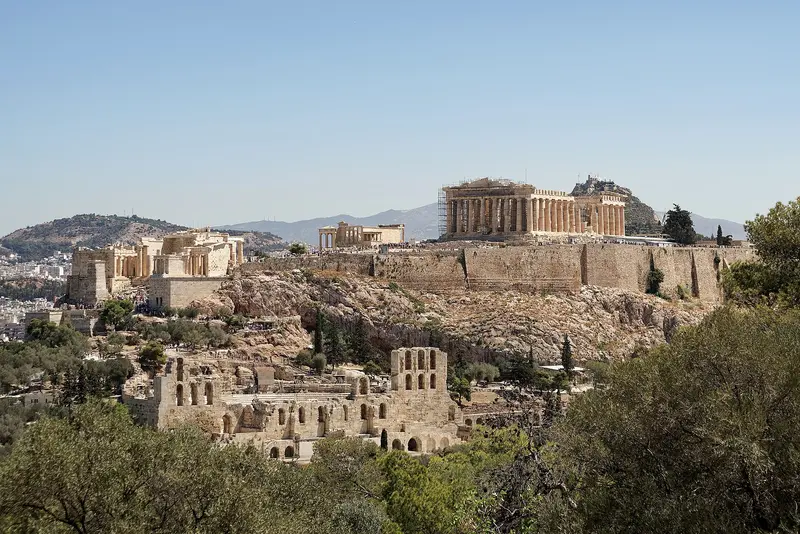
Jakub Hałun / Wikimedia Commons / CC BY 4.0, mod.
City trip · Greece
Athens in four days
by Felix Gillen
- 5 Days / 4 Nights
Four days in Athens at the city's own pace: first the Acropolis Museum and the Plaka, then the Acropolis, the Agora and the central market in the morning, on day three the National Archaeological Museum in Exarchia and Kolonaki up to Lycabettus, and finally the stadium and Pangrati. The centre is compact; between neighbourhoods you walk or take the metro for a stop or two. You eat at meze places by the market and in neighbourhood tavernas.
At a glance
- Duration
- 5 Days / 4 Nights
- Stops
- 1
- Arrival
- Flight · Athen (ATH)
- Best Time to Go
- April–June and mid-September–November: 20 to 28 degrees, still bearable on the shadeless Acropolis. In July and August temperatures often pass 35 degrees and the sites are packed
More on when to go
Winter is mild, but the archaeological sites close at 5 pm.
1 stop
Why This Route?
Many people see Athens in a single day between the Acropolis and the ferry. With four days you see the ancient sites early in the morning without heat or crowds and have time for what makes the city: the market on Athinas Street, long evenings in tavernas and neighbourhoods like Exarchia and Pangrati where Athenians live.
Hidden Gems
- The paved Pikionis path over Filopappou Hill is the evening walk of people from Koukaki, with the Acropolis at eye level
- In the Kerameikos, the ancient cemetery behind Psyrri, you are often almost alone among grave reliefs and tortoises
- From the top tier of the Panathenaic Stadium you look across the marble track to the Parthenon, and the audio guide is included in the ticket
Getting there and back
Round trip, returning to where you started
- Arrival
- Flight · Athen (ATH)From the airport the M3 metro runs about every half hour and reaches Syntagma and Monastiraki in about 40 minutes; the airport ticket costs more than a normal fare and is sold separately. The X95 bus runs around the clock to Syntagma Square, taking an hour or more depending on traffic.
- Departure
- Flight · Athen (ATH)Back to the airport on the M3 from Syntagma or Evangelismos (about 40 minutes) or the X95 from Syntagma; because of security, be at the terminal two hours before departure.
Day by day
Day 1: Acropolis Museum, Filopappou and the Plaka
- Acropolis MuseumAfter arriving, M2 to Akropoli. See the original finds first and the rock tomorrow, and the Acropolis makes sense; in winter open only until 5 pm Monday to Thursday, until 10 pm on Fridays.
- Filopappos' HillTen minutes along the pedestrian street Dionysiou Areopagitou to the hill, up top for sunset; free to enter.
- Lysicrates MonumentBack through the Plaka; the little square around the monument is quieter in the evening than Kydathineon.
- Agios Nikolaos Rangavas and AnafiotikaByzantine church at the foot of Anafiotika, the island-style quarter built by workers from the Cyclades; keep your voice down, people live here.
- ScholarhioFamily-run ouzeri where you pick several meze from a tray for the table; ask for a seat on the vine-covered terrace.
- Brettos (Plaka)A glass of ouzo or mastiha from the house distillery, family-owned since 1909.
Day 2: Acropolis, Agora and Central Market
- AcropolisBook the first slot at 8 am on tickets.hh.gr, days ahead in summer; entry is free for EU citizens under 25. Wear firm soles, the marble is slippery.
- Areopagus (Ares' Hill)On the way down, the view over the Agora, still without crowds at this hour.
- Ancient Agora with Temple of HephaestusShady and less busy than the rock; in the museum in the Stoa of Attalos see the potsherds Athens used to banish politicians. Separate ticket.
- Central Market (Varvakios Agora)Via Monastiraki to Athinas Street; liveliest in the morning, closed on Sundays.
- Diporto (Market Quarter)Basement tavern with no sign and no menu: chickpeas, fried sardines and barrel wine at lunchtime at shared tables; cash only.
- KerameikosTen minutes west through Psyrri; in winter the site closes in the afternoon, so go straight after lunch.
- KaramanlidikaPastourma, soutzouki and cheeses of the Asia Minor Greeks among the shelves of a delicatessen; book for the evening.
- six d.o.g.s (Monastiraki)Concerts or DJs in the courtyard garden behind Monastiraki; check the programme on the website first.
Day 3: Exarchia, Kolonaki and Lycabettus
- National Archaeological MuseumAt opening time, M1 to Viktoria; on Tuesdays only from 1 pm, otherwise only until 3:30 pm in winter. The gold mask, the Artemision bronze and the Antikythera mechanism fill three hours.
- RozaliaLunch on Valtetsiou: meze and charcoal grill, with students and families from Exarchia at the next table.
- Museum of Cycladic ArtTwenty minutes downhill to Kolonaki; the 5,000-year-old marble figures look like modern art. Closed on Tuesdays.
- Lykavittos HillUp the stepped lanes or by funicular from Aristippou Street, for sunset over the whole city down to the sea.
- OikeioOn the way back, on the stepped lane Ploutarchou: home cooking such as moussaka and stews; book ahead.
Day 4: Syntagma, the Stadium and Pangrati
- Syntagma, Parliament and Changing of the GuardThe evzones change guard every hour on the hour, on Sundays at 11 am with a band.
- National GardenSouth through the shady garden, past the Zappeion.
- Olympieion and Hadrian's ArchYou can see the columns from the fence; the ticket is worth it if you want to stand among them.
- Panathinaiko StadiumThe marble stadium of 1896, with Pangrati beginning behind it; from the top tier you see the Parthenon.
- Mavros Gatos (Pangrati)A farewell meal of stews and grilled meat at the neighbourhood taverna in Pangrati. Then the M3 from Evangelismos to the airport.
Itinerary
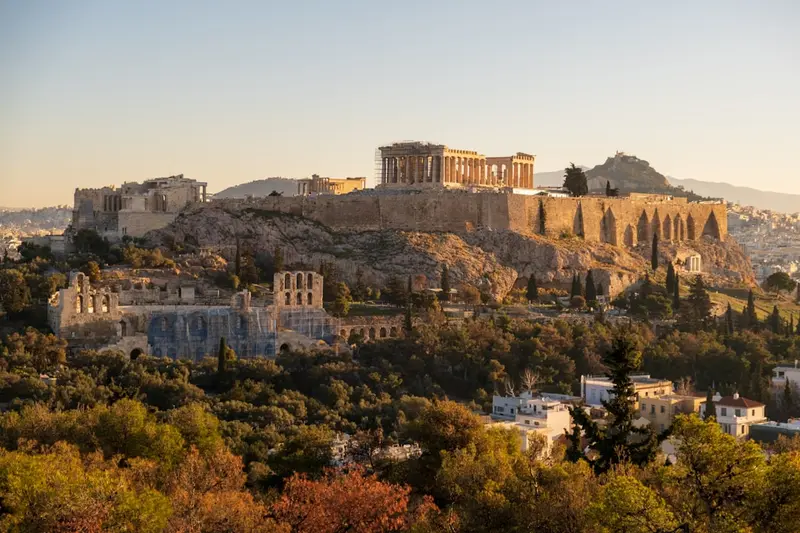
Athens
Athens is the capital of Greece and the main arrival point for most travelers in the country. Above the city stands the Acropolis with the Parthenon, a UNESCO World Heritage site since 1987. At its foot lie the Ancient Agora, the Acropolis Museum, and the old town districts of Plaka, Monastiraki, and Psyrri with tavernas, markets, and rooftop terraces.Two full days are sufficient for the major ancient sites and museums. If you wish to also explore districts like Kolonaki, Mount Lycabettus, and take a trip to Cape Sounion, plan three to four days. From April to June and in September and October, it is pleasantly warm, but in July and August, it gets very hot in the city.
Stay in Koukaki or Pangrati: quiet residential areas with bakeries and tavernas, ten to twenty minutes on foot from the Acropolis and Syntagma; the Plaka is pretty but at night mostly full of visitors. Athenians use the ATH.ENA Card, and one ride is valid for 90 minutes on metro, tram and bus. Toilet paper goes in the bin next to the toilet, not in the bowl; in churches shoulders and knees are covered.
13 Sights
5 Restaurants
Culture and History
Athens has been inhabited for over 3,000 years. In the 5th century BC, under Pericles, it gave rise to Attic democracy, tragedy as a theatrical form, and the buildings of the Acropolis. Philosophers like Socrates, Plato, and Aristotle taught in the city.Antiquity and ByzantiumThe Acropolis, with the Parthenon, Propylaea, and Erechtheion, combines Doric and Ionic architectural styles. From the Byzantine era come small domed cruciform churches like Kapnikarea and Panagia Gorgoepikoos, which today stand amidst commercial buildings.Capital since 1834When Athens became the capital of the new state in 1834, it was a small town. Under King Otto, Neoclassical buildings such as the University, Academy, and National Library emerged, designed among others by the Hansen brothers. Today, the Acropolis Museum and the National Archaeological Museum display the ancient finds.
Plan this route as your trip
All stops, trains and nights go into your trip planner. You adjust dates and places to stay afterwards.
This route is a suggestion from our research. Please check timetables, times in port, opening hours and prices before you book – what your tour operator or carrier says is what counts.
Fernweh is a free travel guide and trip planner: routes researched by people, taken over in one click, used day by day on the road. More about Fernweh
1 stop
Route Summary
Duration5 Days
Stops1 Places
TypeCulture