Fernweh
    ExploreTravel GuidesMy Trips
    de|en
    All Places & RegionsAbout FernwehImprintFAQPrivacy Policy
    ExploreTravel GuidesMy Trips
    • Neighborhoods & highlights
    • Eat & drink
    • Food culture
    • Culture
    • Nightlife
    • Getting around
    • Accommodation
    • Plan trip
    • Nearby
    Monastiraki and Psyrri
    City

    Monastiraki and Psyrri

    Monastiraki is the market and flea market district of Athens' Old Town, named after the small monastic church of Pantanassa on the square of the same name.

    More
    1. Home
    2. Destinations
    3. Greece
    4. Athens
    5. Monastiraki and Psyrri
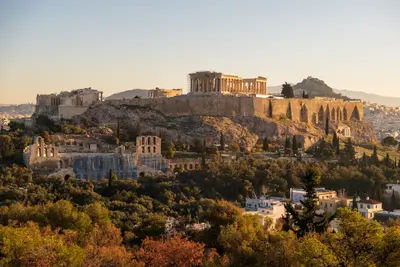
    Monastiraki is the market and flea market district of Athens' Old Town, named after the small monastic church of Pantanassa on the square of the same name. To its north lies Psyrri, a former artisan quarter, where today tavernas, bars, and workshops are densely packed. Both districts are lively until late into the night.
    Location and CharacterMonastiraki Square lies on the northern slope below the Acropolis and, with its Lines 1 and 3 Metro station, is a central transport hub. Around the square, the Pantanassa Church, the Tzistarakis Mosque, and the ruins of Hadrian's Library stand close together. The lanes Pandrossou and Ifestou are lined with shops selling clothes, leather goods, and souvenirs, while Avissinias Square hosts the heart of the flea market.PsyrriBeyond Ermou Street lies Psyrri, once defined by workshops and small businesses. Today, tavernas, mezedopolia, bars, and street art dominate the scene. The central Varvakios Market and the spice district on Evripidou Street are just a short walk away.
    Monastiraki and Psyrri blend seamlessly. Monastiraki Square features a flea market, mosque, and Hadrian's Library; north of Ermou Street, Psyrri unfurls as a network of workshops, taverns, and bars around Iroon Square.

    Sights in Monastiraki and Psyrri

    Discover the most important sights and attractions

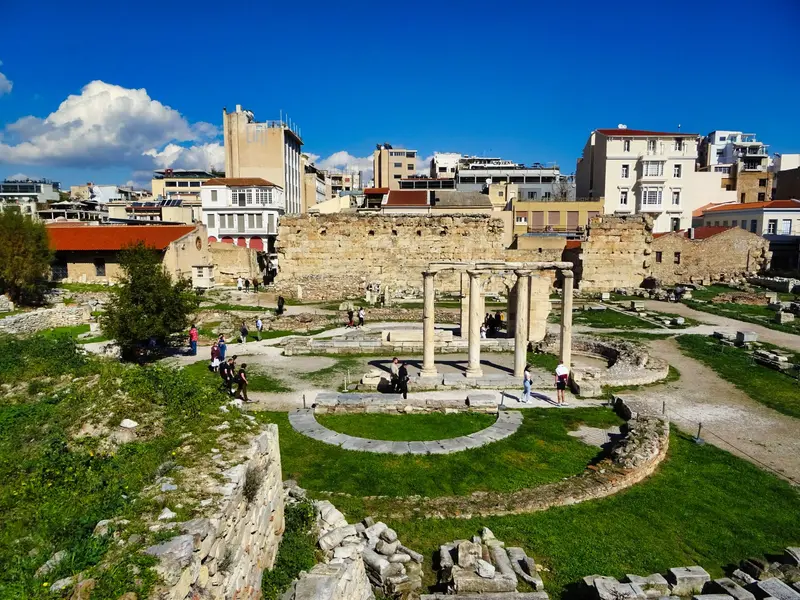
    Hadrian's Library

    1Hadrian's Library

    Emperor Hadrian had the complex built in 132 AD on the north side of the Acropolis. Modeled on a Roman forum, a high wall enclosed a colonnaded courtyard with an elongated water basin; the main library hall, along with reading and lecture rooms, lay in the eastern part. During Byzantine times, three churches were successively built on the site, including the city's first cathedral. The west facade with its columns can be seen from Monastiraki Square.
    Open in Google Maps
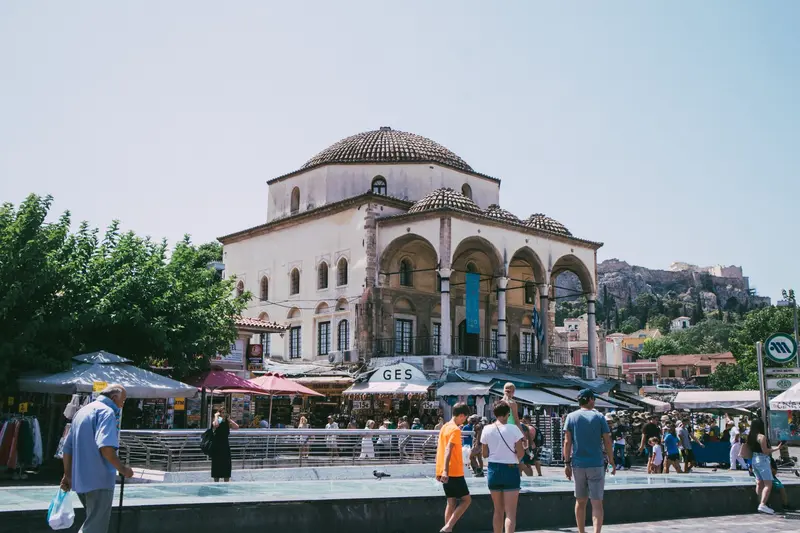
    Tzistarakis Mosque

    2Tzistarakis Mosque

    The mosque in Monastiraki Square was built by the Ottoman governor Mustapha Agha Tzistarakis in 1759. Legend has it that he had an ancient column burned for the lime, presumably from the neighbouring Hadrian's Library, which cost him his office. After earthquake damage in 1981, the building was restored and reopened in 1991. Today, it houses the Museum of Greek Folk Art, showcasing the V. Kyriazopoulos ceramics collection.
    Open in Google Maps
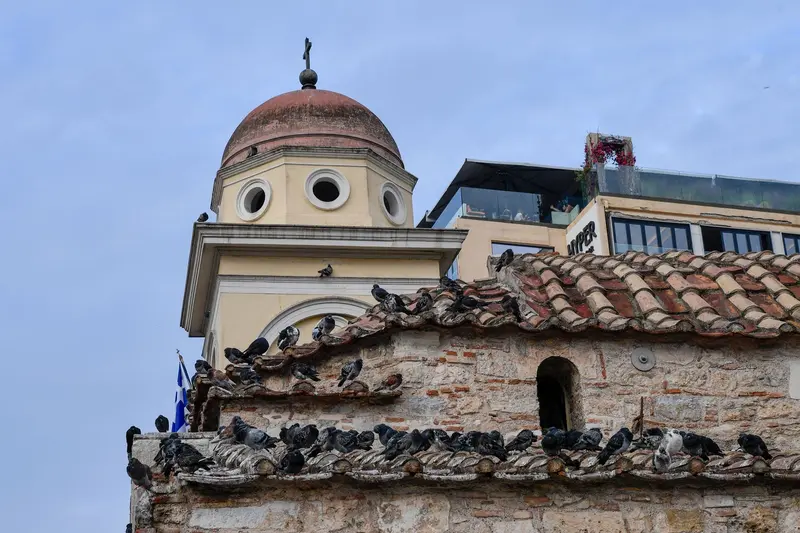
    Pantanassa Church

    3Pantanassa Church

    The small church in the middle of Monastiraki Square dates back to the 10th century and was the Katholikon of a large monastery. From its nickname Monastiraki, the 'little monastery,' the name of the entire district is derived. The monastery has disappeared, but the church dedicated to the Dormition of the Theotokos is still used for services today.
    Open in Google Maps
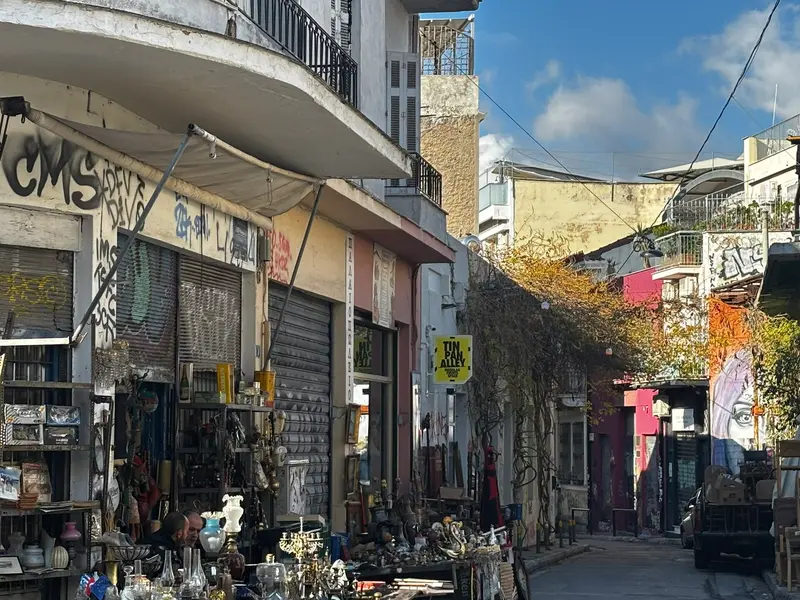
    Avissinias Square Flea Market
    Gveret Tered / Wikimedia Commons / CC BY-SA 4.0

    4Avissinias Square Flea Market

    The heart of Athens Flea Market lies on the small Avissinias Square, west of Monastiraki Square. Second-hand dealers and antique shops sell furniture, records, crockery, and knick-knacks; on weekends, additional vendors spread their wares across the square. The adjacent alleys of Ifestou and Pandrossou are part of the market district.
    Open in Google Maps

    Restaurants in Monastiraki and Psyrri

    Bairaktaris
    1

    Bairaktaris

    Family-run tavern directly on Monastiraki Square with an all-day open kitchen. Besides Souvlaki and Gyros, hearty Greek tavern dishes are on the menu.
    Show on Google Maps
    Thanasis
    2

    Thanasis

    Souvlaki spot on Monastiraki Square, known for its minced meat kebab skewers in pita. Dine at tables indoors or outdoors in the pedestrian area around the square.
    Show on Google Maps
    Lithos
    3

    Lithos

    Rustic tavern in the alleys of Psyrri with a casual atmosphere and terrace. The menu features Mezedes, salads, and grilled dishes.
    Show on Google Maps
    Avli
    4

    Avli

    Small, rustically furnished eatery in northern Psyrri, near Evripidou Street. Serving traditional dishes from Greek regions in a relaxed atmosphere.
    Show on Google Maps
    Karamanlidika
    5

    Karamanlidika

    Delicatessen and restaurant on Evripidou Street, at the northern edge of Psyrri, near the Central Market Hall. The focus is on charcuterie and cheese specialties like Pastourma and Soutzouki, served as Mezedes.
    Show on Google Maps

    Food & Drink

    Monastiraki is the place for quick grab-and-go food, especially Souvlaki around the square. In Psyrri and along Evripidou Street towards the Central Market, tavernas, Mezedopoleia, and delis are added to the mix.
    Souvlaki and Kebab
    Miyagawa / Wikimedia Commons / CC BY-SA 4.0

    Souvlaki and Kebab

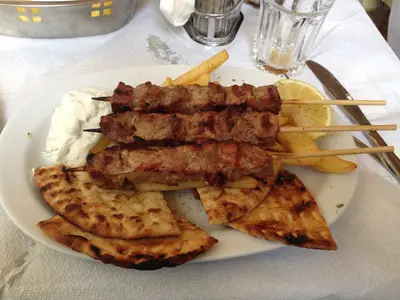
    Along Mitropoleos Street, right on Monastiraki Square, several souvlaki eateries are lined up. The classic is the kebab: grilled minced meat skewers in pita with tomato, onion, and yogurt.

    Mezedes and Tsipouro

    In Psyrri, you order many small sharing plates in tavernas and mezedopoleia. Tsipouro, a pomace brandy often served in small carafes, pairs well with them.
    Pastourma and Soutzouki
    Proudbolsahye / Wikimedia Commons / CC BY-SA 3.0

    Pastourma and Soutzouki

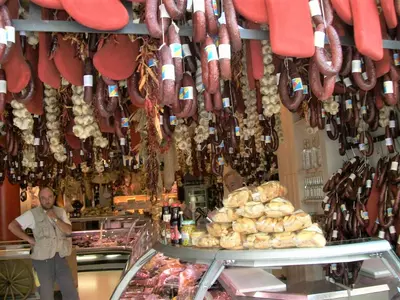
    Air-dried beef coated in spice paste and spicy cured sausage are part of the food culture of Asia Minor Greeks. You can find them in delis on Evripidou Street, sometimes served as meze at your table.

    History and Culture

    From Monastery to Neighborhood NameThe 10th-century Pantanassa Church was the Katholikon of a large monastery. Monastiraki ("little monastery") became the name for the entire district. The monastery vanished; the church is still in use today.Roman and Ottoman TracesEmperor Hadrian built his library with a colonnaded courtyard and water basin in 132 AD; several churches rose on the site in Byzantine times. The 1759 Tzistarakis Mosque, built by Ottoman governor Mustapha Agha Tzistarakis, now hosts a ceramics collection from the Museum of Greek Folk Art.Market TraditionCommerce still defines the district today: from the flea market selling bric-a-brac, furniture, and records to the fish, meat, and spice vendors around Athinas Street.

    Nightlife

    Local Character
    1

    Local Character

    Rooftop bar on Normanou Lane, by Monastiraki Square, with Acropolis views. Serves regional and international small plates alongside cocktails.
    Show on Google Maps
    Beertime
    2

    Beertime

    Beer bar with food by Iroon Square, Psyrri's main square. Greek pub dishes also served, a good start for a night out in nearby alleys.
    Show on Google Maps
    TAF (The Art Foundation)
    3

    TAF (The Art Foundation)

    Kunstraum mit Bar in der Normanou-Straße zwischen Monastiraki und Psyrri. Getrunken wird im Innenhof, um den sich Ausstellungsräume gruppieren.
    Show on Google Maps

    Exploring Monastiraki and Psyrri

    ArrivalThe Monastiraki Metro Station is located directly on the square and is served by Lines 1 and 3. Line 3 connects the district directly to the airport, Line 1 to Piraeus.On FootErmou Street and Adrianou Street are pedestrian zones and connect Monastiraki with Syntagma and the Ancient Agora. Psyrri is just minutes away via the alleys north of Ermou; the district is compact and best explored on foot.

    Accommodations in Monastiraki and Psyrri

    Find perfect stay in Monastiraki and Psyrri

    Booking.com
    Search Hotels
    Agoda
    Search Hotels
    Airbnb
    Vacation Rentals
    Hotels.com
    Hotels Worldwide
    Hostelworld
    Hostels

    Campgrounds in Monastiraki and Psyrri

    Find perfect campground in Monastiraki and Psyrri

    Search via Google Maps
    Campgrounds nearby (15km)
    Camping.info
    Find Campgrounds
    Park4Night
    RV Parks & Camping

    Plan your trip to Monastiraki and Psyrri

    Save places, build a route and plan your city trip — all in one place.

    Save places

    Bookmark sights, restaurants and neighborhoods you're interested in.

    Build your route

    Turn your bookmarks into a route — define order, days and budget.

    Refine with AI

    Let Mein Fernweh suggest experiences and put together a tailored daily plan.

    Start trip planningOpen bookmarks

    Nearby

    Plaka

    Plaka

    Plaka is the Old Town of Athens, situated on the northern and eastern slopes of the Acropolis. Narrow alleys, neoclassical townhouses, and small Byzantine churches characterize the district, which stretches between Syntagma and Monastiraki. Adrianou Street divides it into Upper Plaka, directly below the Acropolis Rock, and Lower Plaka.
    Athens

    Athens

    Athens is a city that doesn't keep its 3,400 years in a museum, but lives them daily: Beneath the Acropolis lie districts full of tavernas, record shops, and rooftop bars. If you only seek antiquity, stay two days. If you want to get to know the city, you need four.
    Attica

    Attica

    Attica, the vibrant heart of ancient Greece, a cradle of civilization and home to its capital, Athens. It fascinates with its unique mix of iconic archaeological sites, scenic coasts, and vibrant modern culture. From historic marvels to its tranquil Aegean coast, Attica offers unforgettable experiences.
    Kolonaki

    Kolonaki

    Kolonaki is an upscale residential and commercial district on the southern slopes of Lykavittos. Around Kolonaki Square are boutiques, galleries, cafes, and embassies, while several major museums line Vasilissis Sofias Avenue. The district is named for a small column in the square.
    Marathon

    Marathon

    Marathon is a place of immense historical significance, particularly known for the famous Battle of 490 BC, which shaped the fate of ancient Greece. Here you'll find the Archaeological Museum of Marathon, housing a rich collection of artifacts from the region, spanning from the prehistoric era to Roman times. A central and moving highlight is the Tymvos, the imposing burial mound of the Athenians who fell in the decisive battle against the Persians. The history of the marathon race, which has its roots in the tradition of a messenger after the victory, becomes tangible here. The area also offers the picturesque Marathon Lake with its impressive marble dam and the expansive Marathon Beach, inviting relaxation. For a deeper exploration of the historical sites, a visit in spring or autumn is recommended to avoid the crowds. Ideally, combine your visit with a trip to the Sanctuary of the Egyptian Gods in Brexiza for a comprehensive cultural experience.