Berthold Werner / Wikimedia Commons / CC BY-SA 4.0, mod.
Round trip · Ireland
Ancient East: From Newgrange to Cork
by Felix Gillen
- 11 Days / 10 Nights
- Dublin → Cork
This route crosses the east and south of Ireland, from Dublin to the passage tombs of Brú na Bóinne, the monastic valley of Glendalough and on to Kilkenny, Waterford and Cork. After two days in the capital you pick up a rental car, and the drives are short: Glendalough to Kilkenny takes about 1 hour 20 minutes, Kilkenny to Waterford just over half an hour, and Waterford to Cashel and Cashel to Cork about an hour each. Along the way are Jerpoint Abbey, the Rock of Cashel and the Waterford Greenway on an old railway line. It is quieter than the west and suits travelers who prefer history, small towns and easy driving days to sea cliffs.
At a glance
- Duration
- 11 Days / 10 Nights
- Stops
- 7 · Dublin → Cork
- Arrival
- Flight · Dublin (DUB)
- Departure
- Flight · Cork (ORK)
- Best Time to Go
- May to September, quieter in May and September
More on when to go
In winter the days are short, and the Rock of Cashel sometimes closes at short notice in stormy weather.
7 stops
Why This Route?
Within a compact area, the route tells Ireland's story in the order it happened: Stone Age tombs, early Christian monasteries, Viking-founded Waterford and medieval Kilkenny. Short drives leave time for museums and walks, and flying into Dublin and out of Cork means you never cover the same road twice.
Hidden Gems
- Hore Abbey, the ruined monastery about 500 meters below the Rock of Cashel
- Jerpoint Abbey near Thomastown, with figure carvings in its cloister
- The round tower of St Canice's Cathedral in Kilkenny, one of only two round towers in Ireland you can climb
Getting there and back
Open jaw: start and end are in different places
- Arrival
- Flight · Dublin (DUB)Express buses run from the airport to the city center in about 30 minutes. Without flying, you can reach Ireland by ferry from Cherbourg to Dublin or Rosslare (about 18 hours) or by train and ferry via London and Holyhead.
- Departure
- Flight · Cork (ORK)Cork Airport is 6.5 kilometers south of the city center; buses take about 20 minutes. Alternatively, an hourly train reaches Dublin in just over two and a half hours. Check one-way rental from Dublin to Cork with the rental company in advance.
Itinerary
Dublin
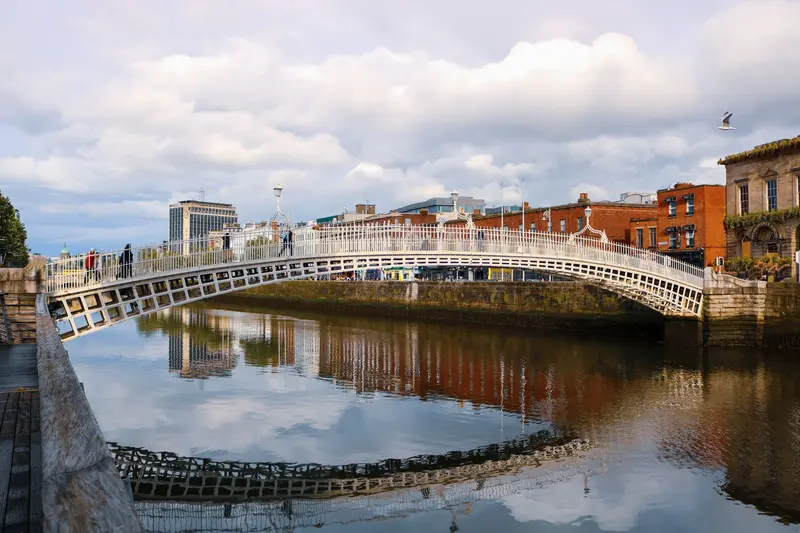
Dublin is the capital of Ireland and, with around 1.26 million inhabitants in the urban area including suburbs, is by far the country's largest city. The Liffey divides it into Northside and Southside; on its banks, Vikings established a fortified base in 841.You can easily reach the Book of Kells at Trinity College, the medieval cathedrals Christ Church and St Patrick's, Dublin Castle and Kilmainham Gaol prison, where 14 leaders of the 1916 Easter Rising were executed. You'll also find Georgian squares like Merrion Square, the brewery district The Liberties with the Guinness Storehouse, the modern Docklands and the fishing village of Howth at the end of the DART coastal line.
Express buses take about 30 minutes from the airport to the center. You won't need a car in Dublin, so pick up the rental on the morning of day three.
6 Sights
6 Restaurants
History and Culture
From Viking Settlement to Capital CityIn 841, Vikings established a fortified stronghold on the Liffey; the city officially dates its founding to 988. From 1204, under the Normans, Dublin, with Dublin Castle, became the seat of English, later British, rule, which remained here until 1922. Christ Church Cathedral dates back to a foundation around 1030, St Patrick's Cathedral was consecrated in 1191 and is Ireland's largest church; Jonathan Swift served as dean here and is buried here.Georgian Dublin and 1916The 18th century saw the development of Georgian squares in the city's southeast, such as Merrion Square, laid out from 1762, where Oscar Wilde spent his childhood. In the 20th century, Dublin became the scene of the Easter Rising; 14 of its leaders were executed at Kilmainham Gaol.Museums and LiteratureTrinity College hosts an exhibition featuring the Book of Kells, an illuminated Gospel manuscript, and the Long Room of the Old Library.The National Museum of Ireland on Kildare Street displays archaeological treasures such as the Tara Brooch and bog bodies.EPIC in the Docklands tells the story of Irish emigration.
Brú na Bóinne (Newgrange)
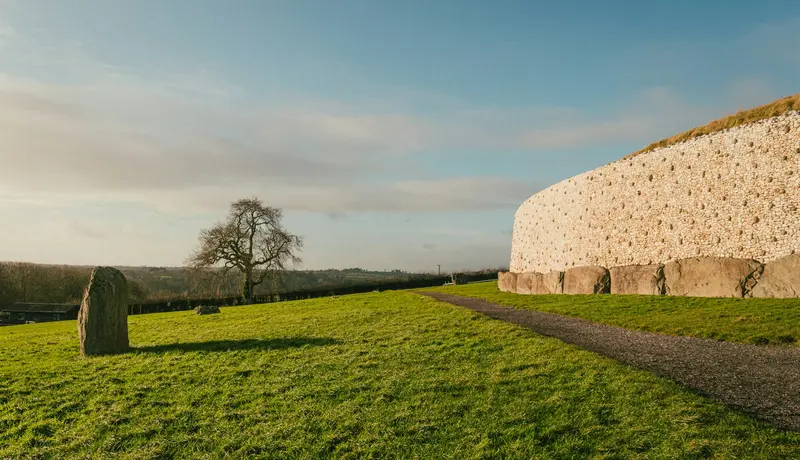
Brú na Bóinne in the Boyne Valley north of Dublin is one of Europe's most significant Stone Age landscapes and has been a UNESCO World Heritage site since 1993. The Newgrange passage tomb was built around 3200 BC, making it older than Stonehenge and the Pyramids of Giza; at the winter solstice, the light of the rising sun shines through an opening above the entrance directly into the burial chamber.You can only visit Newgrange and the neighbouring Knowth with a guided tour starting from the Brú na Bóinne Visitor Centre near Donore; from there, shuttle buses take groups to the monuments. Tickets are limited, so advance online booking is highly recommended. Places in the chamber on solstice morning are allocated annually by lottery.
About 45 minutes north of Dublin. Newgrange and Knowth can only be reached by shuttle from the visitor center; tickets are limited, so book ahead.
3 Sights
Older than Stonehenge
NewgrangeThe passage tomb dates back to around 3200 BC, making it around 1,000 years older than Stonehenge. At the winter solstice, sunlight streams for about 17 minutes through the ‘roof box’ above the entrance into the chamber.The LotteryThe spots in the chamber for the solstice are raffled off: In 2026, over 34,000 people applied online for 38 winning spots, drawn by local schoolchildren.
Glendalough & Wicklow Mountains
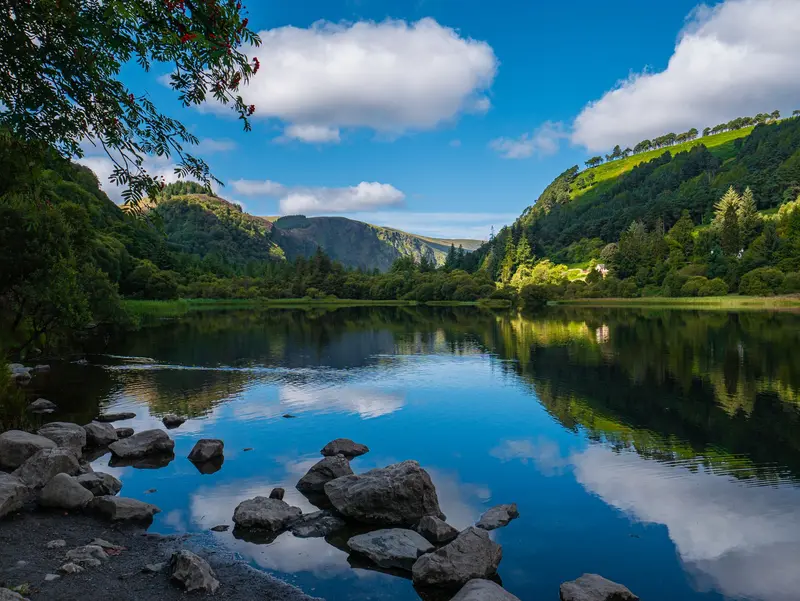
Glendalough is a glacial valley with two lakes in the Wicklow Mountains south of Dublin, where Saint Kevin founded a monastery in the 6th century. Preserved are a round tower approximately 30 metres high, several churches like St Kevin's Church, and high crosses, which are among Ireland's most famous early Christian sites.The valley belongs to the Wicklow Mountains National Park, opened in 1991, which covers approximately 20,500 hectares. Nine marked trails start at the Visitor Centre or the National Park's information office, from short walks by the Lower Lake to the Spink Circuit above the Upper Lake. The monastic site is freely accessible, the car park at the Visitor Centre charges a fee.
About 1 hour 20 minutes from Brú na Bóinne. Besides St Kevin's monastic settlement with its round tower of about 30 meters, the Spinc loop above the Upper Lake (8.8 kilometers, about three and a half hours) is well worth it.
2 Sights
Abbey in the Valley of Two Lakes
St Kevin and the Monastic SettlementThe name Glendalough comes from Gleann dá Loch, "Valley of two lakes". St Kevin founded a monastery here in the 6th century; preserved are the approximately 1,000-year-old Round Tower, the cathedral ruin, and St Kevin's Kitchen.PowerscourtThe Palladian mansion Powerscourt was built 1730–1741 to plans by Richard Castle, 27 kilometres south of Dublin. Powerscourt Waterfall, about 6 kilometres away, is Ireland's highest waterfall.Military RoadThe road over Sally Gap was built by the British Army in the early 19th century; it connects Laragh and Glencree.
Kilkenny
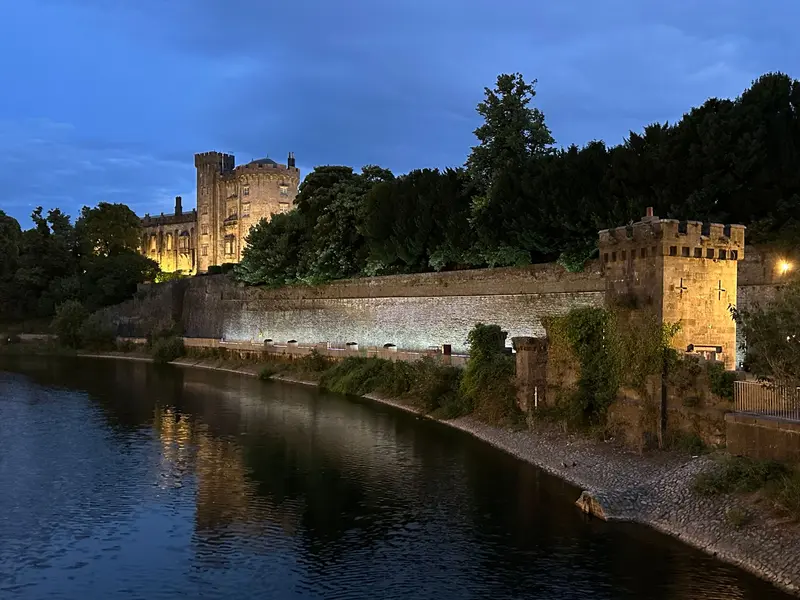
Kilkenny in southeast Ireland is a city with approximately 27,000 inhabitants and one of the best-preserved medieval cityscapes in the country. It lies on both banks of the River Nore; it owes its nickname "Marble City" to the dark limestone of the area, and from 1642 to 1649, the Confederation of Kilkenny met here.The Medieval Mile connects Kilkenny Castle, a 13th-century castle with Victorian alterations and a freely accessible park, with St Canice's Cathedral (1202–1285), whose approximately 30-meter-high 9th-century round tower you can climb. Along the way are the Medieval Mile Museum, Rothe House, the merchant's house, the Black Abbey, and the Smithwick's Experience, dedicated to the city's brewing tradition.
About 1 hour 20 minutes from Glendalough. The Medieval Mile links Kilkenny Castle with St Canice's Cathedral; on the second day, drive to Jerpoint Abbey, 2.5 kilometers southwest of Thomastown.
3 Sights
Medieval Promenade
Castle and CathedralKilkenny Castle dates back to a Norman fortress built in 1195. St Canice's Cathedral has been a place of worship since the 6th century; its approximately 30-meter-high round tower is the city's oldest standing structure.Beer and CraftsThe Smithwick's Experience showcases a brewing tradition dating back to 1710. The Kilkenny Design Centre offers Irish craftsmanship, while the Medieval Mile Museum, located in the 13th-century St Mary's Church, reveals 800 years of city history.Kilkenny Arts FestivalIn August (2026: August 6-16), the festival takes over churches, the castle, and gardens.
Waterford
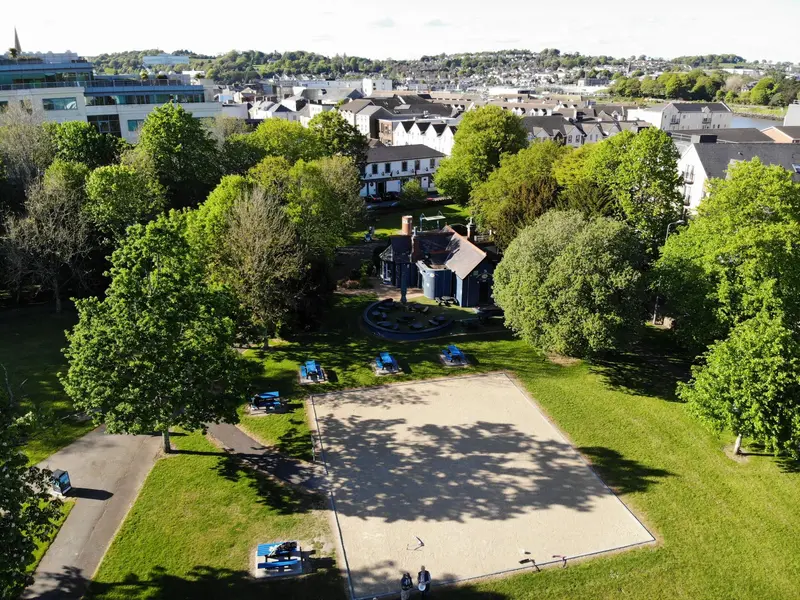
Waterford is considered Ireland's oldest city; Norwegian Vikings traditionally founded it in 914. In the historic centre, the Viking Triangle, Reginald's Tower with an exhibition on the Viking Age, the Medieval Museum, the Georgian Bishop's Palace, and other small museums are clustered in a compact area.At the House of Waterford Crystal on the Mall, a guided tour demonstrates how the famous glassware is designed, blown, and engraved. Just outside the city, the Waterford Greenway begins, at around 46 kilometres, Ireland's longest railway line cycle path, leading over viaducts and through a tunnel to Dungarvan.
Just over half an hour from Kilkenny. Vikings founded the city in 914, and the Viking Triangle holds three museums, including Reginald's Tower; the Waterford Greenway runs 46 kilometers along an old railway line to Dungarvan.
5 Sights
Vikings and Crystal
Viking CityVikings founded Waterford in 914, making it one of Ireland's oldest cities. The Viking Triangle is named after the Viking city walls; at its heart stands Reginald's Tower, an Anglo-Norman structure on Viking foundations with an exhibition, including the 12th-century Kite Brooch.Waterford CrystalThe crystal tradition dates back to 1783; after its closure in 1853, the craft was revived in 1947. The House of Waterford Crystal showcases its production.MuseumsAmong its exhibits, the Medieval Museum houses Henry VIII's Cap of Maintenance; the Bishop's Palace displays Georgian architecture.
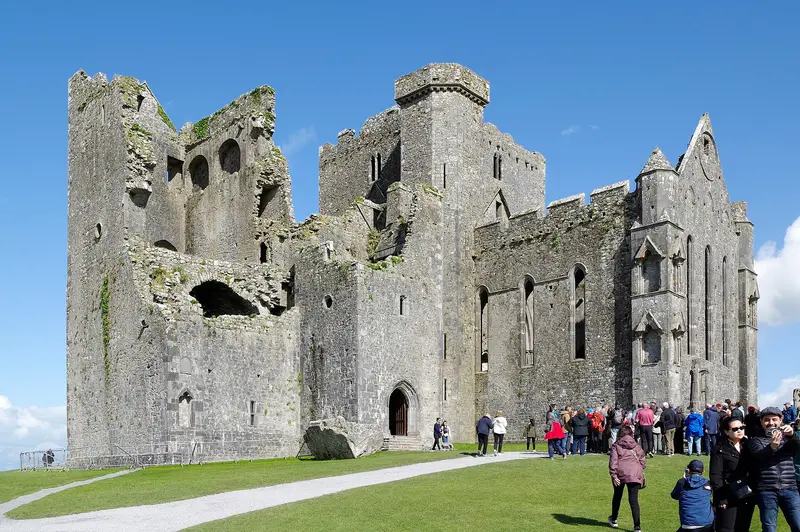
Rock of Cashel
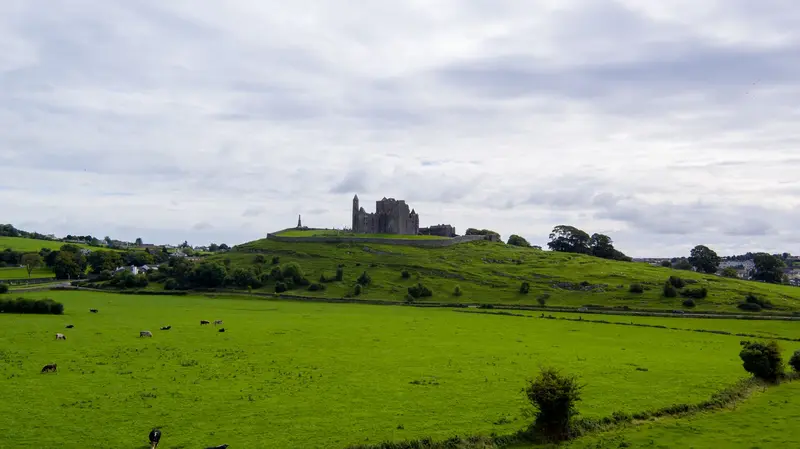
The Rock of Cashel is a limestone outcrop in County Tipperary, where the Kings of Munster resided before handing it over to the church in 1101. Today, it hosts Ireland's most extensive collection of medieval buildings: a 12th-century round tower, the 13th-century Gothic cathedral, a tower house, the Hall of the Vicars Choral, and the Romanesque Cormac's Chapel, consecrated in 1134.The chapel houses Ireland's only surviving Romanesque frescoes and is only accessible via a short guided tour, for which an additional fee applies and tickets are sold in limited numbers on-site. In stormy weather, the complex may close at short notice. The ruins of Hore Abbey can be reached on foot in about ten minutes.
About an hour from Waterford. On the former seat of the kings of Munster, Cormac's Chapel, with Ireland's only surviving Romanesque frescoes, can only be seen on a guided tour, with tickets sold on site only.
2 Sights
Seat of the Kings of Munster
HistoryThe limestone rock was the seat of the Kings of Munster; Brian Boru was crowned here in 978. In 1101, the rock passed to the Church. Visible are a Round Tower, a Gothic Cathedral, and Cormac's Chapel with Ireland's only surviving Romanesque frescoes.
Cork
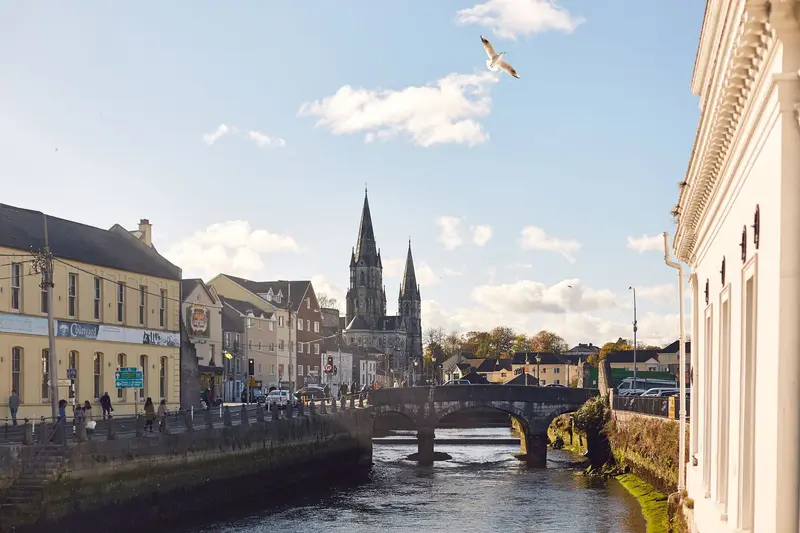
With a population of around 224,000, Cork is the second-largest city in the Republic of Ireland; its centre lies on an island between two arms of the River Lee. The covered English Market, a municipal market since the late 18th century, is the city's most famous food market.Overlooking the city is St Anne's Church in Shandon, while to the south rises the neo-Gothic St Fin Barre's Cathedral. Excursions lead to Cobh, the Titanic's last port of call in April 1912 and the departure point for around 2.5 million emigrants, and to Blarney Castle, about eight kilometres northwest, where visitors lean backwards to kiss the Blarney Stone.
About an hour from the Rock of Cashel. The English Market has traded since 1788; the commuter train takes under 25 minutes to Cobh, the Titanic's last port of call in 1912.
4 Sights
2 Restaurants
Market, Bells and Harbor
English MarketThe market hall in the centre dates back to 1788.Shandon BellsIn the tower of St Anne's Church (1722), climb 132 steps to ring the bells yourself.Cobh and the TitanicCobh, the port town, was the Titanic's last stop in 1912; the Titanic Experience recounts it. A ferry from Cobh goes to Spike Island with its fort.
Plan this route as your trip
All stops, trains and nights go into your trip planner. You adjust dates and places to stay afterwards.
This route is a suggestion from our research. Please check timetables, times in port, opening hours and prices before you book – what your tour operator or carrier says is what counts.
Fernweh is a free travel guide and trip planner: routes researched by people, taken over in one click, used day by day on the road. More about Fernweh
7 stops
Route Summary
Duration11 Days
Stops7 Places
TypeCulture