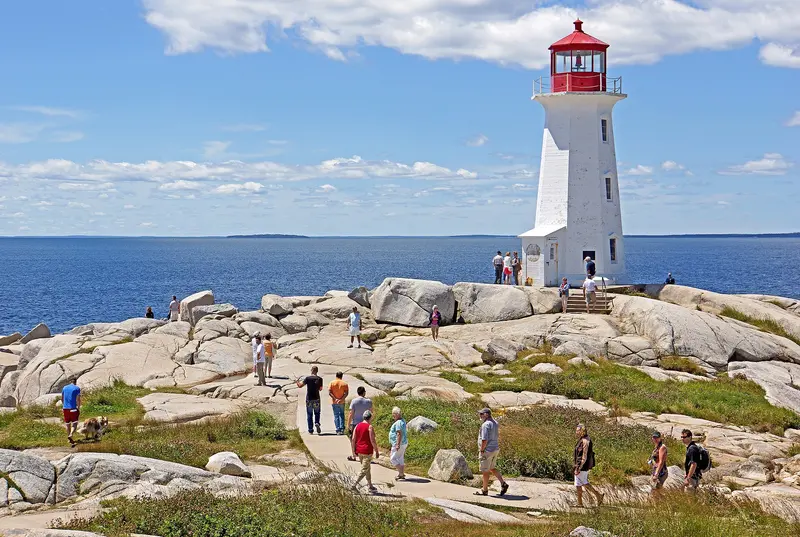
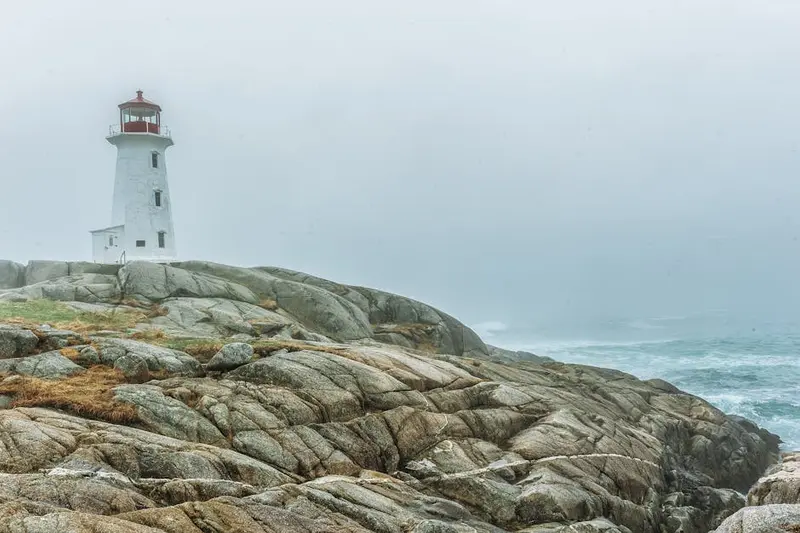
The route begins in Halifax and leads to Peggy's Cove lighthouse, then to New Brunswick into Fundy National Park, featuring tidal ranges of over ten meters. Via the Confederation Bridge, it continues to Prince Edward Island, and by ferry from Wood Islands, returns to Nova Scotia, culminating in the Cabot Trail on Cape Breton. The longest leg, from Peggy's Cove to Fundy National Park, takes approximately four hours.
16 Days / 15 Nights
June–September
RV Friendly
5 stops
Why This Route?
For travelers who want to experience coastal towns, lighthouses, and tides on Canada's tranquil Atlantic side.
Hidden Gems
Dickson Falls in Fundy National Park, a short walk through mossy woods to a waterfall
Greenwich Dunes in Prince Edward Island National Park with a floating boardwalk
Meat Cove at the north end of Cape Breton, a secluded cove off the Cabot Trail
Itinerary
Stop 1 • 2 Nights
Halifax
City
Halifax, the capital of Nova Scotia, sits on one of the world's largest natural harbors. Its long waterfront promenade, the Citadel overlooking downtown, and museums of seafaring and immigration define the city, which is also a great base for exploring the Atlantic coast.
6 Sights
4 Restaurants
Culture & History
Founding and Military SignificanceHalifax was founded in 1749 as a British military outpost to secure British interests in North America and offset the French presence in Louisbourg. Its strategic location on a natural harbor quickly made it a crucial naval base. You'll find that this military past continues to shape the cityscape and cultural identity to this day. The city played a significant role in various conflicts, including the American Revolutionary War and the War of 1812. The Halifax Citadel National Historic Site is a prime example of this military history. The star-shaped fortress atop the hill overlooking the city offers breathtaking views and transports you back to the 19th century. Regular demonstrations with actors in historical uniforms illustrate the life and duties of the soldiers.Maritime Heritage and DisastersThe strong connection to the sea is a central element of Halifax’s culture and history. The harbor was and remains the city's heart, a melting pot for sailors, immigrants, and trade. However, this maritime history is also marked by tragic events that have left deep scars. Its connection to the RMS Titanic is undeniable: After its sinking in 1912, Halifax played a pivotal role in the recovery and burial of the victims. The Fairview Lawn Cemetery is home to the graves of over 120 victims. The Halifax Explosion of 1917, in which two ships collided in the harbor, caused the largest non-nuclear, human-made explosion prior to World War II. The disaster claimed thousands of lives and devastated large parts of the city. The Maritime Museum of the Atlantic dedicates extensive exhibitions to these events and general seafaring history.Cultural Diversity and Indigenous RootsBeyond its military and maritime heritage, Halifax is a mosaic of diverse cultural influences. The city is part of the traditional territory of the Mi'kmaq, whose indigenous history and culture form a vital part of the regional identity. Scottish, Irish, and African immigrants have also significantly shaped the city's culture. You'll discover a vibrant arts scene that testifies to this diversity, with numerous galleries and theaters. The Africville Museum and Heritage Trust commemorates the history of the Africville Afro-Canadian community, which was relocated in the 1960s, highlighting its cultural heritage and struggle for justice. The many pubs and music events, especially along the Waterfront, reflect the region's Celtic roots and invite you to experience the local music scene.
Welcome to Peggy’s Cove, a picturesque fishing village that feels like a postcard brought to life from Nova Scotia. Here, where the rugged Atlantic meets iconic granite boulders, you will immerse yourself in a world of maritime beauty and Canadian hospitality. Let the charm of this historic place enchant you and discover unforgettable views that will draw you back time and again.
3 Sights
1 Restaurant
Culture & History
Peggy’s Cove, officially founded in 1766, traces its origins to settlement by German immigrants. The name is subject to speculation: it either derives from Margaret (Peggy), the wife of the first settler, or from a young shipwrecked girl named Peggy, taken in by the community. Over centuries, the village evolved into an active working fishing village, with fishing, especially lobster fishing, forming its livelihood. The modest, colourful wooden houses and traditional fishing shacks testify to this long maritime history and its strong connection to the sea.The Lighthouse: A Maritime LandmarkThe undeniably most prominent structure and cultural icon of Peggy’s Cove is the Peggy’s Cove Lighthouse, often also known as Peggy’s Cove Light. The first lighthouse on this site was built in 1868; today's cylindrical concrete structure dates from 1915. It stands on the characteristic granite rocks and is not only an active navigational aid but also one of Canada's most photographed lighthouses. Until 2009, it even housed Canada's only post office within a lighthouse, underscoring its unique status.The Sea Shapes Life and SpiritThe rugged beauty of the coast with its glacier-formed granite formations is deeply rooted in the culture of Peggy’s Cove. The inhabitants maintain a close relationship with the sea and nature, which has shaped their way of life and character for generations. The village has long been a magnet for artists, painters, and photographers who are inspired by the dramatic landscape and authentic atmosphere. A significant, though tragic, recent history is that of Swissair Flight 111 in 1998, whose memorial not far from the village commemorates the victims and the local population's extraordinary helpfulness. This testifies to the resilience and compassion of the Peggy's Cove community.
Immerse yourself in the breathtaking wilderness of Fundy National Park, where the world's highest tides meet rugged coastlines and pristine forests. Here, you will experience a unique landscape that dramatically transforms with the ebb and flow, inviting you to unforgettable adventures.This park is a paradise for outdoor enthusiasts and nature lovers who wish to feel the majestic power of nature firsthand while enjoying the tranquility of maritime forests.
3 Sights
4 Restaurants
Culture and History
Indigenous Heritage and OriginsThe region now encompassing Fundy National Park has been home to Indigenous peoples for millennia. Specifically, the Mi'kmaq and Wolastoqiyik (Maliseet) used this land as a vital part of their traditional territories. Here you will find traces of their deep connection to nature, reflected in their hunting, fishing, and gathering practices.The Mi'kmaq referred to this land as part of Gespe'gewa'gi, one of their seven traditional districts.The rivers, forests, and coastal strips offered rich resources and served as a livelihood as well as for spiritual purposes.Archaeological findings confirm a continuous presence and use of the area over thousands of years.European Settlement and the AcadiansWith the arrival of European settlers in the 17th century, a new era began for the region. The French established the colony of Acadia here, its influence felt even in the coastal regions of present-day New Brunswick.Acadians settled the fertile coastal plains and developed a unique culture and way of life.The Great Expulsion of the Acadians (Le Grand Dérangement) in the 18th century by the British forced many inhabitants to flee or be deported, profoundly changing the demographic and cultural landscape.Later, British Loyalists arrived in the region after the American Revolution, shaping the development of the communities.From Logging Camp to National ParkIn the 19th and early 20th centuries, forestry played a crucial role in the local economy, particularly along the Upper Salmon River. The remnants of this era can still be discovered in the park today.The rivers served as transportation routes for felled trees, leading to the construction of dams and logging camps.The establishment of Fundy National Park in 1948 aimed to protect the unique natural landscape and make it accessible to the public.The creation of the park led to land expropriations from existing communities, representing a complex chapter in local history. Today, the park maintains close relationships with surrounding communities like Alma, which thrive on fishing and tourism and continue to share the region's story.
Prince Edward Island, in the Gulf of St. Lawrence, is Canada's smallest province, linked to New Brunswick by the 12.9-kilometer Confederation Bridge. Red sandstone cliffs, long beaches, lobsters, and mussels define the island, as does Green Gables in Cavendish, the inspiration for Lucy Maud Montgomery's novel "Anne of Green Gables."
5 Sights
5 Restaurants
Culture & History
Mi'kmaq and AcadiansThe Mi'kmaq call the island Epekwitk. From the 18th century, French Acadians settled until the British deported many in 1758. In the west, in the Région Évangéline, Acadian culture, with its music and language, thrives to this day.Cradle of ConfederationIn 1864, delegates from British colonies met in Charlottetown for the conference leading to Canada's founding in 1867. The island itself only joined in 1873. Province House, the conference venue, is a national historic site.Anne of Green GablesLucy Maud Montgomery made the island world-famous with her novel Anne of Green Gables (1908). In Cavendish, you can visit the farmhouse, her inspiration; the musical Anne of Green Gables runs every summer in Charlottetown since 1965.
Cape Breton Island forms the northeastern part of Nova Scotia. Here you'll find the Cabot Trail, one of Canada's most famous coastal roads, the Bras d'Or saltwater lake, and a vibrant Gaelic and Acadian music tradition.
3 Sights
4 Restaurants
Culture & History
On Cape Breton, you'll encounter a deeply rooted history and a vibrant, multifaceted culture shaped by the Mi'kmaq Indigenous people, Scottish immigrants, and Acadian settlers. This island is a melting pot of traditions, languages, and stories, which you can discover for yourself in many places.The Legacy of the Mi'kmaq Indigenous PeopleThe Mi'kmaq are the original inhabitants of Cape Breton, whose traditional name is Unama’ki. Their culture and history date back thousands of years and remain an integral part of the island's identity. You can gain authentic insights into their traditions.Visit Eskasoni Cultural Journeys in Eskasoni, the world's largest Mi'kmaq community, where you can learn about traditional songs, dances, and stories.Discover the Mi'kmaq's history and art at the Membertou Heritage Park, including exhibitions and cultural performances.Look for the petroglyphs and historic sites that demonstrate the Mi'kmaq's deep connection to the land.Scottish Roots and Gaelic SoundsThe largest wave of immigration to Cape Breton came from Scotland, particularly after the Highland Clearances. This left an unmistakable Scottish-Gaelic culture on the island, which remains vibrant to this day.The Gaelic language is taught and preserved at the Gaelic College of Celtic Arts and Culture in St. Ann's. Here, you can also experience live music and dance performances.Experience the traditional music of Ceilidhs in community centers and pubs, often featuring fiddle music and step-dancing.The annual Celtic Colours International Festival in October attracts musicians and visitors from around the world and is a stronghold of Celtic culture.Acadian Presence and ResilienceIn western Cape Breton, along the Cabot Trail, you'll find communities with a strong Acadian identity. This French-speaking minority has a rich history of resistance and cultural preservation.In Chéticamp, you can experience the unique Acadian culture, reflected in its language, cuisine, and traditional handicrafts, such as the famous hooked rugs.Visit the Les Trois Pignons Museum to learn more about local Acadian history and craftsmanship.Historic Fortresses and Industrial HistoryThe Fortress Louisbourg National Historic Site is an impressive reconstruction of an 18th-century French fortress town. Here, you can immerse yourself in the lives of settlers and soldiers and observe artisans at work.The Cape Breton Miners’ Museum in Glace Bay honors the island's mining history and offers underground tours through a former coal mine.The Alexander Graham Bell National Historic Site in Baddeck commemorates the life and innovations of the famous inventor, who spent many years on Cape Breton and conducted groundbreaking experiments here.