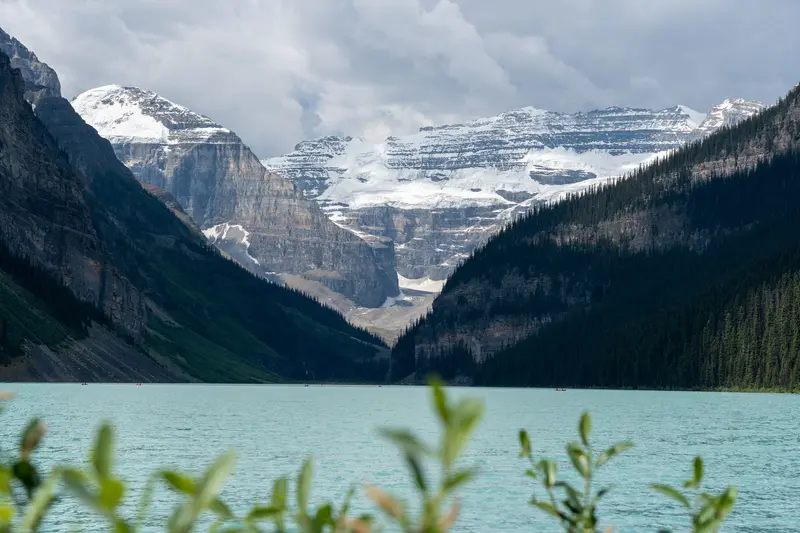
From Vancouver, the ferry transports you to Vancouver Island, allowing six nights for its rainforests and Pacific coast. Back on the mainland, the Sea-to-Sky Highway takes you from Horseshoe Bay to Whistler. Afterwards, the journey continues via Kamloops inland to Jasper – around eight and a half hours, which you might want to split with an overnight stop. Via the Icefields Parkway, you'll reach Banff, and from there it's about an hour and a half to Calgary Airport.
19 Days / 18 Nights
June–September
RV Friendly
5 stops
Why This Route?
For travelers wanting to combine the Pacific Coast, rainforest, and Rocky Mountains in just under three weeks.
Hidden Gems
Emerald Lake in Yoho National Park, about an hour from Banff, quieter than Lake Louise in the evening
Maligne Canyon near Jasper, a narrow limestone canyon with several bridges
Cathedral Grove in MacMillan Provincial Park on Vancouver Island with centuries-old Douglas firs
Itinerary
Stop 1 • 2 Nights
Vancouver
Region
Route highlight
Vancouver is nestled between the Coast Mountains and the Pacific, making it Canada's third-largest metropolitan area. Stanley Park, city beaches, and the North Shore mountains are just a few kilometers from downtown, making hiking, kayaking, and winter skiing part of everyday life. The city's cuisine is strongly influenced by its Asian immigrant population.
20 Sights
16 Restaurants
Culture & History
Unceded TerritoryVancouver is located on the traditional, unceded land of the Musqueam, Squamish, and Tsleil-Waututh. Their art is present in the cityscape: in the totem poles in Stanley Park, at the Museum of Anthropology, and the Bill Reid Gallery of Northwest Coast Art in Downtown.A Young CityThe city only emerged in the 1880s as the western terminus of the Canadian Pacific Railway. In Gastown and Chinatown, brick buildings from that early period are preserved; Chinatown is one of the largest in North America. Expo 86 and the 2010 Winter Olympics shaped the cityscape with Canada Place, the Seawall, and the Olympic Village.Multicultural PresentAlmost half of the population in Metro Vancouver has Asian roots, primarily Chinese, South Asian, and Filipino. This is evident in festivals like Lunar New Year and Vaisakhi, as well as in a cuisine that is among Canada's most diverse.
Vancouver Island, about 460 km long, is the largest island on North America's Pacific coast. In the south lies the provincial capital Victoria; on the wild west coast are Tofino and the Pacific Rim National Park; in the north, fjords, rainforest, and some of the best areas for whale and bear watching in Canada.
5 Sights
4 Restaurants
Culture and History
Origins of the First NationsVancouver Island, the largest island on the west coast of North America, is the traditional territory of numerous First Nations. Their culture and history stretch back thousands of years, shaping the island's identity to this day. Here, you will find the home of peoples such as the Kwakwaka'wakw, Nuu-chah-nulth, and Coast Salish, whose stories, art, and ways of life are deeply rooted in the landscape.The Nuu-chah-nulth are known for their rich whaling tradition and reside along the west coast.The Kwakwaka'wakw, based in the north of the island, are famous for their complex Potlatch ceremonies and intricate totem poles.The Coast Salish settled vast areas of southern Vancouver Island and the adjacent mainland.Numerous cultural sites, including ancient villages and rock carvings, bear witness to their presence. Museums and cultural centers offer insights into their diverse traditions, languages, and the enduring significance of their myths and arts.European Exploration and ColonizationThe island's European history began in the late 18th century with the expeditions of Captain James Cook and George Vancouver. In the 19th century, the island became an important base for the fur trade and later for coal mining and the timber industry.Fort Victoria was founded in 1843 by the Hudson's Bay Company and evolved into today's capital, Victoria.Coal mining in towns like Nanaimo and Cumberland attracted many immigrants and shaped the local economy and society.The timber industry was a dominant economic sector for decades, shaping the island's landscape and infrastructure.The arrival of Europeans led to profound changes for the First Nations, whose land and ways of life were greatly impacted. Today, there are efforts towards reconciliation and the recognition of historical injustices.Museums and Historic SitesTo explore the rich and often complex history of Vancouver Island, various museums and historic sites are available to you:The Royal BC Museum in Victoria is an excellent starting point to understand the natural and cultural history of British Columbia, including the First Nations and European settlement.The Butchart Gardens National Historic Site, originally a quarry, tells the story of transformation through visionary horticultural art.The U'mista Cultural Centre in Alert Bay preserves the culture of the Kwakwaka'wakw and houses an impressive collection of Potlatch artifacts.In towns like Cumberland and Nanaimo, you will find local museums documenting the history of coal mining and early settlers.These places offer you a deep insight into the layers of cultures and histories that make Vancouver Island the diverse travel destination it is today.
Whistler is about 120 km north of Vancouver in the Coast Mountains. The car-free Village at the foot of Whistler and Blackcomb is in winter one of North America's largest ski areas, and in summer a hub for mountain biking, hiking and lakes; in 2010, it hosted the alpine competitions of the Olympic Winter Games.
7 Sights
10 Restaurants
Culture and History
Whistler, renowned today as one of the world's leading winter sports destinations, boasts a multifaceted history and culture deeply rooted in Canada's Indigenous traditions, evolving over the years into an international draw.Whistler's Indigenous RootsBefore the first European settlers arrived in this valley, the land that now encompasses Whistler had been the traditional home for millennia to two Indigenous Nations: the Squamish Nation (Sk̲wx̲wú7mesh Úxwumixw) and the Lil'wat Nation (L̓il̓wat7úl). Here, you'll find a deep cultural connection to nature and the land that endures to this day.The Squamish Nation utilized the area for hunting, fishing, and gathering resources, migrating seasonally between coastal areas and the mountains.The Lil'wat Nation resided in the upper regions of the Pemberton Valley, using mountain passes and valleys around Whistler for trade and connection with other nations.These original peoples lived in harmony with nature, and their stories and traditions are closely tied to the region's mountains, rivers, and lakes. The Squamish Lil'wat Cultural Centre in Whistler Village is an outstanding place to learn more about their history, art, and culture.From Remote Outpost to Winter Sports HubEuropean presence in the region began in the late 19th century with fur traders and gold prospectors. The area was initially known as London Mountain but was renamed Whistler Mountain, inspired by the whistling of the native marmots.The vision to create a world-class ski resort took shape in the 1960s when a group of businessmen and enthusiastic skiers recognized the valley's potential for Olympic Winter Games. In 1966, the first ski lift on Whistler Mountain was put into operation, laying the groundwork for its development.The Olympic Games and Modern WhistlerRapid development continued, and in the 1980s, the Blackcomb Mountain ski area emerged, transforming Whistler into a dual-mountain resort. The two mountains were merged in 1997 under the name Whistler Blackcomb, further consolidating its infrastructure and offerings.A crucial milestone in Whistler's history was the 2010 Olympic and Paralympic Winter Games, which Whistler co-hosted with Vancouver. These Games brought immense international attention and investment in infrastructure, solidifying Whistler's position as a globally leading destination for winter sports and year-round outdoor activities. Today, Whistler presents itself as a vibrant community that combines its alpine character with a rich cultural history and a strong focus on environmental awareness.
Perfect for an exciting city trip. For adventure seekers and Perfect for unwinding and relaxation.
Jasper is the only town in the national park of the same name, the largest in the Canadian Rockies and part of the UNESCO World Heritage site. The small town originated as a railway station and is quieter than Banff. In July 2024, a wildfire destroyed about a third of the buildings in the town; reconstruction is underway, and some trails and facilities in the surrounding area were temporarily closed – check Parks Canada's current advisories before your visit.
6 Sights
5 Restaurants
Jaspers' Cultural Heritage
Jasper, deeply rooted in the Canadian Rocky Mountains, boasts a rich history that extends long before its establishment as a national park town. The area is traditional territory of the First Nations and Métis, whose presence and cultural heritage shaped the landscape and early explorations. European fur traders and explorers followed in the early 19th century, before Jasper National Park was founded in 1907.Jasper's architecture often reflects the rustic style of earlier national park buildings, featuring wooden beams and stone that blend harmoniously into the alpine environment. Local traditions are closely tied to nature and the park's conservation, while modern art and culture find expression in the community through galleries and seasonal events. The preservation of wilderness and respect for Indigenous history are central cultural pillars of the town.
Perfect for an exciting city trip. For adventure seekers and Perfect for unwinding and relaxation.
A vibrant mountain town in the heart of Banff National Park, serving as a central hub for outdoor adventures, shopping, and relaxation.
9 Sights
5 Restaurants
Culture, Art, and History in Banff
Banff's cultural identity is deeply rooted in its genesis as Canada's first national park and the influence of the Canadian Pacific Railway. Founded in 1885 around the discovery of the Cave and Basin Hot Springs, Banff rapidly developed into an exclusive destination celebrating the majestic mountain landscape. Long before European settlement, however, this area was home to Indigenous peoples, including the Stoney Nakoda, Siksika, and Tsuut'ina, whose deep knowledge of the land and their traditions forms a fundamental, often overlooked part of its cultural heritage.The town's architecture is significantly shaped by the "Parkitecture" style, characterized by the use of local materials like wood and stone, blending harmoniously into the alpine environment. Prominent examples include the historic Fairmont Banff Springs Hotel, an imposing railway hotel, and the Banff Park Museum, Canada's oldest natural history museum. Cultural specifics include the strong connection to nature and outdoor sports, reflected in numerous traditions and events. The importance of the arts is underscored by institutions like the Banff Centre for Arts and Creativity, which attracts international artists and offers festivals and workshops year-round, inspired by the surrounding landscape.