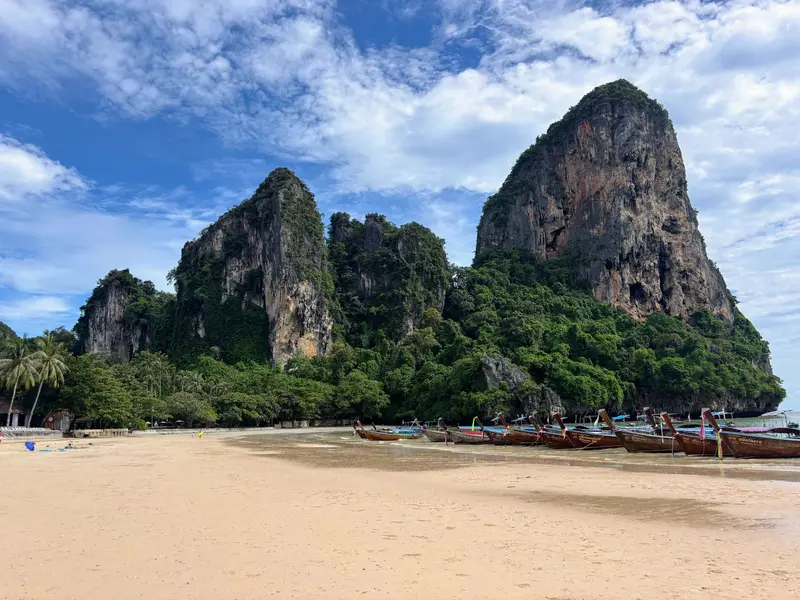
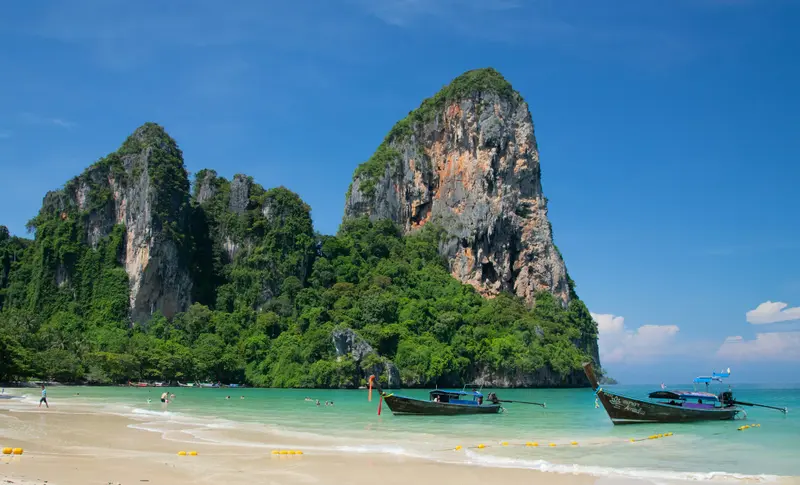
The route quickly leaves Bangkok and spends most time on the Andaman Sea: long beaches in Khao Lak, tranquil Koh Yao Noi, and limestone karsts around Krabi. From Bangkok you fly to Phuket, Khao Lak is an hour north of the airport; further stages are short and easily covered by minibus and boat.
18 Days / 17 Nights
November–April
4 stops
Why This Route?
For all who want to experience Thailand without rush: few location changes and much time by the sea.
Hidden Gems
Pakarang Cape north of Khao Lak for sunset
Day trip to the Similan Islands from Khao Lak (mid-October to mid-May)
Kayak tour through the mangrove channels of Ao Thalane near Krabi
Itinerary
Stop 1 • 3 Nights
Bangkok
City
Perfect for an exciting city trip. Rich in culture and history and Culinary highlights.
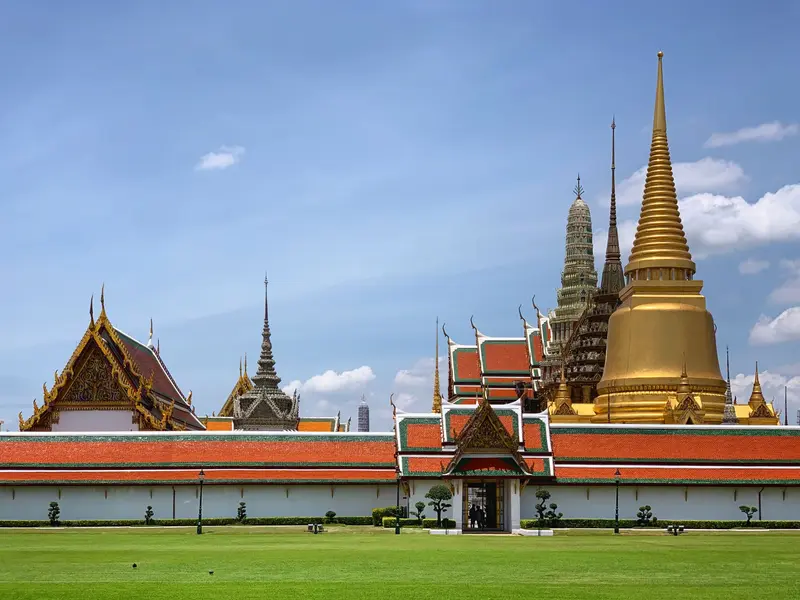
Bangkok is Thailand's capital and by far its largest city, where Buddhist temples, street food, and high-rise districts lie closely side by side. Along the Chao Phraya River stand the Grand Palace with the Emerald Buddha, Wat Pho with its 46-meter-long Reclining Buddha, and opposite, Wat Arun. Markets like the Chatuchak Weekend Market and the street food of Yaowarat showcase daily city life, while Sukhumvit and Siam are known for shopping malls and nightlife. The most pleasant time to visit is from November to February. You can avoid traffic jams with the Skytrain (BTS), Metro (MRT), and river boats.
10 Sights
3 Restaurants
History and Culture
History and CultureAfter the destruction of Ayutthaya in 1767, the capital was initially in Thonburi on the west bank. King Rama I relocated it in 1782 to Rattanakosin Island on the east bank; the erection of the City Pillar on April 21, 1782, is considered the founding date of Bangkok as the capital. From this period date the Grand Palace and Wat Phra Kaeo with the Emerald Buddha. Older are Wat Pho, which Rama I had rebuilt from 1788, and Wat Arun on the west bank, whose grand prang was completed in 1851.Buddhism shapes daily life: In the early morning, monks walk through the neighborhoods on their alms rounds, and many people bring offerings to temples and shrines. The monarchy enjoys high reverence; you'll see images of the royal family everywhere; insults to the royal house are punishable by law. During Songkran in April, entire streets turn into water fights.
Perfect for unwinding and relaxation. For adventure seekers.
Khao Lak in Phang Nga province is not a single town, but a string of beaches and settlements north of Phuket. The beaches Nang Thong, Bang Niang, and Khuk Khak stretch for miles and are less developed than the famous beaches on Phuket; many families and divers come here.Khao Lak is a starting point for diving trips to the Similan Islands, with boats departing from the nearby Thap Lamu pier. On the land side, it borders the Khao Lak-Lam Ru National Park, featuring coastal forest and viewpoints.No other Thai coast was as severely hit by the 2004 tsunami as this one. Among other things, Police Boat 813 serves as a reminder of this, which the wave carried approximately two kilometers inland and which now stands in a memorial park. The season runs approximately from November to April; during the rainy season, many businesses close, and boat tours to the islands are suspended.
5 Sights
4 Restaurants
Culture and History
Tin and TourismThe region thrived on tin for a long time. Takua Pa, about 30 kilometers north, was a tin mining center in the 19th and early 20th centuries, attracting Chinese immigrants; their Sino-Portuguese shophouses still stand today. Later, rubber, oil palm, fishing, and tourism developed.The 2004 TsunamiOn December 26, 2004, the tsunami hit Khao Lak more severely than any other part of Thailand's coast. Memorial sites, like the park around Police Boat 813 in Bang Niang, shaped like a wave with victims' names, keep the memory alive. Discretion is advised when visiting, as many locals lost relatives.In temples, mosques, and villages, covered clothing is required; swimwear remains at the beach.
Koh Yao Noi is located in Phang Nga Bay between Phuket and Krabi, offering views of limestone karsts rising from the shallow waters. Its name translates to "small long island." To its south lies the larger sister island, Koh Yao Yai.The island is predominantly Muslim and thrives on fishing, rubber cultivation, and rice farming. It features villages, a ring road, mosques, and a number of resorts and homestays, but no nightlife. You'll mostly get around by scooter.The beaches on the east coast are very shallow, and the tidal range is significant. At low tide, the sea recedes considerably. The beaches are only suitable for swimming around high tide; plan according to the tide calendar.Nonetheless, the island is an excellent base for kayak and boat tours to the bay's rocky islands. As the population lives conservatively, swimwear is inappropriate outside of beach and pool areas.
7 Sights
5 Restaurants
Culture & Everyday
Around 90 percent of the people in Koh Yao district are Muslim, with mosques shaping the villages. Outside the beaches, dress with covered shoulders and knees.The island thrives on fishing, rubber, and agriculture. Residents established their own homestay programs early on to earn from tourism without fundamentally changing the island. For this, Koh Yao Noi received in 2002 the World Legacy Award from Conservation International and National Geographic Traveler. In homestays, you can watch rubber tapping or fishing.
For adventure seekers. Perfect for unwinding and relaxation and Rich in culture and history.
Krabi Town is the administrative hub of the province and, for many travelers, primarily the gateway to the islands of the Andaman Sea. The town is situated on the Krabi River amidst mangroves and limestone cliffs, revealing authentic Thai daily life that the surrounding beach resorts rarely offer, most vividly at its night markets. Staying here for a night or two offers more affordable accommodation, easy access to Wat Tham Suea and the mangrove canals, and a convenient base for excursions to Ao Nang, Railay, and the islands.
3 Sights
4 Restaurants
Culture and Daily Life in Krabi
Buddhist and MuslimIn Krabi province, Buddhist and Muslim communities have long lived side by side. You'll see this in the townscape with mosques next to temples, and in the cuisine with halal eateries and a noticeable Malay influence. On the river island of Koh Klang, opposite the town, a predominantly Muslim community lives from fishing and agriculture; you should not bring alcohol there.Wat Tham SueaThe most important religious site in the area is the Tiger Cave Temple north of town, a meditation center whose monks sometimes live in caves at the foot of the mountain. Around 1,260 steep steps lead to the summit sanctuary at 278 meters. Start early, bring plenty of water, and keep food in your backpack, as monkeys sit on the staircase. Covered clothing is required in temples.