Fernweh: Home
ExploreGuideDestinationsMy tripsMy trip
de|en
All Places & RegionsRound tripsNight trains in EuropeAll highlightsAbout FernwehFAQPrivacy PolicyImprint
Download on the App StoreGet it on Google Play
ExploreGuideDestinationsMy tripsMy trip
    • Places & highlights
    • Recommendations
    • Tours
    • Eat & drink
    • Culture
    • Getting around
    • Accommodation
    • Nearby
    DMZ and Paju

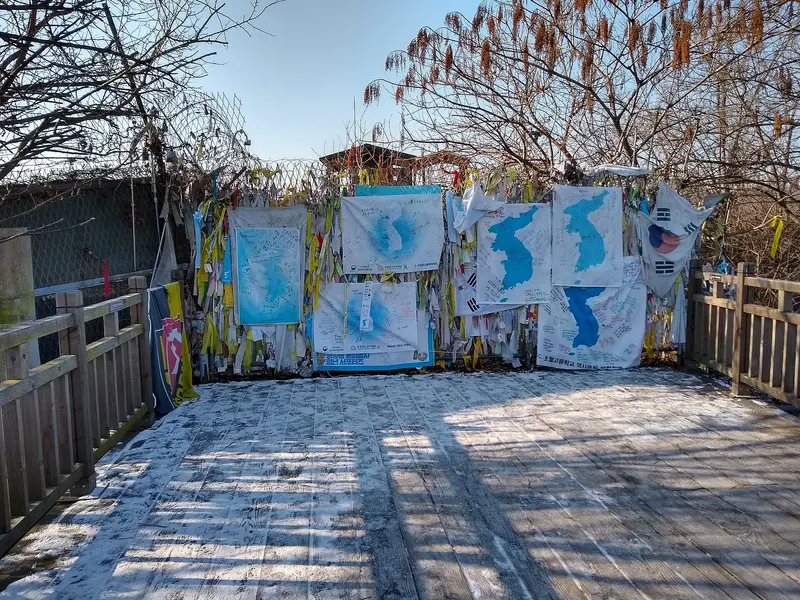
    Lance Vanlewen / Wikimedia Commons / CC BY-SA 4.0, mod.

    South Korea

    DMZ and Paju

    Point of Interest

    Before any visit to the border region, check the current UK FCDO travel advice for South Korea (gov. uk/foreign-travel-advice).

    by Felix Gillen

    1. Home
    2. Destinations
    3. South Korea
    4. DMZ and Paju
    Before any visit to the border region, check the current UK FCDO travel advice for South Korea (gov.uk/foreign-travel-advice).Individual visits to the Demilitarized Zone are restricted. You visit it on the Paju DMZ Peace Tour from Imjingak or on an organised tour from Seoul. Course A runs from Imjingak to the Third Tunnel, the Dora Observatory and back via Tongil-chon, takes about 3 hours and costs 12,200 KRW including the monorail in the tunnel. Tickets are sold on site from 9 am to 2:30 pm, bookings via dmz.paju.go.kr.Since 24 April 2026, the DMZ Peace Link Train has also run on the 2nd and 4th Friday of each month from Seoul Station via Unjeong and Imjingang to Dorasan. Reservations are made through KORAIL's tourism website.You must carry your original passport; copies or phone photos are not accepted. The area is closed on Mondays and public holidays, and tours can be cancelled without notice because of the security situation or the weather. The JSA at Panmunjom has been closed to regular tourists since 18 July 2023; since May 2025 only special visits for selected groups take place there, and a visit is still not possible for ordinary travellers (as of November 2026).
    South Korea travel guideRound trips in South KoreaPlan a trip with DMZ and Paju

    Contents

    • Places & highlights
    • Recommendations
    • Tours
    • Eat & drink
    • Culture
    • Getting around
    • Accommodation
    • Nearby

    Sights in DMZ and Paju

    Discover the most important sights and attractions

    Attraction

    1Imjingak

    The park was established in 1972 to provide comfort to people from both sides who cannot return to their hometowns. It is located approximately a 10-minute walk from Imjingak Station (Gyeongui Line) and serves as the starting point for the Paju DMZ Peace Tour.
    Open in Google Maps
    Historic Landmark

    2Third Infiltration Tunnel

    Discovered in 1978, the tunnel is 1,635 m long and 52 km from Seoul. Access only via Paju-DMZ Peace Tour or organized tour; on foot or by monorail. Open 09:20-15:30, until 15:00 in winter; closed Mondays and public holidays. Bring original passport.
    Open in Google Maps
    Attraction

    3Freedom Bridge

    The former railway bridge over the Imjin at Imjingak: Across it, POWs and soldiers returned from the North.
    Open in Google Maps
    Attraction

    4The Dora Observatory

    The Observatory is an integral stop on Course A of the Paju DMZ Peace Tour, between the Third Tunnel and Tongil-chon. Independent visits are not permitted.
    Open in Google Maps
    Point of Interest

    5Dorasan Station

    The station was opened on April 11, 2002, and is located approx. 650 m from the southern border of the Demilitarized Zone. It is part of organized DMZ day tours.
    Open in Google Maps

    6Paju DMZ Gondola

    The gondola connects Imjingak with Camp Greaves. Standard Cabin 12,000 KRW, Crystal Cabin 15,000 KRW (Adults), plus 9,000 KRW admission. Open 09:00 to 18:00, last entry at 17:30.
    Open in Google Maps

    Tours & experiences in DMZ and Paju

    Search tours for DMZ and Paju on GetYourGuide* (Affiliate link)On GetYourGuide, with reviews from other travellers

    * Affiliate link: if you book through it, we earn a small commission. The price stays the same for you.

    Restaurants in DMZ and Paju

    Background

    The Border Since the ArmisticeThe Korean War ended on July 27, 1953, with an armistice signed in Panmunjom, creating the Demilitarized Zone. To this day, there is no peace treaty. Along the border lies a four-kilometer-wide border strip; on the South Korean side, a military exclusion zone prevents direct access to the demarcation line.Imjingak and the Freedom BridgeImjingak Park was established in 1972 to bring comfort to people from both sides unable to return to their hometowns. Prisoners of war and soldiers returned from the North via the Freedom Bridge, a former railway bridge over the Imjin.On-site ConductDo not photograph military facilities. A permit is required for drones. Minors must be accompanied by adults to join the tour.

    Arrival and Tours

    By Train and Bus to ImjingakTake the Gyeongui Line to Imjingak. From the station, it's about a 10-minute walk to the park. According to Gyeonggi Province, buses 909, 9710, and 058 also run to Imjingak Resort. Car access is restricted; use the shuttle.Paju DMZ Peace TourCourse A of the Peace Tour starts from Imjingak (approx. 3 hours, 12,200 KRW including monorail; 9,200 KRW for walking in the tunnel). Tickets are available on-site from 9 AM to 2:30 PM, booking via dmz.paju.go.kr. Closed on Mondays and public holidays.Organized Tours from SeoulFull-day tours from Seoul cost approx. 70,000 KRW. On Mondays, tours from Seoul go to the Second Tunnel and Aegibong Observatory instead of the Third Tunnel. The JSA in Panmunjom has been closed to regular tourists since July 2023.

    Accommodations in DMZ and Paju

    Find perfect stay in DMZ and Paju

    Booking.com* (Affiliate link)
    Search Hotels
    Agoda* (Affiliate link)
    Search Hotels
    Airbnb
    Vacation Rentals

    * Affiliate link: if you book through it, we earn a small commission. The price stays the same for you.

    Nearby

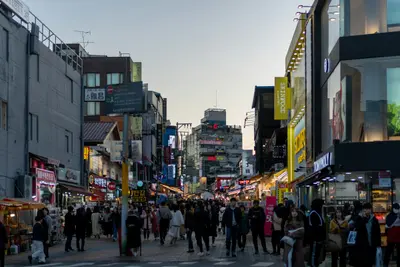
    Jongno and Palace Quarter

    Jongno and Palace Quarter

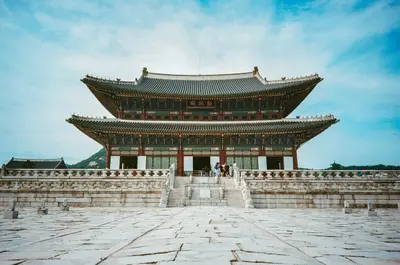
    Seoul's historic heart stretches from Gwanghwamun Square, featuring statues of King Sejong and Admiral Yi Sun-sin, to the Joseon Dynasty palaces. Gyeongbokgung, Changdeokgung, Changgyeonggung, and the Jongmyo Shrine are tightly grouped here, with Bukchon Hanok Village and Samcheong-dong's galleries in between. West of Gyeongbokgung, Seochon, one of the city's oldest residential areas, is worth exploring, with the Tongin Market.

    Daniel Bernard·Unsplash

    Hongdae and Mapo

    Hongdae and Mapo

    Around Hongik University in Mapo District, a young neighborhood with art, indie bands, and live clubs has emerged, known simply as Hongdae. Along a former railway line, the Gyeongui Line Forest Park stretches, a green strip lined with cafes on both sides. In neighboring Mangwon, the market blends traditional stalls with new cafes and dessert shops.

    Patrick·Unsplash

    Insadong and Ikseon-dong

    Insadong and Ikseon-dong

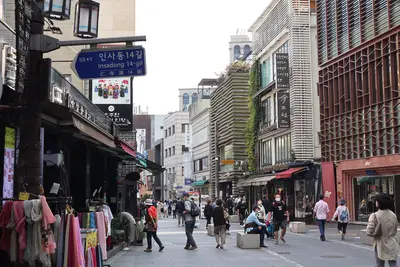
    The approximately 700-meter-long Insadong-gil is Seoul's street for handicrafts, antiques, galleries, and teahouses; on weekends, it belongs to pedestrians and street musicians. Just a few minutes' walk east lies Ikseon-dong, a labyrinth of small Hanok houses from the 1920s and 1930s, now home to cafés and shops. Further east, the Naksan section of the old city wall leads up a hill with a view over the city.

    S h y numis·CC BY-SA 4.0

    Seoul

    Seoul

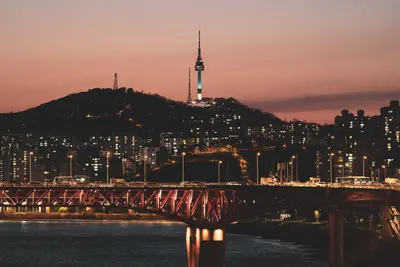
    Seoul ist das politische, wirtschaftliche und kulturelle Zentrum Südkoreas: rund 9,3 Millionen Menschen leben in der Stadt am Han-Fluss, im Großraum sind es rund 26 Millionen. Fünf Königspaläste und der Ahnenschrein Jongmyo erinnern an die über 500 Jahre, in denen Seoul Hauptstadt der Joseon-Dynastie war. Daneben findest du Hanok-Gassen in Bukchon und Ikseon-dong, quirlige Märkte wie Gwangjang, das Designzentrum DDP von Zaha Hadid und den 555 Meter hohen Lotte World Tower. Abends locken die Studenten- und Musikszene in Hongdae, das internationale Itaewon und das schicke Gangnam südlich des Flusses.

    Hyeok Jang·Pexels

    Myeongdong and Namsan

    Myeongdong and Namsan

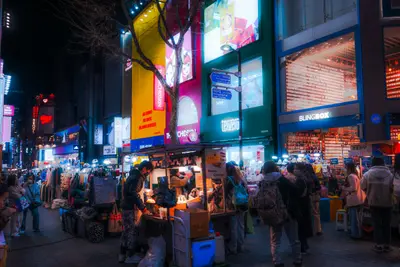
    Myeongdong is Seoul's shopping district for fashion and cosmetics; in the evenings, street food stalls line the alleys. The neo-Gothic Myeongdong Cathedral towers above the district, and behind it, Namsan Mountain, home to the N Seoul Tower, ascends. The district also encompasses Sungnyemun Gate, the large Namdaemun Market, and the elevated park Seoullo 7017 at Seoul Station.

    Nathan Park·Unsplash

    Your next steps

    DMZ and Paju is in South Korea. Ways to carry on from here.

    • More in South Korea

      Highlights, areas, routes and the best time to travel for all of South Korea.

      South Korea travel guide
    • Round trips in South Korea

      Ready-made routes through South Korea, with stops, nights and a map.

      See the routes
    • Plan a trip with DMZ and Paju

      The Guide asks about season, length and who is coming, and suggests a trip with DMZ and Paju.

      Plan the trip

    Sources & method

    • Photos: Wikimedia Commons. Each photo carries its credit.
    • Place data such as addresses and ratings comes from Google Maps.
    • The content is based on web research from public, traceable sources. How the content is made · The role of AI