Fernweh: Home
ExploreGuideDestinationsMy tripsMy trip
de|en
All Places & RegionsRound tripsNight trains in EuropeAll highlightsAbout FernwehFAQPrivacy PolicyImprint
Download on the App StoreGet it on Google Play
ExploreGuideDestinationsMy tripsMy trip
    • Neighborhoods & highlights
    • Tours
    • Eat & drink
    • Culture
    • Getting around
    • Accommodation
    • Plan trip
    • Round trips
    • Nearby
    Oslo

    Photo by Pierre Blaché on Unsplash

    Norway

    Oslo

    City

    Oslo, the capital of Norway, is located at the inner end of the Oslofjord, surrounded by forested hills, the Marka, and about 40 islands within the city area.

    by Felix Gillen

    1. Home
    2. Destinations
    3. Norway
    4. Oslo
    Oslo, the capital of Norway, is located at the inner end of the Oslofjord, surrounded by forested hills, the Marka, and about 40 islands within the city area. For most travelers, it is the arrival point: Gardermoen Airport is located about 47 kilometers north and is connected by the Flytoget airport express.The city originated in the 11th century as a trading post and became a royal seat around 1300 under Håkon V., who also had Akershus Fortress built. After a fire in 1624, it was rebuilt as Christiania and has only been called Oslo again since 1925. Around the Bjørvika harbor and Aker Brygge, you will find the Opera House, the Munch Museum, and the City Hall today, where the Nobel Peace Prize is awarded every December. On the Bygdøy peninsula are museums dedicated to maritime and polar history.
    Norway travel guideSee the round tripPlan a trip with Oslo

    Contents

    • Neighborhoods & highlights
    • Tours
    • Eat & drink
    • Culture
    • Getting around
    • Accommodation
    • Round trips
    • Nearby

    Sights in Oslo

    Discover the most important sights and attractions

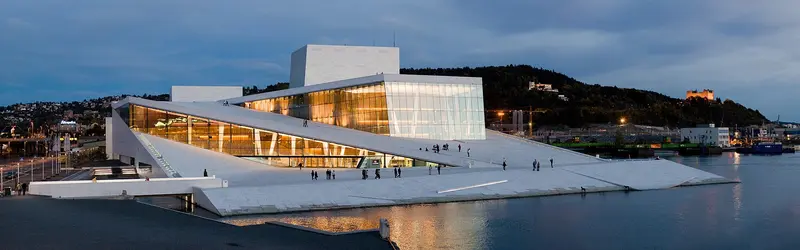
    Oslo Opera House

    Rafał Konieczny / Wikimedia Commons / CC BY-SA 4.0, mod.

    Attraction

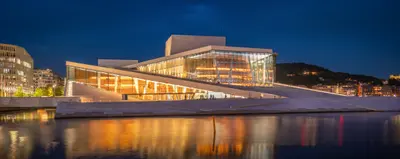
    1Oslo Opera House

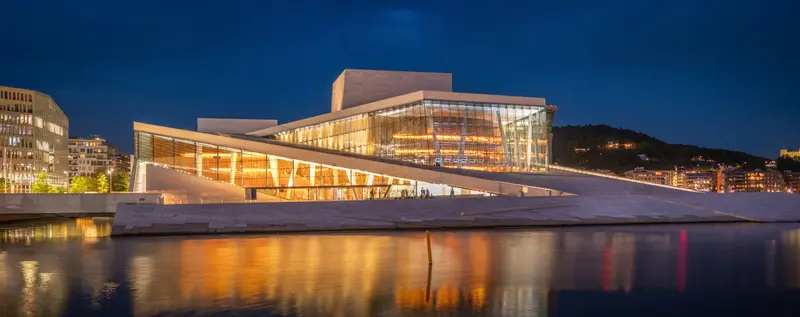
    The Opera House in Bjørvika, opened in 2008, is home to the Norwegian Opera and National Ballet. Its sloping roof, clad in light stone, is open to all and offers views over the Oslofjord and the city.
    Open in Google Maps
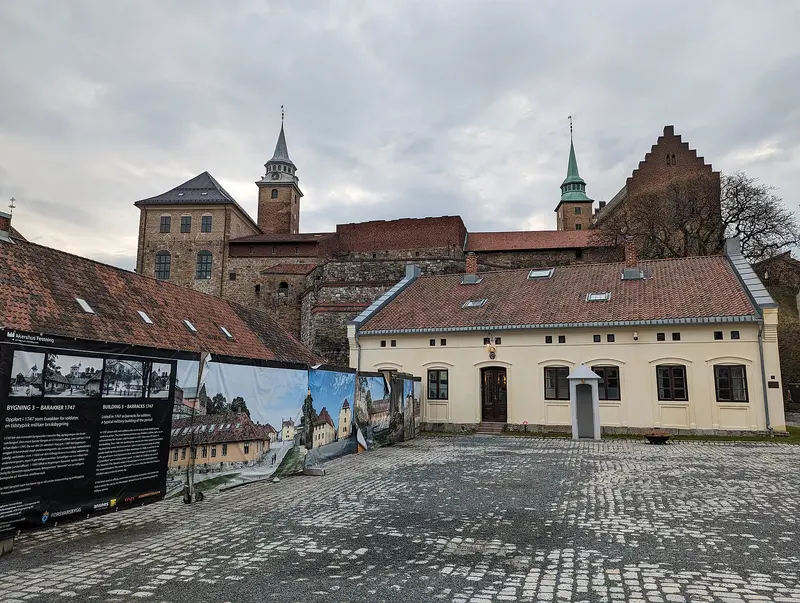
    Akershus Fortress

    Jonathan Platteau / Wikimedia Commons / CC BY-SA 4.0, mod.

    Park

    2Akershus Fortress

    Under Håkon V., the castle overlooking the harbor likely began construction in the late 1290s. The complex on the headland between City Hall and the Opera is accessible daily from 6 AM to 9 PM; from its ramparts, you gaze over the fjord. The grounds house the Armed Forces Museum and the Resistance Museum, and in the royal crypt rest, among others, Håkon VII. and Olav V.
    Open in Google Maps
    Munch Museum (MUNCH)

    Annikdance / Wikimedia Commons / CC BY-SA 4.0, mod.

    Museum

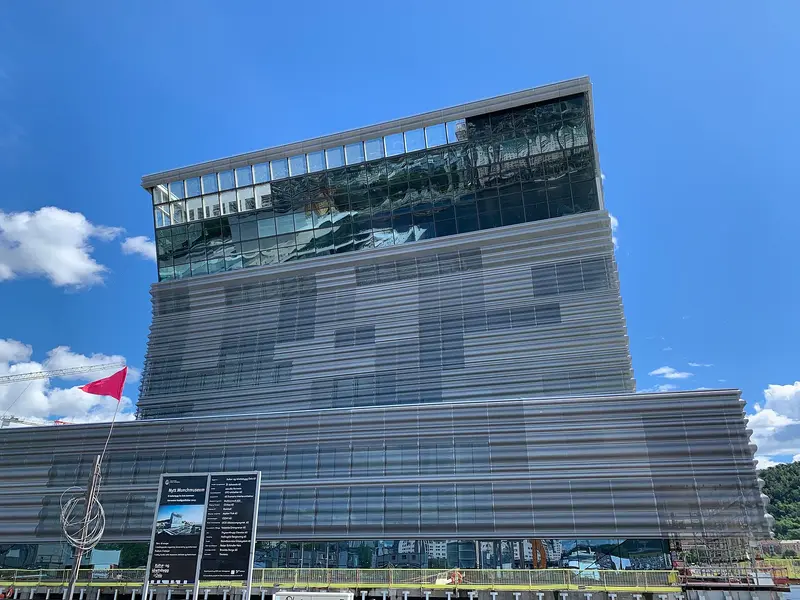
    3Munch Museum (MUNCH)

    The museum next to the Opera preserves Edvard Munch's estate, including versions of his most famous motif 'The Scream'. It features changing selections from the collection and special exhibitions.
    Open in Google Maps
    Park

    4Vigeland Park (Frogner Park)

    In Frogner Park, Oslo's largest park, stand 212 sculptures of granite and bronze, all designed by Gustav Vigeland, who worked on the site from 1924 until his death in 1943. The highlight is the more than 14-meter-high Monolith, composed of 121 intertwined figures, on which three stonemasons worked for 14 years. The park is always open.
    Open in Google Maps
    Museum

    5Fram Museum (Bygdøy)

    The museum, opened in 1936 on the Bygdøy peninsula, features the polar ship Fram, built for Fridtjof Nansen from 1891; you can enter its original, preserved interior. In a separate building stands the Gjøa, with which Roald Amundsen was the first to traverse the Northwest Passage by 1906. Bygdøy also hosts the Kon-Tiki Museum and the Norsk Folkemuseum; the former Viking Ship Museum is closed for renovation and construction.
    Open in Google Maps
    Point of Interest

    6Oslo Cityhall

    The City Hall, with its two brick towers by the harbor, was built from 1931 to 1950 and inaugurated for the city's 900th anniversary. Every year on December 10th, the Nobel Peace Prize is awarded here. Murals by Henrik Sørensen and Alf Rolfsen adorn the great hall, depicting the history of Norway and Oslo, including the occupation period.
    Open in Google Maps

    Tours & experiences in Oslo

    Search tours for Oslo on GetYourGuide* (Affiliate link)On GetYourGuide, with reviews from other travellers

    * Affiliate link: if you book through it, we earn a small commission. The price stays the same for you.

    Restaurants in Oslo

    1

    Contrast

    The restaurant in the former industrial district of Vulkan has two stars in the Guide Michelin 2026. The space is simple and dimly lit, with the open kitchen, which modernly interprets Scandinavian products, as the focal point.
    Show on Google Maps
    2

    Engebret Café

    According to Falstaff, Oslo's oldest restaurant, located on Bankplassen in Kvadraturen. The cuisine is traditional Norwegian: Skrei in winter, game in autumn, and Lutefisk at Christmas, plus open-faced sandwiches. Visit Oslo calls it a city institution.
    Show on Google Maps
    3

    The Little Pickle

    Tøyen eatery, Bib Gourmand in 2026 Michelin Guide. Daytime sourdough bakery & café; Night: British classics like Pie and Mash with Norwegian-inspired dishes; Sunday roast.
    Show on Google Maps
    4

    Maaemo

    Maaemo holds three stars in the Guide Michelin Nordic 2026, making it Oslo's highest-rated restaurant. The restaurant is in the Bjørvika harbor district, close to the Opera and MUNCH.
    Show on Google Maps
    5

    Statholdergaarden

    The restaurant on Rådhusgata in the Kvadraturen district holds a star in the Guide Michelin Nordic 2026. It is just a few minutes' walk from Akershus Fortress.
    Show on Google Maps
    6

    My Uncle

    Mon Oncle in Universitetsgata has a star in the Guide Michelin Nordic 2026. The restaurant is centrally located, a short walk from Nationaltheatret.
    Show on Google Maps

    Art, Architecture and Skiing

    Art by the FjordThe Opera House opened in 2008, designed by Snøhetta. Its marble-clad roof is expressly designed for walking on; you can stroll from the waterfront all the way up to the roof's edge. Right next door, since 2021, is the 13-story new MUNCH building, home to the world's largest collection of Edvard Munch's works. The National Museum opened in June 2022 and displays over 6,500 works in nearly 90 rooms, including "The Scream".Winter Sports at HolmenkollenAt Holmenkollen, overlooking the city, international ski jumping and cross-country skiing competitions have taken place for over 100 years. The Holmenkollen Ski Festival 2027 is scheduled for March 12-14, featuring World Cup races in cross-country skiing, ski jumping, and Nordic Combined. The Ski Museum at the base of the jump has been open since 1923.Museums on BygdøyOn the Bygdøy peninsula, the Fram Museum, the Kon-Tiki Museum, and the Norsk Folkemuseum are located close to each other. The Museum of the Viking Age (formerly the Viking Ship Museum) is closed for new construction, with reopening tentatively planned for 2027.

    On the Go in Oslo

    From the Airport to the CityThe Flytoget airport train runs every 10 minutes during the day between Oslo Gardermoen and Oslo Central Station Oslo S, and every 20 minutes early mornings, late evenings, weekends, school holidays. Journey time is about 20 minutes. Adult single tickets from Oslo S cost 276 NOK. Youths (16-20), students, and seniors (67+) pay half price with valid ID. Accompanied children under 16 travel free. Vy regional trains are cheaper, departing roughly three times an hour. The Oslo Pass is valid on Vy trains, not Flytoget.To BygdøyYear-round, Bus 30 departs Nationaltheatret, reaching all Bygdøy museums in about 15 minutes. In season (2026 from March 14 to October 4), the Bygdøy ferry also departs every 20 minutes from City Hall, Rådhusbrygge 3. After about 10 minutes, it reaches Dronningen (Folkemuseum), then Bygdøynes with the Kon-Tiki, Fram, and Maritime Museums. Ruter tickets are not valid on the ferry; the Oslo Pass is.

    Accommodations in Oslo

    Find perfect stay in Oslo

    Booking.com* (Affiliate link)
    Search Hotels
    Agoda* (Affiliate link)
    Search Hotels
    Airbnb
    Vacation Rentals

    * Affiliate link: if you book through it, we earn a small commission. The price stays the same for you.

    Campgrounds in Oslo

    Find perfect campground in Oslo

    Search via Google Maps
    Campgrounds nearby (15km)
    Camping.info
    Find Campgrounds
    Park4Night
    RV Parks & Camping

    Plan your trip to Oslo

    Save places, build a route and plan your city trip, all in one place.

    1. 1
      Sunrise over alpine peaks and a sea of clouds
      1234

      Round trip

      12 days · 4 stops

      Saved

      Pick a route

      Pick a ready-made one or save places and plan your own.

      Open bookmarks
    2. 2

      Trip to Oslo

      Live
      • 1Oslo Opera House3 days
      • 2Akershus Fortress4 days
      • 3Munch Museum (MUNCH)5 days
      Budget

      Plan your trip

      The planner sorts stops, days and budget. Plan together in real time.

      Start trip planning
    3. 3
      9:41 No signal
      Oslo
      Available offline

      Photo by Pierre Blaché on Unsplash

      Use it on the road

      Download the guide to your phone and use it on site, even offline.

    Round trips with Oslo

    Classic Norway by Train: Oslo, Flåm and Bergen

    Classic Norway by Train: Oslo, Flåm and Bergen

    A week without a car: You start in Oslo with the Opera, Munch Museum, and the museums on Bygdøy, then travel by Bergensbahn over the mountains to Myrdal and by Flåmsbana down to the Aurlandsfjord. After two nights by the fjord, you return to Myrdal and continue to Bergen, where Bryggen and Fløyen await. Return flight from Bergen.

    9 Days
    3 stops
    Open jaw

    Pierre Blaché·Unsplash

    Nearby

    Fredrikstad

    Fredrikstad

    Fredrikstad is situated at the mouth of the Glomma, just over an hour south of Oslo. The reason for a visit is its Old Town, Gamlebyen, described by Visit Norway as Northern Europe's best-preserved fortified city.King Frederik II founded the city in 1567 as a replacement for Borg, which had been destroyed by Sweden. The ramparts were later reinforced under the Dutch Quartermaster General Willem Coucheron. In 1814, Swedish Crown Prince Carl Bernadotte attacked, and the city surrendered after a few hours. With the dissolution of the Østfold Regiment in 2002, 350 years of military presence ended.West of the city lies the Hvaler archipelago with 833 islands and skerries.

    Helge Høifødt·CC BY-SA 4.0

    Telemark

    Telemark

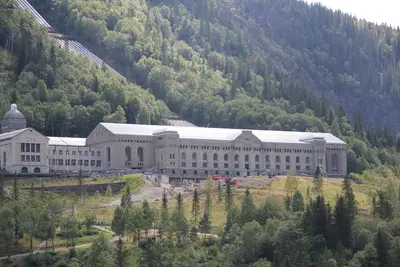
    Telemark is the region in the hinterland of Norway's south coast, stretching from Skien to the edge of the Hardangervidda mountain plateau. You come here for the UNESCO World Heritage site Rjukan-Notodden, a boat trip on the Telemark Canal, and Heddal Stave Church, Norway's largest stave church.Since 2015, the industrial landscape of Rjukan and Notodden has been part of the World Heritage. Norsk Hydro produced artificial fertilizers from atmospheric nitrogen here using hydropower; power plants, pipelines, factories, railways, and ferries are preserved. The Vemork power plant near Rjukan was, upon its completion in 1911, the largest of its kind worldwide.The 105-kilometer long Telemark Canal between Skien and Dalen was completed in 1892 and was then considered the "eighth wonder of the world."

    Linus Folke Jensen·CC BY-SA 4.0

    Lillehammer

    Lillehammer

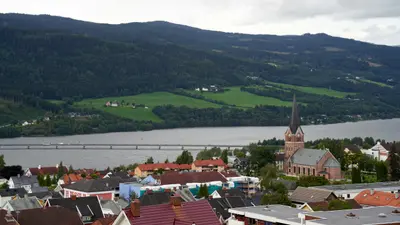
    Lillehammer is located approximately 200 kilometers north of Oslo on Lake Mjøsa, Norway's largest lake, and at the entrance to Gudbrandsdal. The city hosted the 1994 Winter Olympics, and many of its venues can still be visited today.In addition to winter sports, the Maihaugen open-air museum attracts visitors with around 200 restored buildings. The region also features Hunderfossen, one of the country's largest and most popular amusement parks, according to Visit Norway. The brown cheese Gudbrandsdalsost originates from Gudbrandsdal.

    Barnabas Davoti·Unsplash

    Värmland

    Värmland

    Värmland is a forest and lake landscape in central Sweden on the shores of Lake Vänern, with Karlstad as its main town. You travel here for canoe trips and hiking trails in the Glaskogen Nature Reserve, rafting on the Klarälven river, and the traces of author Selma Lagerlöf.The Swedish part of the Klarälven river is about 460 kilometers long and is one of the country's longest rivers; timber was floated on it until 1991. Lagerlöf, who in 1909 became the first woman to receive the Nobel Prize in Literature, lived on the Mårbacka farm near Sunne.On your plate you'll find Raggmunk, potato pancakes with fried bacon and lingonberries, or spinach soup with poached egg.

    Ssu·CC BY-SA 4.0

    Åmål

    Åmål

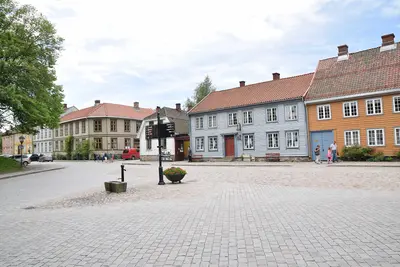
    Åmål is a small town in Dalsland on the western shore of Lake Vänern. Gamla Staden survived the great town fire of 1901, and its wooden houses from the 18th and 19th centuries still shape its character today. At the guest harbor are the local heritage museum, tourist office, and old church.

    Unsplash

    Your next steps

    Oslo is in Norway. Ways to carry on from here.

    • More in Norway

      Highlights, areas, routes and the best time to travel for all of Norway.

      Norway travel guide
    • Round trips with Oslo

      One route passes through Oslo, with stops, nights and a map.

      See the round trip

    Sources & method

    • Photos: Wikimedia Commons, Unsplash. Each photo carries its credit.
    • Place data such as addresses and ratings comes from Google Maps.
    • The content is based on web research from public, traceable sources. How the content is made · The role of AI