ExploreTravel GuidesPlan a trip
    de|en
    All Places & RegionsAbout FernwehFAQPrivacy PolicyImprint
    ExploreTravel GuidesPlan a trip
    • Neighborhoods & highlights
    • Eat & drink
    • Accommodation
    • Plan trip
    • Nearby
    Heidelberg Old Town

    Germany

    Heidelberg Old Town

    City

    The Heidelberger Altstadt is considered a Baroque city on a medieval layout: After French troops devastated the city in the Palatinate War of Succession in 1693, new Baroque buildings were erected on the old foundations, yet the original…

    1. Home
    2. Destinations
    3. Germany
    4. Heidelberg
    5. Heidelberg Old Town
    The Heidelberger Altstadt is considered a Baroque city on a medieval layout: After French troops devastated the city in the Palatinate War of Succession in 1693, new Baroque buildings were erected on the old foundations, yet the original right-angled grid layout from its founding period remained. Only a few houses survived the city fire, among them the Renaissance House zum Ritter opposite the Heiliggeistkirche. In the west, between Bismarckplatz and Universitätsplatz, shops characterize the scene, while in the core Old Town further east, guesthouses, pubs, and restaurants dominate.You stroll along the Hauptstraße, car and tram-free since 1976, turning off to the squares: Universitätsplatz with the Baroque Old University, Marktplatz with its Hercules Fountain, and Kornmarkt with its 1718 Madonna statue, where the castle funicular departs. Bismarckplatz, at the west end, is a major hub for trams and buses; the Heidelberg-Altstadt train station lies at the east end, by Karlstor.

    Sights in Heidelberg Old Town

    Discover the most important sights and attractions

    Attraction

    1Kornmarkt

    In the square below the castle stands Pieter van den Branden's Madonna statue, erected in 1718. Here too is the valley station of the mountain railway, which runs via the castle and Molkenkur to Königstuhl.
    Open in Google Maps
    Attraction

    2University Square

    The Old Town's central square, established in 1705, replaced the Augustinian Monastery where Luther spoke in 1518. The Lion Fountain stands by the Old University's west facade; opposite, the New University with the Witch's Tower in its court.
    Open in Google Maps
    Museum

    3Old University and University Museum

    The Baroque building was built 1712-1735 by Johann Adam Breunig's design. Since 1996, the Universitätsmuseum here showcases the Ruprecht-Karls-Universität's history; the Alte Aula, redesigned in 1886 for its 500th anniversary, is in the west wing.
    Open in Google Maps
    Church

    4St. Peter's

    The Old Town's oldest church was first mentioned in 1196 and has been officially the University Church since 1896. Its present Neo-Gothic interior dates from the renovation of 1864 to 1870, and on its walls, some 150 epitaphs commemorate professors and electoral officials.
    Open in Google Maps
    Historic Landmark

    5Karlstor

    The gate, resembling a Roman triumphal arch, was designed by Nicolas de Pigage and built from 1775 to 1781, intended as the citizens' thanks to Elector Karl Theodor. It marks the Old Town's eastern end; its city side shows portraits of the Elector and his wife.
    Open in Google Maps

    Restaurants in Heidelberg Old Town

    Accommodations in Heidelberg Old Town

    Find perfect stay in Heidelberg Old Town

    Booking.com* (Affiliate link)
    Search Hotels
    Agoda* (Affiliate link)
    Search Hotels
    Airbnb
    Vacation Rentals

    * Affiliate link: if you book through it, we earn a small commission. The price stays the same for you.

    Campgrounds in Heidelberg Old Town

    Find perfect campground in Heidelberg Old Town

    Search via Google Maps
    Campgrounds nearby (15km)
    Camping.info
    Find Campgrounds
    Park4Night
    RV Parks & Camping

    Plan your trip to Heidelberg Old Town

    Save places, build a route and plan your city trip, all in one place.

    1. 1
      1234

      Round trip

      12 days · 4 stops

      Saved

      Pick a route

      Pick a ready-made one or save places and plan your own.

      Open bookmarks
    2. 2

      Trip to Heidelberg Old Town

      Live
      • 1Kornmarkt3 days
      • 2University Square4 days
      • 3Old University and University Museum5 days
      Budget

      Plan your trip

      The planner sorts stops, days and budget. Plan together in real time.

      Start trip planning
    3. 3
      9:41 No signal
      Available offline

      Use it on the road

      Download the guide to your phone and use it on site, even offline.

    Nearby

    Heidelberg

    Heidelberg

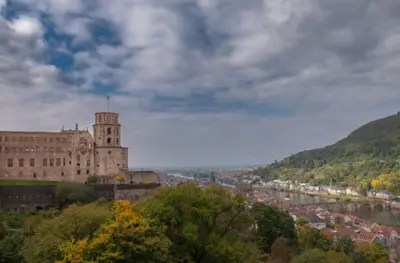
    Heidelberg is situated on the Neckar, precisely where the river exits the Odenwald and flows into the Upper Rhine Plain. The Old Town stretches narrowly between the river and the 568-meter-high Königstuhl, topped by the famous castle ruin, which French troops set ablaze in 1689 and blew up in 1693.Founded in 1386, Ruprecht-Karls-Universität is Germany's oldest university and continues to shape the city today. You can stroll along the approximately 1.6-kilometer-long Hauptstraße, one of Europe's longest pedestrian zones, cross the Alte Brücke, and look back at the castle and Old Town from the Philosophenweg on the opposite side of the Neckar.

    Neuenheim

    Neuenheim lies opposite the Old Town on the Neckar's north bank and was first mentioned as "Niwenheim" in the Lorscher Codex in 765. During Roman times, a camp, a Neckar bridge, and two Mithraea stood here. Until the Gründerzeit, Neuenheim was a village of farmers, vintners, and fishermen. In 1891, it was incorporated into Heidelberg as the first neighboring village. Today, villas and abundant greenery characterize the district. West of the old village core, the large campus with the Universitätsklinikum and Deutschem Krebsforschungszentrum is located in the Neuenheimer Feld.Cross via the Alte Brücke and climb up to the Philosophenweg and Heiligenberg. On its Neuenheim-side slope lie the remains of the Stephanskloster and the approximately 56-meter-deep Heidenloch. At Neuenheim's Marktplatz, the tower and choir of the old Johanneskirche still stand; not far away, the 55-meter-high Neo-Gothic tower of the new Johanneskirche rises. The Zoo is located in the district's west. Brückenstraße and Berliner Straße, the two main axes, are served by RNV tram and bus lines.

    Handschuhsheim

    Handschuhsheim, with around 18,000 inhabitants, is Heidelberg's most populous district and was first mentioned in 765 in the Lorscher Codex as "Hantscuhesheim." The locality successively belonged to Lorsch, Kurmainz, and from 1460 to the Electoral Palatinate, only becoming incorporated on January 1, 1903. For a long time, horticulture shaped the village, with strawberries, cherries, and greenhouse plants being primarily cultivated. In the old village center, you'll still find farmhouses, winding alleys, and garden restaurants, with more than half of the municipal area being forest.The focal point is the Tiefburg, the sole moated castle on the Bergstraße, hosting many district festivals in its courtyard. Here also stands St. Vitus, Heidelberg's oldest church. Within Handschuhsheim's area also lies the 439-meter-high Heiligenberg summit, with the Michaelskloster ruins and the Thingstätte. Tram lines 5, 21, 24, and 26 of the RNV go here; bus line 38 connects the old village center and Mühltal.
    Speyer

    Speyer

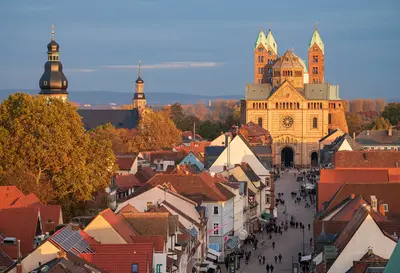
    Speyer is located on the Rhine, which here forms the border between Rhineland-Palatinate and Baden-Württemberg, just under 20 kilometers south of Mannheim. The city, with around 51,000 inhabitants, boasts two UNESCO World Heritage Sites: the Imperial Cathedral (Kaiserdom), consecrated in 1061, the largest preserved Romanesque church after the destruction of Cluny, and the Jewish Courtyard (Judenhof) with its synagogue ruins and Germany's oldest completely preserved mikveh.From Cathedral Square, Maximilianstraße, a pedestrian zone, leads to the 55-meter-high Altpörtel, the city's former western gate. Additionally, you'll find the Historical Museum of the Palatinate with its cathedral treasury, and the Technik Museum, where you can see, among other things, a Boeing 747 and the Buran prototype OK-GLI.
    Pfalz & German Wine Route

    Pfalz & German Wine Route

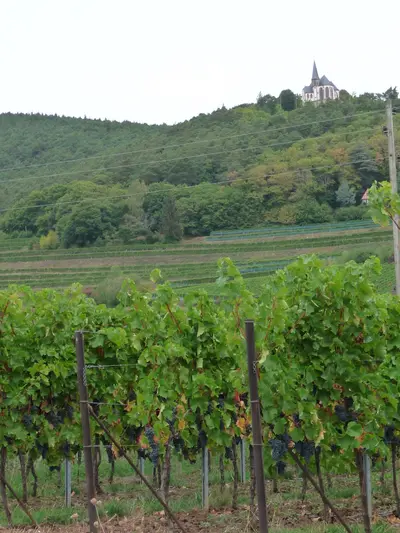
    The Palatinate in the south of Rhineland-Palatinate is Germany's second-largest wine region. Running through its heart since 1935 is the approximately 85-kilometer-long German Wine Route, stretching from the German Wine Gate in Schweigen on the French border to Bockenheim, always alongside the Haardtrand, the eastern edge of the Palatinate Forest.On your journey, you'll combine wine villages with rich history: By the Rhine, in Speyer, stands the Romanesque Imperial Cathedral, a UNESCO World Heritage site since 1981; above Neustadt an der Weinstraße, Hambach Castle towers, the site of the Hambach Festival of 1832; and in Bad Dürkheim awaits the Giant Cask from 1934.