ExploreTravel GuidesPlan a trip
    de|en
    All Places & RegionsAbout FernwehFAQPrivacy PolicyImprint
    ExploreTravel GuidesPlan a trip
    • Neighborhoods & highlights
    • Eat & drink
    • Getting around
    • Accommodation
    • Plan trip
    • Nearby
    Malibu

    United States

    Malibu

    City

    Malibu is not a city with a central core, but rather a 34-kilometer-long stretch of coastline along the Pacific Coast Highway, nestled between the Santa Monica Mountains and the Pacific Ocean.

    1. Home
    2. Destinations
    3. United States
    4. Los Angeles
    5. Malibu
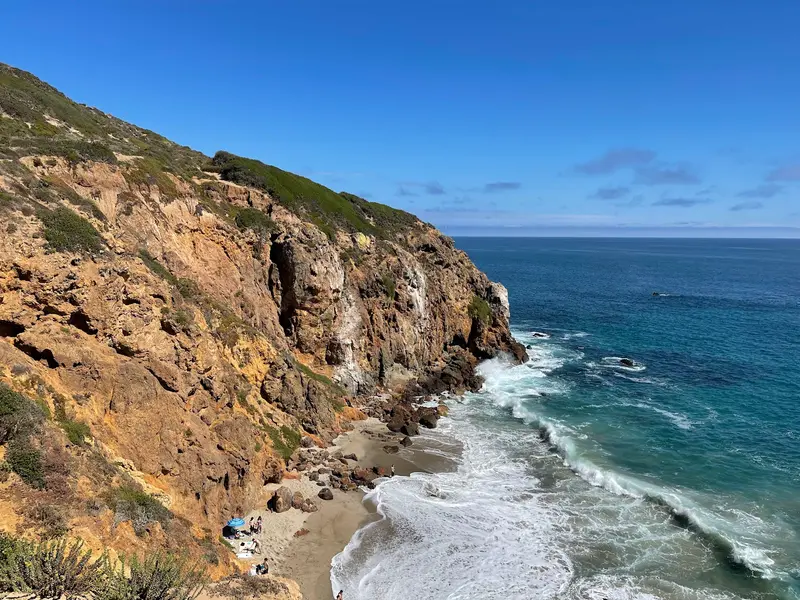
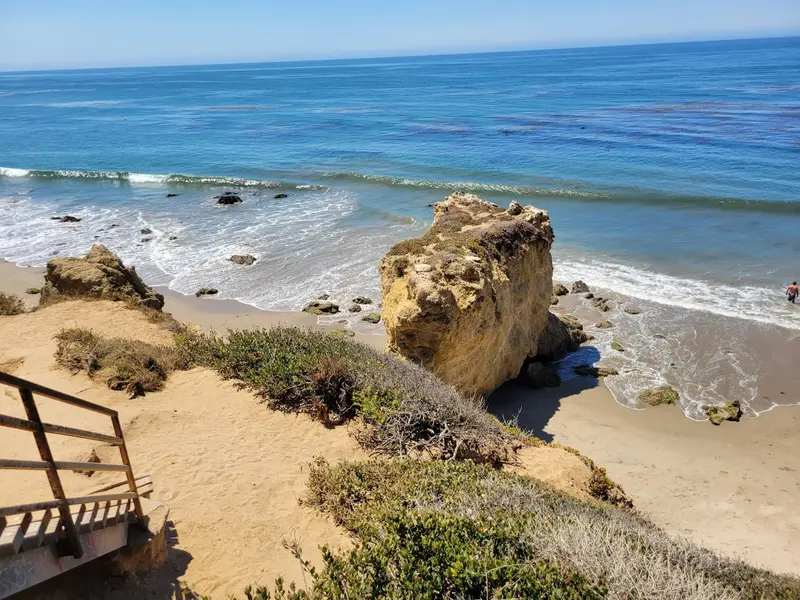
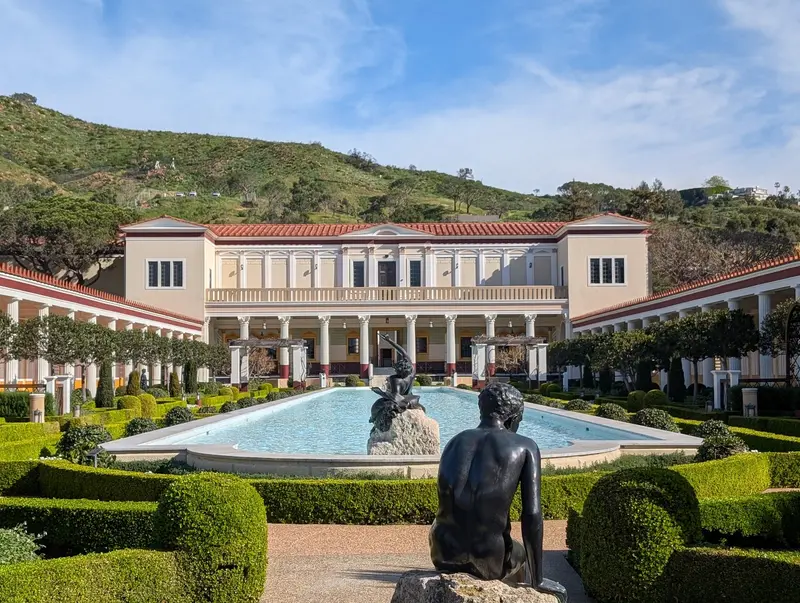
    Malibu is not a city with a central core, but rather a 34-kilometer-long stretch of coastline along the Pacific Coast Highway, nestled between the Santa Monica Mountains and the Pacific Ocean. Officially, Malibu lies outside the city of Los Angeles, only establishing itself as its own municipality in 1991. It is known for its surf beaches, rocky coves, and rugged cliffs.The fires of December 2024 and January 2025 hit Malibu hard; the Palisades Fire destroyed a large portion of the beach houses in the eastern part of the area. The Pacific Coast Highway has been open to all traffic again since May 2025, reconstruction is ongoing, and many restaurants have only gradually reopened.On the eastern edge of the coastline lies the Getty Villa, a recreation of the Roman Villa dei Papiri from Herculaneum, housing around 44,000 Greek, Roman, and Etruscan antiquities. Further west, Point Dume juts into the sea, a headland at the northern end of Santa Monica Bay. From February into spring, you can often spot gray whales and humpback whales on their migration from here. Approximately 16 kilometers west of the center, paths and stairs lead down to El Matador State Beach, a small cove nestled beneath the cliffs.For Malibu, you'll need a full day and preferably a car. The beaches are emptier in the mornings, and a sunset at El Matador or on Point Dume makes for a perfect end to the day.

    Sights in Malibu

    Discover the most important sights and attractions

    Getty Villa
    Museum

    1Getty Villa

    Replica of a Roman villa from Herculaneum with around 44,000 ancient works, including the “Victorious Youth.” Daily 10 AM to 5 PM, closed Tuesdays. Free admission with reservation. Reopened since June 2025 after the Palisades Fire.
    Open in Google Maps
    Point Dume
    Park

    2Point Dume

    Point at the northern end of Santa Monica Bay, with approx. 1.6 km of trails and two viewpoints. Grey and humpback whales are often seen from February through spring.
    Open in Google Maps
    El Matador State Beach
    Attraction

    3El Matador State Beach

    A small cove with rocks in the water, part of Robert H. Meyer Memorial State Beach. A path and stairs lead down from the cliff-top parking lot; no dogs allowed.
    Open in Google Maps
    Malibu Pier
    Attraction

    4Malibu Pier

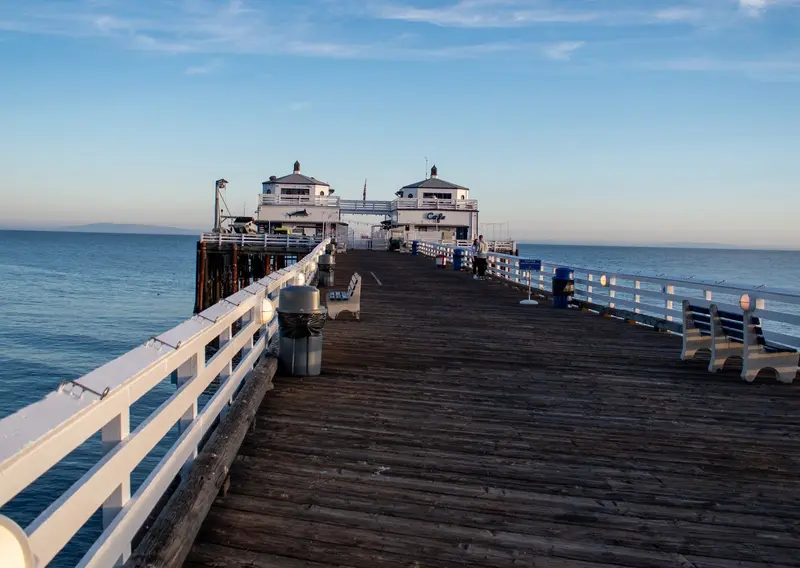
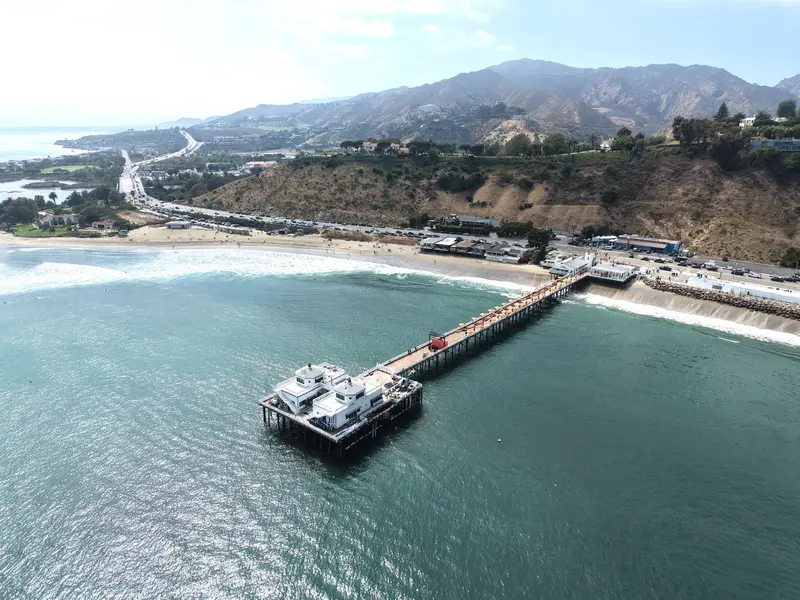
    The pier next to Surfrider Beach once served the Rindge Ranch as a landing and reopened in 2008 after renovation.
    Open in Google Maps

    Restaurants in Malibu

    1

    Malibu Farm

    Restaurant and bar at the start of Malibu Pier, with local cuisine and water views. Open daily from 9 AM.
    Show on Google Maps
    2

    Duke's Malibu

    Beachfront restaurant on the Pacific Coast Highway, named after the Hawaiian surfer and Olympic swimmer Duke Kahanamoku. Reopened in 2026 with limited opening hours after fire and landslide damage.
    Show on Google Maps

    Getting There and Around

    Malibu is car country; destinations are widely spread out along the Pacific Coast Highway (Highway 1). Without a car, the bus is your only option.Bus Metro 134: from E-Line Station Downtown Santa Monica along the Pacific Coast Highway to Trancas Canyon, stopping at Malibu Civic CenterGetty Villa: Free admission, but only with an online-booked time slot. Parking costs 25 US dollars, 15 dollars from 3 PM, card payments onlyEl Matador State Beach: small parking lot on the cliff, 10 dollars per day or 3 dollars per hour, open 8 AM until sunsetPoint Dume: very limited parking, come early
    Accommodations in Malibu

    Find perfect stay in Malibu

    Booking.com* (Affiliate link)
    Search Hotels
    Agoda* (Affiliate link)
    Search Hotels
    Airbnb
    Vacation Rentals

    * Affiliate link: if you book through it, we earn a small commission. The price stays the same for you.

    Campgrounds in Malibu

    Find perfect campground in Malibu

    Search via Google Maps
    Campgrounds nearby (15km)
    Camping.info
    Find Campgrounds
    Park4Night
    RV Parks & Camping

    Plan your trip to Malibu

    Save places, build a route and plan your city trip, all in one place.

    1. 1
      1234

      Round trip

      12 days · 4 stops

      Saved

      Pick a route

      Pick a ready-made one or save places and plan your own.

      Open bookmarks
    2. 2

      Trip to Malibu

      Live
      • 1Getty Villa3 days
      • 2Point Dume4 days
      • 3El Matador State Beach5 days
      Budget

      Plan your trip

      The planner sorts stops, days and budget. Plan together in real time.

      Start trip planning
    3. 3
      9:41 No signal
      Available offline

      Use it on the road

      Download the guide to your phone and use it on site, even offline.

    Nearby

    Santa Monica

    Santa Monica

    Santa Monica is a city by the sea in its own right, but for most visitors, it's where Los Angeles meets the Pacific. Wide sandy beaches, a bike path along the water, palm trees on the bluff above the coastal road. The center is compact and easily explored on foot, which is rare in LA.At its heart is the Santa Monica Pier. The Municipal Pier opened in 1909, and in 1916, the Looff family's amusement pier was added to its south. The Looff Hippodrome features a 1922 carousel, and the pier is home to Pacific Park amusement park with its solar-powered Pacific Wheel Ferris wheel. Since 2009, the 'End of the Trail' sign has stood here, a photo op for everyone who has driven Route 66. Officially, however, the road ended at the intersection of Lincoln and Olympic Boulevard. Route 66 celebrates its 100th birthday in 2026.A few blocks inland, the Third Street Promenade runs between Wilshire Boulevard and Broadway, a pedestrian zone since 1965, featuring street musicians and dinosaur-shaped topiary hedges. On Wednesdays and Saturdays, a Farmers Market is held there. South of the pier is the Original Muscle Beach, where gymnasts and bodybuilders like Jack LaLanne trained from the 1930s onwards.The pier is most beautiful at sunset, when the Ferris wheel begins to glow. For the beach and bike path, mornings are quieter.
    Venice

    Venice

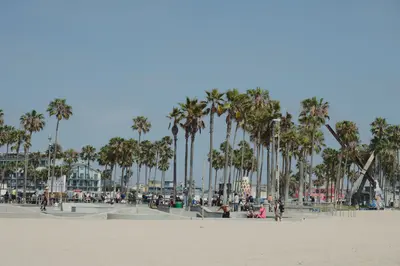
    Venice was Abbot Kinney's dream: in 1905, the entrepreneur established a seaside resort here called "Venice of America," complete with canals, a pier, and Venetian architecture. In 1926, the previously independent city became part of Los Angeles, and many canals were later filled in. What remains is a district with a leaning towards counterculture: due to low rents, artists and Beat poets moved here, and The Doors formed in 1965.The Venice Beach Boardwalk, approximately three kilometers long, is always bustling: street artists, souvenir stands, skaters, and cyclists on the beach bike path. At the outdoor gym Muscle Beach Venice, bodybuilders lift weights for an audience, and right next to it is the 2009 skate park with bowls reminiscent of empty swimming pools. In addition, there are the graffiti walls of the Venice Art Walls.A few blocks inland, it gets quieter. In the Venice Canal Historic District, listed on the National Register of Historic Places since 1982, you can stroll along the preserved canals from 1905. The Abbot Kinney Boulevard, a street over 1.5 kilometers long with boutiques, galleries, and restaurants, is Venice's shopping and entertainment district.The Boardwalk is liveliest on weekend afternoons. For the canals, early morning or late afternoon light are best, and in the evening, you'll find the best spots at a restaurant on Abbot Kinney.
    Beverly Hills and West Hollywood

    Beverly Hills and West Hollywood

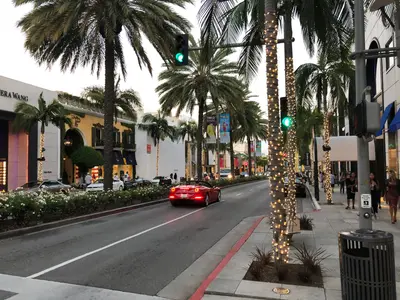
    Two distinct cities within the Los Angeles urban area, two distinct personalities: Beverly Hills stands for villas, palm-lined avenues, and luxury boutiques, while West Hollywood, founded only in 1984, is synonymous with rock history, comedy, and nightlife.The most famous section of Rodeo Drive comprises approximately three blocks between Wilshire Boulevard and Little Santa Monica Boulevard. The Beverly Wilshire hotel stands at the corner of Wilshire Boulevard. At the intersection with Dayton Way, the “Torso” sculpture marks the Rodeo Drive Walk of Style, where commemorative plaques honor fashion icons. This is where the scene in “Pretty Woman” (1990) takes place, where Julia Roberts is complimented out of a boutique. Worth a detour is Greystone Mansion, a 1928 Tudor estate, now a city park and a backdrop for films like “There Will Be Blood” and “The Big Lebowski.” For a photo with the iconic lettering, head to the Beverly Hills Sign in Beverly Gardens Park.The Sunset Strip, approximately 2.7 kilometers of Sunset Boulevard in West Hollywood, was the stage for rock in the 1960s. At the Whisky a Go Go, opened in 1964, The Doors played as the house band, and The Comedy Store has been around since 1972. Huge billboards still line the street today.Beverly Hills is best explored on foot during the day, while the Strip comes alive from late evening, when concerts and comedy shows begin.
    Hollywood

    Hollywood

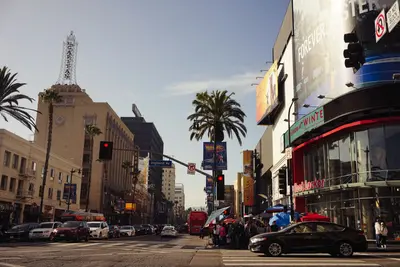
    Hollywood is less about glamour and more of a pilgrimage site: On Hollywood Boulevard, visitors jostle over the Walk of Fame stars, costumed characters pose for tips, amidst souvenir shops and old movie palaces. Film history lies in the details, such as the hand and footprints in front of the TCL Chinese Theatre or in bars where Frank Sinatra and Charles Bukowski once sat.The Walk of Fame spans 15 blocks of Hollywood Boulevard and three blocks of Vine Street. The first permanent stars were laid in 1960; there are now around 2,850. The Chinese Theatre opened in 1927 and is currently an IMAX cinema. Right next door is the Ovation Hollywood complex, home to the Dolby Theatre, where the Oscars have been presented since 2002. From 2029, the gala will move to the Peacock Theater in Downtown.The Hollywood Sign has stood on Mount Lee since 1923, originally an advertisement for the "Hollywoodland" settlement. You cannot get close to the letters; the steep terrain is cordoned off and monitored. Two viewpoints are officially recommended: the terraces of Ovation Hollywood and the Griffith Observatory in neighboring Griffith Park, reachable by bus or car in under half an hour.It's best to come in the morning before the boulevard fills, and return in the evening for a drink at the Frolic Room or a steak at Musso & Frank. Then the neon signs glow, and the day visitors have disappeared.
    Griffith Park and Los Feliz

    Griffith Park and Los Feliz

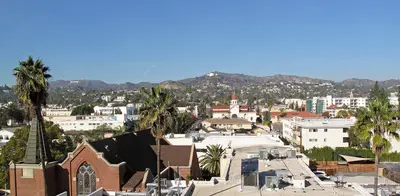
    Griffith Park is a piece of wild mountainous landscape right in the city: dry slopes, hiking trails, viewpoints over the Los Angeles basin. Griffith J. Griffith gifted its original land to the city in 1896; today, the park spans about 1,740 hectares.The main attraction is the Griffith Observatory on the southern slope of Mount Hollywood, opened in 1935. Admission is free, over nine million people have already looked through the Zeiss telescope on the roof, and on clear evenings, you can look through it for free. From the parking lot, you can see the Hollywood Sign, and from its far end, hiking trails lead up Mount Hollywood to further viewpoints. The observatory appears twice in the film "Rebel Without a Cause" (1955).Scattered throughout the park you'll also find the Los Angeles Zoo, the Greek Theatre (dating from 1930), the Bronson Caves, which served as the Batcave in the 1960s Batman series, and the shady valley of Fern Dell. To the south is Los Feliz, a hillside neighborhood with villas in the hills and Los Feliz Village around Vermont and Hillhurst Avenue, featuring cafés, restaurants, and vintage shops. On Olive Hill stands Frank Lloyd Wright's Hollyhock House, the first UNESCO World Heritage Site in Los Angeles since 2019.For hiking, it's best to go early in the morning. The observatory is worth visiting in the evening: it's open until 10 PM, and the sea of city lights is most beautiful after sunset.