ExploreTravel GuidesPlan a trip
    de|en
    All Places & RegionsAbout FernwehFAQPrivacy PolicyImprint
    ExploreTravel GuidesPlan a trip
    The Hambach Castle

    Germany

    The Hambach Castle

    Point of Interest

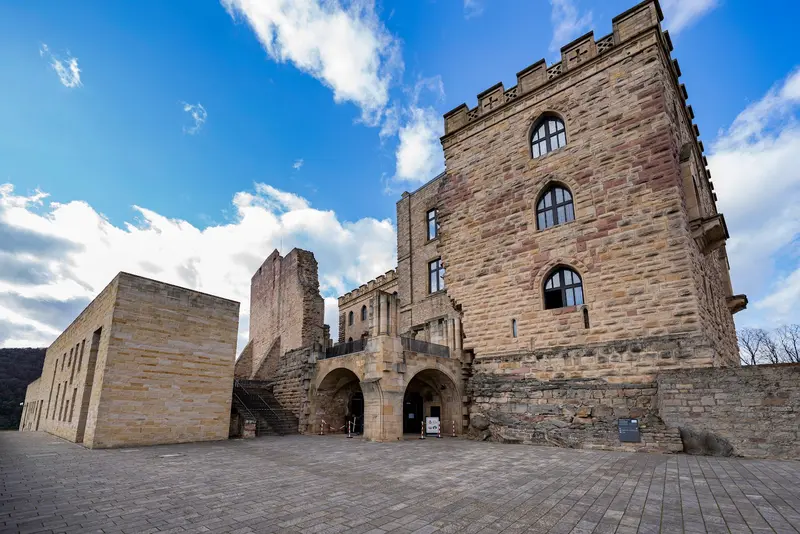
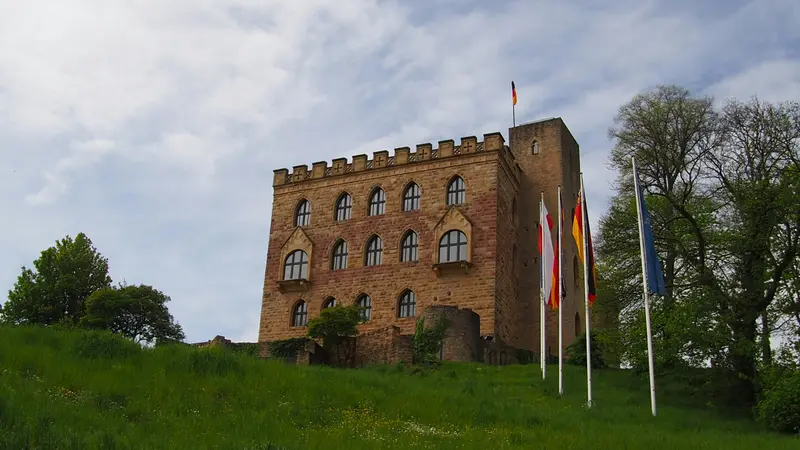
    Hambach Castle stands at an altitude of 376 meters on the Haardtrand, the eastern edge of the Palatinate Forest, in the Hambach district of Neustadt.

    1. Home
    2. Destinations
    3. Germany
    4. Pfalz & German Wine Route
    5. The Hambach Castle
    Hambach Castle stands at an altitude of 376 meters on the Haardtrand, the eastern edge of the Palatinate Forest, in the Hambach district of Neustadt. From May 27 to June 1, 1832, approximately 25,000 people gathered here for the Hambach Festival, a six-day "National Festival of the Germans."The permanent exhibition "Up, Up to the Castle" on the fifth floor, since 2008, tells the story of the events of 1832, their background, and consequences. Around 200,000 people visit the castle annually; it also features a restaurant with over 100 seats.

    Sights in The Hambach Castle

    Discover the most important sights and attractions

    Hambacher Castle
    Museum

    1Hambacher Castle

    The setting for the Hambach Festival, attended by some 25,000 people from May 27 to June 1, 1832. The permanent exhibition 'Hinauf, hinauf zum Schloss' tells the story.
    Open in Google Maps

    Restaurants in The Hambach Castle

    Accommodations in The Hambach Castle

    Find perfect stay in The Hambach Castle

    Booking.com* (Affiliate link)
    Search Hotels
    Agoda* (Affiliate link)
    Search Hotels
    Airbnb
    Vacation Rentals

    * Affiliate link: if you book through it, we earn a small commission. The price stays the same for you.

    Campgrounds in The Hambach Castle

    Find perfect campground in The Hambach Castle
    Search via Google Maps
    Campgrounds nearby (15km)
    Camping.info
    Find Campgrounds
    Park4Night
    RV Parks & Camping

    Nearby

    Pfalz & German Wine Route

    Pfalz & German Wine Route

    The Palatinate in the south of Rhineland-Palatinate is Germany's second-largest wine region. Running through its heart since 1935 is the approximately 85-kilometer-long German Wine Route, stretching from the German Wine Gate in Schweigen on the French border to Bockenheim, always alongside the Haardtrand, the eastern edge of the Palatinate Forest.On your journey, you'll combine wine villages with rich history: By the Rhine, in Speyer, stands the Romanesque Imperial Cathedral, a UNESCO World Heritage site since 1981; above Neustadt an der Weinstraße, Hambach Castle towers, the site of the Hambach Festival of 1832; and in Bad Dürkheim awaits the Giant Cask from 1934.
    Bad Dürkheim

    Bad Dürkheim

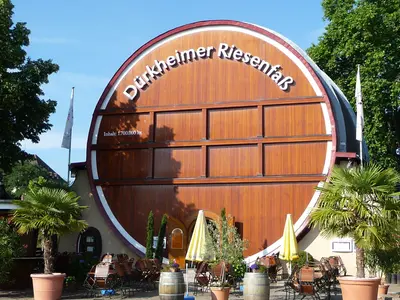
    In Bad Dürkheim, the German Wine Route was officially opened with a ceremony on October 19, 1935. Its most famous landmark is the Dürkheimer Riesenfass, which cooper master and winery owner Fritz Keller had built in 1934: 13.5 meters in diameter and with a capacity of around 1.7 million liters.However, wine is not stored in it; the cask is a restaurant in the style of a wine tavern with space for around 430 guests. The cask itself is open mainly during the Dürkheimer Wurstmarkt, while the attached "Bütt" serves guests year-round.
    Speyer

    Speyer

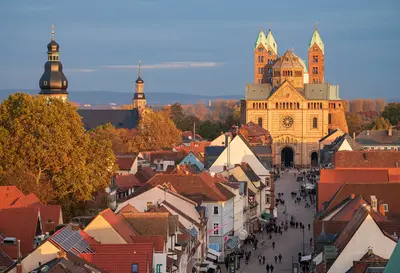
    Speyer is located on the Rhine, which here forms the border between Rhineland-Palatinate and Baden-Württemberg, just under 20 kilometers south of Mannheim. The city, with around 51,000 inhabitants, boasts two UNESCO World Heritage Sites: the Imperial Cathedral (Kaiserdom), consecrated in 1061, the largest preserved Romanesque church after the destruction of Cluny, and the Jewish Courtyard (Judenhof) with its synagogue ruins and Germany's oldest completely preserved mikveh.From Cathedral Square, Maximilianstraße, a pedestrian zone, leads to the 55-meter-high Altpörtel, the city's former western gate. Additionally, you'll find the Historical Museum of the Palatinate with its cathedral treasury, and the Technik Museum, where you can see, among other things, a Boeing 747 and the Buran prototype OK-GLI.
    Heidelberg

    Heidelberg

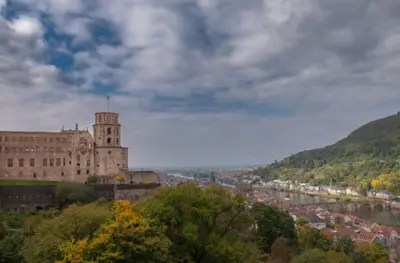
    Heidelberg is situated on the Neckar, precisely where the river exits the Odenwald and flows into the Upper Rhine Plain. The Old Town stretches narrowly between the river and the 568-meter-high Königstuhl, topped by the famous castle ruin, which French troops set ablaze in 1689 and blew up in 1693.Founded in 1386, Ruprecht-Karls-Universität is Germany's oldest university and continues to shape the city today. You can stroll along the approximately 1.6-kilometer-long Hauptstraße, one of Europe's longest pedestrian zones, cross the Alte Brücke, and look back at the castle and Old Town from the Philosophenweg on the opposite side of the Neckar.
    Baden-Baden

    Baden-Baden

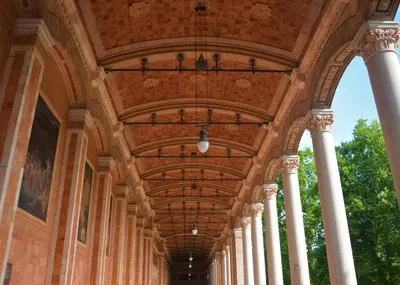
    Baden-Baden liegt am Westrand des Nordschwarzwalds im Tal der Oos und zählt seit Juli 2021 als eine der elf "Great Spa Towns of Europe" zum UNESCO-Welterbe. Schon die Römer badeten am Florentinerberg, wo heute das Friedrichsbad steht, und im 19. Jahrhundert wurde die Stadt zu einem der bekanntesten Kurorte Europas.Herz der Stadt ist das klassizistische Kurhaus von Friedrich Weinbrenner mit seiner Spielbank, dahinter beginnt die Lichtentaler Allee entlang der Oos. Für den Blick von oben fährt die Merkurbergbahn seit 1913 auf den 669 Meter hohen Merkur.