Fernweh: Home
    ExploreTravel GuidesPlan a tripMy tripLast visited
    de|en
    All Places & RegionsAll highlightsAbout FernwehFAQPrivacy PolicyImprint
    ExploreTravel GuidesPlan a tripMy tripLast visited
    • Places in the region
    • Nearby
    Midlands & Shannon
    Joseph Mischyshyn / Wikimedia Commons / CC BY-SA 2.0

    Ireland

    Midlands & Shannon

    Region

    The Midlands are Ireland's tranquil interior, featuring bogs, lakes, and the Shannon, the country's longest river.

    by Felix Gillen

    1. Home
    2. Destinations
    3. Ireland
    4. Midlands & Shannon
    The Midlands are Ireland's tranquil interior, featuring bogs, lakes, and the Shannon, the country's longest river. From a tourism perspective, they are overshadowed by the coasts, but they lie on the route from Dublin to Galway and are worth a stopover.The most important destination is the monastic city of Clonmacnoise on the banks of the Shannon south of Athlone, one of Ireland's most significant early Christian sites.

    More places in Midlands & Shannon
    Clonmacnoise

    Clonmacnoise

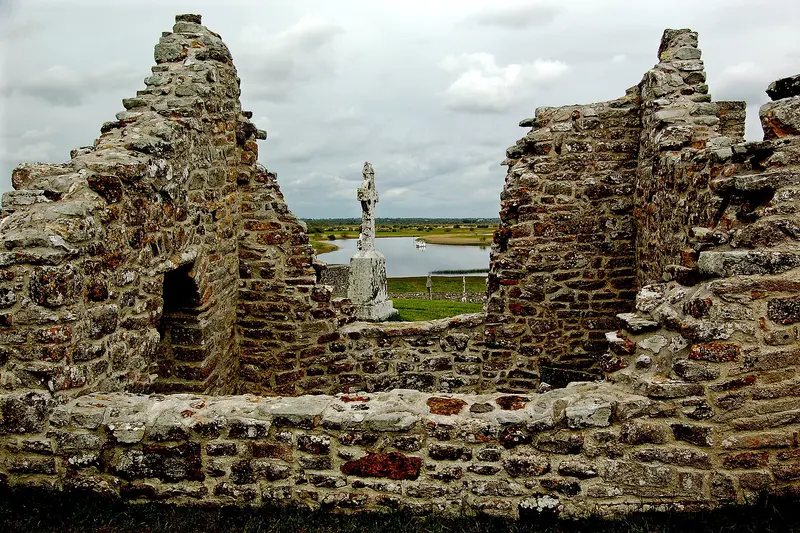
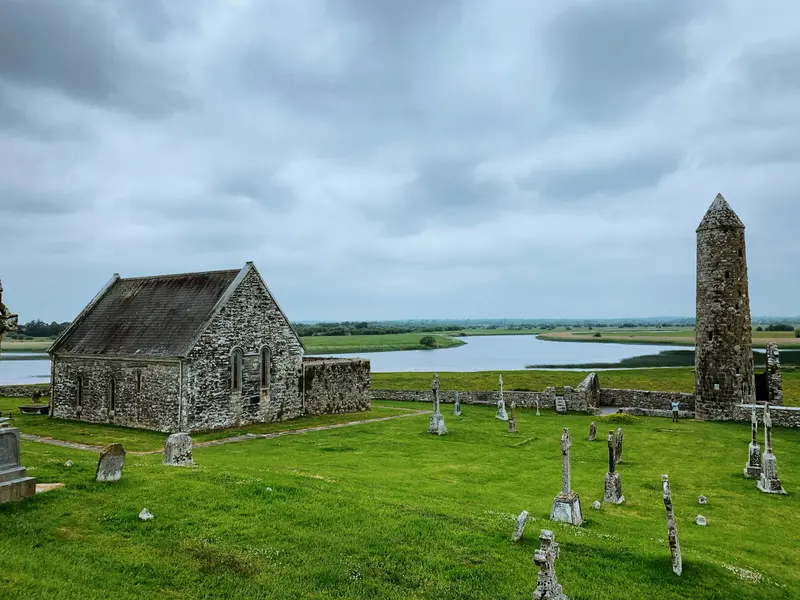
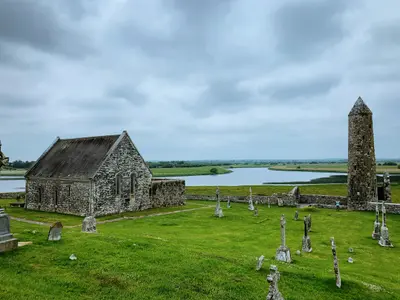
    Clonmacnoise on the banks of the Shannon in County Offaly is one of Ireland's most important early Christian monastic sites, founded by Saint Ciarán in 544. Remaining are the ruins of a cathedral, several churches, two round towers, and three high crosses.The original, approximately four-meter-high Cross of the Scriptures from around 900, is now protected in the visitor centre, with a copy outdoors. The site is managed by the Office of Public Works and is located south of Athlone, approximately halfway between Dublin and Galway.
    Nearby

    Clonmacnoise

    Clonmacnoise

    Clonmacnoise on the banks of the Shannon in County Offaly is one of Ireland's most important early Christian monastic sites, founded by Saint Ciarán in 544. Remaining are the ruins of a cathedral, several churches, two round towers, and three high crosses.The original, approximately four-meter-high Cross of the Scriptures from around 900, is now protected in the visitor centre, with a copy outdoors. The site is managed by the Office of Public Works and is located south of Athlone, approximately halfway between Dublin and Galway.
    Galway

    Galway

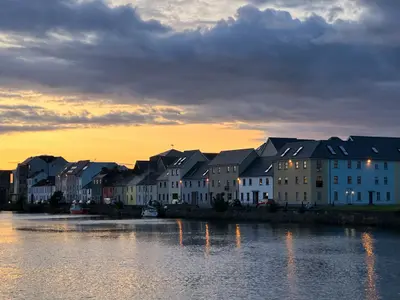
    With around 86,000 inhabitants, Galway is the largest city on the west coast and was European Capital of Culture in 2020. Life revolves around the Latin Quarter near Quay Street, with pubs, street music, and small shops; on the riverbank stands the Spanish Arch, a remnant of the medieval city wall, right next to it the Galway City Museum.Eyre Square marks the center of the new town, and to the west, the Salthill promenade stretches about two kilometers along Galway Bay. The city is a starting point for Connemara and the Aran Islands, with year-round ferries departing from Rossaveal, located about 37 kilometers away.

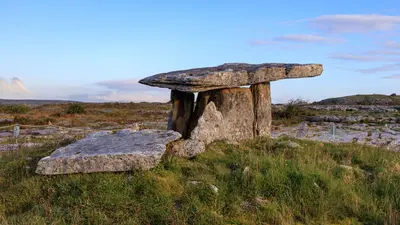
    The Burren in the north of County Clare is a karst landscape of grey limestone pavements, where rare plants bloom in spring between the fissures. Together with the Cliffs of Moher, it has formed a UNESCO Global Geopark since 2011; the Burren National Park, founded in 1991, covers approximately 1,500 hectares.The most famous monument is the Poulnabrone Dolmen, a portal tomb from the Neolithic period, where archaeologists found the remains of over 30 people. The coastal village of Doolin is known for traditional music in its pubs and as a port for seasonal ferries to the Aran Islands.
    Kilkenny

    Kilkenny

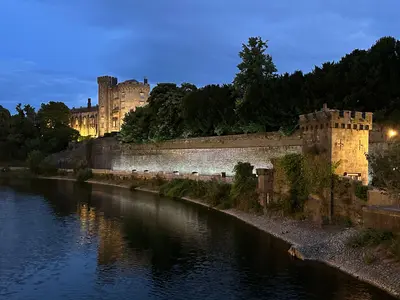
    Kilkenny in southeast Ireland is a city with approximately 27,000 inhabitants and one of the best-preserved medieval cityscapes in the country. It lies on both banks of the River Nore; it owes its nickname "Marble City" to the dark limestone of the area, and from 1642 to 1649, the Confederation of Kilkenny met here.The Medieval Mile connects Kilkenny Castle, a 13th-century castle with Victorian alterations and a freely accessible park, with St Canice's Cathedral (1202–1285), whose approximately 30-meter-high 9th-century round tower you can climb. Along the way are the Medieval Mile Museum, Rothe House, the merchant's house, the Black Abbey, and the Smithwick's Experience, dedicated to the city's brewing tradition.
    Rock of Cashel

    Rock of Cashel

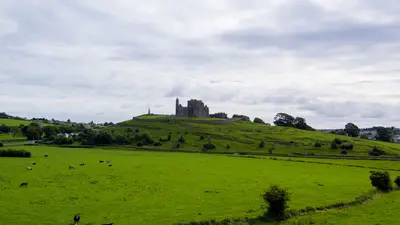
    The Rock of Cashel is a limestone outcrop in County Tipperary, where the Kings of Munster resided before handing it over to the church in 1101. Today, it hosts Ireland's most extensive collection of medieval buildings: a 12th-century round tower, the 13th-century Gothic cathedral, a tower house, the Hall of the Vicars Choral, and the Romanesque Cormac's Chapel, consecrated in 1134.The chapel houses Ireland's only surviving Romanesque frescoes and is only accessible via a short guided tour, for which an additional fee applies and tickets are sold in limited numbers on-site. In stormy weather, the complex may close at short notice. The ruins of Hore Abbey can be reached on foot in about ten minutes.

    Sources & method

    • Photos: Wikimedia Commons. Each photo carries its credit.
    • The content is based on web research from public, traceable sources. How the content is made · The role of AI