Fernweh: Home
ExploreGuideDestinationsMy tripsMy trip
de|en
All Places & RegionsRound tripsNight trains in EuropeAll highlightsAbout FernwehFAQPrivacy PolicyImprint
Download on the App StoreGet it on Google Play
ExploreGuideDestinationsMy tripsMy trip
    • Overview
    • Places in the region
    • Culture
    • Getting around
    • Nearby
    High Coast

    Pudelek / Wikimedia Commons / CC BY-SA 4.0, mod.

    Sweden

    High Coast

    RegionNatureUNESCO

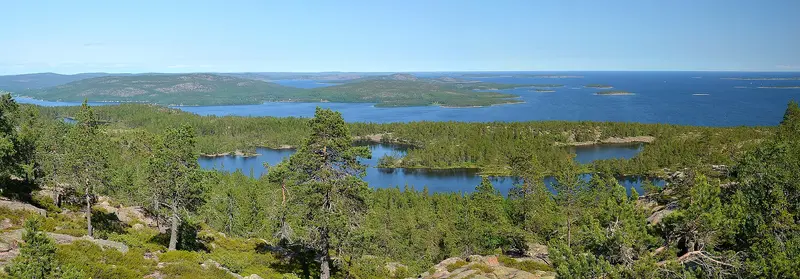
    Höga Kusten, the High Coast, is located on the Bothnian Bay in northern Sweden, between Härnösand and Örnsköldsvik.

    by Felix Gillen

    1. Home
    2. Destinations
    3. Sweden
    4. High Coast
    Höga Kusten, the High Coast, is located on the Bothnian Bay in northern Sweden, between Härnösand and Örnsköldsvik. Since 2000, it has been a UNESCO World Heritage site because the land here has risen exceptionally strongly since the last Ice Age.Land uplift still measures about 8 to 9 millimeters annually. The highest scientifically documented coastline lies at Skuleberget, 286 meters above current sea level. Together with Finland's Kvarken Archipelago, the region forms a transboundary World Heritage site. Off the coast, the Bothnian Sea reaches its greatest depth at 293 meters.Hikers come for Skuleskogen National Park and the approximately 135-kilometer-long Höga Kustenleden, while the curious come for the Surströmming from the archipelago island of Ulvön. The Högakustenbron bridge, with a total height of 182 meters, spans the Ångermanälven river.
    Sweden travel guideRound trips in SwedenPlan a trip with High Coast

    Contents

    • Overview
    • Places in the region
    • Culture
    • Getting around
    • Nearby
    Höga Kusten lies along the E4 between Härnösand in the south and Örnsköldsvik in the north, with Kramfors acting as the rail and airport hub in between. Key attractions include Skuleberget, Skuleskogen National Park, and the archipelago islands of Ulvön, Trysunda, and Grisslan. The best way to explore the region is by car or on foot along the Höga Kustenleden. In winter, Skuleberget is ideal for cross-country skiing and snowshoeing.

    Sights in High Coast

    Discover the most important sights and attractions

    Park

    Skuleberget

    On the 294-meter-high mountain by the E4, at 286 meters, lies the region's highest ancient coastline, a world record in land uplift according to Höga Kusten Turism. A cable car goes to the summit, where lunch with local products is served; it stops during thunderstorms or storms. The mountain is popular with climbers, and in winter with cross-country skiers and snowshoe hikers.
    Open in Google Maps
    National Park

    Skuleskogen National Park

    Many marked hiking trails lead through forest and over rocks in the High Coast National Park. Highlights include the Slåttdalsskrevan rock crevice and the view from the summit of Slåttdalsberget. The Höga Kustenleden also runs through the park; this entry marks the northern entrance near Näske.
    Open in Google Maps
    Historic Landmark

    Slåttdalsskrevan

    The 40-meter-high rock cleft lies in Skuleskogen National Park. Since summer 2023, a new section of the Höga Kustenleden passes the cleft, offering views from above and below. Hiking through the cleft is no longer permitted for safety reasons.
    Open in Google Maps
    Park

    Trysunda

    Trysunda, along with Ulvön and Grisslan, is one of the three well-known archipelago islands of The High Coast. The island is protected as a nature reserve.
    Open in Google Maps
    Point of Interest

    Naturum Höga Kusten

    The World Heritage Visitor Centre is located at the foot of Skuleberget near Docksta. Here you can learn about land uplift, hiking trails, and Skuleskogen National Park before you set off.
    Open in Google Maps

    Ulvön

    The islands of Norra and Södra Ulvön, with the former fishing village of Ulvöhamn, are considered a jewel of the Bothnian Sea. Surströmming, fermented herring, has been produced here since the 1880s, with its season traditionally starting on the third Thursday in August.
    Open in Google Maps

    Culture & Nature

    A Land Rising from the SeaAfter the last Ice Age, the land at Höga Kusten rose by hundreds of meters, and it continues to rise by approximately 8 millimeters per year. At Skuleberget, the ancient coastline is now 286 meters above sea level. This is why the region became a UNESCO World Heritage site in 2000, together with the Finnish Kvarken Archipelago.Surströmming from UlvönOn Ulvön, Surströmming, fermented Baltic Sea herring, has been produced since the 1880s. Traditionally, the Surströmming season begins on the third Thursday in August.

    Getting there & around

    By TrainSJ and Norrtåg trains run to Kramfors, Härnösand, and Örnsköldsvik. From Stockholm, the journey takes five to six hours during the day, or about seven hours by night train.By PlaneFrom Stockholm Arlanda, you can fly to Kramfors (Höga Kusten Airport), Örnsköldsvik, Sundsvall-Timrå, or Umeå in about an hour.Getting AroundBy car, follow the E4 and cross the Högakustenbron. According to Höga Kusten Turism, the Höga Kustenleden is about 135 kilometres long and divided into nine stages; allow seven to nine days for the entire route.

    Nearby

    Östersund

    Östersund

    Östersund is the city of Jämtland, located on the shore of Lake Storsjön in northern Sweden. Since 2010, it has been a UNESCO Creative City of Gastronomy, and with the Jamtli Museum and Frösön island, it has culture and nature right on its doorstep.Gustav III. founded the city in 1786. On Frösön, near the Frösö Bridge, stands Sweden's northernmost runestone, as well as a church overlooking the lake and fells, and Sommarhagen, the summer residence of composer Peterson-Berger.In winter, Lake Storsjön, Sweden's fifth-largest lake, becomes a 20-kilometer-long ice rink, and approximately 89 kilometers of cross-country ski trails lead through the city.

    Hult·CC BY-SA 4.0

    Jämtland

    Jämtland

    Jämtland is the fells and lake region around the Storsjön in Northern Sweden. You travel here for Åre, Sweden's largest ski resort, and for Östersund, which has been a UNESCO Creative City of Gastronomy since 2010.In winter, slopes, cross-country trails and a 20-kilometer ice rink on the Storsjön, Sweden's fifth-largest lake, await. In summer, hikers, mountain bikers, and Tännforsen waterfall visitors come. You can reach Östersund and Åre by overnight trains from Stockholm and Gothenburg.

    Lmylmy·CC0

    Åre

    Åre

    Åre is a mountain resort in Jämtland at the foot of Åreskutan and Sweden's largest ski area. In winter, you come for 91 slopes and over 100 kilometers of cross-country trails; in summer, for the bike park, hiking trails, and the Tännforsen waterfall.The ski area comprises the sub-areas Åre by, Åre Björnen, and Duved/Tegefjäll, with 46 lifts and, according to operator Skistar, Sweden's largest vertical drop of 890 meters. In March, Åre regularly hosts the Alpine Ski World Cup.From the marketplace, the Åre Bergbana funicular railway has been ascending the slope since 1910. At the very top of Åreskutan, at 1,420 meters, lies the Toppstugan, according to Visit Sweden Sweden's highest café.

    Andreas Eriksson·public domain

    Rauma

    Rauma

    The coastal town on the west coast, around 90 kilometers north of Turku, boasts Vanha Rauma, the largest continuously preserved wooden town in the Nordic countries, UNESCO World Heritage site since 1991. You come for its over 600 wooden houses along medieval alleys, its bobbin lace tradition, and the islands off the coast.The old town is not a museum: around 800 people live here among shops, cafés, and workshops. 20 kilometers inland is Sammallahdenmäki, a second World Heritage site of Bronze Age burial mounds.

    Lauren Stevens·CC BY-SA 4.0

    Rättvik

    Rättvik

    Rättvik is located on the eastern shore of Lake Siljan in Dalarna, blending nature with cherished tradition. At 628 meters, the Långbryggan is the world's longest inland lake pier and was built in 1895 as a landing stage for steamships. The medieval Rättvik Church with its historic church stables is a landmark of the town. About eight kilometers north lies Dalhalla, an open-air arena in a former limestone quarry with space for around 6,000 visitors. In summer, the Classic Car Week (always in calendar week 31) and the Musik vid Siljan festival (calendar week 27) take place, and the Midsummer celebrations are also considered particularly beautiful.

    Unsplash

    Your next steps

    High Coast is in Sweden. Ways to carry on from here.

    • More in Sweden

      Highlights, areas, routes and the best time to travel for all of Sweden.

      Sweden travel guide
    • Round trips in Sweden

      Ready-made routes through Sweden, with stops, nights and a map.

      See the routes
    • Plan a trip with High Coast

      The Guide asks about season, length and who is coming, and suggests a trip with High Coast.

      Plan the trip

    Sources & method

    • Photos: Wikimedia Commons. Each photo carries its credit.
    • Place data such as addresses and ratings comes from Google Maps.
    • The content is based on web research from public, traceable sources. How the content is made · The role of AI