Photo: Unsplash
Indonesia
Raja Ampat (Southwest Papua)
Region
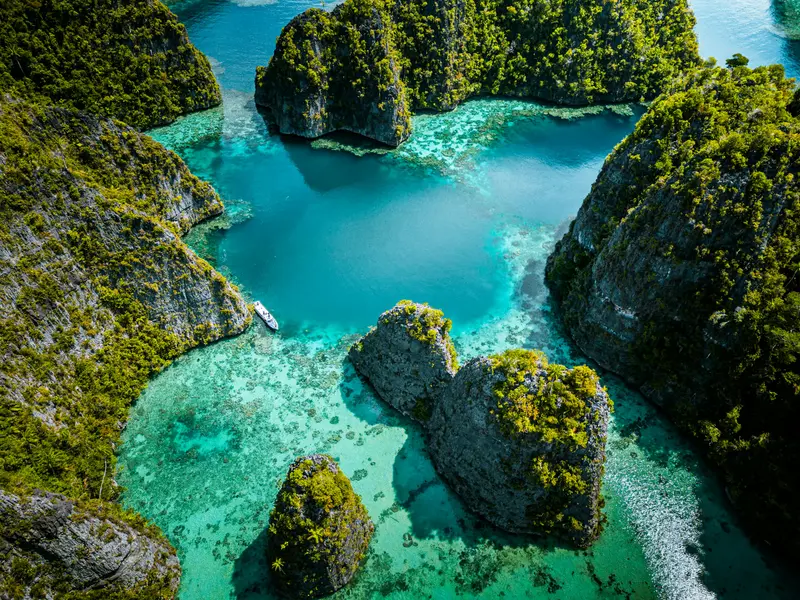
Raja Ampat, off the western tip of New Guinea, consists of around 1,500 islands, reefs and sandbanks. It lies in the Coral Triangle and is considered one of the most biodiverse marine areas on earth.
by Felix Gillen
Raja Ampat, off the western tip of New Guinea, consists of around 1,500 islands, reefs and sandbanks. It lies in the Coral Triangle and is considered one of the most biodiverse marine areas on earth.Raja Ampat and Sorong belong to the province of Southwest Papua (Papua Barat Daya), one of six provinces into which Papua has been reorganised. The UK FCDO describes the security situation in Highland Papua and Central Papua as unpredictable. Check the current FCDO travel advice for Indonesia (gov.uk/foreign-travel-advice/indonesia) before you travel.
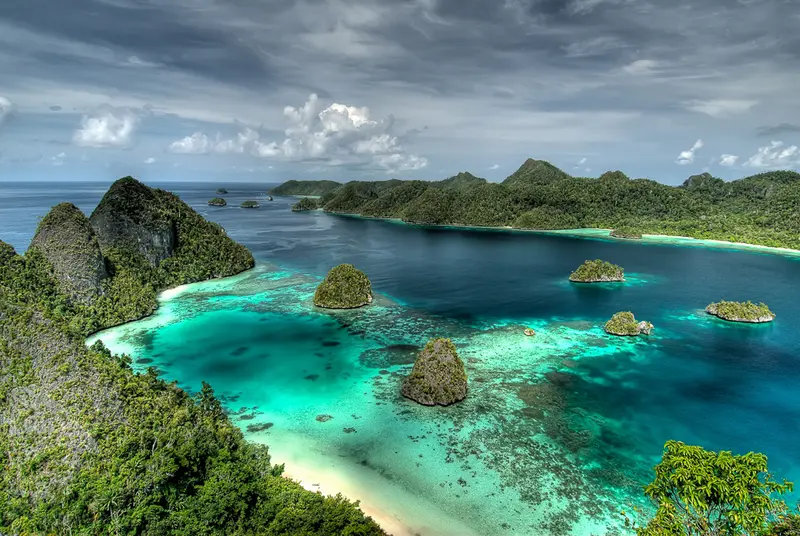
The four main islands are Waigeo, Batanta, Salawati, and Misool. The starting point is the city of Sorong on the mainland; from there, the ferry goes to Waisai on Waigeo. Most travelers stay in simple homestays run by village communities on islands like Kri, Gam, and Arborek, in dive resorts, or on liveaboard boats. Well-known destinations include the karst islands of Piaynemo and Wayag in the north, and the lagoons of Misool in the south. For your visit, you pay entrance and environmental fees, totaling around 1.7 million IDR for foreign guests since January 2026; children under 12 are exempt. Due to the distances and boat costs, plan for sufficient time and budget.
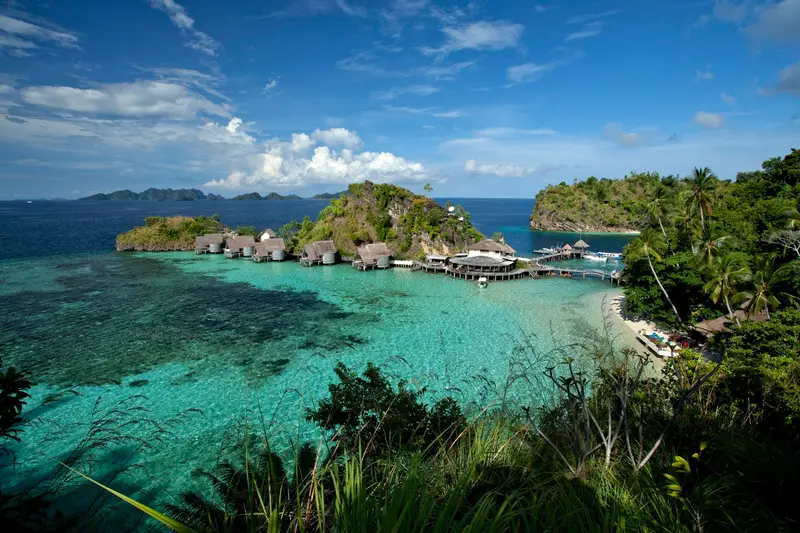
Photo by Jeffry Surianto on Pexels
Lord Mountbatten / Wikimedia Commons / CC BY-SA 4.0, mod.
Bird's Head Seascape / Jones/Shimlock / Secret Sea Visions / Wikimedia Commons / CC BY-SA 4.0, mod.
The Food and Drink
Papeda
Sticky sago porridge, eaten with fish in yellow broth, the staple food in Papua.
Ikan Bakar
Freshly caught grilled fish, almost daily served in the homestays.
Best Time to Visit
When is the best time for your trip?
27–28°C·152–276 mm(heavy rain)
From October to April, Raja Ampat's sea is usually calmer, ideal for diving and boat tours. From May to September, the Southeast Monsoon brings more rain and waves, and some liveaboards then operate elsewhere.
The monthly values are for Sorong (climate normal values 1991 to 2020, published by the Japanese Meteorological Agency JMA). Most rain falls there in July with 448 mm, the least in January with 152 mm. Rain falls throughout the year; crucial for travel is the sea state.
Seasons
Jan
Feb
Mar
Apr
May
Jun
Jul
Aug
Sep
Oct
Nov
Dec
Quieter Sea, Peak Season
Southeast Monsoon with more rain and swell
Best Time to Visit
▶Show detailed monthly data
| Month | Temp (°C) | Rain (mm) |
|---|---|---|
| January | 27.4 | 152 |
| February | 27.6 | 154 |
| March | 27.5 | 227 |
| April | 27.3 | 276 |
| May | 27.4 | 335 |
| June | 26.7 | 370 |
| July | 26.2 | 448 |
| August | 26.1 | 315 |
| September | 26.6 | 304 |
| October | 27.2 | 215 |
| November | 27.3 | 205 |
| December | 27.3 | 194 |
Spirit
HistoryRaja Ampat means 'Four Kings'. According to legend, a woman found seven eggs, from some of which kings hatched and ruled the islands. In the 16th and 17th centuries, the Sultanate of Tidore in the Moluccas had close economic and political ties to the islands, which were considered part of the Sultanate. Later, the Netherlands claimed the territory. In 1969, during the so-called Act of Free Choice, 1,025 representatives selected by the military voted for West New Guinea's integration into Indonesia. The process remains internationally disputed to this day.Religion and BeliefsThe inhabitants are predominantly Papuan. Around two-thirds are Protestants, just under one-third are Muslims, a significantly higher proportion than in other parts of Papua. Islam gained a foothold, especially on Misool, as early as the 16th and 17th centuries.Society and CustomsMany inhabitants live in small fishing villages. Many villages operate their own homestays and have established conservation zones where fishing is prohibited. Traditionally, fishing grounds are temporarily closed off through the Sasi system: Elders mark a reef or bay, often with a carved wooden pole, and for months, no fish, lobsters, sea cucumbers, or shells may be harvested from there. To reopen it, someone blows a triton shell horn. In many villages, village elders and the church jointly lead the ceremony.Visitor ConductFor your visit, you need to pay entrance and environmental fees, whose revenues finance conservation projects and local communities. Some places are subject to unwritten rules of customary law; follow your guide's instructions. A Sasi ceremony is not a show; inquire if your presence is appropriate. In the villages, outside the water, do not wear swimwear, but at least a T-shirt and shorts that are not too short, and ask before taking photos.
Getting There and Around
Getting ThereBy Air: Domine Eduard Osok Airport in Sorong has connections to Jakarta, Makassar, and Manado. From the airport to the ferry port, it's 10 to 20 minutes by taxi.Ferry Sorong–Waisai: The Express Bahari fast ferry travels daily to Waisai on Waigeo in about two hours. According to the schedule from January 2026, it departs from November to March at 9 AM and 2 PM, and from April to October only at 2 PM. A trip costs approximately 137,000 IDR (Economy) or 262,000 IDR (VIP). The operator adjusts times at short notice, so check locally.Misool: Fewer ferries run to Misool directly from Sorong.Fees (As of Autumn 2026)Raja Ampat Entry: Foreign visitors pay a one-time fee of 1,000,000 IDR per person, regardless of stay duration. The easiest way is to pay in advance via the official online registration system and show proof with your passport at Waisai port, where a counter is also available.Marine Conservation Fee: In addition, there is a separate charge from the provincial Marine Protected Area management, the amount of which changed in August 2026. Have your accommodation or tour operator confirm the current amount in writing.Getting AroundBetween the islands, you rely on boats, which homestays and resorts organize.
Nearby


Your next steps
Raja Ampat (Southwest Papua) is in Indonesia. Ways to carry on from here.
More in Indonesia
Highlights, areas, routes and the best time to travel for all of Indonesia.
Indonesia travel guideRound trips in Indonesia
Ready-made routes through Indonesia, with stops, nights and a map.
See the routesPlan a trip with Raja Ampat (Southwest Papua)
The Guide asks about season, length and who is coming, and suggests a trip with Raja Ampat (Southwest Papua).
Plan the trip