Fernweh: Home
    ExploreTravel GuidesPlan a tripMy tripLast visited
    de|en
    All Places & RegionsAll highlightsAbout FernwehFAQPrivacy PolicyImprint
    ExploreTravel GuidesPlan a tripMy tripLast visited
    Salento Peninsula

    Italy

    Salento Peninsula

    Point of Interest

    Salento is the southernmost part of Apulia, the "heel" of the Italian boot between the Adriatic and Ionian Seas.

    by Felix Gillen

    1. Home
    2. Destinations
    3. Italy
    4. Apulien
    5. Salento Peninsula
    Salento is the southernmost part of Apulia, the "heel" of the Italian boot between the Adriatic and Ionian Seas. On the east coast, limestone cliffs with grottoes drop steeply into the sea, while on the west coast, near Porto Cesareo and Gallipoli, there are long sandy beaches with shallow water.Inland, olive groves, dry stone walls, and small towns with Baroque churches define the landscape. In the towns of Grecìa Salentina, such as Corigliano d'Otranto and Melpignano, a Greek dialect is still spoken today. Lecce is the cultural center; Otranto and Gallipoli are the best-known coastal towns.

    Points of interest

    Discover the most important sights and attractions

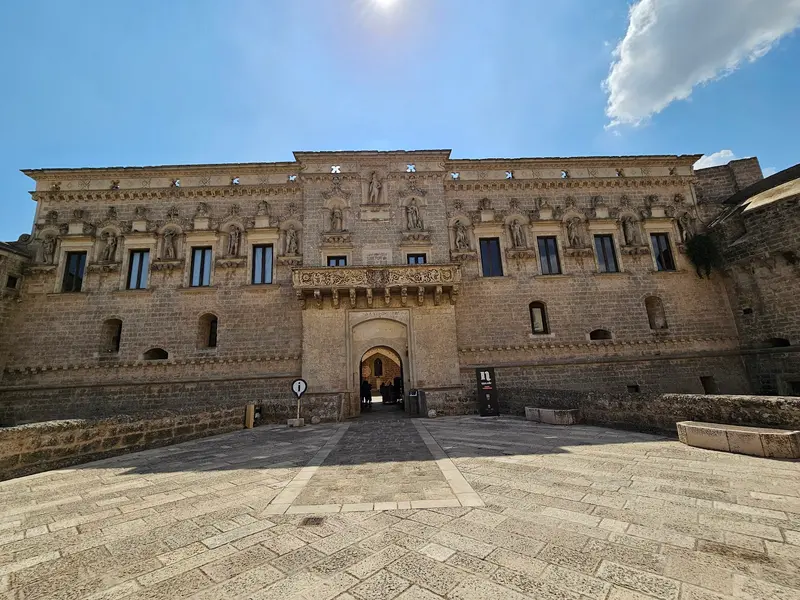
    Castello de' Monti, Corigliano d'Otranto

    1Castello de' Monti, Corigliano d'Otranto

    Castle in the center of Corigliano d'Otranto, one of the Greek-speaking towns of Grecìa Salentina. The core with three towers is medieval; in the 16th century, Giovan Battista de' Monti had it surrounded by a fortress and four additional towers. In the 17th century, the Baroque façade with allegorical statues in niches was added. Today, the castle hosts workshops and events.
    Open in Google Maps
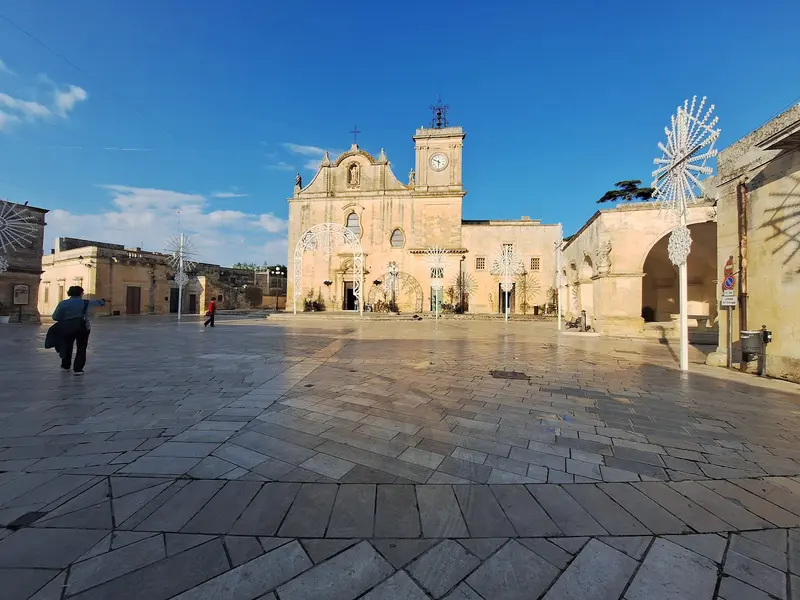
    Piazza San Giorgio, Melpignano

    2Piazza San Giorgio, Melpignano

    Melpignano's main square, flanked by Renaissance arcades with round arches, constructed from the late 16th century for a large weekly market, along with the Mother Church San Giorgio and the 1901 clock tower. Every August, this small town in Grecìa Salentina is the setting for the final concert of the Notte della Taranta, the Pizzica folk music festival, held on the square in front of the former Augustinian monastery.
    Open in Google Maps
    Grotta Zinzulusa
    Attraction

    3Grotta Zinzulusa

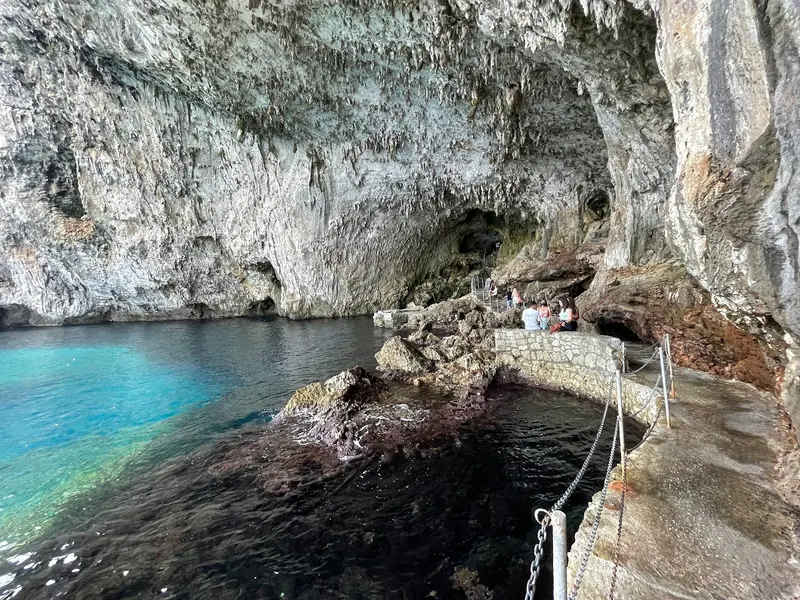
    A karst cave on the Adriatic coast between Castro and Santa Cesarea Terme. Its stalactites hang like threads from the ceiling. Only the first approx. 150 meters are accessible to visitors; the partly flooded remainder remains closed to protect its wildlife. The cave is visited with a guided tour; you can reach it on foot from Castro Marina or by boat from the small harbor. Current times can be found on the grotto's website.
    Open in Google Maps
    Grotta della Poesia
    Attraction

    4Grotta della Poesia

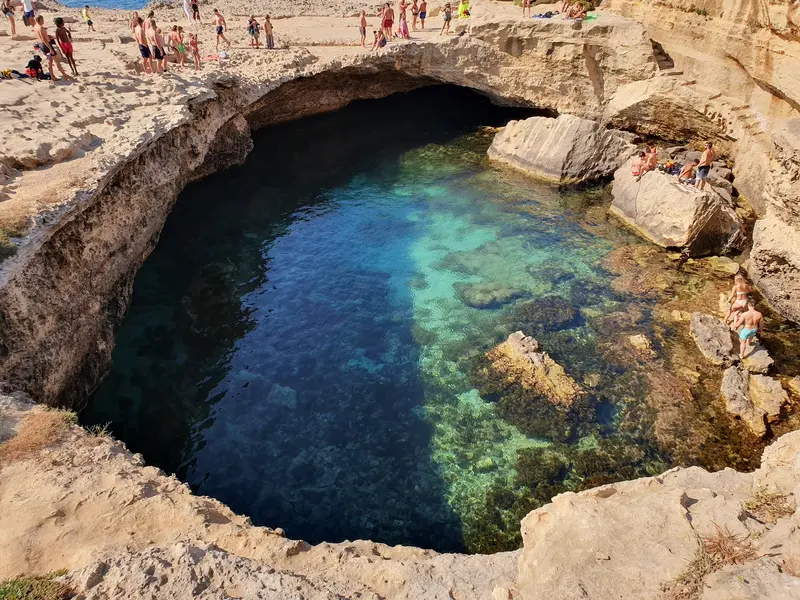
    Natural rock pool at Roca Vecchia on the Adriatic coast, linked to the sea via an underwater tunnel. Adjacent is the excavation site of the Bronze Age and Messapian settlement of Roca. From Summer 2026, a ticket is required for the site and grotto during the season. Swimming and jumping in the grotto are forbidden, even with a ticket; check current rules before your visit.
    Open in Google Maps

    Dining & Drinks

    1

    Ristorante da Umberto 1972

    Seafood restaurant on coastal road SP366 between San Foca and Torre dell'Orso on the Adriatic coast of Salento.
    Show on Google Maps

    Accommodations in Salento Peninsula

    Find perfect stay in Salento Peninsula

    Booking.com* (Affiliate link)
    Search Hotels
    Agoda* (Affiliate link)
    Search Hotels
    Airbnb
    Vacation Rentals

    * Affiliate link: if you book through it, we earn a small commission. The price stays the same for you.

    Campgrounds in Salento Peninsula

    Find perfect campground in Salento Peninsula

    Search via Google Maps
    Campgrounds nearby (15km)
    Camping.info
    Find Campgrounds
    Park4Night
    RV Parks & Camping

    Nearby

    Otranto

    Otranto

    Otranto is located on the Adriatic coast of Salento. Just south of the city, Punta Palascìa marks Italy's easternmost point, and is also the closest point to Albania.The old town, with its Norman Cathedral and Aragonese Castle, overlooks the harbor. North of the city lie the Laghi Alimini and the Baia dei Turchi.
    Lecce

    Lecce

    Lecce, Salento's provincial capital, has an old town shaped by baroque churches and palaces, built from the region's light, soft, dense limestone, the *pietra leccese*. Its easy workability fostered a unique, richly ornamented Baroque style here in the 17th century.Roman remains, including the Amphitheater on Piazza Sant'Oronzo and the Theater in the old town, lie beside the baroque facades. The city's territory stretches over 20 kilometers of coast to the Adria.
    Gallipoli

    Gallipoli

    Gallipoli is located on the west coast of Salento on the Ionian Sea. The old town is situated on a small limestone island, connected by a 17th-century bridge to the new town on the mainland. A waterfront promenade circles around it, linking the bastions of the old city wall.In the narrow streets of the old town stand Baroque churches and palazzi, including the Cathedral Sant'Agata. South of the city, sandy beaches such as Baia Verde and Punta della Suina stretch along the coast.
    Ostuni

    Ostuni

    Ostuni is situated on three hills at the edge of the Murgia, about 7.5 kilometers from the Adriatic coast. The lime-whitewashed houses of the old town have earned it the nickname Città Bianca, the white city.In the old town, alleys, stairs, and arches lead up to the cathedral with its late Gothic facade and a large rose window. Surrounding the city lies the Piana degli Ulivi with numerous monumental olive trees.
    Alberobello

    Alberobello

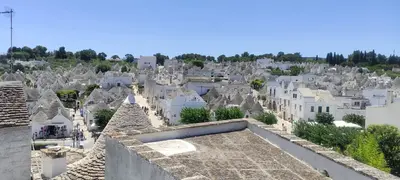
    Alberobello is located in the Valle d'Itria in the Metropolitan City of Bari and is known for its Trulli, houses built of roughly hewn limestone using dry-stone techniques without mortar, with conical roofs made of stone slabs. Since 1996, they have been a UNESCO World Heritage site.The two Trulli districts are Rione Monti and Aia Piccola.

    Sources & method

    • Photos: Unsplash, Google Maps. Each photo carries its credit.
    • Place data such as addresses and ratings comes from Google Maps.
    • The content is based on web research from public, traceable sources. How the content is made · The role of AI