Fernweh: Home
    ExploreTravel GuidesPlan a tripMy tripLast visited
    de|en
    All Places & RegionsAll highlightsAbout FernwehFAQPrivacy PolicyImprint
    ExploreTravel GuidesPlan a tripMy tripLast visited
    • Overview
    • Places in the region
    • Eat & drink
    • Food culture
    • Culture
    • Getting around
    • Nearby
    Khao Sok Region (Surat Thani Inland)

    Thailand

    Khao Sok Region (Surat Thani Inland)

    Region

    The Khao Sok Region is located in southern Thailand, inland in the provinces of Surat Thani and Phang Nga, approximately halfway between the Gulf and Andaman coasts. This makes it an obvious stopover between the coasts.

    by Felix Gillen

    1. Home
    2. Destinations
    3. Thailand
    4. Khao Sok Region (Surat Thani Inland)
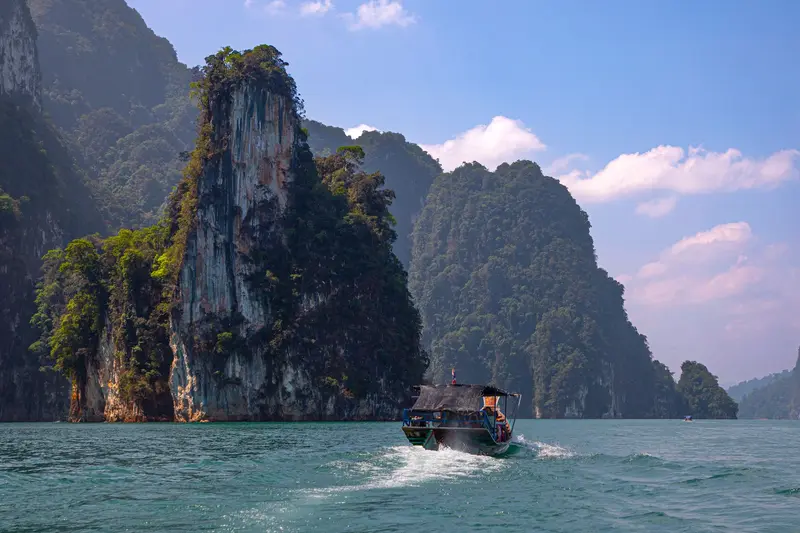
    The Khao Sok Region is located in southern Thailand, inland in the provinces of Surat Thani and Phang Nga, approximately halfway between the Gulf and Andaman coasts. This makes it an obvious stopover between the coasts.Characterized by steep limestone mountains rising above evergreen rainforest and *Cheow Lan Lake*: A dam flooded a valley system, leaving the mountaintops standing as rocky towers in the water. The Khao Sok National Park protects a large contiguous rainforest, home to hornbills, gibbons, and wild elephants, among other species.Infrastructure is concentrated around Khlong Sok village at the park entrance and the floating raft houses on the lake. Guided jungle treks, canoe tours, and cave visits are common activities.The driest period is from January to March, with most rainfall occurring from May to October. Following heavy rain, streams and caves carry a lot of water, and some paths may be closed.
    The Khao Sok Region in the hinterland of Surat Thani consists of limestone karst, rainforest, and Cheow Lan Lake. The National Park was established in 1980 and is part of a large forest complex. The starting point is Khlong Sok village at the park entrance, from where guided hikes lead into the forest. On the lake, you stay in floating bungalows and travel by longtail boat to caves and coves. The driest period is from January to March. Lake bungalows book up quickly during peak season.
    Cheow-Lan Lake

    Place 1 of 4

    Cheow-Lan Lake

    Cheow Lan Lake is not a natural body of water, but rather the reservoir of the Ratchaprapha Dam, completed in 1987, which flooded a valley system in Khao Sok National Park. The lake spans approximately 185 square kilometers.

    Discover
    Khao Sok Village

    Place 2 of 4

    Khao Sok Village

    Around the Visitor Center of Khao Sok National Park, the region's infrastructure has congregated in Khlong Sok village: guesthouses and lodges along the road and river, tour offices, restaurants, and a small market.

    Discover
    Khao Sok River

    Place 3 of 4

    Khao Sok River

    The Sok River runs along the western edge of Khao Sok National Park and flows past Khlong Sok village, home to most of the region's accommodations.

    Discover
    Nam Talu Cave

    Place 4 of 4

    Nam Talu Cave

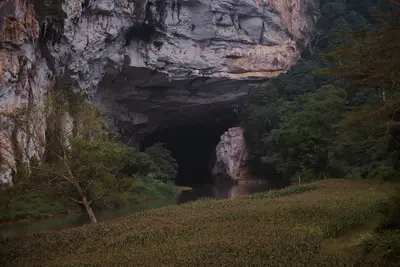
    The **Nam Talu Cave** is a river cave in Khao Sok National Park on Cheow Lan Lake. A stream flows through the limestone mountain, with the path often leading through water: knee-deep, sometimes deeper, and some sections requiring swimming.

    Discover

    More places in Khao Sok Region (Surat Thani Inland)

    Pra Kie Cave (Coral Cave)

    Pra Kie Cave (Coral Cave)

    The Pra Kie Cave, also known as Coral Cave, is located on the shores of Cheow Lan Lake in Khao Sok National Park. It earned its nickname due to the stalactites and stalagmites whose porous, branching surfaces resemble corals.The cave is only accessible by water: Longtail boats take you from the raft houses or the pier at the dam into the bay, from there a short path leads to the entrance.Unlike Nam Talu, Pra Kie is a dry cave without water passages. It is therefore often offered when Nam Talu is closed. The ground is nevertheless damp and slippery, so sturdy shoes and a headlamp are essential.Do not break anything, do not touch anything: The formations grow over millennia. Guided tours are organized by the accommodations by the lake.

    Sights in Khao Sok Region (Surat Thani Inland)

    Discover the most important sights and attractions

    Khao Sok National Park

    Founded in 1980, the park protects 739 sq km of rainforest, limestone karst, and river valleys, part of a large forest complex. From the headquarters near Khlong Sok, only a few trails are permitted without a guide; for most routes and night treks, you need a guide. The park is home to animals such as elephants, gaurs, tapirs, gibbons, and nearly 400 bird species. Around February, the giant Rafflesia kerrii blooms. Entrance fee 200 Baht; for Cheow Lan Lake, an additional 300 Baht.
    Open in Google Maps

    The park south of Khao Sok belongs to the same forest complex but receives far fewer visitors. Highlights include waterfalls, caves, and rainforest hiking trails. An ideal alternative when the main park is busy.
    Open in Google Maps

    Essen & Trinken

    Lost Horizon Resort

    Restaurant in 41.
    Show on Google Maps
    1

    Hornbill Restaurant

    A restaurant in Khlong Sok village at the entrance to Khao Sok National Park, named after the hornbills living in the park. Thai cuisine is served, and the menu is designed for travelers, so it's mildly spiced – if you like it hot, you need to say so. The venue has an open-air design, and guests come from the surrounding accommodations.
    Show on Google Maps
    2

    Ninety Kitchen (Khlong-Phanom National Park)

    The restaurant at Khlong Phanom National Park, south of Khao Sok, is primarily intended for park visitors. Simple Thai food is served, and the facilities are functional and geared towards its operation. In an area with little choice, this is its practical value – it is not a culinary destination.
    Show on Google Maps
    3

    Thai food restaurant

    A simple Thai eatery in the Khao Sok region, open-plan and with basic furnishings. The menu sticks to standard Thai cuisine. It's sufficient for a meal between two tours to the National Park.
    Show on Google Maps

    Food & Beverage

    Here, Southern Thai cuisine is served, spicier than central dishes, with turmeric, shrimp paste, and fresh vegetables. Given its inland location, freshwater fish, including river and reservoir species, are more prominent than seafood. The surrounding area features rubber and palm oil plantations, plus orchards, influencing market selections. In Khlong Sok, many restaurants cater to visitors and reduce the spice; those wanting the original can simply ask when ordering.

    Gaeng Som

    Sour, turmeric-based curry without coconut milk, with fish and vegetables, distinctly spicy and salty. Locally, it's often cooked with freshwater fish, bamboo shoots, or papaya. Eaten with rice, usually with other curries.

    Sataw

    The green seeds of the stink bean tree, known as Petai in Germany, are among Southern Thailand's characteristic ingredients. They are stir-fried with shrimp paste and chili and have a strong, slightly bitter taste. Their season is the rainy season, when they are found in all markets.

    Freshwater fish from the reservoir

    At Cheow Lan Lake and on the rivers, fish is grilled, steamed or fried and served with a spicy sauce. In the floating bungalows, it's usually part of the package dinner. A common preparation is Pla Phao, a whole fish grilled in a salt crust and herbs.

    Khanom Jeen

    Fermented rice noodles, topped with curry, served with a mound of fresh herbs, cucumber slices, and pickled vegetables for customisation. In the South, a turmeric fish curry is usually served with it. A typical breakfast found in rural markets.

    Tropical fruits from Surat Thani

    The province is a major growing region for rambutan, mangosteen, langsat, and durian. The main harvest season is in the months around mid-year, when roadside stalls sell directly from the plantations. Durian is not permitted in rooms in many accommodations.

    Old Times

    The area around Khao Sok was long sparsely populated and covered by forest. People lived from agriculture, rubber, and forest products. The National Park was established in 1980, becoming Thailand's 22nd.The Ratchaprapha Dam was constructed in the 1980s, flooding the Khlong Saeng valley and creating Cheow Lan Lake. Today, many families in the surrounding area make their living from tourism, working as guides, boat operators, or in guesthouses.

    Exploring Locally

    Highway 401 connects Surat Thani with Takua Pa on the west coast and passes by Khlong Sok village, the entrance to the National Park.From Surat Thani, allow about two hours by minivan or bus; from Khao Lak, roughly one to two; from Krabi and Phuket, three to four respectively. From Bangkok, the easiest way is to take an overnight train or bus to Surat Thani and change there.Within the region, scooters or rental cars are the most practical. Accommodations in Khlong Sok are spread out over several kilometers.To Cheow Lan Lake, it's about 60 kilometers east from Khlong Sok to the pier at Ratchaprapha Dam near Ban Ta Khun. You usually book transfers through your accommodation.On the lake, you can only travel by longtail boat. Getting to the more remote bungalows can take up to two hours.The driest months are January to March. From May to October, there's the most rain, and some paths and caves are closed then.Current safety and health information can be found at the German Federal Foreign Office.

    Nearby

    Cheow-Lan Lake

    Cheow-Lan Lake

    Cheow Lan Lake is not a natural body of water, but rather the reservoir of the Ratchaprapha Dam, completed in 1987, which flooded a valley system in Khao Sok National Park. The lake spans approximately 185 square kilometers. From the water, the peaks of limestone mountains emerge as steep rock towers; the landscape is often compared to Guilin in Southern China.Typical are the raft houses: simple bungalows on pontoons in quiet side arms, rented by the park administration and private operators. Electricity is often only intermittent, mobile reception not everywhere. Expect a basic standard.From the pier at the dam, longtail boats transport visitors to the accommodations. Common activities include canoe tours in the side arms, short jungle treks, and excursions to the caves Nam Talu and Pra Kie.In the mornings, fog often settles between the rocks, which is when you are most likely to spot hornbills, gibbons, and macaques. Plan at least one overnight stay, as day trips involve significant travel time.
    Khao Sok River

    Khao Sok River

    The Sok River runs along the western edge of Khao Sok National Park and flows past Khlong Sok village, home to most of the region's accommodations. Many lodges are situated directly on its banks, making the river at once a transport route, a swimming area, and a scenic vista.On the water, activities include tubing, canoe trips, and rides on bamboo rafts. The current is mostly calm, making the tours more about the scenery than strenuous sport: Above the river, the park's limestone cliffs ascend, and with a little patience, hornbills, kingfishers, and monkeys can be spotted along the banks.The water level fluctuates significantly. After rain, the river carries much more water, while during the dry season, it can become very shallow in certain areas; operators adjust routes accordingly. Early mornings and dusk are the best times for wildlife observation, and the heat is more tolerable than at midday.
    Pra Kie Cave (Coral Cave)

    Pra Kie Cave (Coral Cave)

    The Pra Kie Cave, also known as Coral Cave, is located on the shores of Cheow Lan Lake in Khao Sok National Park. It earned its nickname due to the stalactites and stalagmites whose porous, branching surfaces resemble corals.The cave is only accessible by water: Longtail boats take you from the raft houses or the pier at the dam into the bay, from there a short path leads to the entrance.Unlike Nam Talu, Pra Kie is a dry cave without water passages. It is therefore often offered when Nam Talu is closed. The ground is nevertheless damp and slippery, so sturdy shoes and a headlamp are essential.Do not break anything, do not touch anything: The formations grow over millennia. Guided tours are organized by the accommodations by the lake.
    Khao Sok Village

    Khao Sok Village

    Around the Visitor Center of Khao Sok National Park, the region's infrastructure has congregated in Khlong Sok village: guesthouses and lodges along the road and river, tour offices, restaurants, and a small market. The main road between Surat Thani and Takua Pa passes directly by, making the location easily accessible from both coasts.From the park entrance, the main hiking trail begins, following the valley with branches leading to several waterfalls. Night hikes are only possible with a guide and are organized locally. During the dry season, especially from January to March, the Rafflesia kerrii blooms in the region, with flowers reaching 50 to 90 centimeters in diameter.The village also serves as a starting point for trips to Cheow Lan Lake, available as day or overnight tours.Several elephant camps operate in the vicinity, each with a very different approach. Those who value animal welfare should check in advance what a camp truly offers.
    Nam Talu Cave

    Nam Talu Cave

    The **Nam Talu Cave** is a river cave in Khao Sok National Park on Cheow Lan Lake. A stream flows through the limestone mountain, with the path often leading through water: knee-deep, sometimes deeper, and some sections requiring swimming. Inside, you'll find stalactites and bats.Access is by boat and hike, usually as a day trip from one of the raft houses. A **licensed guide is mandatory**.The reason is serious: Eight tourists died in a flash flood in the cave in October 2007, and a guide in August 2024. The cave is therefore closed from June 1 to November 30; even outside this period, it can close at short notice after rain.You should bring shoes that can get wet and provide grip, a headlamp, and waterproof packed items. If you cannot swim or tolerate confined spaces poorly, you should skip the tour.

    Sources & method

    • Photos: Pexels. Each photo carries its credit.
    • The content is based on web research from public, traceable sources. How the content is made · The role of AI