Fernweh: Home
ExploreGuideDestinationsMy tripsMy trip
de|en
All Places & RegionsRound tripsNight trains in EuropeAll highlightsAbout FernwehFAQPrivacy PolicyImprint
Download on the App StoreGet it on Google Play
ExploreGuideDestinationsMy tripsMy trip
    • Places in the region
    • Culture
    • Getting around
    • Nearby
    Calabria

    Photo by Rainhard Wiesinger on Unsplash

    Italy

    Calabria

    RegionBeach

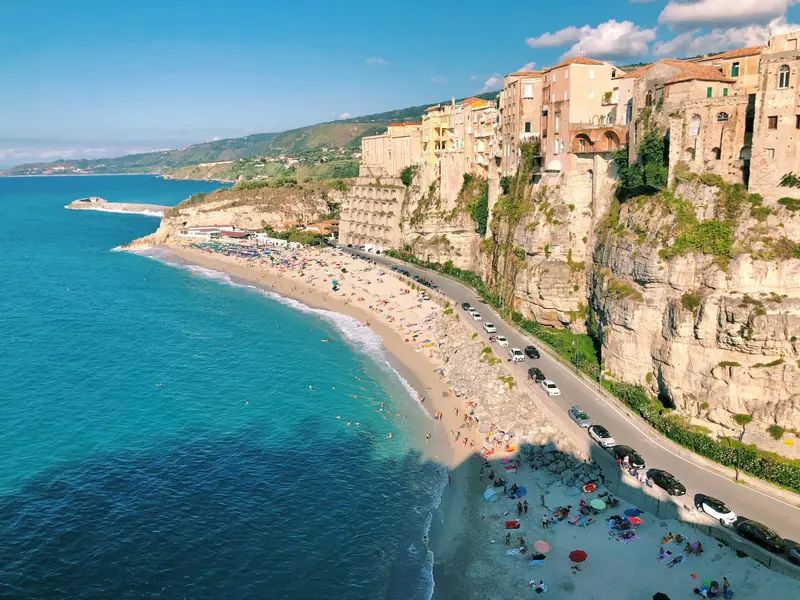
    Calabria forms the toe of Italy's boot, bordered on the west by the Tyrrhenian Sea, on the east by the Ionian Sea, and separated from Sicily in the south only by the Strait of Messina.

    by Felix Gillen

    1. Home
    2. Destinations
    3. Italy
    4. Calabria
    Calabria forms the toe of Italy's boot, bordered on the west by the Tyrrhenian Sea, on the east by the Ionian Sea, and separated from Sicily in the south only by the Strait of Messina. Most travellers are drawn to the Costa degli Dei, the approximately 55-kilometre long stretch of coastline between Pizzo and Nicotera: featuring the clifftop town of Tropea, the coves around Capo Vaticano, and on clear days, views extending to the smoking Stromboli.Further south, the fishing village of Scilla lies on the strait, and in Reggio Calabria, the National Archaeological Museum displays the Riace Bronzes. June and September are particularly suitable for swimming, as the sea is warm then and the beaches are less crowded than in August.
    Italy travel guideRound trips in ItalyPlan a trip with Calabria

    Contents

    • Places in the region
    • Culture
    • Getting around
    • Nearby
    Pizzo

    Photo by Domenico Adornato on Pexels

    Place 1 of 2

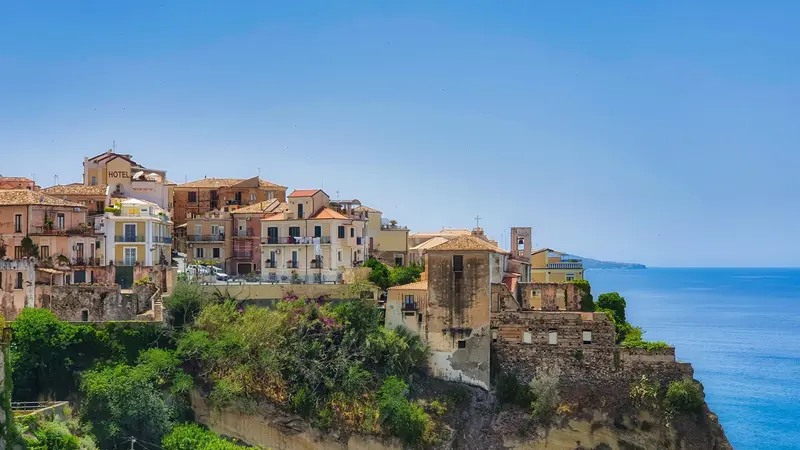
    Pizzo

    The town on the Gulf of Sant'Eufemia marks the northern tip of the Costa degli Dei and lies just 25 kilometers from Lamezia Terme Airport.

    Discover
    Tropea

    Photo by Anastasia Pirri on Unsplash

    Place 2 of 2

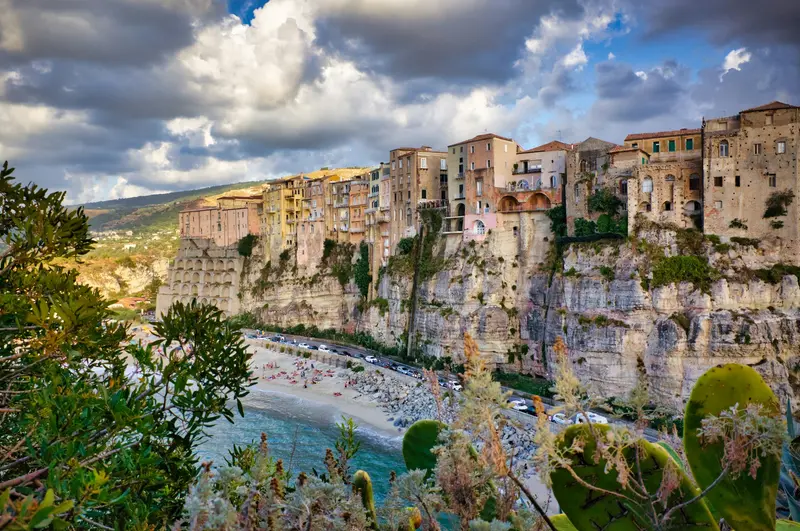
    Tropea

    Tropea is Calabria's most renowned seaside resort: Its old town perches on a cliff about 60 meters high above the Tyrrhenian Sea; below lie bright sandy beaches, and on a rock just offshore is the pilgrimage church Santa Maria dell'Isola, the emblem of the…

    Discover

    Sights in Calabria

    Discover the most important sights and attractions

    Museum

    National Archaeological Museum of Reggio Calabria (Riace Bronzes)

    The museum in Reggio Calabria is globally known for the Riace Bronzes, two Greek warrior statues from the 5th century BC, permanently exhibited here. The other halls display finds from all of Calabria, from prehistory to the late Roman period, especially from the cities of Magna Graecia. The museum is open Tuesday to Sunday from 9 AM to 8 PM, and is closed on Mondays. Access to the Bronzes hall is limited for conservation reasons; please follow staff instructions.
    Open in Google Maps
    Castle

    Scilla with Castello Ruffo and Chianalea

    The fishing village on the Strait of Messina belongs to the Borghi più belli d'Italia. Castello Ruffo castle stands on a rocky outcrop above the village, offering views over the strait, the small harbor, and the crescent-shaped Marina Grande beach. Below it lies the oldest district Chianalea, known as "Little Venice of the South" due to its houses directly on the water and narrow canals; here, fishermen still mend their nets. According to the Odyssey, the monster Scylla lurked in this strait.
    Open in Google Maps
    Attraction

    Castello Aragonese of Le Castella

    The fortress on the Ionian coast near Isola di Capo Rizzuto stands on a small rocky island offshore, connected to the mainland only by a narrow causeway that high seas sometimes submerge. Its current form dates back to the 15th century when the coast was fortified against raids; beneath it lie traces of Byzantine, Norman, Hohenstaufen, and Angevin eras, as well as Greek remains from the 4th century BC. The castle marks the southern end of the Capo Rizzuto Marine Protected Area; a worthwhile detour leads to Capo Colonna cape with the remains of an ancient sanctuary. Check opening hours before visiting.
    Open in Google Maps
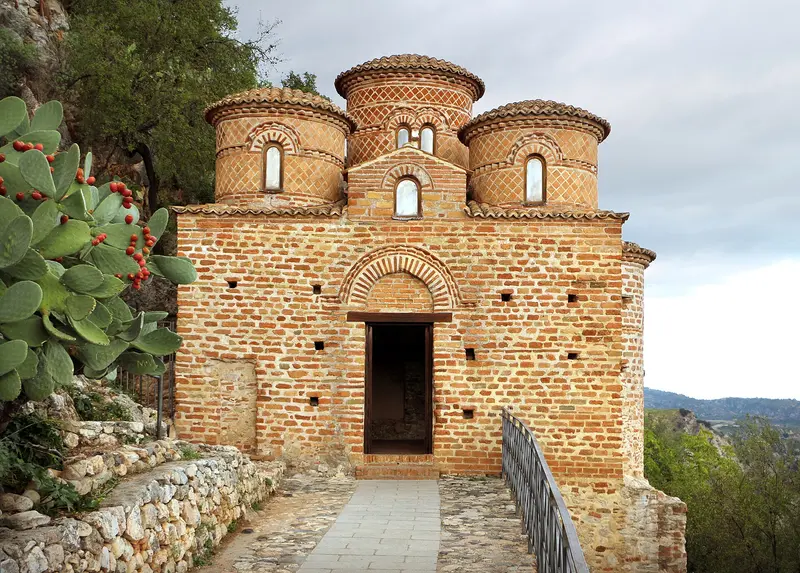
    Cattolica di Stilo

    “La cattolica di stilo, esterno 06” by Sailko / Wikimedia Commons / CC BY 3.0, mod.

    Church

    Cattolica di Stilo

    Small Byzantine church at the foot of Monte Consolino, near the mountain village of Stilo, in the Vallata dello Stilaro in eastern Calabria. The cross-in-square building measures approximately seven meters per side and features five domes; inside, four ancient spolia columns, one of them inverted, divide the space into nine bays. The frescoes date from the 10th to the 15th century. Following conservation work, the church has been reopened since July 29, 2026; current visiting hours can be found on the Ministry of Culture's website.
    Open in Google Maps

    Food and Culture

    Red Onion and TartufoThe sweet Cipolla Rossa di Tropea Calabria has been registered as a Protected Geographical Indication (PGI) since 2008 and is featured in many coastal dishes. From Pizzo comes the Tartufo, an ice cream ball of chocolate and hazelnut ice cream with a liquid chocolate core, coated in cocoa; it too is a Protected Geographical Indication.Myth and AntiquityIn ancient times, Calabria belonged to Magna Graecia, the Greek colonies of Southern Italy. Its most famous testament are the Riace Bronzes from the 5th century BC in the Reggio Calabria Museum. On the Strait of Messina, the Odyssey places the monsters Scylla and Charybdis; the town of Scilla is named after Scylla.

    Arrival and Exploration

    Lamezia Terme AirportFor the Costa degli Dei, you'll usually land at Lamezia Terme (SUF), about 60 kilometers north of Tropea and 25 kilometers from Pizzo. The Lamezia Airlink, a combined train and bus shuttle service by Trenitalia, operates every 30 minutes between the airport and Lamezia Terme train station. From the train station, regional trains continue to Tropea.By TrainTropea has a train station near its old town, with regional trains connecting to Lamezia Terme and Reggio Calabria. Pizzo's two train stations are located far outside the town; from Pizzo station, direct trains run to Lamezia Terme and Reggio Calabria, more frequently in summer.By Car and BoatFor exploring the bays around Capo Vaticano, the inland villages, and Scilla on the Strait of Messina, a rental car is most convenient. From Tropea port, excursion boats depart seasonally for the Aeolian Islands.

    Nearby

    Maratea

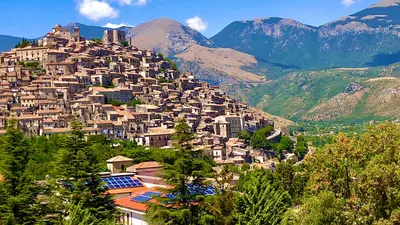
    Maratea

    Maratea is the only town in Basilicata situated on the Tyrrhenian Sea, on the Gulf of Policastro. The municipality stretches for approximately 32 kilometers along a steep coast and comprises several districts: the old town on the hillside, and along the coast, among others, Acquafredda, Fiumicello, Porto, and Marina.Monte San BiagioAbove the old town, on Monte San Biagio, stands the Christ statue from 1965 next to the pilgrimage church of the town's patron saint. From there, you can overlook the coast and the hinterland.CoastBetween steep rock faces lie sand and pebble beaches and small coves, some of which are only accessible from the sea. Over 130 grottoes are recorded within the municipal area.

    Unsplash

    Taormina

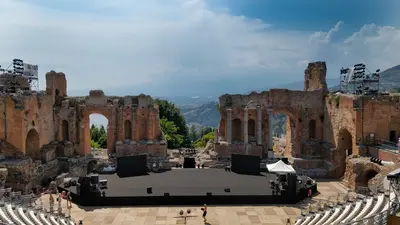
    Taormina

    Taormina is located on the east coast of Sicily, about 200 meters above the Ionian Sea, between Messina and Catania. From here, views stretch along the coast to Mount Etna. Its main attraction is the ancient theatre, originally built by the Greeks and later modified by the Romans. The Corso Umberto runs through the old town, passing palaces, churches, and Piazza IX Aprile. Below the town are Mazzarò and the bay of Isola Bella. Since the 19th century, Taormina has been an international resort; it is accordingly crowded in summer.

    Unsplash

    Etna

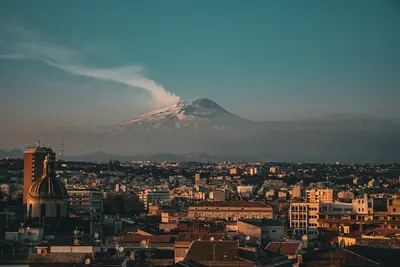
    Etna

    Mount Etna, on the eastern coast of Sicily, is Europe's highest active volcano, standing over 3,300 meters tall; its exact height changes by several dozen meters with each eruption. Since 2013, it has been a UNESCO World Heritage site. On the south side, a road leads up to nearly 2,000 meters and a cable car to around 2,500 meters. You hike over cooled lava flows, past secondary craters, and gaze out from the upper slopes over the Ionian Coast. On the lower slopes, wine, pistachios, and fruit grow in fertile volcanic soil.

    Unsplash

    Basilicata

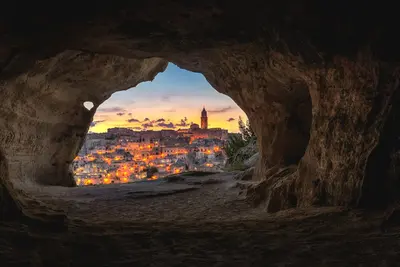
    Basilicata

    Basilicata, nestled between Campania, Apulia, and Calabria, is Italy's second least populated region after the Aosta Valley. It has two short coastlines: on the Tyrrhenian Sea near Maratea and on the Ionian Sea near Metaponto. Mountains and hills make up most of its area.MateraKnown for the Sassi of Matera, cave districts with rock churches, a UNESCO World Heritage site since 1993.LandscapeThe south features Pollino National Park, bordering Calabria; the center has the Piccole Dolomiti Lucane rocks, with the villages Castelmezzano and Pietrapertosa. Craco is an abandoned ghost town.AntiquityOn the Ionian coast, Greeks founded colonies like Metapontion; remains are in Metaponto and Policoro.

    Unsplash

    Gallipoli

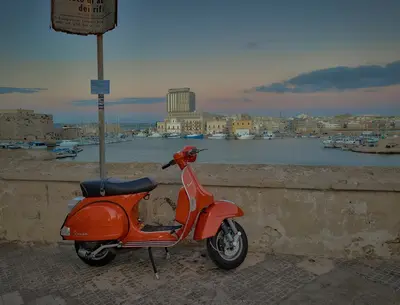
    Gallipoli

    Gallipoli is located on the west coast of Salento on the Ionian Sea. The old town is situated on a small limestone island, connected by a 17th-century bridge to the new town on the mainland. A waterfront promenade circles around it, linking the bastions of the old city wall.In the narrow streets of the old town stand Baroque churches and palazzi, including the Cathedral Sant'Agata. South of the city, sandy beaches such as Baia Verde and Punta della Suina stretch along the coast.

    Unsplash

    Your next steps

    Calabria is in Italy. Ways to carry on from here.

    • More in Italy

      Highlights, areas, routes and the best time to travel for all of Italy.

      Italy travel guide
    • Round trips in Italy

      Ready-made routes through Italy, with stops, nights and a map.

      See the routes
    • Plan a trip with Calabria

      The Guide asks about season, length and who is coming, and suggests a trip with Calabria.

      Plan the trip

    Sources & method

    • Photos: Wikimedia Commons, Unsplash. Each photo carries its credit.
    • Place data such as addresses and ratings comes from Google Maps.
    • The content is based on web research from public, traceable sources. How the content is made · The role of AI