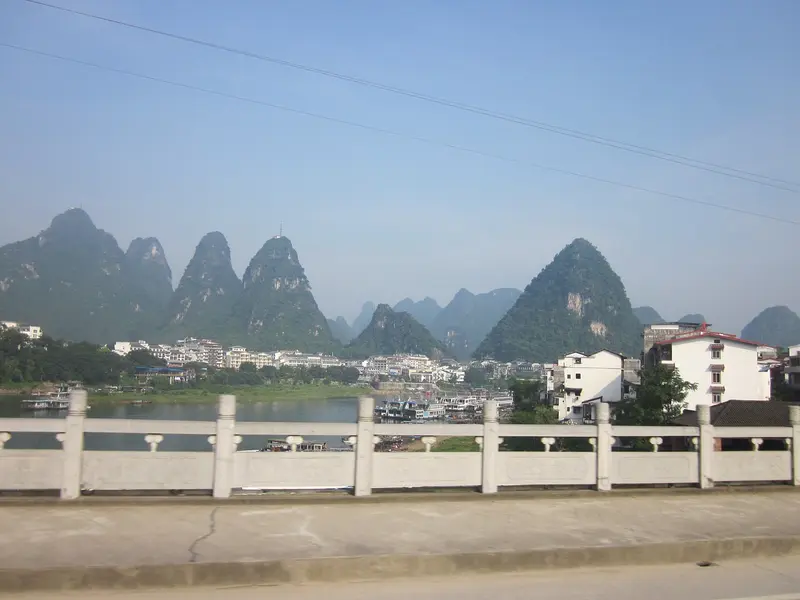
Huangdan2060 / Wikimedia Commons / CC0
Round trip · China
China Classic: Beijing, Xi'an, Chengdu, Guilin and Shanghai
by Felix Gillen
- 19 Days / 18 Nights
- Peking → Hangzhou
The classic first China trip links Imperial Beijing, the Great Wall, Xi'an's Terracotta Army, Chengdu's pandas, the Li River's karst landscape, and Yangtze Delta cities. Most legs are by high-speed train; only between Guilin and Shanghai is a domestic flight sensible. Book trains via 12306 using your passport; sales start 15 days before departure.
At a glance
- Duration
- 19 Days / 18 Nights
- Stops
- 7 · Peking → Hangzhou
- Arrival
- Flight · Peking Capital (PEK) oder Daxing (PKX)
- Departure
- Flight · Shanghai Pudong (PVG)
- Best Time to Go
- April to May and September to October, avoid Golden Week in early October
7 stops
Why This Route?
The route covers destinations most first-time visitors to China travel to, utilizing the high-speed rail network to minimize time lost to transfers. It fits well within the 30 days of visa-free entry.
Hidden Gems
- Enjoying the sunset from Jingshan, Beijing
- Small Wild Goose Pagoda in Xi'an with free entry
- Panda Base via the West Gate in Chengdu
- Rafting from Jinlong Bridge on the Yulong River
- Canglang Pavilion in Suzhou
Getting there and back
Open jaw: start and end are in different places
- Arrival
- Flight · Peking Capital (PEK) oder Daxing (PKX)Capital Airport's Airport Express runs for 25 CNY via Dongzhimen to Beixinqiao; the Daxing Line from Daxing reaches Caoqiao in about 20 minutes. Per the German Foreign Office (as of 11.11.2026), visa-free entry for Germans for up to 30 days is only valid until 31.12.2026; check the current status before booking.
- Departure
- Flight · Shanghai Pudong (PVG)From Hangzhou East, you'll reach Shanghai Hongqiao in 45 to 60 minutes. From there, continue to Pudong Airport via Metro Line 2 or Airport Link Line. Allow ample time.
Itinerary
Peking
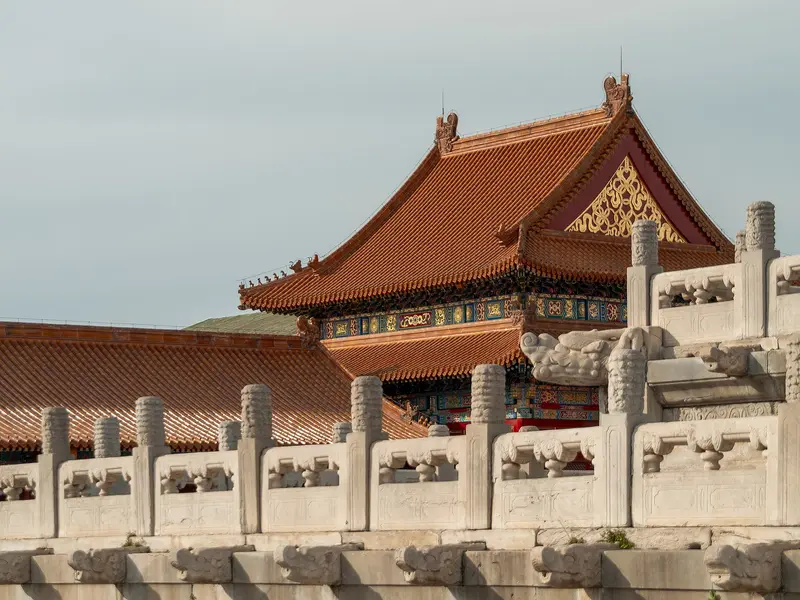
Beijing is the capital of China and has approximately 21.8 million inhabitants (end of 2024). The city first became a capital in 1153 under the Jin Dynasty; under Kublai Khan, the Yuan capital Dadu was established, and since the early 15th century, the emperors of the Ming and Qing dynasties ruled here. The Forbidden City, the Temple of Heaven, and the Summer Palace date from this period.Beijing boasts eight UNESCO World Heritage Sites, including the Great Wall and, since 2024, the Central Axis, which extends from the Temple of Heaven, past the Imperial Palace, to the Drum and Bell Tower. Nestled between these magnificent structures are the Hutongs, narrow alleys of courtyard houses, especially around the Shichahai lakes. For the main attractions, you'll need three to four days, plus one day for the Wall.Important: The Palace Museum, Tian'anmen Square, and National Museum can only be visited with a prior online reservation in your name. Many establishments are closed on Mondays. Always carry your passport with you.
Palace Museum, Tian'anmen, Temple of Heaven, Summer Palace and Hutongs, a day for the Great Wall at Mutianyu. Palace Museum and Tian'anmen must be reserved in advance with passport. Palace Museum closed on Mondays.
12 Sights
6 Restaurants
Hutongs, Courtyard Homes & Beijing Opera
Hutongs and SiheyuanHutongs are narrow alleyways formed by rows of Siheyuan, traditional courtyard houses. They originated during the Yuan Dynasty, though many were demolished in recent decades. Well-preserved districts can be found around Shichahai, Nanluoguxiang, and the Lama Temple.Peking OperaPeking Opera emerged in the late 18th century when theatre troupes from Anhui came to the capital in 1790 for the 80th birthday of the Qianlong Emperor. It combines singing, pantomime, and acrobatics, with roles structured into fixed types like Sheng, Dan, Jing, and Chou. Since 2010, it has been on the UNESCO Intangible Cultural Heritage list.Central AxisThe city was planned along a north-south axis, which was designated as a World Heritage site in 2024. Among the landmarks located on it are the Temple of Heaven, Tian'anmen, the Imperial Palace, Jingshan, and the Drum and Bell Towers.
Train
High-speed train Beijing West to Xi'an North, fastest services approx. 4 hours 10 minutes (e.g. G91, train numbers vary with schedule)
Xi'an
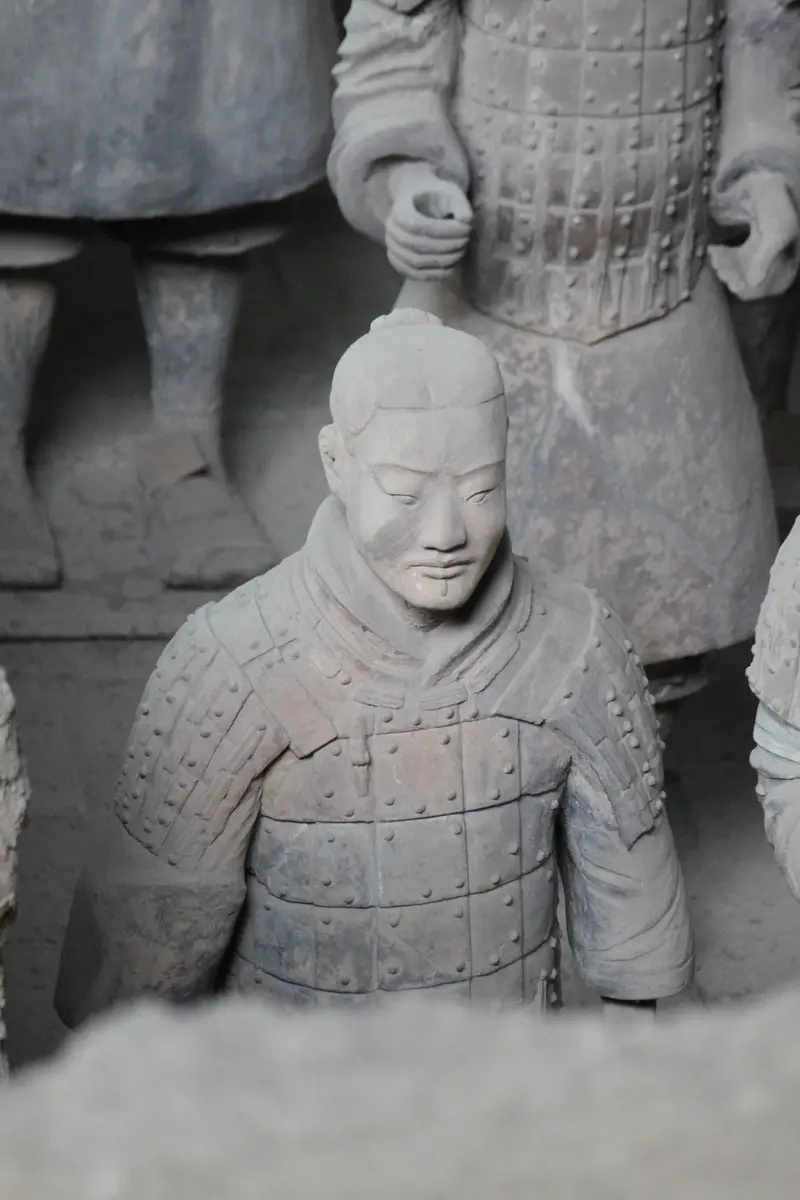
Xi'an, the capital of Shaanxi Province, is one of China's great ancient capitals: Among others, Western Zhou, Qin, Western Han, Sui, and Tang ruled from here; under the Tang, the city was called Chang'an. Most famous is the Terracotta Army in the mausoleum of the First Emperor, discovered in 1974 and a UNESCO World Heritage site since 1987.The old city is encircled by a fully preserved city wall from the Ming Dynasty, built from 1370 onwards and 13.7 kilometers long. Within the walls are the Bell and Drum Tower, the Muslim Quarter with the Great Mosque and Hui street food, and to the south, the Giant Wild Goose Pagoda from the year 652. Plan at least two full days, one of them for the Terracotta Army.
A day for the Terracotta Army (ticket w/ passport data), another for the City Wall by bike, Muslim Quarter and Wild Goose Pagodas.
10 Sights
3 Restaurants
Silk Road and Hui Culture
Starting Point of the Silk RoadAs Chang'an, the city was one of Asia's most important metropolises under the Tang and the starting point for trade routes to the West. Five sites in Xi'an are UNESCO Silk Road World Heritage sites, including the Big Wild Goose Pagoda and the Small Wild Goose Pagoda. From 652, the Big Wild Goose Pagoda housed the Buddhist scriptures that the monk Xuanzang brought from India.The Muslim QuarterHui Muslims live in the quarter northwest of the Bell Tower. The Great Mosque combines Chinese wooden halls with Islamic elements and is built without a minaret. In the alleys, Hui cuisine shapes the scene, with dishes like Yangrou Paomo, Soupy Baozi, and skewers.Traditional EateriesLao Sun Jia has been serving Paomo since the late 19th century, while Defachang has been known for its dumpling banquet since 1936.
Train
High-speed train Xi'an North to Chengdu East, approx. 3 hours 10 minutes
Chengdu
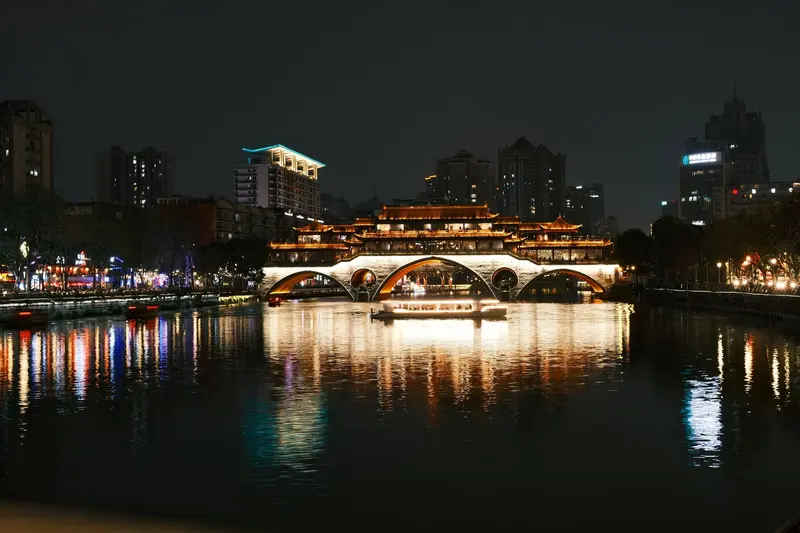
Chengdu is the capital of Sichuan Province and has been a UNESCO City of Gastronomy since 2011. The city is renowned for its spicy Sichuan cuisine, its teahouse culture, and especially for the Panda Breeding Center, which began in 1987 with six giant pandas rescued from the wild. The MICHELIN Guide Chengdu 2027 awarded a restaurant in the city three stars for the first time.In the Old Town are the Wenshu Monastery, the Kuanzhai Xiangzi alleys, the Wuhou Shrine with Jinli Ancient Street, and People's Park with its teahouse. Approximately 60 kilometers northwest, the Dujiangyan Irrigation System and the Taoist Mount Qingcheng are UNESCO World Heritage Sites, while the Leshan Giant Buddha lies just under an hour's train ride south.
Early morning to the Panda Base (reservations up to 14 days prior), teahouse in People's Park, Sichuan Opera. Optional day trip to Leshan (train about one hour).
8 Sights
5 Restaurants
Teahouses, Opera and Mala
Tea House CultureIn Volkspark, laid out in 1911, the Heming Teahouse has been open since 1923. Tea is poured here from long-necked pots, ear cleaners offer services, and on weekends, parents gather for a marriage market.Sichuan OperaSichuan Opera is known for its Bianlian face-changing, where masks change instantly, and for fire-spitting. Evening performances can be seen at the Shufeng Yayun Theatre in Cultural Park on Qintai Road, for example.CuisineMapo Doufu originates from Chengdu, as does its unique hotpot tradition. The MICHELIN Guide Chengdu lists 32 Bib Gourmand addresses in addition to its starred establishments.
Train
High-speed train Chengdu East to Guilin, fastest connections just under 5 hours (e.g., G2963)
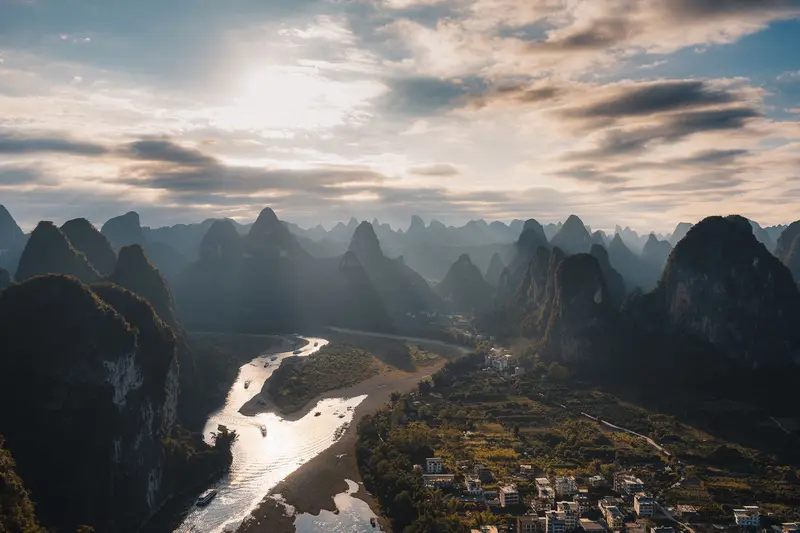
Guilin
Guilin in the Guangxi Autonomous Region is the gateway to the karst landscape along the Li River. In the heart of the city, limestone cones like Elephant Trunk Hill rise, and since 2001, rivers and lakes have been connected to form the Two Rivers and Four Lakes water system. In the surrounding area, Han Chinese live alongside the Yao and Zhuang.From Guilin, boat trips on the Li River to Yangshuo begin; the classic route is approximately 83 kilometers long and takes about four hours. Approximately 100 kilometers northwest, the Longji Rice Terraces stretch across the mountain slopes. The motif on the back of the 20-yuan banknote depicts the Li River.
Elephant Trunk Hill and Reed Flute Cave, evening boat trip on the Two Rivers and Four Lakes.
7 Sights
2 Restaurants
Zhuang, Yao and Rice Noodles
Minorities of the RegionAround Guilin, besides the Han majority, mainly Yao and Zhuang people live. In the Longji Rice Terraces lie the Zhuang village of Ping'an and the Yao village of Huangluo. The open-air show Impression Liu Sanjie near Yangshuo tells a local legend with around 600 participants, predominantly Zhuang.Guilin Rice Noodles and Oil TeaGuilin Rice Noodles are the typical breakfast and lunch, for example at Chongshan Rice Noodles. In the region, people also drink Youcha, a savory oil tea made from roasted tea leaves.
Ferry
Boat trip on the Li River to Yangshuo, approx. 83 km in about 4 hours, departures typically 9-10 am
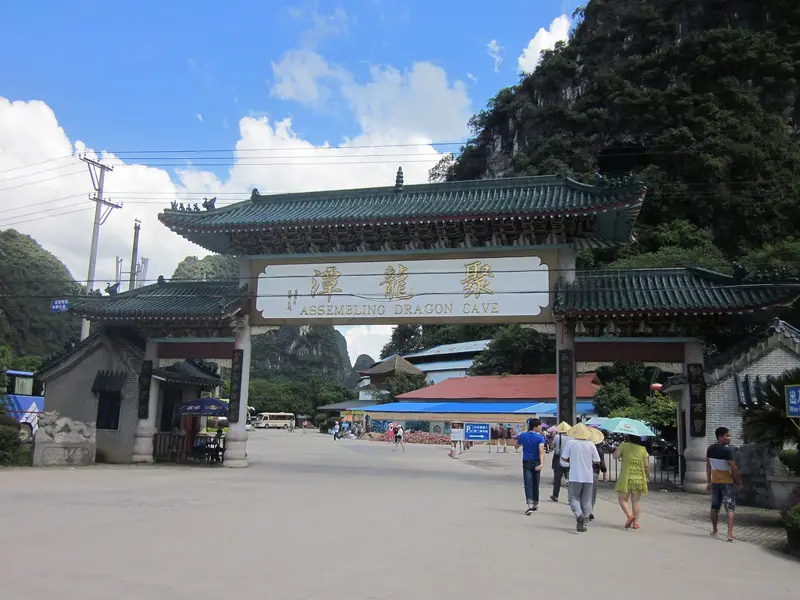
Yangshuo
Yangshuo is the endpoint of the Li River cruise from Guilin and a popular spot to explore the karst landscape on foot, by bike, or on a bamboo raft. The approximately 517-meter-long West Street is the oldest street in the town and has been a meeting point for foreign travelers since the 1980s.The smaller Yulong River flows nearby between rice fields and limestone cones; about 30 kilometers away is the town of Xingping, home to the motif of the 20-Yuan note. In the evenings, the open-air show Impression Liu Sanjie depicts a regional folk legend against illuminated karst peaks by the river. The local dish is Beer Fish from the Li River.
By bike to Yulong River and Moon Hill, bamboo rafting, evening Liu Sanjie Impression.
6 Sights
2 Restaurants
Beer fish, bike and bamboo raft
Backpacker's HubSince the 1980s, Yangshuo has attracted foreign travelers; West Street remains its hub. It's quiet in the mornings, very lively in the evenings.Beer FishThis local specialty features Li River fish braised in beer. Xiedajie Beer Fish is particularly renowned for it.Impression Liu SanjieLaunched in 2004 and directed by Zhang Yimou, this open-air show uses twelve illuminated karst peaks along the Li River as its backdrop, located about 1.5 kilometers from town.
Flight
Bus or taxi to Guilin Airport (approx. 90 minutes), domestic flight to Shanghai
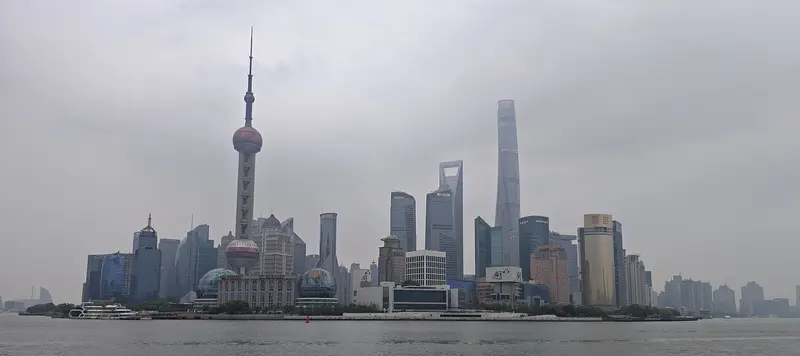
Shanghai
Shanghai has over 24 million inhabitants and is divided into two halves by the Huangpu River: To the west lies Puxi with the Bund promenade and its approximately 50 Western-style buildings; to the east, Pudong with the skyscrapers of Lujiazui. According to the city administration, the 632-meter-tall Shanghai Tower is China's tallest building.Amidst these contrasts, you'll find the Ming-era Yuyuan Garden in the Old City, the plane tree-lined streets of the former French Concession, and the Shikumen stone-gate houses in Tianzifang and Xintiandi. Shanghai is also a good starting point for excursions to Suzhou and Hangzhou. Plan three to four days for the city.
Bund, Pudong, Yuyuan Garden and French Concession, day trip to Suzhou (train from Hongqiao 20-30 minutes) to the classical gardens.
10 Sights
5 Restaurants
Shikumen, Benbang Cuisine and Art
ShikumenThese stone-gate houses emerged in the mid-19th century, blending Chinese courtyard house elements with Western terraced house architecture. In Tianzifang, people still live in the alleys amidst studios and shops, while in Xintiandi, the façades are preserved, and the interiors have been modernly converted.Shanghai CuisineThe local Benbang cuisine is rather sweetish and robustly braised. Lao Zheng Xing is considered the oldest restaurant serving this cuisine, established in 1862. The broth-filled Xiaolongbao originate from today's suburb of Nanxiang.MuseumsIn addition to its main building at People's Square, the Shanghai Museum has had a large second location in Pudong, the Shanghai Museum East, since 2024.
Train
High-speed train Shanghai Hongqiao to Hangzhou East, 45 to 60 minutes
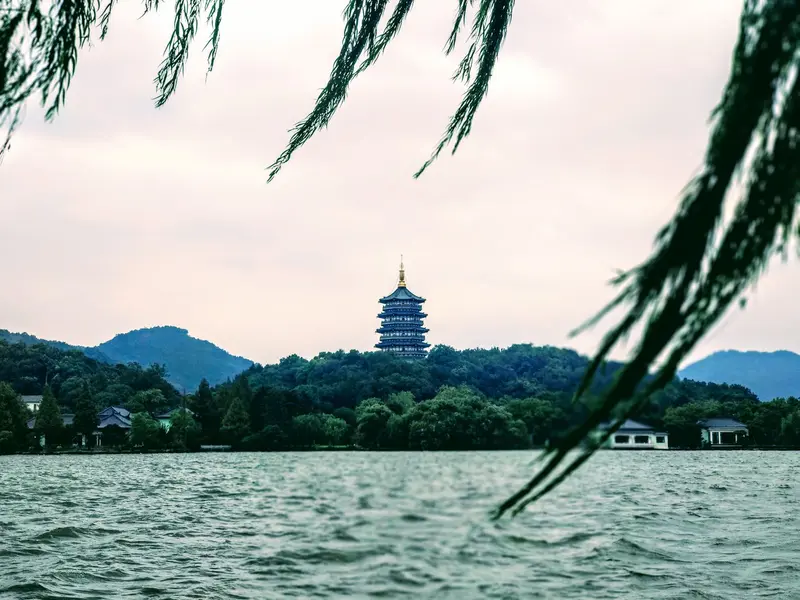
Hangzhou
Hangzhou war von 1132 bis 1276 als Lin'an Hauptstadt der Südlichen Song-Dynastie und liegt am Südende des Kaiserkanals. Bekannt ist die Stadt vor allem für den Westsee, dessen Kulturlandschaft aus See, Hügeln, Dämmen, Inseln, Tempeln und Pagoden seit 2011 UNESCO-Welterbe ist. Laut UNESCO prägte sie die Gartenkunst in China, Japan und Korea.Der Westsee ist kostenlos zugänglich, sein Ufer misst rund 15 Kilometer. In den Hügeln westlich des Sees wächst der Longjing-Grüntee, dort liegt auch der im Jahr 326 gegründete Lingyin-Tempel. Von Shanghai Hongqiao fährst du mit dem Hochgeschwindigkeitszug 45 bis 60 Minuten.
West Lake with Su Causeway and Leifeng Pagoda, Lingyin Temple and Meijiawu Tea Village.
8 Sights
4 Restaurants
Ten Scenes, Tea and Legends
The Ten Scenes of West LakeSince the Southern Song era, ten classic views of the lake have been immortalized in verse, such as Spring Dawn at Su Causeway, Sunset Glow over Leifeng Pagoda, and Three Ponds Mirroring the Moon.Longjing TeaIn villages such as Meijiawu, Longjing tea has been cultivated for centuries. Harvested from March to early April, the tea villages get very busy around the Qingming Festival.The Legend of the White SnakeThe famous folk tale is set at West Lake; its scenes include Leifeng Pagoda and the Broken Bridge.
Plan this route as your trip
All stops, trains and nights go into your trip planner. You adjust dates and places to stay afterwards.
This route is a suggestion from our research. Please check timetables, times in port, opening hours and prices before you book – what your tour operator or carrier says is what counts.
Fernweh is a free travel guide and trip planner: routes researched by people, taken over in one click, used day by day on the road. More about Fernweh
7 stops
Route Summary
Duration19 Days
Stops7 Places
TypeCulture