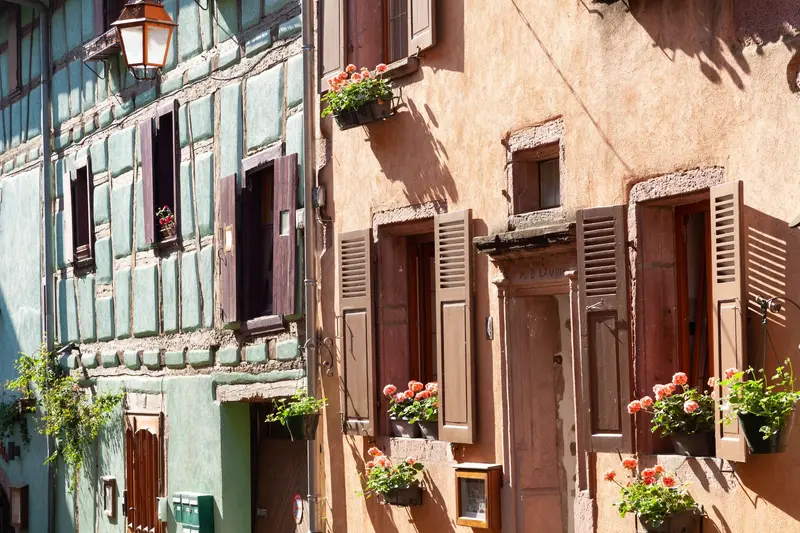
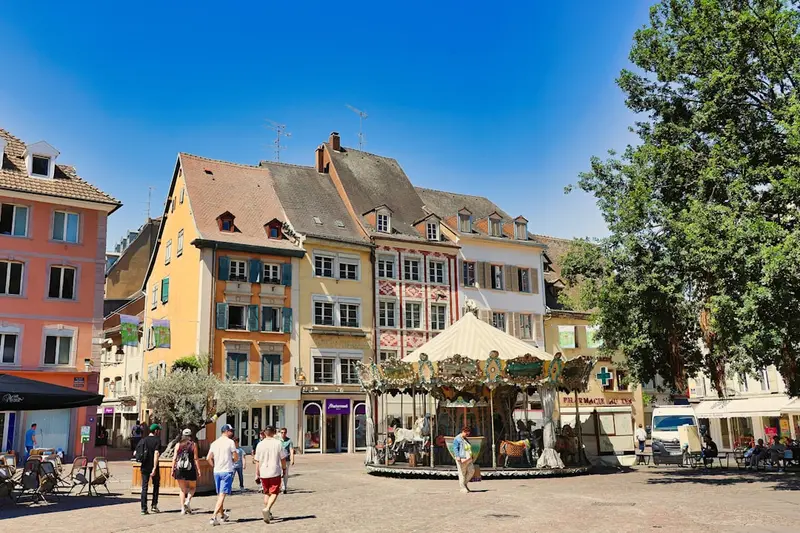
From Strasbourg, south along the Alsace Wine Route via Obernai, Ribeauvillé, and Riquewihr to Colmar. Then Eguisheim, the wine village, and finally Mulhouse; most legs are under half an hour.
11 Days / 10 Nights
April–October
RV Friendly
7 stops
Why This Route?
For those who appreciate wine, half-timbered villages, and local cuisine, with short stages.
Hidden Gems
The three castle ruins Saint-Ulrich, Girsberg and Haut-Ribeaupierre above Ribeauvillé
Mont Sainte-Odile with monastery above Obernai
Les Trois Châteaux, three castle towers in the vineyards above Eguisheim
Itinerary
Stop 1 • 2 Nights
Strasbourg
City
Rich in culture and history. Perfect for an exciting city trip and Culinary highlights.
Strasbourg is the largest city in Alsace and home to European institutions. Its landmark is the Gothic Cathédrale Notre-Dame with its astronomical clock. The La Petite France district, with its half-timbered houses, alleys, and canals of the Ill, is part of the Grande Île, a UNESCO World Heritage site since 1988. From the Ponts Couverts and the rooftop terrace of the Barrage Vauban, you look out over the city and the Ill. The European Parliament and the Council of Europe are located in the European Quarter. It's less crowded in spring and autumn. You can enjoy Alsatian cuisine in traditional Winstubs.
5 Sights
6 Restaurants
Strasbourg: A Mosaic of European History and Culture
Strasbourg's history dates back to the Roman camp Argentoratum. Its location between France and Germany has, for centuries, shaped a blend of both influences, visible in its architecture and traditions.Strasbourg was a Free Imperial City within the Holy Roman Empire and became part of France in 1681. The Notre-Dame Cathedral, a Gothic masterpiece, dominates the old town with its façade and astronomical clock. The half-timbered houses of the Petite France along the arms of the Ill river recall the tanners, millers, and fishermen who once lived here.The Neustadt, developed after 1871 during the German Empire, with its wide avenues and stately buildings, has also been a UNESCO World Heritage site since 2017. Alsatian identity is expressed in its customs, cuisine, and festivals, especially the Christkindelsmärik, which has taken place since 1570 and is considered France's oldest Christmas market.
Rich in culture and history. Culinary highlights and Perfect for relaxed travel without rush.
Obernai, at the foot of the Vosges, lies about 30 km southwest of Strasbourg. It was an Imperial City and member of the Decapole. Its old town boasts half-timbered houses, the 1523 Town Hall, Chapel Tower, Six-Bucket Fountain, and preserved city walls. Enjoy Alsatian cuisine in Winstubs; vineyards are just steps away.
8 Sights
5 Restaurants
Culture, Art & History in Obernai
Obernai (German: Oberehnheim) has a long history linked to Saint Odilia, the patron saint of Alsace. In the Middle Ages, the city became an Imperial City and, from 1354, was part of the League of Ten Cities, the Decapolis. This period of prosperity is still evident today in its well-preserved old town.The cityscape is characterized by half-timbered houses from the 15th to 17th centuries, the Town Hall from 1523, the Halle aux Blés from 1554, the Chapel Tower, a remnant of a 13th-century chapel, and sections of the medieval city fortifications. Culturally, Obernai is deeply rooted in Alsatian traditions, visible in its cuisine, dialect, and wine festivals. Since 1969, Kronenbourg's main brewery has been located on the outskirts of the town.
Rich in culture and history. Culinary highlights and Great for exploring on foot.
Ribeauvillé is a small town on the Alsace Wine Route, about 15 kilometers north of Colmar. Along the Grand'Rue stand half-timbered houses, fountains, and the Butcher's Tower; above the vineyards are the ruins of three castles belonging to the Lords of Rappoltstein. The town is also known for its Pfeifertag (Piper's Day) in September and the surrounding Grand Cru vineyards.
5 Sights
5 Restaurants
History and Heritage of Ribeauvillé
Ribeauvillé's history is closely tied to the Lords of Rappoltstein, who shaped the town for centuries. The town was first mentioned in the 8th century and experienced a golden age in the Late Middle Ages and the Renaissance.The old town is lined with half-timbered houses from the 15th to 18th centuries. Overlooking the valley are the ruins of the three Rappoltstein castles: Ulrichsburg, Girsberg, and Hohrappoltstein.A special testament to local tradition is the Pfifferdaj, the Piper's Day. Since the Middle Ages, the Lords of Rappoltstein were patrons of the minstrels in Alsace, who gathered once a year in Ribeauvillé. Today, the festival is celebrated on the first September weekend with a historical parade. Viticulture is an economic pillar and an integral part of the local way of life.
Rich in culture and history. Perfect for unwinding and relaxation and Culinary highlights.
Riquewihr, a picturesque village on the Alsatian Wine Route, captivates with its exceptionally well-preserved medieval architecture. The main street, Rue du Général de Gaulle, leads you past colorful half-timbered houses and historic buildings that reflect the rich heritage of the place. Particularly striking is the Dolder Tower, a former 13th-century defensive gate that now houses a museum and offers insights into the local history. Here you will find numerous wine taverns and shops offering local products and the famous Alsatian wine. To experience the authentic atmosphere away from the main thoroughfare, we recommend exploring the smaller alleys and courtyards. A visit in spring or autumn, outside the high season, allows for a calmer experience of the historic setting and wine tastings.
4 Sights
4 Restaurants
Culture, Art & History of Riquewihr
Riquewihr's history stretches back to the Middle Ages. For a long time, it belonged to the Württemberg lordship of Reichenweier, experiencing a boom in the 16th century due to wine trade. Wars largely spared it, even during World War II, which contributed to its exceptional preservation.Narrow alleys lead between numerous half-timbered and stone houses from the 15th to 18th centuries, many featuring carvings, colourful facades, bay windows, and courtyards. The landmark is the Dolder, a gate tower from 1291, now home to a small museum; higher up stands the Diebsturm, the former prison.Riquewihr is closely linked to viticulture and one of the best-known stops on the Alsace Wine Route, with the Grand Cru vineyards Schoenenbourg and Sporen. The town is also known for its Christmas market.
Rich in culture and history. Perfect for an exciting city trip and Perfect for unwinding and relaxation.
Colmar, located in Alsace, captivates with its picturesque old town and the unique blend of French and German culture. Here you'll find well-preserved half-timbered houses, winding alleys and canals, which have earned Colmar the nickname "Little Venice" (La Petite Venise). A central highlight is the Musée Unterlinden, home to the famous Isenheim Altarpiece and making art history accessible. Stroll through the Fischermarkt quarter and along the Lauch River to experience the idyllic scenery, or visit the historic Koïfhus. The city is also an excellent starting point for the Alsatian Wine Route. You can best explore Colmar on foot or by boat; the spring and autumn months are ideal for a visit to avoid crowds.
6 Sights
5 Restaurants
Colmar's Cultural Heritage
Colmar exemplifies the French and German influences in its architecture, art, and traditions that define Alsace.The city was first documented in the 9th century. As an Imperial City and member of the Decapole, it developed into an important trade hub in the Middle Ages. In the 17th century, Colmar became part of France, changing hands several times between France and Germany thereafter.The cityscape is characterized by a well-preserved Old Town with half-timbered and stone houses from the 14th to 18th centuries, including the Koifhus, the old customs and trade house, and the Maison des Têtes. A major artistic highlight is the Isenheim Altarpiece by Matthias Grünewald in the Musée Unterlinden. Colmar is also the birthplace of the sculptor Auguste Bartholdi, creator of the Statue of Liberty; his birthplace is now a museum.Local traditions are evident in the cuisine, at the wine festivals, and in the Christmas markets.
Perfect for couples and romantic getaways. Romantic atmosphere for couples and Great for exploring on foot.
Eguisheim, on the Alsace Wine Route just southwest of Colmar, is one of the "Plus Beaux Villages de France". Its cobbled streets spiral around the central castle, lined with colorful, flower-adorned half-timbered houses. The Grand Cru sites Eichberg and Pfersigberg surround it.
5 Sights
5 Restaurants
Culture, Art & History of Eguisheim
Eguisheim is one of the "Plus Beaux Villages de France" and is deeply rooted in the history of Alsace.Eguisheim's settlement dates back far; its parish church stands on a Carolingian predecessor. It's known as the traditional birthplace of Pope Leo IX. (1002), though Dabo in Lorraine is also a possibility. The concentric street arrangement around the Counts of Eguisheim's castle is an unusual, well-preserved example of medieval town planning. Its 16th and 17th-century half-timbered houses showcase typical Alsatian architectural features: colorful facades and wood carvings.Village life is closely linked to viticulture, which has shaped the area for centuries. Wine festivals and the Christmas market in the circular lanes are part of the annual cycle, alongside Alsatian dialect and regional specialties.
Rich in culture and history. Perfect for an exciting city trip and For adventure seekers.
Mulhouse is the largest city in the south of Alsace, near the border with Switzerland and Germany. It is known for its industrial history and its museums, especially the Automobile Museum Cité de l'Automobile and the Railway Museum Cité du Train.
4 Sights
5 Restaurants
History and Culture of Mulhouse
Mulhouse was an Imperial City in the Middle Ages, allied itself with the Swiss Confederacy from the 16th century onwards, and existed as a small independent republic until its voluntary incorporation into France in 1798. Afterwards, the city developed into a center of the textile industry, especially of **cotton printing**.The most famous building in the old town is the **Town Hall (Hôtel de Ville)** from the mid-16th century, in the Rhenish Renaissance style with a painted facade; today it houses the historical museum. Besides patrician houses, there are early examples of industrial architecture and workers' housing, such as the Cité ouvrière from the 19th century.Museums like the **Cité de l'Automobile**, the Cité du Train and the Musée de l'Impression sur Étoffes document the industrial heritage. Additionally, there are Alsatian traditions in cuisine and festivals, as well as a modern art scene, visible in numerous murals throughout the city.