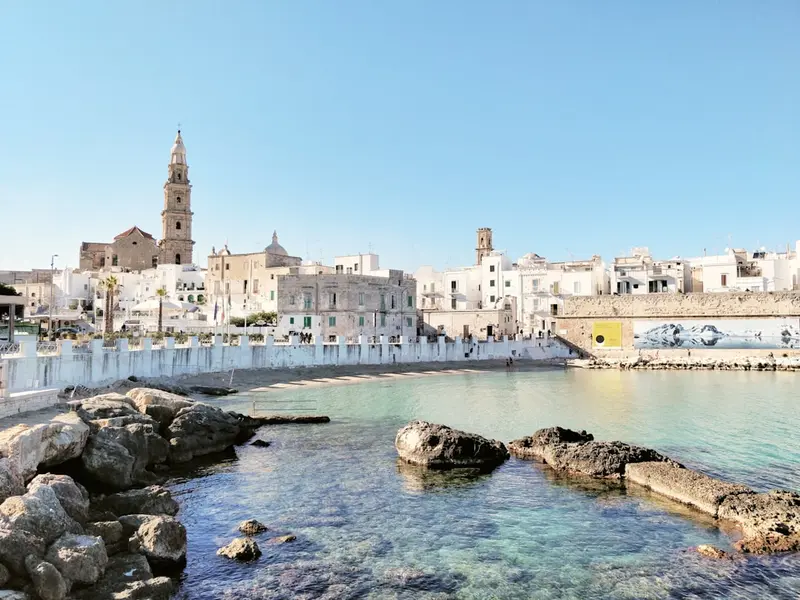
The route leads from Bari via Polignano a Mare, Alberobello and Ostuni into the Salento region to Lecce, Otranto and Gallipoli. The stages are short and rarely last more than an hour's drive. In August, beaches and accommodations are heavily booked.
16 Days / 15 Nights
May–October
RV Friendly
7 stops
Why This Route?
For families and leisure travelers who want to combine beaches, Baroque cities, and Apulian cuisine on short stages.
Hidden Gems
Grotta della Poesia near Roca Vecchia between Lecce and Otranto, a natural rock pool by the sea
Cava di Bauxite near Otranto, a red bauxite quarry with a green lake
Trullo Sovrano in Alberobello, the only two-story Trullo, away from the souvenir alleys of Rione Monti
Itinerary
Stop 1 • 2 Nights
Bari
City
Rich in culture and history. Culinary highlights and Dreamy beaches.
Bari is the capital of Apulia and has approximately 315,000 inhabitants. In the winding old town, Bari Vecchia, stand the Basilica San Nicola with the relics of Saint Nicholas and the San Sabino Cathedral; on Via dell'Arco Basso, women shape orecchiette pasta outside their doorways.
7 Sights
5 Restaurants
Culture and History
Bari developed in Roman times along the Via Traiana and, from 975, was the seat of the Byzantine Katepan, the governor for Southern Italy. In 1071, the Normans conquered the city.In 1087, sailors from Bari brought the relics of Saint Nicholas from Myra to the city. The Basilica San Nicola, erected over them, is considered one of the prototypes of Apulian Romanesque; an apse in the crypt is reserved for Orthodox worship. The Romanesque Cathedral San Sabino was built in the 12th and 13th centuries. Roger II had the Castello Normanno-Svevo built in 1131; Frederick II rebuilt it.Bari Vecchia preserves its Byzantine street plan and has about 40 churches. On Via dell'Arco Basso, women still make Orecchiette before their doorways. From 1813, the new town developed under Joachim Murat.
Perfect for unwinding and relaxation. Perfect for an exciting city trip.
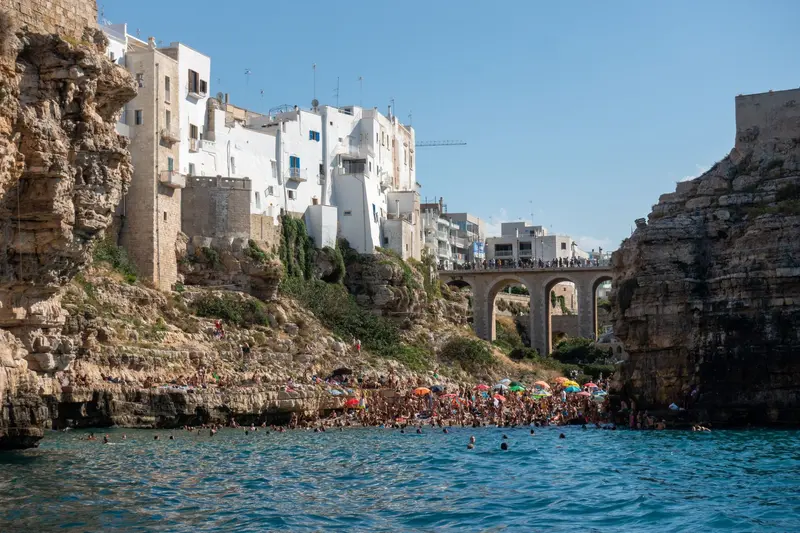
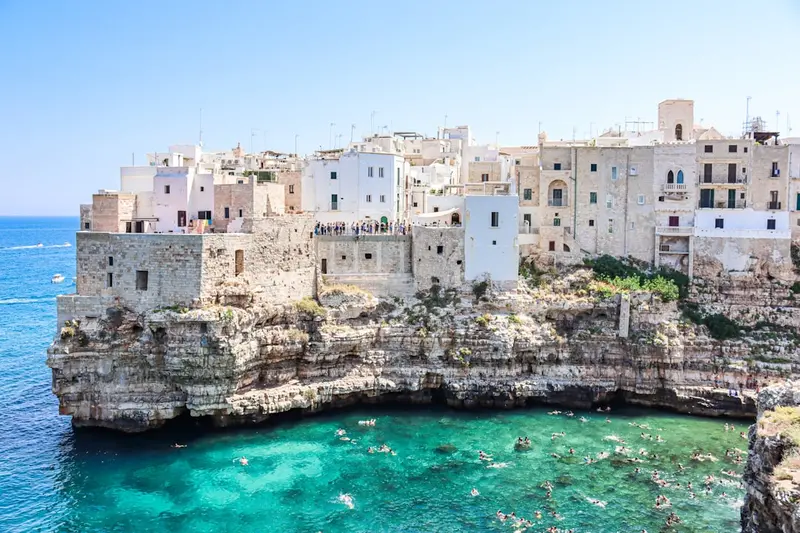
Polignano a Mare lies about 33 kilometers south of Bari on the Adriatic coast. The oldest part of its old town sits on a rocky spur, dropping steeply to the sea; beneath, along the coast, lie numerous sea caves.In the town's center, the Lama Monachile cove cuts into the coast, spanned by the early 19th-century Bourbon Bridge; beneath it ran the ancient Via Traiana. Polignano is the birthplace of singer Domenico Modugno, commemorated by a statue on the waterfront.
2 Sights
4 Restaurants
History and Culture
The town was located on the Via Traiana, the Roman road to Brindisi. At Lama Monachile, a smaller Roman bridge made of tuff blocks is preserved alongside the Bourbon Bridge.The Chiesa Matrice Santa Maria Assunta served as a bishop's church until 1818, when the small diocese was united with Monopoli. The 16th-century Arco Marchesale, also known as Porta Grande, was once the sole entrance to the fortified old town.Domenico Modugno was born in Polignano in 1928. In the old town, street artist Guido Lupori, known as Guido il Flâneur, paints verses by renowned poets on house walls, steps, and doors.
Rich in culture and history. Perfect for an exciting city trip and Perfect for relaxed travel without rush.
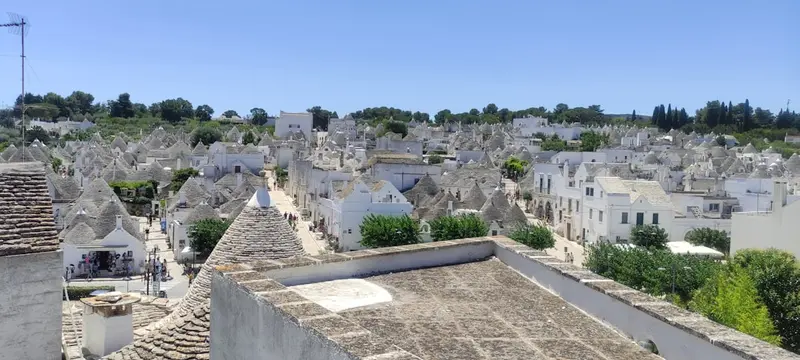
Alberobello is located in the Valle d'Itria in the Metropolitan City of Bari and is known for its Trulli, houses built of roughly hewn limestone using dry-stone techniques without mortar, with conical roofs made of stone slabs. Since 1996, they have been a UNESCO World Heritage site.The two Trulli districts are Rione Monti and Aia Piccola.
3 Sights
5 Restaurants
History of the Trulli
In the early 16th century, Count Andrea Matteo III. Acquaviva d'Aragona settled peasant families here. He only allowed houses made of dry stone masonry without mortar; this allowed him to avoid paying taxes to the Spanish Viceroy in the Kingdom of Naples.In 1797, King Ferdinand IV. elevated Alberobello to a royal town, thereby ending feudal rule.The tips of the conical roofs, the pinnacoli, are often decoratively designed and were considered by many to be the signature of the respective master builder.
Perfect for an exciting city trip. Rich in culture and history.
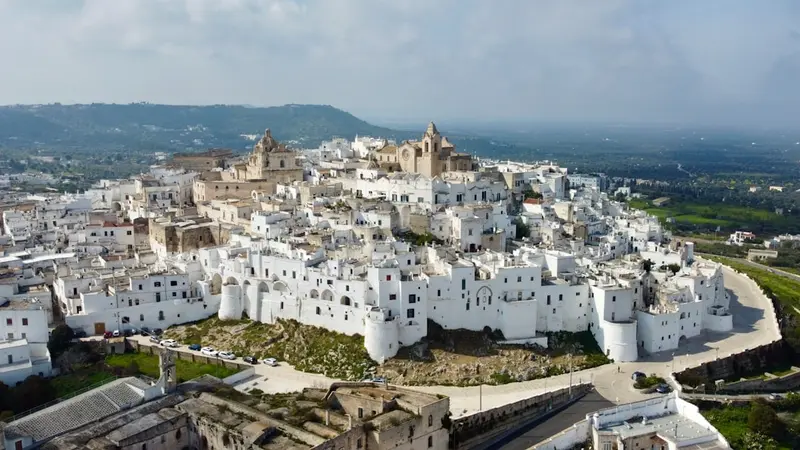
Ostuni is situated on three hills at the edge of the Murgia, about 7.5 kilometers from the Adriatic coast. The lime-whitewashed houses of the old town have earned it the nickname Città Bianca, the white city.In the old town, alleys, stairs, and arches lead up to the cathedral with its late Gothic facade and a large rose window. Surrounding the city lies the Piana degli Ulivi with numerous monumental olive trees.
2 Sights
2 Restaurants
History and Traditions
Discoveries from the surrounding grottoes attest to settlement since the Paleolithic Age. The most famous is the Donna di Ostuni, the approximately 28,000-year-old skeleton of a pregnant woman found in the Grotto Santa Maria di Agnano in 1991; a cast of the burial site can be seen in the city's museum.The whitewash of the houses brightened the narrow medieval alleys; during the 17th-century plague, it was also considered a disinfectant.On August 26, the Cavalcata di Sant'Oronzo takes place, where riders in red uniforms on richly adorned horses parade through the streets in honor of the city's patron saint.
Rich in culture and history. Perfect for an exciting city trip.
Lecce, Salento's provincial capital, has an old town shaped by baroque churches and palaces, built from the region's light, soft, dense limestone, the *pietra leccese*. Its easy workability fostered a unique, richly ornamented Baroque style here in the 17th century.Roman remains, including the Amphitheater on Piazza Sant'Oronzo and the Theater in the old town, lie beside the baroque facades. The city's territory stretches over 20 kilometers of coast to the Adria.
5 Sights
3 Restaurants
History and the Baroque
Lecce dates back to a Messapian settlement and was known as Lupiae in Roman times. From this era stem the amphitheater, about a third of which is visible, and the Augustan-era theater. On Piazza Sant'Oronzo stands a column that Brindisi gifted to the city.In the 17th century, the Barocco leccese spread with densely ornamented facades. An important master builder was Giuseppe Zimbalo, who rebuilt the Cathedral. Karl V. had the castle fortified from 1539; in his honor, Porta Napoli was erected in 1548.Papier-mâché figures, the cartapesta, are a traditional craft of Lecce.
Otranto is located on the Adriatic coast of Salento. Just south of the city, Punta Palascìa marks Italy's easternmost point, and is also the closest point to Albania.The old town, with its Norman Cathedral and Aragonese Castle, overlooks the harbor. North of the city lie the Laghi Alimini and the Baia dei Turchi.
3 Sights
3 Restaurants
History and Culture
Otranto was a Messapian settlement and later a Roman one, who called it Hydruntum. The Basilian monks of the Monastery of San Nicola di Casole, a few kilometers south of the city, possessed one of the largest libraries in the Western world, which was destroyed in 1480.In July 1480, Ottoman troops landed and besieged the city for about two weeks; it fell on August 11th. Around 800 inhabitants, who refused to renounce their faith, were executed on August 14th. Pope Francis canonized them in 2013 as the Martyrs of Otranto; a part of their remains is kept in the cathedral. In 1481, Alfonso of Aragon recaptured the city; from 1485, the new castle was built.The cathedral's mosaic was created by a team led by the Basilian monk Pantaleone between 1163 and 1165. It depicts, along a Tree of Life, scenes from the Old Testament, chivalric epics, animals from medieval bestiaries, and the Romance of Alexander.
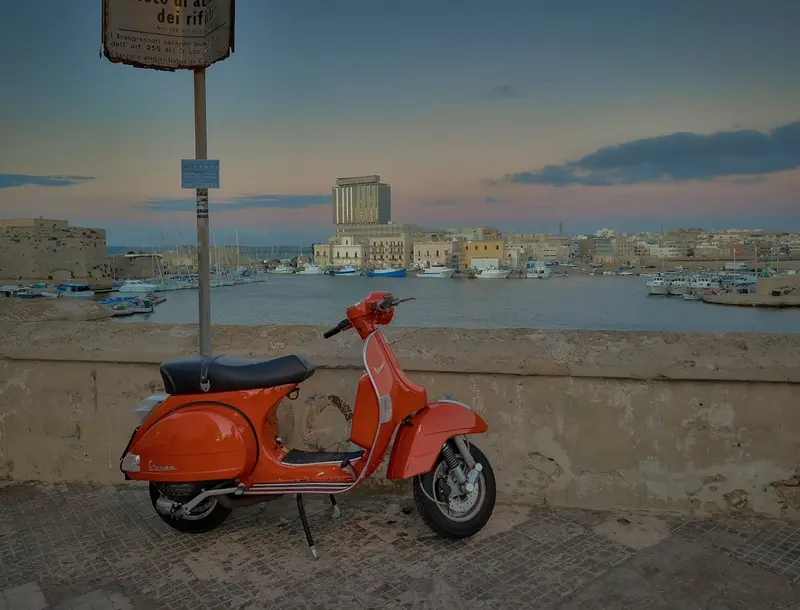
Gallipoli is located on the west coast of Salento on the Ionian Sea. The old town is situated on a small limestone island, connected by a 17th-century bridge to the new town on the mainland. A waterfront promenade circles around it, linking the bastions of the old city wall.In the narrow streets of the old town stand Baroque churches and palazzi, including the Cathedral Sant'Agata. South of the city, sandy beaches such as Baia Verde and Punta della Suina stretch along the coast.
4 Sights
3 Restaurants
History and Culture
The name is presumed to derive from the Greek Kallipolis, meaning beautiful city. In the 4th century BC, Gallipoli was likely a base of Tarentum, and after the Social War, it became a Roman municipium. Later, among others, the Angevins and Aragonese shaped the city, as demonstrated by the expansion of its castle.From the 16th to the 19th century, Gallipoli exported lamp oil, the price of which was listed on the exchanges of Naples and London. It was pressed in underground mills, the frantoi ipogei, with around 35 of them built beneath the old town.The city's brotherhoods have their own churches, such as Santa Maria della Purità for the port workers. During Holy Week, among other things, the wooden figure of the dead Christ from the Church of del Crocifisso is carried in a procession.