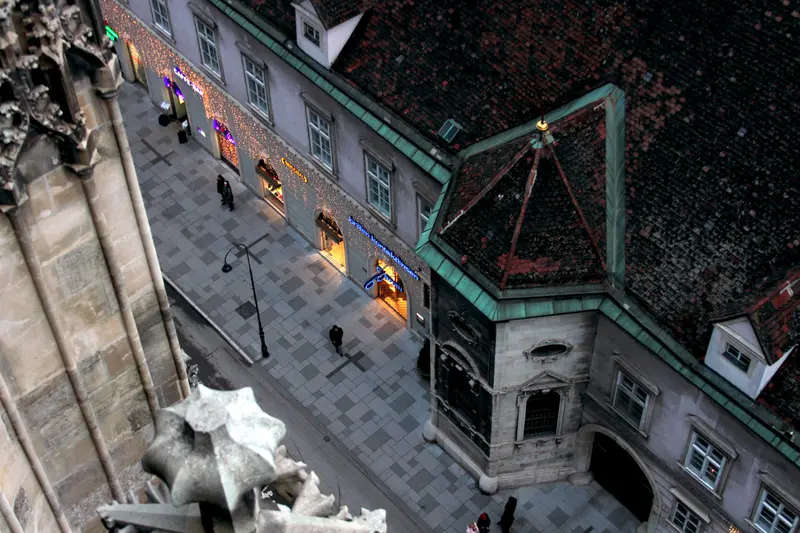
Photo by Lydia Gulinkina on Unsplash
City trip · Austria
Vienna in four days
by Felix Gillen
- 5 Days / 4 Nights
Four days between the imperial city and its Grätzl neighbourhoods: on arrival day the Innere Stadt with St. Stephen's Cathedral, the Hofburg and the Opera, then a day with Bruegel, the Naschmarkt and Klimt, Schönbrunn in the morning and the Brunnenmarkt in Ottakring in the afternoon, and finally Leopoldstadt, the Prater and an evening at a Heuriger. Vienna opens up by U-Bahn and tram; in between you walk and sit in a Kaffeehaus, as the Viennese do. You eat in a Wirtshaus, at the market and at the Heuriger.
At a glance
- Duration
- 5 Days / 4 Nights
- Stops
- 1
- Arrival
- Train · Wien Hbf
- Best Time to Go
- April–June, September–October, Advent
1 stop
Why This Route?
Vienna is easy to reach by train from Germany and Switzerland and easy to get around by U-Bahn and tram. The route puts the big collections and palaces in the mornings, when they are quieter, and spends the afternoons in the districts where Vienna lives and shops: at the markets in Ottakring and Leopoldstadt and out among the vineyards.
Hidden Gems
- Standing room at the State Opera costs just a few Euros, sold on the day of the performance
- A Heuriger is open when a pine bough hangs above the door: offering house wine and cold dishes
- In summer, Viennese swim in the Old Danube, accessible via U1
- Vienna's tap water is high-alpine spring water, served without asking in coffee houses.
Getting there and back
Round trip, returning to where you started
- Arrival
- Train · Wien HbfThe Railjet from Munich reaches Wien Hbf in about four hours, and the Nightjet arrives overnight from Hamburg, Berlin, Düsseldorf or Zurich. From the main station the U1 gets you to Stephansplatz in five minutes. A 72-hour Wiener Linien ticket is worth it for public transport.
- Departure
- Train · Wien HbfBack the way you came; reserve a seat or couchette early, as westbound trains are full on Fridays and Sundays.
Day by day
Day 1: Innere Stadt
- St. Stephen's CathedralFrom the main station the U1 takes five minutes to Stephansplatz. 343 steps lead up the South Tower; visits take place outside services, so cover shoulders and knees.
- Plachutta WollzeileA few steps into Wollzeile: Tafelspitz and other classics of Viennese boiled-beef cooking; book for dinner.
- HofburgAlong the Graben and Kohlmarkt to the Hofburg. The Imperial Apartments with the Sisi Museum or the State Hall of the National Library; both in one afternoon is tight, so book a time slot online.
- Vienna State OperaIn the evening a standing place from a few euros: they go on sale only on the day of the performance from 10 a.m., online, by phone or at the day box office. During the day there are guided tours of the house.
- Loos American BarAfter the opera, into Kärntner Durchgang: a cocktail in the bar Adolf Loos built in 1908 on about 27 square metres.
Day 2: Bruegel, Naschmarkt and Klimt
- Kunsthistorisches MuseumStraight to the Bruegel room when it opens at 10 a.m. Open daily 10 a.m.–6 p.m., Thursdays until 9 p.m.
- MuseumsQuartier and SpittelbergAcross the road into the MuseumsQuartier, sit on the Enzis loungers in the courtyard, then through the Biedermeier lanes of Spittelberg.
- Café SperlTen minutes to Gumpendorfer Strasse: a coffee house from 1880 with billiard tables, for a Melange and a slice of cake.
- NaschmarktLunch at the stalls between fruit, spices and olives; closed on Sundays, and on Saturdays the flea market sets up at the far end.
- KarlskircheThe baroque domed church on Karlsplatz, with a Henry Moore sculpture in the pool in front.
- BelvedereA 15-minute walk south. The Upper Belvedere holds The Kiss and works by Schiele, with timed tickets online; the baroque garden lies between the two palaces.
- GmoakellerDown to the Heumarkt: Viennese tavern cooking since 1858. Mon–Sat 11 a.m.–midnight, closed on Sundays and public holidays.
Day 3: Schönbrunn and Ottakring
- Schönbrunn PalaceU4 to Schönbrunn at opening time. The state rooms have timed tickets; the park is free, so walk up to the Gloriette.
- Brunnenmarkt and YppenplatzU4 to Längenfeldgasse and U6 to Josefstädter Strasse. Lunch at a stall or restaurant on Yppenplatz; the market runs Mon–Sat, with a farmers' market on Saturdays.
- Stadtbahn arches on the GürtelUnder the viaducts of Otto Wagner's Stadtbahn, now used by the U6, there are bars, clubs and restaurants.
- Kent (Brunnengasse)Back on Brunnengasse: meze, meat and fish from the charcoal grill of the open kitchen in the first Kent, opened in 1990.
- B72Five minutes to the Gürtel: a concert or DJ night in the Stadtbahn arches, running since 1998; the programme is online.
Day 4: Leopoldstadt, Prater and Heuriger
- Café PrückelBreakfast in the 1903 coffee house on Stubenring, then on foot across the Danube Canal into Leopoldstadt.
- KarmelitermarktIn the morning, best on Saturday with the farmers' market. Until 1938 the area was shaped by Jewish life.
- Prater and HauptalleeAlong Taborstrasse to Praterstern and a stretch down the chestnut-lined Hauptallee, where the Viennese run and cycle.
- Giant Ferris Wheel (Wiener Riesenrad)The Giant Ferris Wheel from 1897 at the entrance to the Wurstelprater, known from the film The Third Man.
- KahlenbergU1 and U4 to Heiligenstadt, bus 38A up the hill, and back on foot through the vineyards.
- Mayer am PfarrplatzA traditional Heuriger in the Beethoven house on Pfarrplatz in Heiligenstadt; Mon–Thu from 4 p.m., Fri–Sun and public holidays from noon.
Itinerary
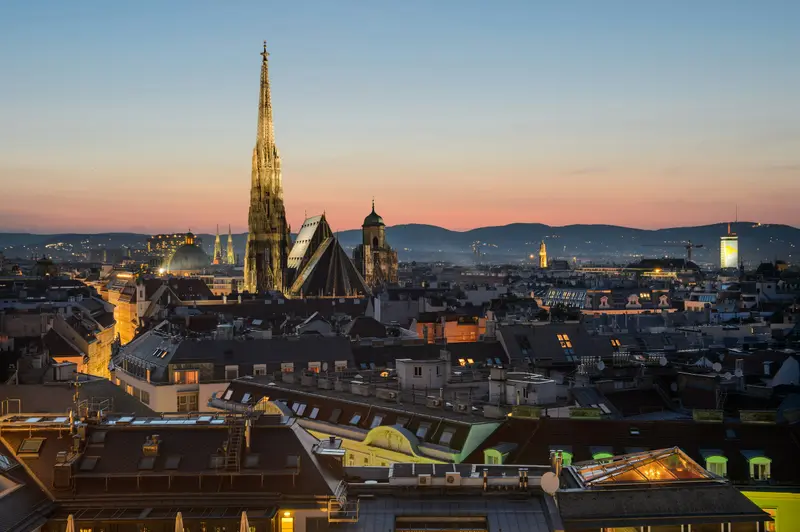
Vienna
Austria's capital on the Danube was for centuries the residence of the Habsburgs. Around St. Stephen's Cathedral are the Hofburg, State Opera and the Ringstrasse; to the west is Schönbrunn Palace, and in the Prater, the Giant Ferris Wheel spins. Coffeehouse culture and Heurige are part of UNESCO's intangible cultural heritage.
Stay inside the Gürtel, for example in Neubau, Mariahilf, Wieden or Leopoldstadt; from there you reach everything by U-Bahn and tram. The Viennese travel on an annual pass; for you a 72-hour Wiener Linien ticket from the WienMobil app is worth it. Book time slots online for the Imperial Apartments, Schönbrunn and the Belvedere. In a coffee house you take a free table yourself, wait for the waiter and pay at the table; nobody will rush you.
9 Sights
5 Restaurants
Kaffeehaus, Heuriger and Music
Coffee House and HeurigerViennese coffee house culture and Heuriger culture are part of the intangible cultural heritage. In a coffee house, you can stay as long as you like; at a Heuriger, vintners on the city's outskirts serve their own wine. A pine branch and the sign "Ausg’steckt" indicate that it's open. "Heuriger" also refers to the young wine, traditionally available until St. Martin's Day on November 11.Imperial LegacyFor centuries, Vienna was the residence of the Habsburgs. The Hofburg houses the Imperial Apartments, Sisi Museum, and Imperial Treasury; in the west of the city lies Schönbrunn Palace with its Tiergarten (zoo), founded in 1752, the world's oldest still-existing zoo. The Habsburgs have been interred in the Imperial Crypt (Kaisergruft) beneath the Capuchin Church since 1633.Art and MusicGustav Klimt's "The Kiss" is in the Upper Belvedere; the Leopold Museum (MuseumsQuartier) showcases Egon Schiele and Klimt.The Kunsthistorisches Museum at Maria-Theresien-Platz holds the world's largest Bruegel collection.UNESCO honors Vienna as a leading European music center from the 16th to 20th centuries. The State Opera on the Ringstrasse is its musical heart, and the Opera Ball one of the nation's most famous social events.
Plan this route as your trip
All stops, trains and nights go into your trip planner. You adjust dates and places to stay afterwards.
This route is a suggestion from our research. Please check timetables, times in port, opening hours and prices before you book – what your tour operator or carrier says is what counts.
Fernweh is a free travel guide and trip planner: routes researched by people, taken over in one click, used day by day on the road. More about Fernweh
1 stop
Route Summary
Duration5 Days
Stops1 Places
TypeCulture