Photo by Yana Oleksiuk on Pexels
Night train trip
Two night trains: from Berlin to Krakow and to the Baltic Sea to Gdansk
by Felix Gillen
- 7 Days / 6 Nights
- Berlin → Danzig (Gdańsk)
Late in the evening, the Polish night train departs from the German border to Krakow, and early in the morning you are in the old royal city. After three nights, you take the next night train across the country to the Baltic Sea and wake up in Gdansk. There you stay three nights and during the day travel back to Berlin on the EuroCity. Two nights on the train, two cities with completely different histories, and no journey that costs you a vacation day.
At a glance
- Duration
- 7 Days / 6 Nights
- Stops
- 3 · Berlin → Danzig (Gdańsk)
- Countries on the route
- Poland, Germany
- Arrival
- Train · Berlin Hbf
- Departure
- Train · Gdańsk Główny
- Nights on a night train or ferry
- 2
- Best Time to Go
- May to September. July and August see Krakow and Gdansk crowded
More on when to go
Both cities have Christmas markets in Advent.
3 stops
Why This Route?
Krakow and Gdańsk are at opposite ends of Poland; the night train connects them without a domestic flight or a lost day. You'll travel on the same trains Poles use for their holidays and, beyond the old towns, discover markets, neighborhoods, and cuisines away from the main squares.
Hidden Gems
- Nowa Huta, the socialist model district in eastern Krakow, about 30 minutes by tram
- Podgórze on the Vistula's south bank, with Krakus Mound and city views
- Oliwa Abbey in Gdańsk, about 20 minutes by SKM commuter rail
Getting there and back
Open jaw: start and end are in different places
- Arrival
- Train · Berlin HbfThe night train to Krakow (continuing to Przemyśl) currently starts at the border due to construction work: Late 2026, a replacement bus departs from Berlin Hbf (Invalidenstraße) at 20:30 for Rzepin; in spring 2027, the RE1 takes you to Frankfurt (Oder). Book tickets with PKP Intercity; check the feeder service shortly before your trip.
- Departure
- Train · Gdańsk GłównyReturn daily: Eurocity EC 230 Gdańsk Główny departs 7:29 for Frankfurt (Oder), then Berlin via replacement bus or RE1, arrival early afternoon (Autumn 2026). Alternatively, travel via Warsaw.
Itinerary
Start
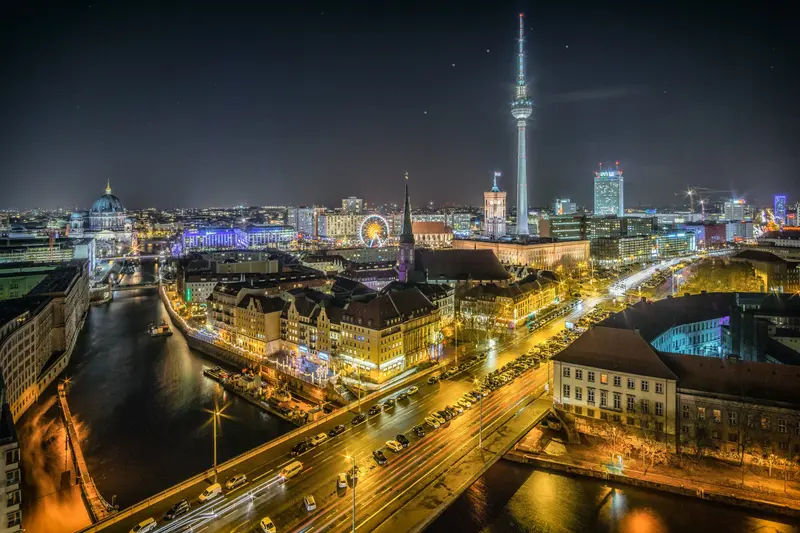
Berlin
Evening departure, bring snacks for the night. Until end 2026, a replacement bus departs Berlin Hbf at 20:30 for the train to Rzepin; from spring 2027, the RE1 to Frankfurt (Oder).
Night train
PKP Intercity IC 431 Rzepin 23:31 → Kraków Główny 6:35, daily. From spring 2027 from Frankfurt (Oder) 23:12 → Krakow 5:46.
Krakow (Kraków)
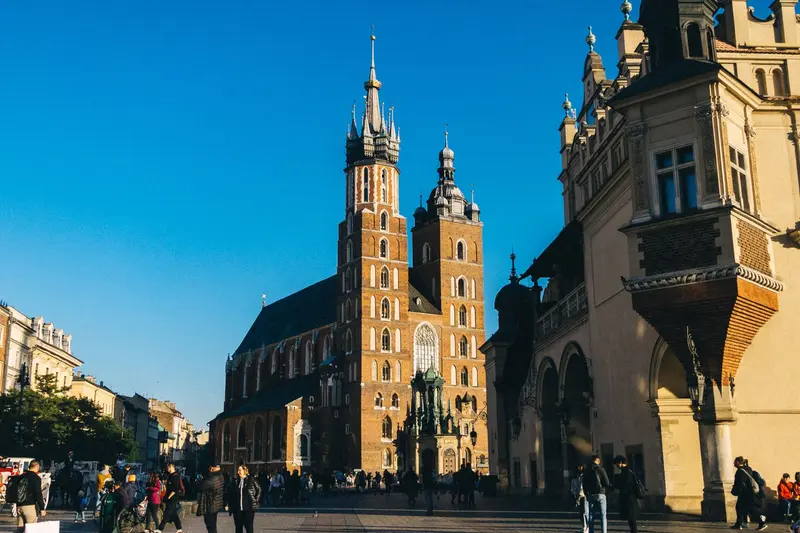
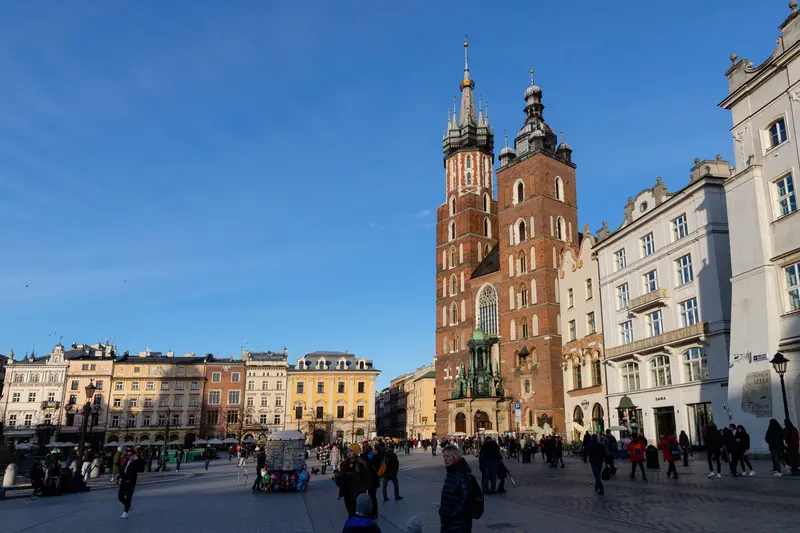
Krakow (Kraków) lies on the Vistula in southern Poland and, with around 800,000 inhabitants, is the country's second-largest city. Until 1596, it was the capital of the Kingdom of Poland; on Wawel Hill, kings were crowned until 1734 and most of them were interred. Since 1978, its historic center—the Old Town, Wawel, Stradom, and Kazimierz—has been a UNESCO World Heritage site.The Old Town (Stare Miasto) surrounds the Rynek Główny, whose layout dates back to 1257. A green belt, the Planty, occupies the site of the former city fortifications; the historic Royal Route begins at St. Florian's Gate and led coronation processions up to Wawel. South of it lies Kazimierz, founded as a separate city in 1335 and for centuries a center of Jewish life. Today, synagogues, cafés, and bars mingle there.Beyond the Vistula lies Podgórze, where German occupiers established the ghetto in 1941; in the Zabłocie district stands Oskar Schindler's former enamel factory. To the east, Nowa Huta is an industrial city of the socialist era, incorporated in 1951.
Shop in the morning at Stary Kleparz, where local farmers sell smoked cheese, mushrooms, and fruit. Eat Polish cuisine at Pod Nosem, between the Old Town and Wawel, or at Kogel Mogel. Away from the Rynek, Podgórze on the other Vistula bank and Nowa Huta, the socialist district, are worth a tram ride.
8 Sights
7 Restaurants
Culture and History
Royal City and UniversityKrakow was residence of Polish kings until 1596, when Sigismund III moved the court to Warsaw. Wawel Cathedral remained the coronation and burial church. In 1364, Casimir the Great founded the Krakow Academy (today's Jagiellonian University), Central Europe's second oldest university after Prague. From St. Mary's Church's taller tower, the Hejnał, a trumpet melody stopping mid-note, is played hourly, recalling a legendary 1241 Mongol attack.Jewish KrakowKazimierz hosts central Jewish historical buildings: the Old Synagogue, Remuh Synagogue (with cemetery), Tempel Synagogue, and Isaac Synagogue. The Old Synagogue is now a museum. Since 1988, the Jewish Culture Festival is held annually, from late June to early July. In Podgórze, the ghetto sites and Schindler's Factory recall the persecution and murder of Krakow's Jews under German occupation.
Night train
TLK 38170 Kraków Główny 21:14 to Gdańsk Główny 5:55, daily (Autumn 2026).
Danzig (Gdańsk)
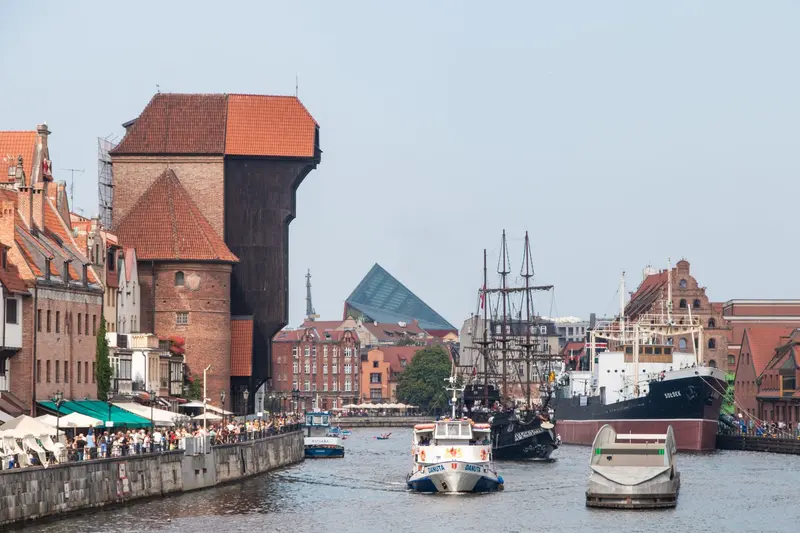
Danzig (Gdańsk) is located on Gdańsk Bay, where the Motława River flows into the Baltic Sea, west of the Vistula estuary. With nearly 490,000 inhabitants, the capital of the Pomeranian Voivodeship is Poland's sixth-largest city and forms the Tri-City (Trójmiasto) with Sopot and Gdingen (Gdynia). For centuries, Danzig was a Hanseatic city, prospering through grain trade and amber. In 1945, its center lay almost entirely in ruins, but it was rebuilt under Polish leadership.
The heart is the Main Town (Główne Miasto) with Long Lane, Long Market, and Mariacka Street. To the north lies the Old Town, and east of the Motława are Granary Island and Langgarten. Further north, the shipyards dominate the landscape, where Solidarność originated in 1980. Outside the center are Langfuhr (Wrzeszcz) and Oliva (Oliwa). In Oliwa, you'll find the monastery founded around 1185 and the cathedral.
A weekend is sufficient for the Old Town and the main museums. With two or three more days, you can visit Westerplatte and take the S-Bahn to Sopot or continue to the Hel Peninsula.
At the 1896 Hala Targowa, locals buy fish, sausages, and bread; in the basement, you can see the foundations of a medieval church. For dining, Hewelke, located in an old brewery with a Bib Gourmand, is a good choice. You can reach Oliva Monastery and Sopot by SKM suburban train, and Westerplatte by bus or boat.
7 Sights
4 Restaurants
Culture and History
Hanseatic City and Reconstruction
Gdańsk was a member of the Hanseatic League from 1361 until the last Hansetag in 1669. This story is told by the gabled houses of Langgasse, Artushof as a meeting place for merchants, and St. Mary's Church, one of the three largest brick churches north of the Alps. Much of what you see today is the result of reconstruction after 1945. On Long Market, the 44th Modern Hansetag was opened in June 2024.
Where the 20th Century Began and Ended
On September 1, 1939, the battleship Schleswig-Holstein shelled the Polish garrison on Westerplatte; the attack is considered the start of World War II in Europe. In August 1980, workers at the Lenin Shipyard went on strike, and from their strike committee under Lech Wałęsa, the Solidarność trade union emerged. The Museum of the Second World War and the European Solidarność Centre tell both chapters in detail.
Plan this route as your trip
All stops, trains and nights go into your trip planner. You adjust dates and places to stay afterwards.
This route is a suggestion from our research. Please check timetables, times in port, opening hours and prices before you book – what your tour operator or carrier says is what counts.
Fernweh is a free travel guide and trip planner: routes researched by people, taken over in one click, used day by day on the road. More about Fernweh
3 stops
Route Summary
Duration7 Days
Stops3 Places
TypeCulture