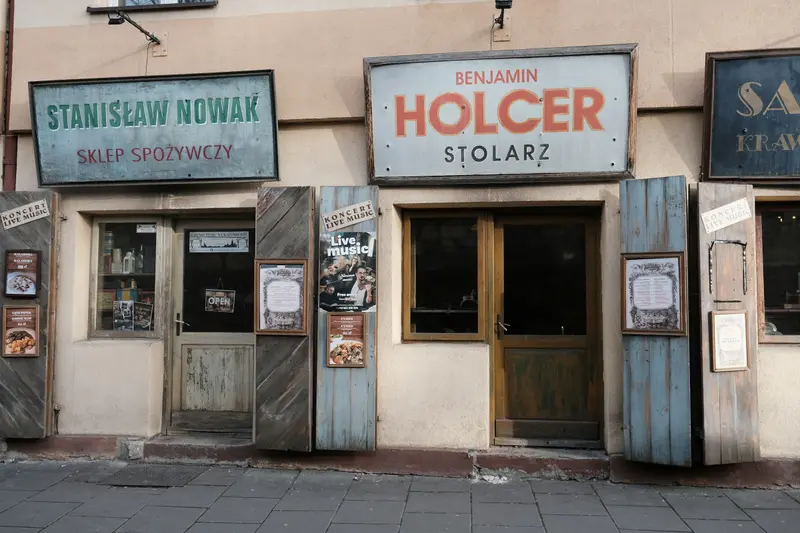
Photo by Noemi Palmieri on Unsplash
City trip · Poland
Kraków in four days
by Felix Gillen
- 5 Days / 4 Nights
Four days, four faces of the city: on arrival day the Rynek, St. Mary's Church and the university, then Wawel and the Jewish quarter of Kazimierz, on the third day the socialist planned town of Nowa Huta, the former ghetto in Podgórze and Schindler's factory, and finally the Wieliczka salt mine. You walk the Old Town, take the tram to the outer districts and the regional train to Wieliczka. You eat in a milk bar, at a hatch on Plac Nowy and in Nowa Huta's oldest restaurant.
At a glance
- Duration
- 5 Days / 4 Nights
- Stops
- 1
- Arrival
- Train · Kraków Główny
- Best Time to Go
- May to June and September: mild and good for walking. In late June and early July Kazimierz hosts the Jewish Culture Festival, and in Advent the Christmas market and nativity scenes fill the Rynek. July and August are hot and crowded
More on when to go
Winter is cold, but the city is quiet.
1 stop
Why This Route?
Kraków is compact but many-layered: royal city, Jewish quarter, site of the German occupation and socialist experiment lie a few tram stops apart. The route gives each chapter a day, puts Wawel and the salt mine with timed tickets in the mornings, and takes you to Nowa Huta, where hardly any tour bus goes.
Hidden Gems
- On the first Thursday in December, Kraków families display their home-made nativity scenes (szopki) at the Mickiewicz monument on the Rynek
- The tabernacle of the Ark of the Lord church in Nowa Huta, which residents built against the Party's will, holds a piece of moon rock
- From Krakus Mound in Podgórze you can see across the Vistula to Wawel at sunset, free and usually without crowds
Getting there and back
Round trip, returning to where you started
- Arrival
- Train · Kraków GłównyFrom Berlin the EuroCity runs direct via Wrocław to Kraków Główny three times a day, taking about seven hours. If you fly, the train from Balice airport (KRK) reaches the main station in about 20 minutes. From there it is a ten-minute walk through Planty park into the Old Town.
- Departure
- Train · Kraków GłównyBack from Kraków Główny; trains to Berlin are full at weekends, so reserve a seat. You can stock up for the journey at the Stary Kleparz market north of the Old Town.
Day by day
Day 1: Old Town: Rynek, St. Mary's and the university
- Barbican and St. Florian's GateTen minutes on foot from the main station through Planty park, laid out on the old city moat, and through St. Florian's Gate into Floriańska Street.
- St. Mary's Church (Bazylika Mariacka)Veit Stoss's altarpiece is opened Mon–Sat at 11:50 a.m. and on Sunday afternoons. The visitor area of the church requires a ticket.
- Rynek Główny and Cloth HallsThe ground floor of the Cloth Hall is souvenir stalls; upstairs the National Museum shows 19th-century Polish painting. On the hour you hear the Hejnał from the tower.
- Bar Mleczny Pod Temidą (milk bar)Along Grodzka to the milk bar: self-service, you order at the counter from the board and eat at simple tables, Polish home cooking at low prices.
- Collegium MaiusBack towards the Rynek on ul. Jagiellońska: the Gothic arcaded courtyard of the university where Copernicus studied.
- Kogel MogelKraków classics reinterpreted, on ul. Sienna near the Rynek; book for dinner.
- Evening walk on the PlantyThe green belt encircles the whole Old Town; in the evening locals take a stroll here and the walls by St. Florian's Gate are lit up.
Day 2: Wawel, the Vistula and Kazimierz
- Wawel: Royal Castle and CathedralUp at opening time. Timed tickets for the castle exhibitions online; the cathedral has its own ticket office. On Mondays selected exhibitions are free, with a limited number of tickets.
- Vistula boulevardsFrom the Dragon's Rock below Wawel east along the river, about 15 minutes to Kazimierz.
- Kazimierz and Old SynagogueThe Old Synagogue tells the history of Kraków's Jews; nearby stand the Remuh Synagogue with its old cemetery, the Tempel and the Isaak synagogues. On the Sabbath the synagogues are closed to visitors.
- Zapiekanki in Okrąglak at Plac NowyAt the round market pavilion from 1900, a zapiekanka from one of the hatches, eaten standing up like everyone else.
- NOAHIsraeli dishes for sharing, Bib Gourmand in the Michelin Guide; book for dinner.
- AlchemiaA candlelit pub with old furniture on ul. Estery, with concerts in the cellar.
Day 3: Nowa Huta, Podgórze and Zabłocie
- Nowa Huta and Plac CentralnyTram 4 from Dworzec Główny to Plac Centralny in about half an hour. Walk along Aleja Róż and through the courtyards of the housing blocks, where the neighbourhood lives.
- Restauracja StylowaLunch in Nowa Huta's oldest restaurant, opened in 1956, serving Polish cooking.
- Oskar Schindler Enamel FactoryBack to Zabłocie by tram. Tickets are limited, sold online up to 90 days ahead and personalised, so bring ID; on Mondays entry is free, but without advance booking.
- Plac Bohaterów GettaTen minutes on foot: on the square of the former Podgórze ghetto, empty bronze chairs form a memorial, and on the corner stands the Pod Orłem pharmacy, now a museum.
- Krakus Hill (Kopiec Krakusa) in PodgórzeAbout 20 minutes uphill through Podgórze, in time for sunset; from the top you see across the Vistula to the Old Town.
- FolgaBack to Kazimierz over the Bernatek footbridge, Bib Gourmand in the Michelin Guide; book ahead.
- SingerA candlelit bar with tables made from old sewing machines, one of the first in Kazimierz; it fills up late at night.
Day 4: Wieliczka salt mine and departure
- Wieliczka Salt MineRegional train SKA1 from Kraków Główny to Wieliczka Rynek-Kopalnia, then a few minutes on foot. The Tourist Route is about 3.5 kilometres long and takes two to three hours; buy tickets online in advance.
- Obwarzanek from a cartBack in Kraków: from the small carts locals buy the obwarzanek, a twisted yeast ring with poppy seeds, sesame or salt, protected in the EU as a regional speciality.
- Stary KleparzA few minutes north of the Old Town: farmers from the countryside sell fruit, vegetables, mushrooms, smoked cheese and sausage; good for supplies for the train.
- To Kraków Główny stationWalk from the market to the main station; allow half an hour before your train.
Itinerary
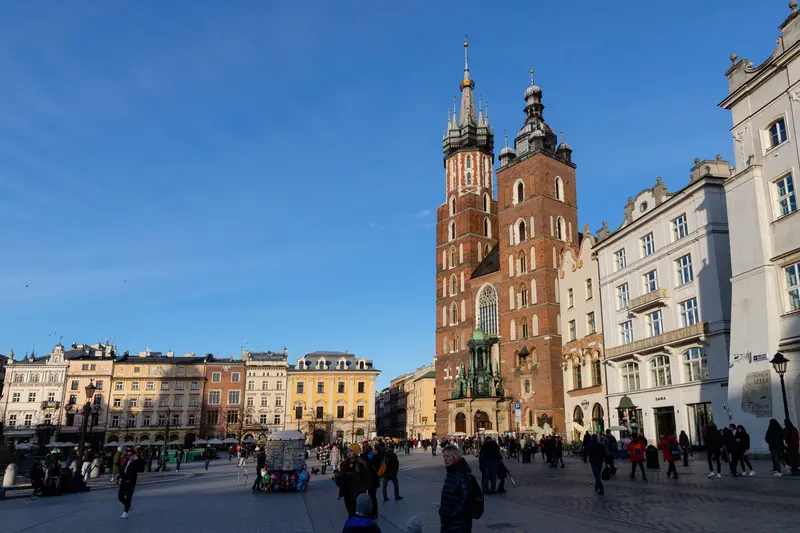
Kraków
Krakow (Kraków) lies on the Vistula in southern Poland and, with around 800,000 inhabitants, is the country's second-largest city. Until 1596, it was the capital of the Kingdom of Poland; on Wawel Hill, kings were crowned until 1734 and most of them were interred. Since 1978, its historic center—the Old Town, Wawel, Stradom, and Kazimierz—has been a UNESCO World Heritage site.The Old Town (Stare Miasto) surrounds the Rynek Główny, whose layout dates back to 1257. A green belt, the Planty, occupies the site of the former city fortifications; the historic Royal Route begins at St. Florian's Gate and led coronation processions up to Wawel. South of it lies Kazimierz, founded as a separate city in 1335 and for centuries a center of Jewish life. Today, synagogues, cafés, and bars mingle there.Beyond the Vistula lies Podgórze, where German occupiers established the ghetto in 1941; in the Zabłocie district stands Oskar Schindler's former enamel factory. To the east, Nowa Huta is an industrial city of the socialist era, incorporated in 1951.
Stay in the Old Town inside the Planty or in Kazimierz: they are a twenty-minute walk apart, and in the evening you have places to eat on your doorstep. Locals use MPK time tickets from the app or from the machine on board the tram, which takes cards; a 72-hour ticket covers trams and buses in the city but not the regional train to Wieliczka. On most Sundays shops in Poland are closed, though restaurants and small corner shops are not. If you want to visit the Auschwitz-Birkenau Memorial, plan a separate day and reserve your ticket in advance at visit.auschwitz.org.
8 Sights
7 Restaurants
Culture and History
Royal City and UniversityKrakow was residence of Polish kings until 1596, when Sigismund III moved the court to Warsaw. Wawel Cathedral remained the coronation and burial church. In 1364, Casimir the Great founded the Krakow Academy (today's Jagiellonian University), Central Europe's second oldest university after Prague. From St. Mary's Church's taller tower, the Hejnał, a trumpet melody stopping mid-note, is played hourly, recalling a legendary 1241 Mongol attack.Jewish KrakowKazimierz hosts central Jewish historical buildings: the Old Synagogue, Remuh Synagogue (with cemetery), Tempel Synagogue, and Isaac Synagogue. The Old Synagogue is now a museum. Since 1988, the Jewish Culture Festival is held annually, from late June to early July. In Podgórze, the ghetto sites and Schindler's Factory recall the persecution and murder of Krakow's Jews under German occupation.
Plan this route as your trip
All stops, trains and nights go into your trip planner. You adjust dates and places to stay afterwards.
This route is a suggestion from our research. Please check timetables, times in port, opening hours and prices before you book – what your tour operator or carrier says is what counts.
Fernweh is a free travel guide and trip planner: routes researched by people, taken over in one click, used day by day on the road. More about Fernweh
1 stop
Route Summary
Duration5 Days
Stops1 Places
TypeCulture