A relaxed route through Southern Sweden with Baltic Sea beaches, coastal towns, and the forests of Småland. From Malmö, the journey goes along the south coast via Ystad to Karlskrona, continuing to Kalmar and Öland, and via Växjö back to the west coast to Halmstad. It’s ideal for a first trip to Sweden and for families, as the stages are mostly short.
16 Days / 15 Nights
May to September
RV Friendly
7 stops
Why This Route?
For families and first-timers to Sweden, wanting to combine coast, forest, and small towns with short stages.
Hidden Gems
Ales Stenar near Kåseberga, east of Ystad, a stone ship formation atop the cliffs
Stumholmen in Karlskrona, with its Naval Museum and harbor views
Långe Jan Lighthouse, Öland's southern tip near Ottenby, where migratory birds rest spring/autumn.
Itinerary
Stop 1 • 2 Nights
Malmö
City
Perfect for an exciting city trip. Rich in culture and history and Culinary highlights.
Malmö has a good 360,000 inhabitants, making it Sweden's third-largest city, and lies on the Öresund, about 40 minutes by train from Copenhagen. The old town around Stortorget and Lilla Torg, the Renaissance castle Malmöhus and the Turning Torso residential tower in the Västra Hamnen harbour district show the range of the city. More than a third of residents were born abroad, which is clearly noticeable in its markets, snack bars and restaurants.
7 Sights
4 Restaurants
Culture and History
From Herring City to Bridge CityMalmö was a Danish trading city in the Middle Ages, sustained by herring fishing. The brick Gothic of Sankt Petri kyrka dates from this era, and the merchant houses around Lilla Torg from the following centuries of Danish rule. In 1658, the city fell to Sweden. In the 20th century, the Kockums shipyard shaped the cityscape until civil shipbuilding ended in 1986. With the Öresund Bridge (2000) and the redevelopment of the shipyard area into Västra Hamnen, Malmö reinvented itself.Cultural LifeModerna Museet Malmö and the Konsthall showcase contemporary art, while Malmö Live Konserthus presents classical and pop music. In August, the Malmöfestivalen city festival transforms the city centre for a week into an open-air stage with free admission.
Rich in culture and history. Perfect for an exciting city trip.
Ystad is a small port town on the south coast of Skåne with a well-preserved historic town centre. Around 300 half-timbered houses, St. Mary's Church, and the Franciscan Monastery, founded in 1267, define the old town. Ystad is also known as the setting for Henning Mankell's Wallander crime novels and as a ferry port to Bornholm.
5 Sights
5 Restaurants
Middle Ages and Wallander
A Medieval Trading TownYstad emerged in the Middle Ages as a trading post under Danish rule, thriving on herring fishing and Baltic Sea trade. Dating from this period are the Marienkirche on Stortorget, whose oldest part dates back to the early 13th century, and the Franziskanerkloster Gråbrödraklostret from 1267, one of the best-preserved monasteries in the country and now home to the city museum. From the tower of the Marienkirche, a town crier has blown his horn every quarter of an hour from evening until midnight since 1748, a tradition that harks back to the old fire watch. Ystad has belonged to Sweden since 1658. The many half-timbered houses, including the Pilgrändshuset from 1480, one of the oldest half-timbered houses in Scandinavia, show how prosperous the town was for centuries.Crime Fiction SettingYstad gained worldwide fame through the novels by Henning Mankell featuring Inspector Kurt Wallander, who investigates here. The Swedish and British film adaptations are set in Ystad and its surroundings, and the visitor center next to the film studios features a Wallander exhibition. Many visitors follow the book's locations through the old town.
Rich in culture and history. Ideal for city trips and urban experiences and Stunning nature and outdoors.
Karlskrona was founded in 1680 as the main base for the Swedish fleet on islands in the Blekinge archipelago. Baroque churches, the large market square Stortorget, shipyard, and fortresses have been UNESCO World Heritage since 1998. To this day, the city is the seat of the Swedish Navy and a starting point for boat trips into the archipelago.
4 Sights
4 Restaurants
Marine City of the Baroque
A City for the FleetAfter Blekinge was ceded to Sweden in 1658, the Swedish government planned to relocate the bulk of its fleet further south from the Stockholm area. In November 1679, Karl XI designated Trossö as the site, and in 1680, the city named after him received its municipal charter. The planned city, with its wide streets, squares, and sightlines, embodies Baroque ideals. The Fredrikskyrkan (consecrated 1744) and the Trefaldighetskyrkan on Stortorget are based on designs by Nicodemus Tessin the Younger. The wooden Admiralitetskyrkan was consecrated in 1685, its timber sourced from Riga. In front of it stands a copy of the painted wooden figure Gubben Rosenbom, a collection box brought to life by Selma Lagerlöf in "Nils Holgersson"; the original is now in the church.World Heritage and NavyIn 1998, UNESCO inscribed Karlskrona onto the World Heritage List as an exceptionally well-preserved example of a planned European naval city. This includes, besides the Old Town, the shipyard, the fortresses of Kungsholms fort and Drottningskär at the bay's entrance, further fortifications on smaller islands, and the Kronmühle in Lyckeby. The navy continues to shape the city to this day; many areas are only accessible with a guided tour. The Marinmuseum on Stumholmen tells the history of the Swedish fleet with ship models, figureheads, and a submarine hall.
Rich in culture and history. Perfect for an exciting city trip.
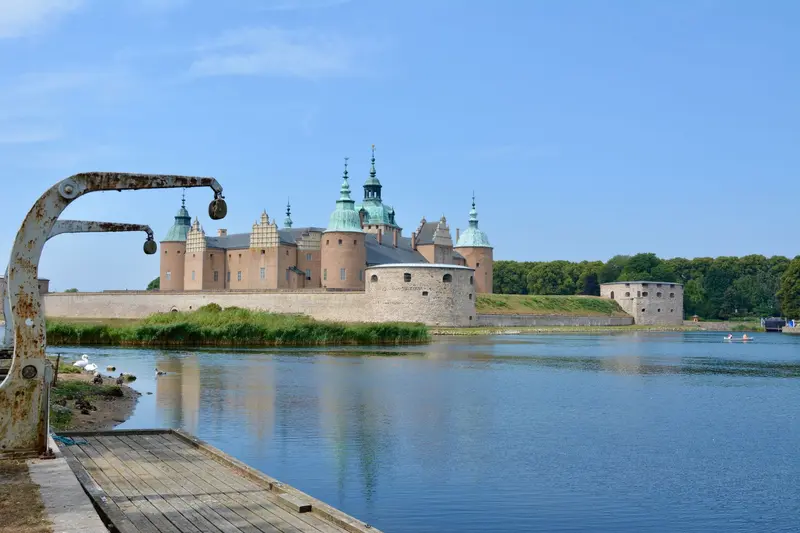
Kalmar is located on the Baltic Sea coast of Småland, opposite the island of Öland. The Renaissance castle on the water, the baroque cathedral, and the Old Town on the island of Kvarnholmen make the city one of Southern Sweden's most important historical destinations. Via the Öland Bridge, you're on Öland in just a few minutes.
5 Sights
5 Restaurants
Culture and History
The Castle and the Kalmar UnionAround 1180, a round defensive tower with a harbour was built on Kalmarsund. In the late 13th century, King Magnus Ladulås had a fortress with a curtain wall and corner towers built around it. In 1397, the Kalmar Union was established here, uniting Denmark, Norway, and Sweden under a single crown until 1523. Under the Vasa kings Gustav I, Erik XIV, and Johan III, the fortress was transformed into a Renaissance castle.New Town on KvarnholmenDuring the Kalmar War from 1611 to 1613, Danish troops besieged the castle. From the mid-17th century, the new town developed on Kvarnholmen, its centrepiece being the Baroque Cathedral by Nicodemus Tessin the Elder, built from 1660 to 1703. The Kalmar läns museum displays finds from the warship Kronan, which exploded and sank off the southern tip of Öland on June 1, 1676.
Perfect for unwinding and relaxation. For adventure seekers.
Öland is Sweden's second-largest island after Gotland, located off Kalmar in the Baltic Sea. The island is flat and elongated, featuring open limestone plains, windmills, stone walls, and sandy beaches. The agricultural landscape in the south is a UNESCO World Heritage site.
5 Sights
3 Restaurants
Culture and History
Iron Age and Agricultural LandscapeÖland was already densely populated in the Iron Age. Evidence of this includes burial grounds, runestones, and ringforts like Eketorp, Ismantorp, and Sandby borg, where archaeologists found traces of a raid from the late 5th century. The agricultural landscape in the south of the island, with its villages along the western edge, stone walls, and the Stora Alvaret, has been a UNESCO World Heritage site since 2000. It shows how people adapted to the sparse conditions over approximately 5,000 years.Windmills, Royal Residence, and Harvest FestivalThe wooden post windmills are the symbol of the island; numerous ones are preserved, some dating back to the 17th century. The royal family spends its summers at Solliden near Borgholm, and on July 14th, Crown Princess Victoria's birthday is publicly celebrated in Borgholm. At the end of September, the island invites visitors to the Skördefest, a large harvest festival featuring farms, markets, and handicrafts, from September 25th to 27th in 2026.
Rich in culture and history. Perfect for an exciting city trip.
Växjö is the main town of the Kronoberg district and a university city in the heart of Småland, surrounded by lakes. In its compact center are the Cathedral, the Småland Museum with the Swedish Glass Museum, and the House of Emigrants. The city is considered a pioneer in municipal climate protection, and in 2018, it was the first Swedish city to receive the European Green Leaf Award. It's not far to the Kingdom of Crystal.
5 Sights
4 Restaurants
Culture and History
Bishopric and EmigrationVäxjö has been a bishopric since the late 12th century; its cathedral, originally a stone church, dates mainly from around 1300. Missionary Sigfrid, revered as the Apostle of Småland, is the city's patron saint. From 1846 to 1930, many locals left their farms, emigrating to North America. The House of Emigrants (Swedish Emigrant Institute since 1965) recounts this history, runs a genealogy archive, and features writer Vilhelm Moberg and his novel series The Emigrants.Glass and MuseumsSmåland Museum and the Swedish Glass Museum are housed in Kulturpark Småland next to the train station. The exhibition showcases centuries of glass art, providing a great prelude to visiting the glassworks east of the city.
Halmstad, Halland's capital, is on the Kattegat midway between Göteborg and Malmö. It is primarily known for the roughly 4-km-long sandy beach of Tylösand. Halmstad gained town rights in 1307 and was a fortified Danish outpost until 1645 against Sweden; the castle on the Nissan dates from then. The centre retains many half-timbered houses; Picasso's Kvinnohuvud stands on the Nissan.
4 Sights
5 Restaurants
History and Culture
Danish HeritageHalmstad has been a town since 1307 and was considered the largest town on Halland's west coast during the Middle Ages. From 1598, a fortress was built, enclosing the center from the castle in the south to Norre Katt Park in the north. Its northern town gate, the Norre port, still stands today. Danish King Christian IV commissioned the castle, which was completed in 1619. In August 1645, Halmstad became Swedish; today, the provincial governor resides in the castle, and its gardens are freely accessible.Church and Old TownSt. Nikolai kyrka on Stora Torg dates from the 14th century and is known for its stained-glass windows; the large windows were created by Einar Forseth. Half-timbered houses are preserved around the church. The square also features Carl Milles' fountain Europa and the Bull.The Halmstad GroupIn 1929, six artists, including brothers Axel and Erik Olson, formed the Halmstad Group here, Sweden's first Surrealists. Their works are exhibited at Mjellby Konstgård, approximately three kilometers northwest of the center. The Museet i Halmstad by the river showcases painted tapestries and living spaces from the 17th to 19th centuries.