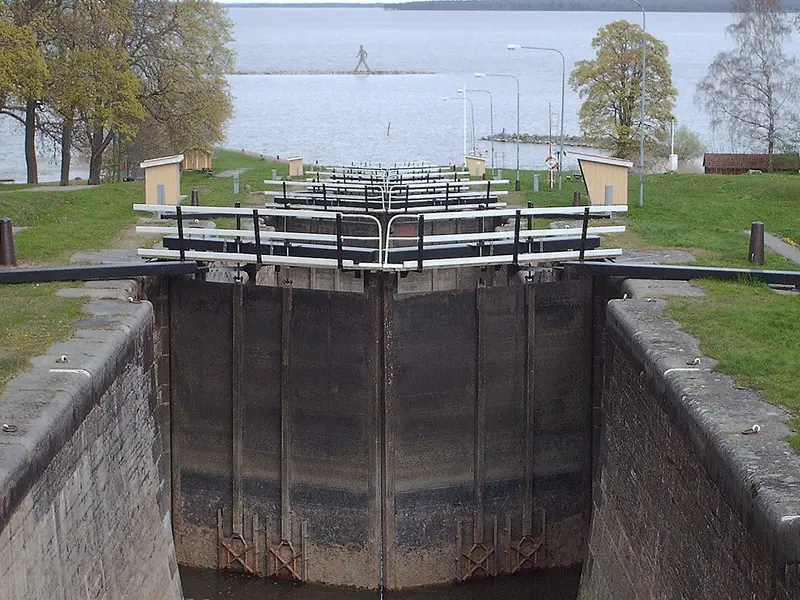
A tranquil motorhome route along the Göta Canal: from Söderköping via Vadstena and Motala on Lake Vättern, continuing along the canal to Sjötorp on Lake Vänern, then via Mariestad and Trollhättan to Gothenburg. Many campsites and guest harbours are located right by the water; the daily stages are short and mostly flat. Plan for just under three weeks.
19 Days / 18 Nights
May–September
RV Friendly
7 stops
Why This Route?
For campers and families seeking ample time by the water with minimal driving.
Hidden Gems
The Berg Lock Staircase on Roxen near Linköping, with seven consecutive chambers
Canal Museum in Sjötorp at the western end of the Göta Canal
Trollhättan Waterfall, where in summer, at fixed times, the water is released over the rocks
Itinerary
Stop 1 • 3 Nights
Söderköping
City
Rich in culture and history. Culinary highlights and Perfect for relaxation.
Söderköping is a small town in Östergötland, approximately 16 kilometers south of Norrköping. In the Middle Ages, it was one of Sweden's most important trading towns. Today, timber houses, the brick church Sankt Laurentii, and the canal harbor on the Göta Canal define its character. The town is also known for its ice cream parlors.
4 Sights
2 Restaurants
Culture and History of Söderköping
Söderköping is one of Sweden’s oldest towns. Around 1300, it was a power centre that could rival Stockholm: three churches were built here in the 13th century, and a Franciscan monastery in 1235. A king and two queens were crowned here, and major assemblies convened in the town, most recently the Riksdag of 1595. German and later Dutch merchant ships frequented the harbour on Slätbaken, until land uplift made access difficult, and Norrköping took over trade in the 18th century.Preserved from the Middle Ages are the brick church Sankt Laurentii, dating from the late 13th century with its bell tower, and Drothems kyrka. The town gained new significance from 1719 as a spa resort, thanks to the Sankt Ragnhilds källa spring, and through the Göta Canal, completed in 1832 and running directly through the locality. The 18th and 19th-century wooden houses make Söderköping a popular excursion destination today.
Vadstena is a small town on the eastern shore of Lake Vättern. Here, in the 14th century, Saint Birgitta founded the mother convent of her order, and Gustav Vasa had a castle built on the lakeside, which later became a royal residence. The abbey church, castle, and medieval buildings are all clustered together in the old town.
4 Sights
1 Restaurant
Abbey, Castle and Opera
The history of Vadstena is closely linked to **Saint Birgitta**. In 1346, King Magnus Eriksson and Queen Blanka bequeathed their royal court in Vadstena to a new monastery, which became the mother convent of the Bridgettine Order, consecrated in 1384. The convent church was consecrated in 1430, and Birgitta's relics are preserved in the Birgitta reliquary. In the Late Middle Ages, the convent was a significant spiritual center and remains a pilgrimage destination to this day; it was closed in 1595 after the Reformation, but Bridgettine nuns have lived in Vadstena again since 1935.**Vadstena Castle** was started by Gustav Vasa in 1545 as a fortress; his son Duke Magnus had it expanded into a Renaissance residence from 1555. Since 1899, it has housed the Regional Archives. In summer, the **Vadstena Academy** stages operas, often rediscovered or newly composed works, including in the castle's wedding hall.
Stunning nature and outdoors. Rich in culture and history and Perfect for relaxation.
Motala is situated on the northeastern shore of Lake Vättern, where the Göta Canal exits the lake. The town, home to just over 30,000 inhabitants, grew around the construction of the canal and the Motala Verkstad engineering works. Today, visitors come for the locks, the technical history museums, and the long sandy beach of Varamobaden.
4 Sights
Channel, Industry & Broadcasting
Motala is closely linked to the Göta Canal, which Baltzar von Platen planned and was built from 1810 to 1832. In 1822, **Motala Verkstad** was founded on his initiative, initially for lock mechanisms and repairs during the canal construction. It grew into one of Sweden's most important engineering workshops, building over 400 ships, around 1,300 locomotives, and more than 800 bridges, among other things. Motala gained market town status in 1823 and city rights in 1881. Von Platen is buried by the canal in Motala.In 1927, Motala's national long-wave transmitter began operations, broadcasting until 1962. Today, the transmitting station, with its historic tube transmitters and two 124-meter-high masts, is a museum. By the water, 19th-century locks and bridges define the scene, and every June, Motala is the destination for the 315-kilometer Vätternrundan cycling tour around the lake.
Sjötorp, on Lake Vänern's shore, is the Göta Canal's western end, stretching 190 km to Mem on the Baltic Sea with 58 locks. Many canal journeys begin or end here, and visitors come to watch the boats pass through the locks and take a break in the harbour. The first lock by the lake is popularly known as Sjöslussen. The canal season for boats is limited to summer. In 2026, the high season ran from June 16th to August 12th; find current times at gotakanal.se.
Perfect for relaxed travel without rush. Rich in culture and history and Stunning nature and outdoors.
Mariestad lies on the eastern shore of Vänern, Sweden's largest lake. This small town boasts a well-preserved old quarter with wooden houses and cobblestones, dominated by the cathedral tower. The harbour and promenade offer direct water access. In summer, boats visit Vänern's archipelago.
4 Sights
4 Restaurants
Mariestad's cultural legacy
Founded by Duke KarlMariestad was founded in 1583 by Duke Karl, who later became King Karl IX. He named the city and its church after his first wife, Maria of the Palatinate.A Cathedral Church Without a BishopThe Mariestad Cathedral Church was built between 1593 and 1619, with its nave already in use by 1602. In the early 17th century, Mariestad was the seat of a superintendency for several decades, which functioned similarly to a diocese. Today, there is no longer a bishop, but the church's name and title have remained.Old Town and MuseumThe wooden buildings of Gamla Stan have been preserved to this day, including parts in Näset dating from before the city fire of 1693. Many houses bear signs detailing their history, but please note that the courtyards are private property. The Vadsbo Museum tells the story of the city and the region.
Stunning nature and outdoors. Rich in culture and history and Ideal for city trips and urban experiences.
Trollhättan on the Göta älv is an industrial city where hydropower and canal construction shape the cityscape. Here you'll find the Trollhätte Falls, the locks of the Trollhätte Canal, and evidence of an industrial history ranging from hydropower to car manufacturing at Saab.
4 Sights
3 Restaurants
Culture, Art and History in Trollhättan
Waterfalls and CanalTrollhättan is inextricably linked to the waterfalls of the Göta älv, which shaped its development over centuries. Attempts to bypass the rapids with locks began as early as the 18th century, and the first Trollhätte Canal was opened in 1800.Hydropower and IndustryThe use of hydropower made Trollhättan an industrial hub. The Olidan power plant and the historic lock systems are now technical monuments. When the dam gates are opened during a Fallpåsläpp, approximately 300,000 liters of water per second plunge down.FilmWith the film production company Film i Väst, Trollhättan has developed into a center for Scandinavian film production, earning it the nickname "Trollywood".
Perfect for an exciting city trip. Rich in culture and history and Culinary highlights.
Gothenburg, Sweden's second-largest city, is shaped by its maritime heritage and characteristic canals. Here, you'll discover a mix of historic charm and modern city life. The Haga district, with its cobblestone streets and well-preserved wooden houses, invites you to a traditional Fika. Along the grand boulevard Avenyn, you'll find numerous shops, restaurants, and cultural institutions. The Feskekôrka, a fish market hall shaped like a church, offers fresh seafood. For a glimpse into nature and the archipelago landscape, it's best to take a ferry to the nearby islands. Exploring the city on foot or with the efficient trams is recommended to experience Gothenburg's diverse facets.
5 Sights
3 Restaurants
Gothenburg's Cultural Heritage
Göteborg, 1621 von König Gustav II. Adolf gegründet, verdankt seine Stadtstruktur und frühe Architektur maßgeblich niederländischen Ingenieuren und Siedlern. Das zeigt sich bis heute in den Kanälen und den Steinbauten entlang des Stora Hamnkanalen. Die Stadt entwickelte sich schnell zu einem bedeutenden Handelszentrum, was ihren weltoffenen Charakter prägte.Im 19. Jahrhundert erlebte Göteborg durch Industrialisierung und Hafenausbau einen starken Aufschwung. Diese Zeit zeigt sich in Neorenaissance- und Jugendstilbauten, aber auch in den typischen Landshövdingehus: dreigeschossigen Häusern mit steinernem Erdgeschoss und Holzetagen darüber. Die maritime Vergangenheit prägt die Stadt bis heute, sichtbar etwa im Seefahrtsmuseum.Das kulturelle Leben wird von zahlreichen Galerien und dem Göteborgs konstmuseum am Götaplatsen geprägt, das eine bedeutende Sammlung nordischer Kunst beherbergt. Fest verankert ist die Kaffeepause Fika, besonders in Vierteln wie Haga mit seinen Holzhäusern und Kopfsteinpflastergassen.