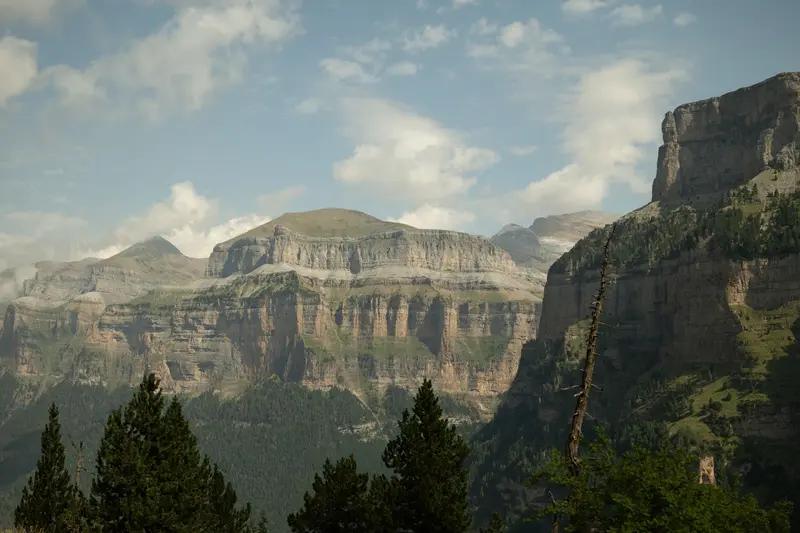
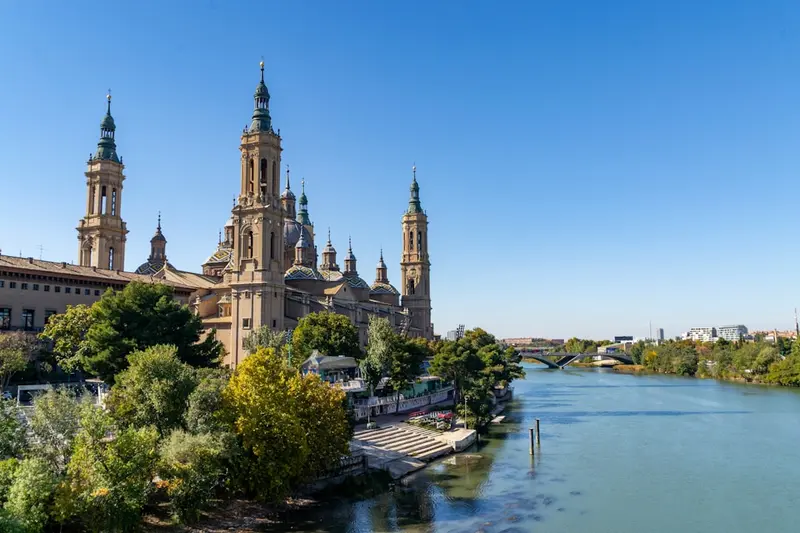
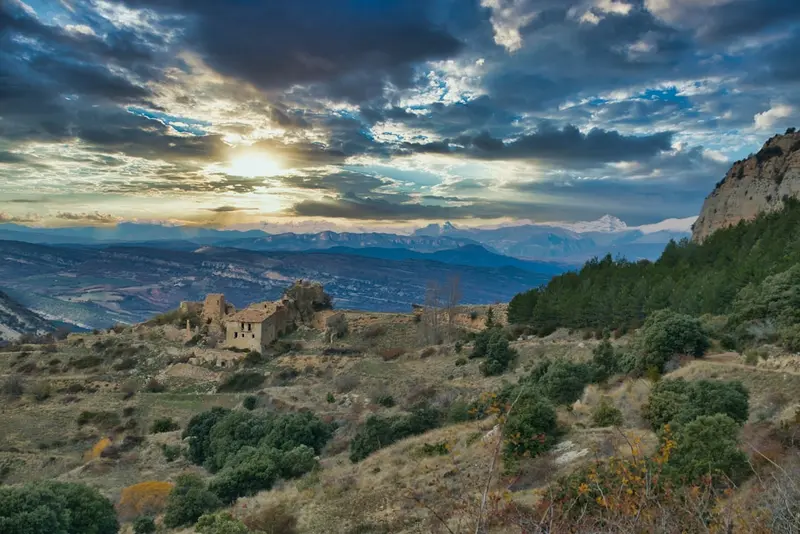
The route leads from Zaragoza, with its Basílica del Pilar, into the Pyrenees to Aínsa, a medieval town at the confluence of the Cinca and Ara, and back via Huesca. From Aínsa, you reach the Ordesa y Monte Perdido National Park in about an hour. No leg of the journey takes longer than two hours.
6 Days / 5 Nights
May–June & September
RV Friendly
3 stops
Why This Route?
For peace-seekers wanting to combine mountains and medieval towns with short stages off the beaten path.
Hidden Gems
Senda de los Cazadores in the Ordesa Valley, a steep path with views into the canyon
Aínsa's castle walls overlooking Peña Montañesa
Castillo de Loarre near Huesca, a Romanesque castle above the plain.
Itinerary
Stop 1 • 2 Nights
Zaragoza
City
Rich in culture and history. Perfect for an exciting city trip.
Aragon's vibrant capital is home to the Basílica de Nuestra Señora del Pilar and the Aljafería Palace, a masterpiece of Islamic architecture in Spain.
Discover Aínsa, a breathtaking medieval fortress majestically perched on a hill in the heart of the Spanish Pyrenees. This historic-artistic gem transports you on an unforgettable journey through time with its cobblestone streets, the imposing castle, and the charming Plaza Mayor. Here, where history meets spectacular nature, you'll feel the spirit of bygone eras and the warm hospitality of the Aragon region.
3 Sights
4 Restaurants
Aínsa: A Journey Through History and Culture
Aínsa is a medieval town in the Spanish Pyrenees, whose history is closely linked to the Reconquista. Its historic core is situated on a rocky ridge above the confluence of the Cinca and Ara. The castle dates back to the 11th century. In 1124, King Alfonso I the Battler granted Aínsa a Carta puebla, which bestowed upon its inhabitants the Law of Jaca (Fuero de Jaca).The architecture of the Casco Antiguo, protected as a historical-artistic ensemble since 1965, bears witness to this past: Narrow streets lead to the Plaza Mayor with its arcades. The Romanesque church of Santa María, consecrated in 1181, and parts of the castle complex shape the townscape.A prominent local tradition is La Morisma, performed in even-numbered years on the last Sunday of August. The play reenacts the reconquest of the town from the Moors, where, according to legend, a fiery cross appeared above a holm oak. This story and the mountainous surroundings continue to shape the town's cultural identity to this day.
Huesca, the capital of the eponymous province in Aragon, lies at the foot of the Pyrenees and is often underestimated. The city combines **centuries-old history, culture, and proximity to the mountains**. Here, a relaxed atmosphere and remarkable buildings await you within a compact area.
4 Sights
4 Restaurants
Huesca's Cultural and Historical Heritage
Huesca, a city with ancient roots, looks back on a rich and diverse history that shapes its current cultural identity. Its origins trace back to pre-Roman times as the Iberian settlement of Bolskan, before becoming Osca under the Romans and later Wasqa under Moorish rule. The nearly four centuries of Muslim presence left deep marks on the city, which was once an important centre of the Taifa of Huesca, in its art, architecture, and intellectual life.The Reconquista in 1096 by King Peter I of Aragon marked a decisive turning point and led to the construction of significant Christian buildings. The most famous is the Cathedral of Huesca, an outstanding example of Gothic architecture, built on the foundations of the former main mosque. Also of great historical significance is the Romanesque church of San Pedro el Viejo, which serves as the royal pantheon for the Kings of Aragon.Cultural traditions are deeply rooted in Huesca, particularly the annual Fiestas de San Lorenzo in August. During these celebrations, the city dresses in white and green, honoring its patron saint with processions, dances, and music. These festivities reflect the vibrant popular culture and sense of community among the people of Huesca, who preserve their history and customs across generations.