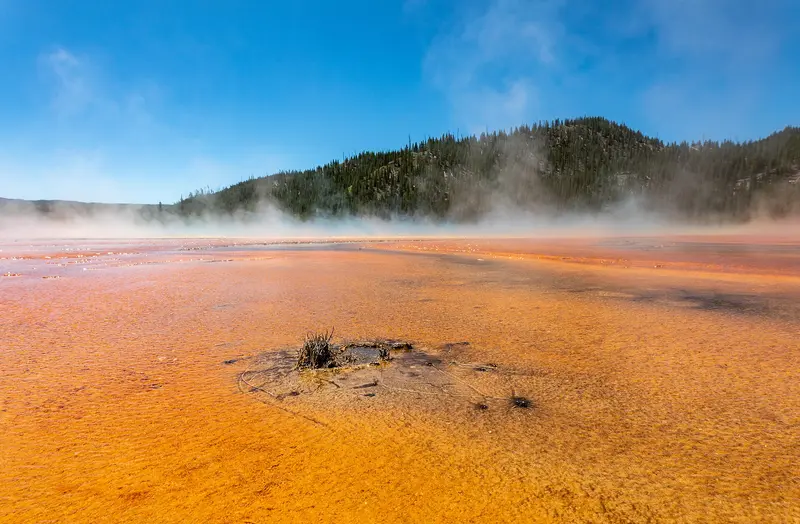
Dietmar Rabich / Wikimedia Commons / CC BY-SA 4.0, mod.
Round trip · United States
Yellowstone and Grand Teton: Geysers, Bison and Mountain Lakes
by Felix Gillen
- 11 Days / 10 Nights
- Yellowstone National Park (Gardiner and Mammoth Hot Springs) → Jackson
The route starts at Bozeman's airport in Montana, runs through Paradise Valley to Yellowstone's North Entrance at Gardiner, then follows the Grand Loop Road to the travertine terraces of Mammoth, the Grand Canyon of the Yellowstone and the geyser basins around Old Faithful. You leave through the South Entrance into Grand Teton National Park and finish in Jackson, Wyoming. You travel by rental car; most legs take one to two hours, and inside the park a good rule of thumb is two minutes per mile, plus extra time for bison jams. In-park lodging fills up early and can be booked up to 13 months ahead. Flying into Bozeman and out of Jackson Hole saves you the long drive back.
At a glance
- Duration
- 11 Days / 10 Nights
- Stops
- 5 · Yellowstone National Park (Gardiner and Mammoth Hot Springs) → Jackson
- Arrival
- Flight · Bozeman (BZN)
- Departure
- Flight · Jackson Hole (JAC)
- Best Time to Go
- Mid-June to mid-September, most pleasant in June and the first half of September
More on when to go
July and August are the busiest. Most Yellowstone roads are open only from about May to early November; the South Entrance usually opens in mid-May and Dunraven Pass in late May, and Teton Park Road is open May 1 to October 31. Only the road from Gardiner via Mammoth to Cooke City stays open year-round.
5 stops
Why This Route?
For travelers who want to combine the two best-known national parks of the northern Rockies in one trip: geothermal wonders, wildlife watching and high mountains on short drives. Staying inside the park cuts out long commutes and puts you at the highlights at the best time of day.
Hidden Gems
- Grand Prismatic Overlook: from the Fairy Falls parking area, about a mile south of Midway Geyser Basin, a 0.6-mile trail climbs to a viewpoint above the spring
- come early, the lot is small
- Artist Point on South Rim Drive, overlooking the 308-foot Lower Falls just steps from the parking lot
- Mormon Row on Antelope Flats Road north of Jackson, where the T. A. Moulton Barn stands in front of the Teton Range
Getting there and back
Open jaw: start and end are in different places
- Arrival
- Flight · Bozeman (BZN)Pick up your rental car at Bozeman Yellowstone International Airport. Gardiner at the North Entrance is about 83 miles (135 km) away via I-90 to Livingston and US-89 through Paradise Valley, roughly an hour and a half. Arrange a one-way rental with drop-off in Jackson Hole when you book.
- Departure
- Flight · Jackson Hole (JAC)Jackson Hole Airport sits about 7 miles (11 km) north of Jackson and is the only commercial airport in the U.S. located inside a national park, Grand Teton. From town it is a short drive.
Itinerary
Yellowstone National Park (Gardiner and Mammoth Hot Springs)
Established in 1872, Yellowstone is considered the world's first national park. Most of it lies in northwest Wyoming, with slivers in Montana and Idaho, and people come for the geysers, the hot springs, and the free-roaming bison and elk.The park has more than 10,000 hydrothermal features, including over 500 geysers. Old Faithful goes off about every 90 minutes on average, and predicted times are posted at the visitor center. In the Grand Canyon of the Yellowstone, the Lower Falls drop 308 feet, and in the Lamar Valley in the northeast corner you can watch bison at dawn and, with luck, wolves.Good to knowFees: $35 per vehicle for 7 days, cash or card. Since 2026, visitors who don't live in the U.S. pay an extra $100 per person age 16 and up, unless they have an annual pass. No entry reservation is required.Season: In 2026 the first roads from the West and North entrances opened on April 17, with more following in May. Most roads close to cars in early November.Time: Give it at least two days, ideally three; distances between areas are long. Start early, because lots at Old Faithful and Grand Prismatic fill fast in summer.
From Bozeman, it's about a 1.5-hour drive to Gardiner, with Mammoth Hot Springs just 4 miles (6 km) further. From there, you'll reach Lamar Valley in 45 to 60 minutes, where wolves are most often spotted at dawn and dusk.
4 Sights
2 Restaurants
Culture and History
Long before it became a park, the high plateau was used by Indigenous peoples including the Shoshone, Bannock, Crow, Nez Perce, Blackfeet, and Salish. The Tukudeka, or Sheepeaters, lived here year-round. Obsidian from Obsidian Cliff, on the road between Mammoth and Norris, was a prized trade good.The Washburn Expedition named Old Faithful on September 18, 1870. After Ferdinand Hayden's survey in 1871, President Grant signed the act creating the first national park on March 1, 1872. The Army ran the park from 1886, and its buildings still stand as Fort Yellowstone in Mammoth. The National Park Service was created in 1916.The Old Faithful Inn, built in 1904 of logs and local stone, is the park's best-known building. Even if you're not staying, step inside to see the soaring log lobby. Wolves have been back in the park since the 1990s.
Yellowstone National Park (Canyon Village)
Established in 1872, Yellowstone is considered the world's first national park. Most of it lies in northwest Wyoming, with slivers in Montana and Idaho, and people come for the geysers, the hot springs, and the free-roaming bison and elk.The park has more than 10,000 hydrothermal features, including over 500 geysers. Old Faithful goes off about every 90 minutes on average, and predicted times are posted at the visitor center. In the Grand Canyon of the Yellowstone, the Lower Falls drop 308 feet, and in the Lamar Valley in the northeast corner you can watch bison at dawn and, with luck, wolves.Good to knowFees: $35 per vehicle for 7 days, cash or card. Since 2026, visitors who don't live in the U.S. pay an extra $100 per person age 16 and up, unless they have an annual pass. No entry reservation is required.Season: In 2026 the first roads from the West and North entrances opened on April 17, with more following in May. Most roads close to cars in early November.Time: Give it at least two days, ideally three; distances between areas are long. Start early, because lots at Old Faithful and Grand Prismatic fill fast in summer.
From Mammoth via Norris to Canyon is about 33 miles (53 km), a good hour without stops. At the Grand Canyon of the Yellowstone, the Lower Falls plunge 308 feet (94 m) deep, and bison often graze in the adjacent Hayden Valley.
4 Sights
2 Restaurants
Culture and History
Long before it became a park, the high plateau was used by Indigenous peoples including the Shoshone, Bannock, Crow, Nez Perce, Blackfeet, and Salish. The Tukudeka, or Sheepeaters, lived here year-round. Obsidian from Obsidian Cliff, on the road between Mammoth and Norris, was a prized trade good.The Washburn Expedition named Old Faithful on September 18, 1870. After Ferdinand Hayden's survey in 1871, President Grant signed the act creating the first national park on March 1, 1872. The Army ran the park from 1886, and its buildings still stand as Fort Yellowstone in Mammoth. The National Park Service was created in 1916.The Old Faithful Inn, built in 1904 of logs and local stone, is the park's best-known building. Even if you're not staying, step inside to see the soaring log lobby. Wolves have been back in the park since the 1990s.
Yellowstone National Park (Old Faithful)
Established in 1872, Yellowstone is considered the world's first national park. Most of it lies in northwest Wyoming, with slivers in Montana and Idaho, and people come for the geysers, the hot springs, and the free-roaming bison and elk.The park has more than 10,000 hydrothermal features, including over 500 geysers. Old Faithful goes off about every 90 minutes on average, and predicted times are posted at the visitor center. In the Grand Canyon of the Yellowstone, the Lower Falls drop 308 feet, and in the Lamar Valley in the northeast corner you can watch bison at dawn and, with luck, wolves.Good to knowFees: $35 per vehicle for 7 days, cash or card. Since 2026, visitors who don't live in the U.S. pay an extra $100 per person age 16 and up, unless they have an annual pass. No entry reservation is required.Season: In 2026 the first roads from the West and North entrances opened on April 17, with more following in May. Most roads close to cars in early November.Time: Give it at least two days, ideally three; distances between areas are long. Start early, because lots at Old Faithful and Grand Prismatic fill fast in summer.
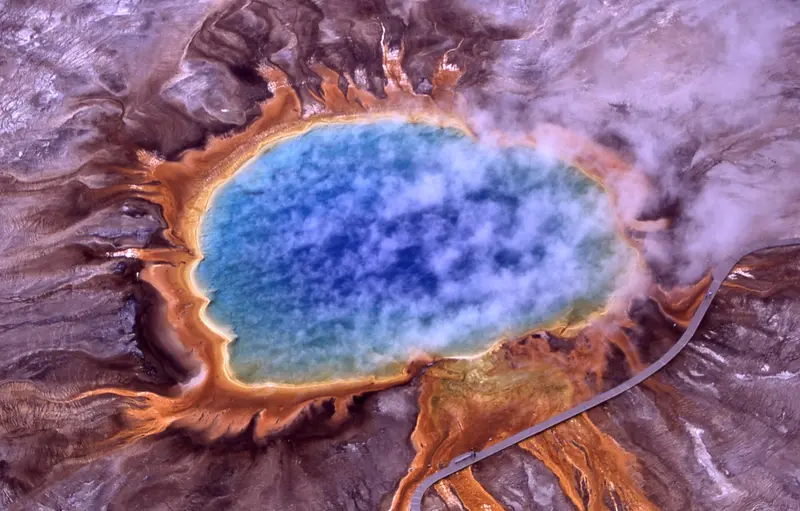
From Canyon, through Norris and Madison, it's about 42 miles (68 km), roughly an hour and a half. Stop along the way at Midway Geyser Basin with the Grand Prismatic Spring; keep at least 25 yards (23 m) from bison and elk, and 100 yards (91 m) from bears and wolves.
4 Sights
2 Restaurants
Culture and History
Long before it became a park, the high plateau was used by Indigenous peoples including the Shoshone, Bannock, Crow, Nez Perce, Blackfeet, and Salish. The Tukudeka, or Sheepeaters, lived here year-round. Obsidian from Obsidian Cliff, on the road between Mammoth and Norris, was a prized trade good.The Washburn Expedition named Old Faithful on September 18, 1870. After Ferdinand Hayden's survey in 1871, President Grant signed the act creating the first national park on March 1, 1872. The Army ran the park from 1886, and its buildings still stand as Fort Yellowstone in Mammoth. The National Park Service was created in 1916.The Old Faithful Inn, built in 1904 of logs and local stone, is the park's best-known building. Even if you're not staying, step inside to see the soaring log lobby. Wolves have been back in the park since the 1990s.
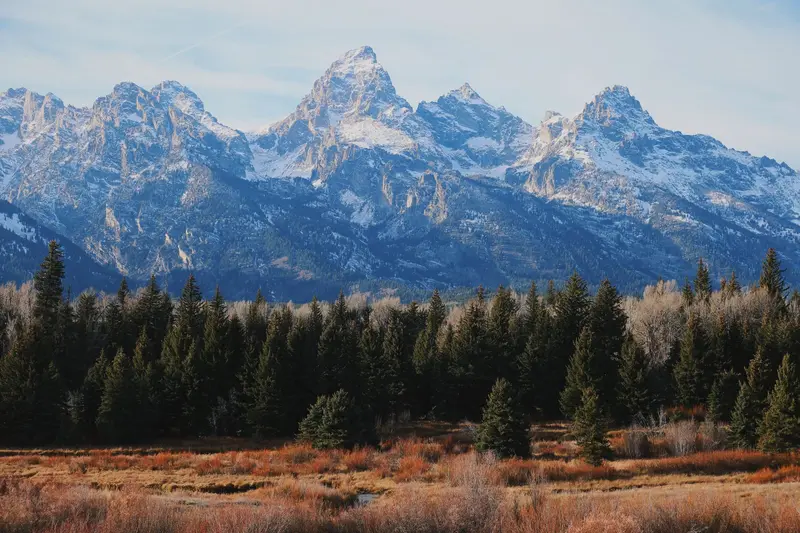
Grand Teton National Park (Jackson Lake and Jenny Lake)
Grand Teton National Park in northwestern Wyoming protects the Teton Range and the valley floor of Jackson Hole. The Grand Teton itself rises to 13,775 feet (4,199 m), more than 7,000 feet above the valley. You come for the alpine lakes at the foot of the range, the trails up into the canyons and the wildlife in the wetlands along the Snake River.The Teton Range runs about 40 miles (64 km). Strung along its base are glacial lakes such as Jenny Lake and 15-mile-long (24 km) Jackson Lake. At Oxbow Bend, Mount Moran is mirrored in the Snake River on calm days, and on Mormon Row old homesteaders' barns stand in front of the peaks.Know Before You GoEntrance fee: $35 per vehicle, valid for 7 days and separate from Yellowstone's fee. Visitors who are not U.S. residents pay an extra $100 per person (age 16 and up) unless they hold an annual pass.Season: The park is open year-round. Teton Park Road is open to cars from May 1 to October 31; from November through April many roads and facilities are closed. In 2026 the Jenny Lake Visitor Center was open May 15 to October 12.Time: Plan on at least two days, more for longer canyon hikes. From June through August expect lines at the Jenny Lake boat dock.
From Old Faithful, via West Thumb and the South Entrance, it's about 60 miles (97 km) to Jackson Lake Junction, approximately two hours. During the summer season, usually from mid-May to late September, a paid shuttle boat crosses Jenny Lake; from the dock on the west shore, it's just under 2 miles (3 km) round trip to Inspiration Point.
5 Sights
Culture and History
First InhabitantsHumans have lived in Jackson Hole for at least 11,000 years. The Shoshone, specifically the Tukudika, who lived in the mountains, primarily hunted bighorn sheep. Following the establishment of the Wind River Indian Reservation in 1868, the Shoshone of the region were relocated there.Settlers and RockefellerIn 1892, Menor's Ferry was established near Moose, allowing wagons to reach the west bank of the Snake River. From the 1890s onwards, Mormon families from Idaho settled east of Blacktail Butte; their homesteads along Mormon Row have been listed on the National Register of Historic Places since 1997. The park was initially established on February 26, 1929, encompassing only the mountains. Beginning in the 1930s, John D. Rockefeller Jr. purchased land in the valley through the Snake River Land Company to donate it to the National Park Service. In 1943, this land became the Jackson Hole National Monument, and in 1950, it was merged with the park.Chapel and AirportThe small Chapel of the Transfiguration, built in 1925 near Moose, frames the peaks of the Cathedral Group behind its altar through a large window. Since the 1950 merger, Jackson Hole Airport has been the only commercial airport in the USA located within a national park.
Jackson
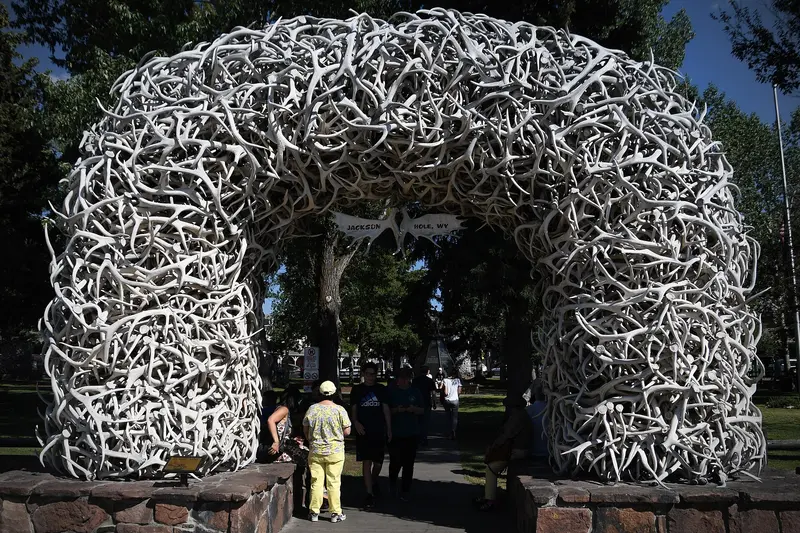
Jackson, home to about 10,800 people, is the main town in the Jackson Hole valley and the natural base for Grand Teton National Park. It sits at 6,237 feet (1,901 m), right next to the National Elk Refuge, and is named for trapper David Jackson, who also gave the valley its name.Shops, restaurants and bars such as the Million Dollar Cowboy Bar line the Town Square with its four elk-antler arches. In summer a shootout is staged there Monday through Saturday at 6 p.m.; in winter there's an ice rink. On the edge of town, Snow King Mountain was Wyoming's first ski area, and Jackson Hole Mountain Resort in Teton Village is 12 miles (19 km) away.Know Before You GoLocation: Jackson Hole Airport is about 7 miles (11 km) north of town, inside Grand Teton National Park.Seasons: Summer is for the national parks; winter is for skiing and horse-drawn sleigh rides among the elk on the refuge.Without a car: The START bus is free within town, but no public bus runs to the national parks.
From Jackson Lake Junction, it's about 34 miles (55 km) south to Jackson. The four arches at Town Square are made of antlers shed by elk in the National Elk Refuge and collected by Scouts.
4 Sights
3 Restaurants
History and Culture
Founding and Women's CouncilJackson was founded in 1894 and incorporated as a town in 1914. John and Maggie Simpson donated the central square, where the first building was erected in 1897. In 1920, Jackson elected an all-female town government, including the mayor and town council. The women's council had the square cleaned, trees planted, and a fence built against livestock.The Antler ArchesThe Rotary Club built the first arch on Town Square in 1953; the other three followed between 1966 and 1969. The antlers are shed by elk in the National Elk Refuge, collected by Boy Scouts since 1968, and auctioned off at ElkFest in May. Most of the proceeds return to the Refuge. Because antlers weather, all four arches were rebuilt by 2015.Art and SaloonThe National Museum of Wildlife Art north of town exhibits animal depictions ranging from Carl Rungius and Albert Bierstadt to Georgia O'Keeffe. The Million Dollar Cowboy Bar on Town Square has existed since 1937 and is a meeting point for locals and visitors, offering live music and dancing.
Plan this route as your trip
All stops, trains and nights go into your trip planner. You adjust dates and places to stay afterwards.
This route is a suggestion from our research. Please check timetables, times in port, opening hours and prices before you book – what your tour operator or carrier says is what counts.
Fernweh is a free travel guide and trip planner: routes researched by people, taken over in one click, used day by day on the road. More about Fernweh
5 stops
Route Summary
Duration11 Days
Stops5 Places
TypeAdventure