Fernweh: Home
ExploreGuideDestinationsMy tripsMy trip
de|en
All Places & RegionsRound tripsNight trains in EuropeAll highlightsAbout FernwehFAQPrivacy PolicyImprint
Download on the App StoreGet it on Google Play
ExploreGuideDestinationsMy tripsMy trip
    • Neighborhoods & highlights
    • Recommendations
    • Eat & drink
    • Culture
    • Getting around
    • Accommodation
    • Plan trip
    • Nearby
    Dali

    Ngguls / Wikimedia Commons / CC BY-SA 4.0, mod.

    China

    Dali

    City

    Dali Old Town lies at about 2,000 meters between the Cangshan Mountains and the 250-square-kilometer Erhai Lake.

    by Felix Gillen

    1. Home
    2. Destinations
    3. China
    4. Southwest: Sichuan and Yunnan
    5. Dali
    Dali Old Town lies at about 2,000 meters between the Cangshan Mountains and the 250-square-kilometer Erhai Lake. It was built in the early Ming era, but the region was a power hub even earlier: Dali served as capital of the Nanzhao (779 to 902) and Dali (937 to 1253) Kingdoms.Here live the Bai, who, according to Wikipedia, have settled in the region for about 3,000 years; their courtyards define villages like Xizhou. Landmarks are the Three Pagodas of Chongsheng Temple north of the Old Town. From Kunming, you reach Dali by high-speed train in about two hours; to Lijiang, it's another 1.5 to 2 hours.
    China travel guideRound trips in ChinaPlan a trip with Dali

    Contents

    • Neighborhoods & highlights
    • Recommendations
    • Eat & drink
    • Culture
    • Getting around
    • Accommodation
    • Nearby

    Sights in Dali

    Discover the most important sights and attractions

    Attraction

    1Dali Old Town

    The early Ming Dynasty Old Town lies at the foot of Cangshan, about 13 kilometers north of Xiaguan. Access is free. Huguo Road and Yu'er Road feature popular eateries like Stella's and the Xinghua Village Restaurant, serving Bai cuisine.
    Open in Google Maps
    Place of Worship

    2Three Pagodas of Chongsheng Temple

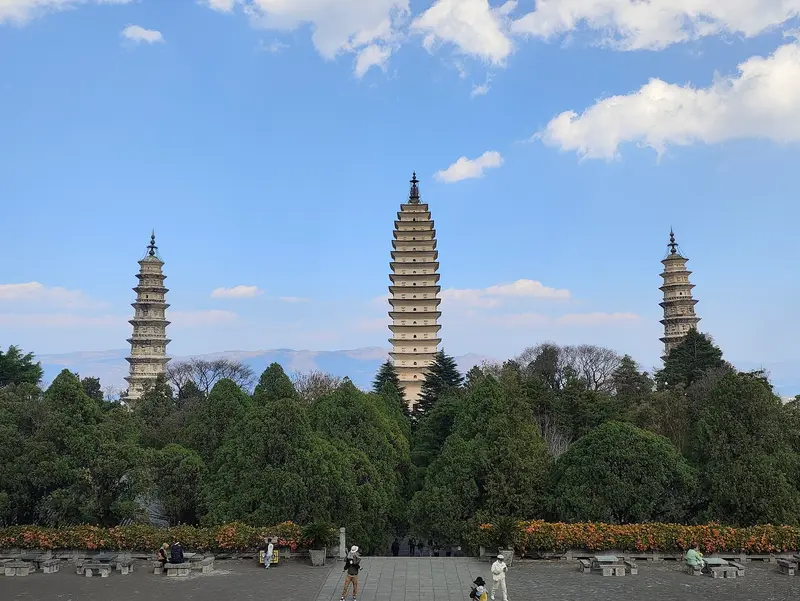
    Around one kilometer north of the old town, the three pagodas stand before the Cangshan Mountains. The large 9th-century Qianxun Pagoda is 69 meters high with 16 floors; the two smaller ones measure about 42 meters each. Admission ranges from 121 to 128 CNY, depending on the source.
    Open in Google Maps
    Park

    3Xizhou

    The place, about 18 to 20 kilometers north of the old town, was a military center of the Nanzhao Kingdom and is known for its Bai courtyards, such as the residences of the Yan and Hou families. Try Xizhou Baba here, a savory flatbread. By car about 30 minutes, by bike around 1.5 hours.
    Open in Google Maps
    Natural Feature

    4Erhai Lake

    The roughly 250-square-kilometer lake lies at 1,972 meters east of the Old Town. Its south end has the 57-hectare Erhai Park with a playground and small zoo; admission is free.
    Open in Google Maps
    Attraction

    5Cang Mountains (Cangshan) and Jade Belt Path

    West of the Old Town, the Cang Mountains rise to nearly 4,000 meters. Roughly halfway up, the paved Jade Belt Path stretches for about 11.5 km, mostly flat, between the Zhonghe and Gantong cable cars, offering views over the Old Town and Erhai Lake. For all cable cars, you need the Geopark Ticket for 35 CNY. The open Zhonghe chairlift costs 30 CNY per ride and is the quietest. Only the Ximatan cable car goes to the summit area but often closes due to wind and fog. The cable cars usually operate until 4 or 5 PM; check current prices at the ticket office.
    Open in Google Maps
    Point of Interest

    6Shuanglang

    The old town is located on the eastern shore of Erhai Lake, with views of the Cang Mountains. It is famous for the sunsets you can see over the lake from the small islands of Yuji and Nanzhao Fengqing. China Highlights notes that Shuanglang is quite far from the old town and very touristy.
    Open in Google Maps

    Restaurants in Dali

    Xinghua Village Restaurant

    Bai cuisine in the Old Town, according to Travel China Guide, featuring stewed carp in a casserole and Rushan.
    Show on Google Maps

    La Stella Pizzeria

    Long-standing pizzeria in the Old Town, recommended by Travel China Guide and Frommer's, such as for pizza with goat cheese salad.
    Show on Google Maps

    The Bai and her Cuisine

    Bai VillagesZhoucheng, with over 1,500 Bai families, is considered the largest Bai village; you can watch batik making for free there. In Xizhou, once a military center of the Nanzhao Kingdom, you'll find Bai courtyards, like the estates of the Yan and Hou families.SpecialtiesRushan, literally 'milk fan', is a dairy product eaten fried or steamed. Xizhou Baba is a savory flatbread with onions and ham.

    Arrival and Getting Around

    By TrainHigh-speed trains from Kunming or Kunming South take approximately 2 to just under 3 hours, with around 97 train pairs operating daily. The onward journey to Lijiang takes 1.5 to 2 hours.LocallyThe Old Town is located approximately 13 km north of Xiaguan. The Three Pagodas are about 1 km north of the Old Town, Xizhou is roughly 18 to 20 km away, taking approximately 30 minutes by car or about 1.5 hours by bike.

    Accommodations in Dali

    Find perfect stay in Dali

    Booking.com* (Affiliate link)
    Search Hotels
    Agoda* (Affiliate link)
    Search Hotels
    Airbnb
    Vacation Rentals

    * Affiliate link: if you book through it, we earn a small commission. The price stays the same for you.

    Plan your trip to Dali

    Save places, build a route and plan your city trip, all in one place.

    1. 1
      Sunrise over alpine peaks and a sea of clouds
      1234

      Round trip

      12 days · 4 stops

      Saved

      Pick a route

      Pick a ready-made one or save places and plan your own.

      Open bookmarks
    2. 2

      Trip to Dali

      Live
      • 1Dali Old Town3 days
      • 2Three Pagodas of Chongsheng Temple4 days
      • 3Xizhou5 days
      Budget

      Plan your trip

      The planner sorts stops, days and budget. Plan together in real time.

      Start trip planning
    3. 3
      9:41 No signal
      Dali
      Available offline

      Ngguls / Wikimedia Commons / CC BY-SA 4.0, mod.

      Use it on the road

      Download the guide to your phone and use it on site, even offline.

    Nearby

    Lijiang

    Lijiang

    Lijiang, at around 2,400 meters in northern Yunnan, was a 12th-century trade hub on the Tea Horse Road. Its Old Town of Dayan, with Baisha and Shuhe villages, is a UNESCO World Heritage site since 1997, its canals fed by springs from the Black Dragon Pool. From 1253, the Mu Clan ruled as hereditary princes.About one-fifth of the population is Naxi, whose Dongba pictographic script is a living pictography. North of the city rises the 5,596-meter Jade Dragon Snow Mountain; Tiger Leaping Gorge is 86 kilometers away. Since November 2023, the train continues to Shangri-La in approx. 80 minutes.

    chensiyuan·CC BY-SA 4.0

    Tiger Leaping Gorge (Hutiao Xia)

    Tiger Leaping Gorge (Hutiao Xia)

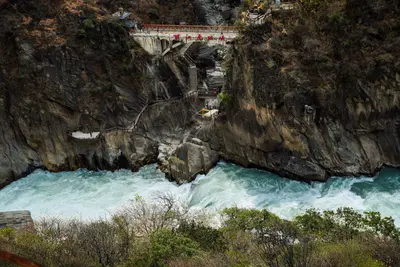
    Between Jade Dragon Snow Mountain and Haba Snow Mountain, the Jinsha, the upper course of the Yangtze River, forces its way through a gorge up to approximately 3,790 meters deep. It lies north of Lijiang on the route to Shangri-La and is part of the UNESCO World Heritage Site of the Three Parallel Rivers. Its name comes from the legend of a tiger said to have leaped across a rock in the river at its narrowest point.The gorge is renowned for the High Trail, a mostly two-day hike high above the river, with overnight stays in simple guesthouses such as Naxi Family, Tea Horse, Halfway, and Tina's. The most challenging section is right at the start: the 28 Bends, involving approximately 500 meters of ascent. The highest point lies at about 2,700 meters.The most pleasant times to hike are September and October, as well as April and May. From June to August is the rainy season, when landslides are frequent and paths or roads may be closed. The Lower Gorge is not recommended due to overgrown paths and scree.

    xiaoxian·Pexels

    Shangri-La

    Shangri-La

    The town at around 3,200 metres in north-western Yunnan was called Zhongdian until 2001, when it was renamed Shangri-La after James Hilton's novel Lost Horizon; the Tibetan name Gyalthang means royal plain. The old town of Dukezong was a stop for tea-horse caravans and has largely been rebuilt since a fire in January 2014.The main sight is Songzanlin Monastery of the Gelug school, built in 1679 to 1681 and also called the Little Potala. Around 22 kilometres away lies Pudacuo National Park, founded in 2007 as mainland China's first national park. Since November 2023 trains reach Shangri-La from Lijiang in about 80 minutes. For advice on altitude and health, see the UK FCDO travel advice.

    Chensiyuan·CC BY-SA 4.0

    Sa Pa

    Sa Pa

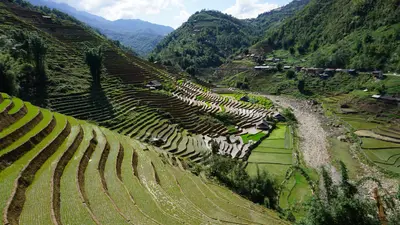
    Sa Pa is a mountain town in Vietnam's far northwest, approximately 250 kilometers from Hanoi and 20 kilometers from the Chinese border. You travel there to hike through the rice terraces of the Mường Hoa Valley, visit Hmong and Dao villages, and take the cable car up Fansipan, Indochina's highest mountain. The town is situated in the Hoàng Liên Sơn mountain range at an average elevation of about 1,600 meters, with a climate significantly cooler than the lowlands. The French developed the area into a hill station from 1909 onwards; almost 300 summer villas were built after the opening of the Hanoi–Lào Cai railway in 1920. The stone church in the center dates from this period. The majority of the population belongs to ethnic minorities, primarily Hmong and Dao, alongside Tày and Giáy. The town itself is heavily tourist-oriented; it becomes quieter in the villages in the valley. The best time to visit is September to November, when the terraces are golden-yellow, as well as March to May.

    Duong Nguyen·Pexels

    Leshan

    Leshan

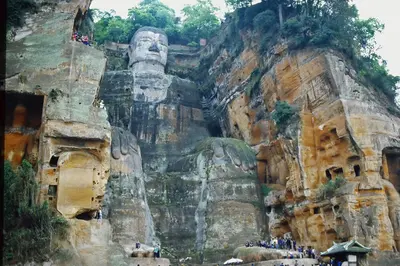
    Leshan is located at the confluence of the Min, Dadu, and Qingyi rivers, about an hour by train south of Chengdu. Above the rivers sits the 71-meter-tall Grand Buddha, carved from the rock in the 8th century at the initiative of monk Haitong. Since 1996, it has been a UNESCO World Heritage site, along with the sacred Mount Emei Shan west of the city.According to UNESCO, China's first Buddhist temple was built on Emei Shan in the 1st century; its Golden Summit lies at 3,077 meters. Leshan can be visited as a day trip from Chengdu, but for Emei Shan with its approximately 50-kilometer-long main path, you'll need more time.

    Jan Kranendonk·CC0

    Your next steps

    Dali is in China. Ways to carry on from here.

    • More in China

      Highlights, areas, routes and the best time to travel for all of China.

      China travel guide
    • Round trips in China

      Ready-made routes through China, with stops, nights and a map.

      See the routes

    Sources & method

    • Photos: Wikimedia Commons. Each photo carries its credit.
    • Place data such as addresses and ratings comes from Google Maps.
    • The content is based on web research from public, traceable sources. How the content is made · The role of AI