ExploreTravel GuidesPlan a trip
    de|en
    All Places & RegionsAbout FernwehFAQPrivacy PolicyImprint
    ExploreTravel GuidesPlan a trip
    Linderhof Palace
    Softeis / Wikimedia Commons / CC BY-SA 3.0

    Germany

    Linderhof Palace

    Point of InterestUNESCO

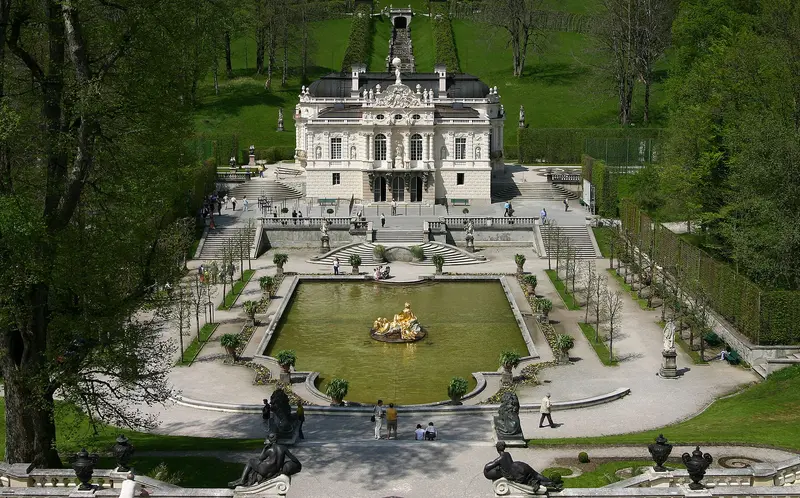
    Linderhof Palace, located in the Graswangtal valley near Ettal, is the smallest of King Ludwig II's three palaces and the only one completed during his lifetime.

    1. Home
    2. Destinations
    3. Germany
    4. Allgäu & King's Castles
    5. Linderhof Palace
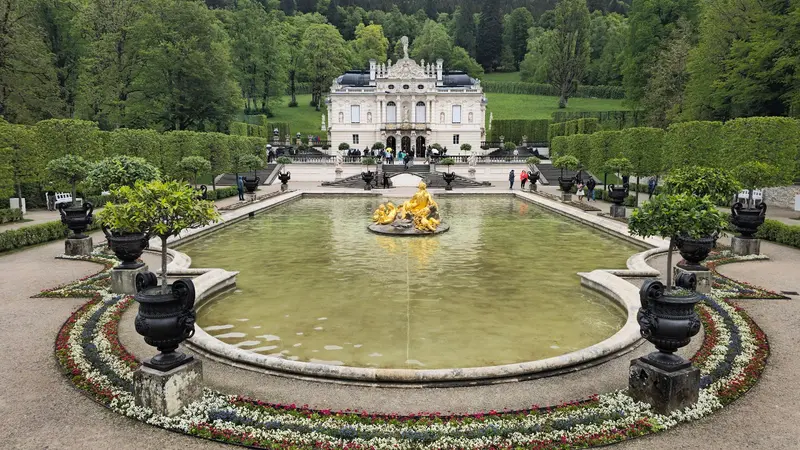
    Linderhof Palace, located in the Graswangtal valley near Ettal, is the smallest of King Ludwig II's three palaces and the only one completed during his lifetime. The palace, built in the Neo-Rococo style, was constructed from 1870 to 1886, with the park created from 1874 to 1880. Since July 2025, Linderhof has been a UNESCO World Heritage site.Surrounding the palace is a formal garden in the French style, whose fountain rises up to 22 meters high, solely powered by natural gradient. The artificial Venus Grotto, alluding to Wagner's "Tannhäuser," is again accessible since the 2026 season, following extensive restoration.

    Sights in Linderhof Palace

    Discover the most important sights and attractions

    Linderhof Palace
    Castle

    1Linderhof Palace

    Ludwig II.'s smallest castle was built from 1870 to 1886 in the Neo-Rococo style, based on plans by Georg Dollmann. It is the only one of his castles that was completed during his lifetime, and since July 2025, it is part of the UNESCO World Heritage.
    Open in Google Maps
    Moorish Kiosk
    Attraction

    2Moorish Kiosk

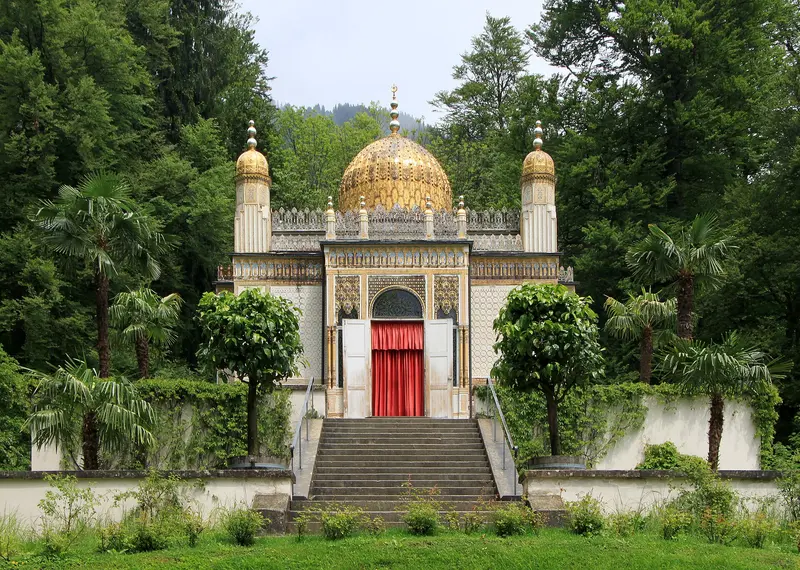
    One of the exotic park structures in Schlosspark Linderhof, whose landscaped part follows English garden design. Other buildings include the Venus Grotto, which, after its restoration, reopens from the 2026 season.
    Open in Google Maps

    Restaurants in Linderhof Palace

    Accommodations in Linderhof Palace

    Find perfect stay in Linderhof Palace

    Booking.com* (Affiliate link)
    Search Hotels
    Agoda* (Affiliate link)
    Search Hotels
    Airbnb
    Vacation Rentals

    * Affiliate link: if you book through it, we earn a small commission. The price stays the same for you.

    Campgrounds in Linderhof Palace

    Find perfect campground in Linderhof Palace

    Search via Google Maps
    Campgrounds nearby (15km)
    Camping.info
    Find Campgrounds
    Park4Night
    RV Parks & Camping

    Nearby

    Allgäu & King's Castles

    Allgäu & King's Castles

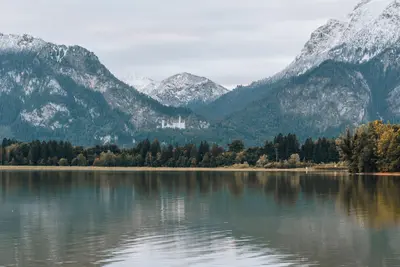
    Here stands Neuschwanstein Castle, which King Ludwig II had built from 1869 onwards above Hohenschwangau. Since July 2025, it has been part of the UNESCO World Heritage together with Linderhof, Herrenchiemsee, and the Königshaus am Schachen. Opposite lies Hohenschwangau Castle, where Ludwig II spent his childhood.Nearby Füssen on the Lech, at 808 meters, is Bavaria's highest town and the end point of the Romantic Road. From Garmisch-Partenkirchen, the Bayerische Zugspitzbahn ascends to the Zugspitze, Germany's highest mountain at 2962 meters, and in the Graswangtal near Ettal lies Linderhof Castle, the only castle Ludwig II saw completed during his lifetime.
    Neuschwanstein Castle

    Neuschwanstein Castle

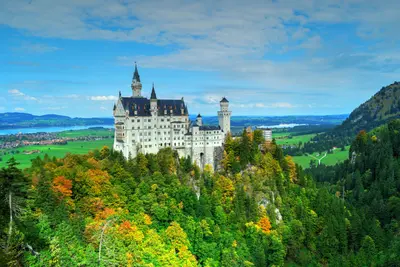
    King Ludwig II had Neuschwanstein Castle built from 1869 in southern Bavaria on a rocky ridge above Hohenschwangau; the Pöllat Gorge lies to its south. Of the more than 200 rooms planned, only about 15 were completed, including the Singers' Hall and the Throne Room. Six weeks after the King's death in 1886, the castle opened to visitors; today, around 1.4 to 1.5 million people come annually. Since July 2025, it has been a UNESCO World Heritage site.You can only see the interiors during an approximately 30-minute guided tour. Tickets for 2026 are sold online subject to availability; a daily remaining contingent is available at the Ticket Center in Hohenschwangau. The restoration of the magnificent rooms, for which the Free State spent around 40 million Euros, ran parallel to visitor operations and was largely completed by August 2024.
    Zugspitze

    Zugspitze

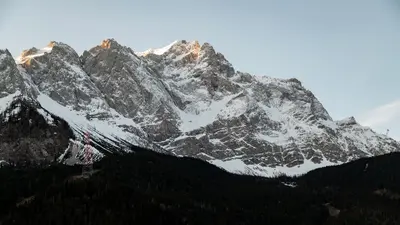
    The Zugspitze, at 2962 meters on its eastern peak, is Germany's highest mountain; the border with Austria runs over its western peak. A 4.88-meter-high summit cross stands on the peak, and below, on the Zugspitzplatt, lies the Nördliche Schneeferner, Germany's largest glacier.You can reach the top in two ways: The Bayerische Zugspitzbahn starts in Garmisch-Partenkirchen and reaches the glacier station at 2588 meters after approximately 45 minutes; the Seilbahn Zugspitze, opened in 2017, soars from Eibsee at 1000 meters directly to the summit.
    Füssen

    Füssen

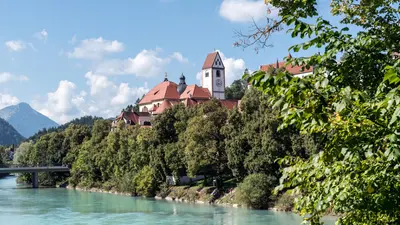
    Situated on the Lech at 808 meters, Füssen is Bavaria's highest city. Above the old town, the Hohe Schloss, the late Gothic residence of the Augsburg Prince-Bishops, presides. Below it lies the baroque former Benedictine monastery of St. Mang, home to the city museum. In 1562, Europe's first lute-makers' guild was founded here.Füssen marks the end of the Romantic Road and serves as the gateway to the royal castles of Neuschwanstein and Hohenschwangau. At the Lechfall, the river carves its way through a gorge; northeast of the city, it flows into Lake Forggensee. Regional trains connect Füssen with Munich and Augsburg.
    Glockenbachviertel

    Glockenbachviertel

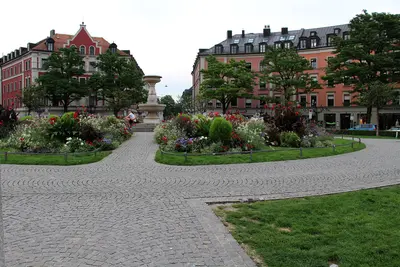
    The Glockenbachviertel gets its name from a bell foundry in front of the Sendlinger Tor, where bells were cast from 1476 to 1671, and from the stream next to it, first documented as Glockenbach in 1575. The district belongs to the Ludwigsvorstadt-Isarvorstadt borough and extends south from Fraunhoferstraße along the Isar. It has a long history as a gay and lesbian-influenced district; Germany's first leather bar opened on Müllerstraße as early as 1967. Together with the neighboring Gärtnerplatzviertel, it is now considered a trendy district with many pubs and bars.During the day, you can stroll through the Alter Südfriedhof with the graves of famous Munich residents, sit at Gärtnerplatz, or walk down to the Isar, which forms the district's southeastern border. In the evenings, the bars and traditional pubs around Fraunhoferstraße, Hans-Sachs-Straße, and Müllerstraße fill up. You can reach the heart of the district by taking U1 and U2 to Fraunhoferstraße station.