ExploreTravel GuidesPlan a trip
    de|en
    All Places & RegionsAbout FernwehFAQPrivacy PolicyImprint
    ExploreTravel GuidesPlan a trip
    Red Rock Canyon National Conservation Area
    The Cosmonaut / Wikimedia Commons / CC BY-SA 2.5 ca

    United States

    Red Rock Canyon National Conservation Area

    Point of Interest

    Just about 27 kilometers west of the Strip, the city abruptly ends.

    1. Home
    2. Destinations
    3. United States
    4. Nevada
    5. Red Rock Canyon National Conservation Area
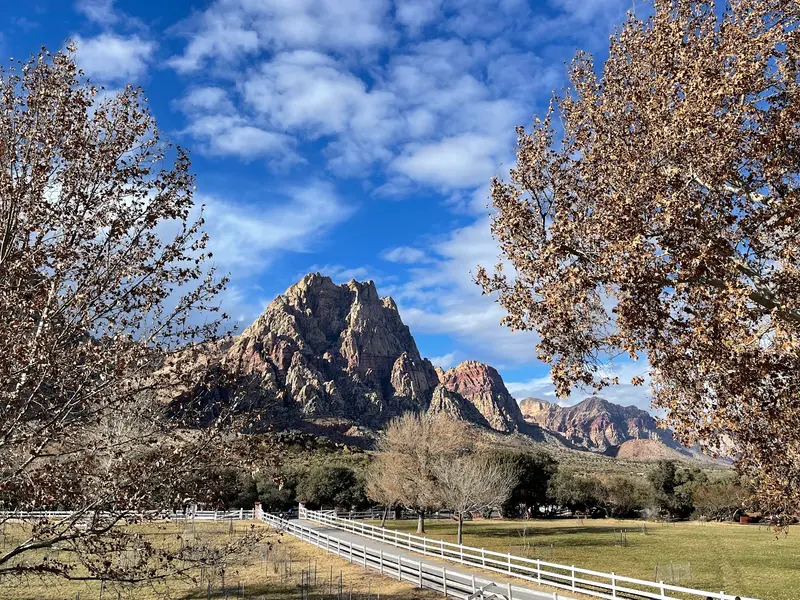
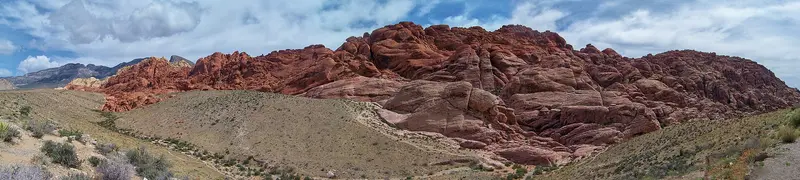
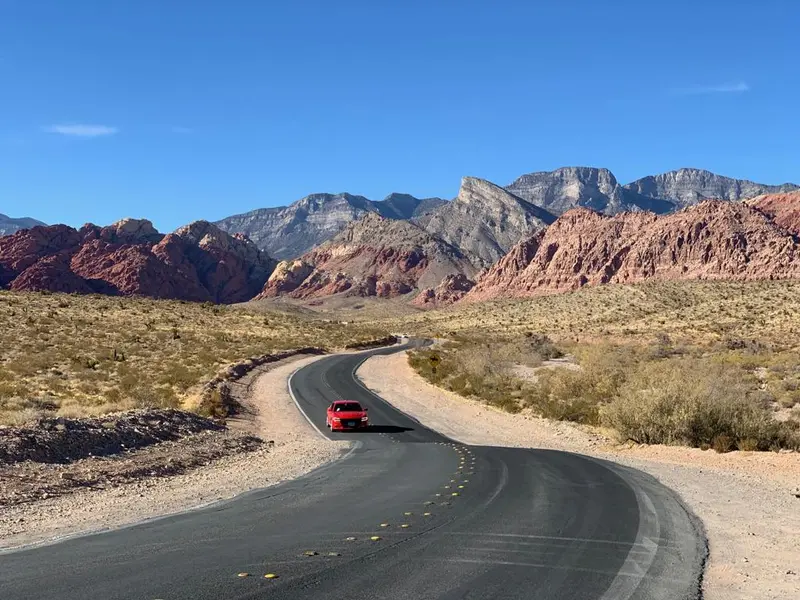
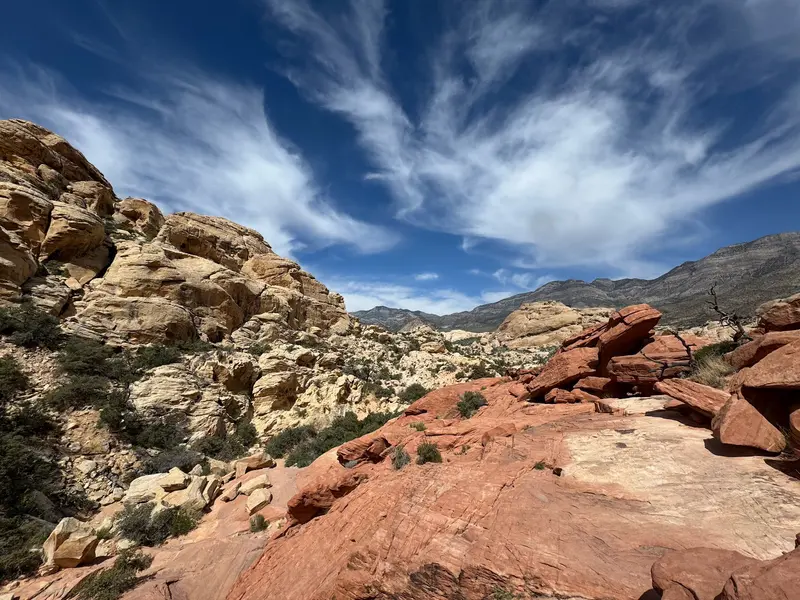
    Just about 27 kilometers west of the Strip, the city abruptly ends. In Red Rock Canyon, red-and-white striped sandstone walls rise from the Mojave Desert; the area has been protected as a National Conservation Area since 1990 and is managed by the Bureau of Land Management. Its rocks are an international climbing destination; for everyone else, there are hiking trails ranging from short family loops to summit treks.Geologically fascinating is the Keystone Thrust, a fault that formed about 66 million years ago and is visible for about 21 kilometers along the rock face. The red Aztec sandstone originated from dunes that were here about 180 million years ago, glowing particularly intensely in the Calico Hills. In some places, you'll find rock art from earlier indigenous cultures.Most visitors drive the 13-mile (21 km) long Scenic Drive, featuring viewpoints and hiking trail parking areas. Important: From October 1st to May 31st, you'll need a Timed-Entry Reservation via Recreation.gov for entry between 8 AM and 5 PM; this also applies to the Visitor Center. With the ticket, you may enter up to 30 minutes earlier and stay all day, but re-entry requires a new reservation.The best time to visit is autumn, winter, and spring. Those wishing to visit without a reservation can enter before 8 AM or after 5 PM. On weekends, parking lots are often full between 9 AM and 3 PM.

    Sights in Red Rock Canyon National Conservation Area

    Discover the most important sights and attractions

    Red Rock Canyon Scenic Drive
    National Park

    1Red Rock Canyon Scenic Drive

    The 21-kilometer panoramic road leads past viewpoints and parking for hikers. Allow at least half a day if you want to hike along the way.
    Open in Google Maps
    Calico Tanks Trail
    Attraction

    2Calico Tanks Trail

    The popular trail leads through the red-and-white rocks of the Calico Hills and ends at a Tinaja, a natural rock basin where rainwater collects. On busy days, it gets crowded here.
    Open in Google Maps
    Spring Mountain Ranch State Park
    Park

    3Spring Mountain Ranch State Park

    State Park with historic ranch at its south end, accessible via State Route 159. Can be combined with a stop in Blue Diamond.
    Open in Google Maps

    Restaurants in Red Rock Canyon National Conservation Area

    1

    Cottonwood Station

    Cafe in the small town of Blue Diamond near Red Rock Canyon, offering breakfast burritos, pizza, smashburgers, homemade pastries, and local craft beer. A meeting spot for hikers, climbers, and mountain bikers, featuring a patio and fire pit.
    Show on Google Maps

    Getting There & Around

    According to the BLM, there is no public transport to Red Rock Canyon. You need a car or can book a guided tour.Directions: From the Strip, about 30 minutes via Beltway 215 to Exit 26 (Charleston Boulevard), then 5.5 miles on State Route 159 to the Scenic Drive entrance. GPS address: 3205 State Highway 159.Timed Entry: Required from October 1 to May 31 for entry between 8 AM and 5 PM. Book on Recreation.gov or call +1 877 444 6777.Admission: $20 per vehicle, $10 per motorcycle, $8 by bicycle, $5 on foot. The America the Beautiful Pass is valid.Scenic Drive Hours: November to February 6 AM to 5 PM, March and October 6 AM to 7 PM, April to September 6 AM to 8 PM. Visitor Center daily 8 AM to 4:30 PM.Tours: Commercial buses and vans only stop at the Visitor Center, Calico I, Willow Spring, and Pine Creek.

    Accommodations in Red Rock Canyon National Conservation Area

    Find perfect stay in Red Rock Canyon National Conservation Area
    Booking.com* (Affiliate link)
    Search Hotels
    Agoda* (Affiliate link)
    Search Hotels
    Airbnb
    Vacation Rentals

    * Affiliate link: if you book through it, we earn a small commission. The price stays the same for you.

    Campgrounds in Red Rock Canyon National Conservation Area
    Find perfect campground in Red Rock Canyon National Conservation Area
    Search via Google Maps
    Campgrounds nearby (15km)
    Camping.info
    Find Campgrounds
    Park4Night
    RV Parks & Camping

    Nearby

    South Strip

    South Strip

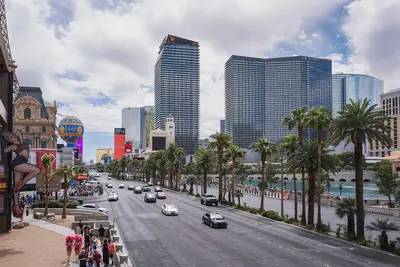
    The southern section of Las Vegas Boulevard is the Las Vegas of grand backdrops: a black glass pyramid, a fairytale castle, a miniature Manhattan skyline, and at its end, the artificial lake of the Bellagio. Between Mandalay Bay in the south and the Bellagio lie some of the city's largest hotel complexes, connected by pedestrian bridges, shopping arcades, and free trams.The themed hotels tell the story of the Strip: Excalibur opened in 1990, Luxor in 1993, New York-New York in 1997, and the Bellagio in 1998. Newer is the district around the T-Mobile Arena, which opened in 2016 and has been home to the NHL team Vegas Golden Knights since 2017. The neighboring Park MGM was known as Monte Carlo until 2018 and has been the only completely smoke-free casino resort on the Strip since 2020.During the day, the Shark Reef Aquarium at Mandalay Bay is worth visiting; in summer, so is the sandy beach with a wave pool at Mandalay Bay Beach. The Fountains of Bellagio and the floral displays in the Conservatory are free. In the evenings, you have a choice between concerts at the Arena and Cirque du Soleil shows: O at the Bellagio, KÀ at MGM Grand, and Michael Jackson ONE at Mandalay Bay.Distances are deceptive: what looks close from hotel to hotel is often a long walk through air-conditioned casinos. In summer, you best explore the Strip in the early morning or after sunset, when the facades glow and the Fountains of Bellagio are most impressive in the dark.
    Center and North Strip

    Center and North Strip

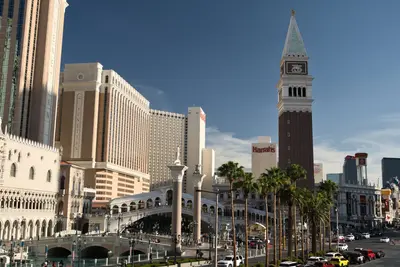
    North of Flamingo Road, the Strip transforms into its most iconic postcard scene: the Roman splendor of 1966's Caesars Palace, the 167-meter-tall High Roller observation wheel at LINQ, the canals and bell tower of the Venetian. Further north, it becomes more spacious, with greater distances between resorts, until the 350-meter-tall STRAT tower concludes the Strip.This area also marks the genesis of modern Las Vegas. The Flamingo opened in 1946 under Bugsy Siegel's direction, and the Wynn was built in 2005 on the legendary Desert Inn's site. The North Strip is a hub for new beginnings: Resorts World opened in 2021 on the former Stardust property, and the Fontainebleau, after years of construction halts, finally in December 2023. Since September 2023, the Sphere illuminates east of the Venetian, its LED exterior visible from much of the city.Much here is free: the flamingos in the Flamingo garden, the gondolas and St. Mark's Square at the Venetian, the Lake of Dreams light show at the Wynn. For a fee, you can ride the observation wheel, ascend to the STRAT's observation deck, or see one of the immersive films in the Sphere.The most beautiful time is dusk: That's when the Sphere changes its displays, and from the High Roller or the STRAT, you can see the Strip light up beneath you.
    Arts District

    Arts District

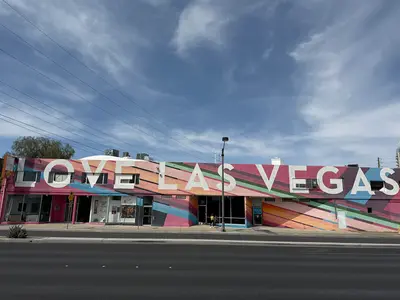
    Between Downtown and the Strip lies the district where Las Vegas looks least like itself: flat commercial buildings, murals, galleries, vintage shops, and breweries instead of casinos. Officially, it's called 18b The Las Vegas Arts District, named for its original 18 blocks. East Charleston Boulevard bisects it, and you'll find most shops and bars on Main Street and Commerce Street.It all began in 1997 with the Arts Factory, when artists moved into vacant spaces. In 2002, antique dealer Cindy Funkhouser launched the First Friday, a monthly art festival that still draws thousands. Since then, theaters, restaurants, and in 2014, Hop Nuts Brewing, the first of many breweries, have joined.By day, browse the shops of Antique Alley on Main Street for Tiki decor, comics, and old Las Vegas souvenirs; pop into the Arts Factory studios and Recycled Propaganda. By evening, it transforms into a nightlife hub: breweries, small cocktail bars, an indie theater, and live music at Swan Dive.The first Friday of the month is the busiest. Following a fatal incident at First Friday in October 2026, the festival's future is under discussion, so check 18b.org beforehand to confirm if and how it's taking place. The district is quieter and more relaxed on weekday afternoons.
    Las Vegas

    Las Vegas

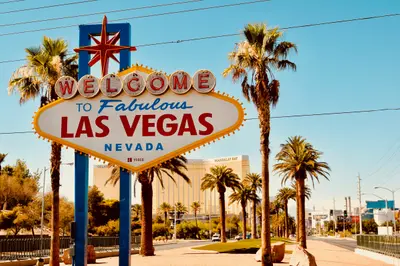
    Las Vegas is located in a basin of the Mojave Desert in Nevada and is connected to Los Angeles via Interstate 15. Founded in 1905, the city is known for its casino resorts and as a starting point for Grand Canyon scenic flights.The approximately 6.8-kilometer long Strip lies outside the city limits in Paradise and Winchester. There, resorts like Bellagio with its freely accessible water fountains, Caesars Palace, and The Venetian are located; the Sphere opened in 2023. The "Welcome to Fabulous Las Vegas" sign from 1959 is a popular photo motif. In Downtown, the Fremont Street Experience has covered five blocks with casinos since 1995, while the Neon Museum displays neon signs outdoors in the Neon Boneyard.Harry Reid International Airport is located just over 3 kilometers from the Strip. Along the resorts, the Monorail with seven stations and the Deuce bus operate; taxis can be taken from hotel stands. In July, average daily highs reach 40 degrees Celsius, and winters are short and mild.
    Downtown and Fremont Street

    Downtown and Fremont Street

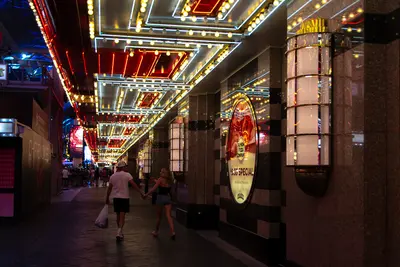
    Downtown is the old Las Vegas: The first casinos were located here, long before resorts grew on the Strip. The Golden Nugget opened in 1946, and even today, casinos line Fremont Street, appearing smaller, louder, and more affordable than their rivals to the south.Since 1995, a roughly 420-meter-long and 27-meter-high barrel vault canopy has spanned four city blocks. The Fremont Street Experience was updated in 2019 with over 49 million LEDs; in the evenings, light and music shows run on it, with bands playing on three stages. Beneath the canopy, people zip past on the SlotZilla zipline. The latest addition is Circa, which opened in 2020, an adults-only hotel with a massive sportsbook and a rooftop pool amphitheater. East of Las Vegas Boulevard, Fremont East begins, featuring bars, the Downtown Container Park, and the neon bar Atomic Liquors.During the day, two museums are worth visiting: The Mob Museum, housed in the former 1933 federal courthouse, tells the story of organized crime, while the Neon Museum displays over 200 decommissioned city signs.Come in the late afternoon, visit one of the museums, and stay for dinner and the first light show. Downtown is more compact than the Strip; almost everything is within walking distance.