Fernweh: Home
ExploreGuideDestinationsMy tripsMy trip
de|en
All Places & RegionsRound tripsNight trains in EuropeAll highlightsAbout FernwehFAQPrivacy PolicyImprint
Download on the App StoreGet it on Google Play
ExploreGuideDestinationsMy tripsMy trip
    • Places in the region
    • Culture
    • Getting around
    • Round trips
    • Nearby
    Basse-Terre and National Park

    Enrevseluj / Wikimedia Commons / CC BY-SA 4.0, mod.

    Guadeloupe

    Basse-Terre and National Park

    Region

    Basse-Terre is Guadeloupe's volcanic, mountainous western half, whose interior is largely taken up by the National Park, founded in 1989.

    by Felix Gillen

    1. Home
    2. Destinations
    3. Guadeloupe
    4. Basse-Terre and National Park
    Basse-Terre is Guadeloupe's volcanic, mountainous western half, whose interior is largely taken up by the National Park, founded in 1989. You come for the rainforest, waterfalls like the Chutes du Carbet, and the hike up the 1,467 m high Grande Soufrière, the island's active volcano.In the Soufrière Massif, 2,500 to over 6,000 mm of rain falls annually, depending on the location, which is why there are so many rivers and waterfalls here. On the calmer west coast lie Deshaies with Grande Anse beach and Bouillante, off whose coast the Réserve Cousteau invites you to snorkel. The Route de la Traversée connects the east and west coasts right through the forest, while the island capital, Basse-Terre, is located in the south at the foot of the volcano.
    Guadeloupe travel guideSee the round tripPlan a trip with Basse-Terre and National Park

    Contents

    • Places in the region
    • Culture
    • Getting around
    • Round trips
    • Nearby

    More places in Basse-Terre and National Park

    Deshaies

    Enrevseluj·CC BY-SA 4.0

    Deshaies

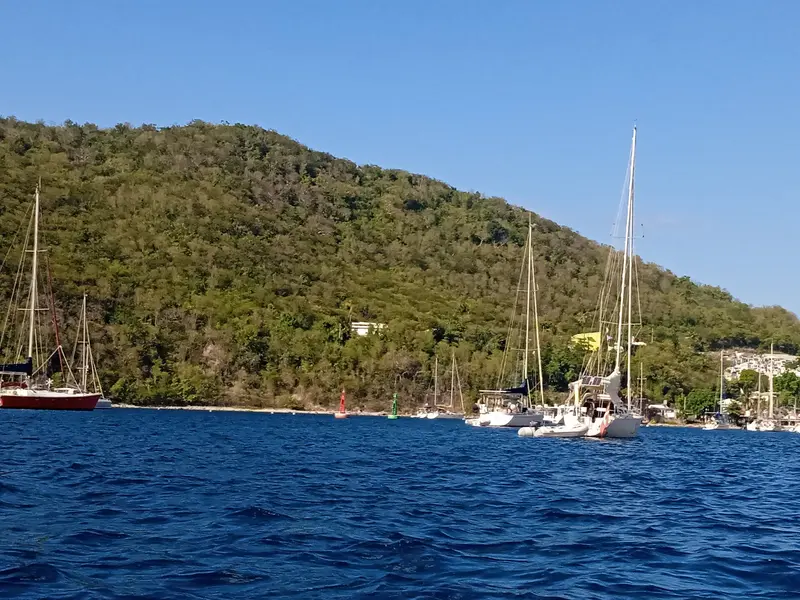
    Deshaies is a small fishing village nestled in a mountain-sheltered bay in the northwest of Basse-Terre, opposite Montserrat island and around a 1 hour 15 minute drive from the airport. You'll visit for its Botanical Garden, the Grande Anse and La Perle beaches, and because it has been the main filming location for the crime series “Death in Paradise” since 2011.The bay is a popular anchorage for sailors. You can reach it via the Route des Mamelles, cutting through the National Park, or along the north coast via Sainte-Rose.

    Sights in Basse-Terre and National Park

    Discover the most important sights and attractions

    Point of Interest

    Chutes du Carbet

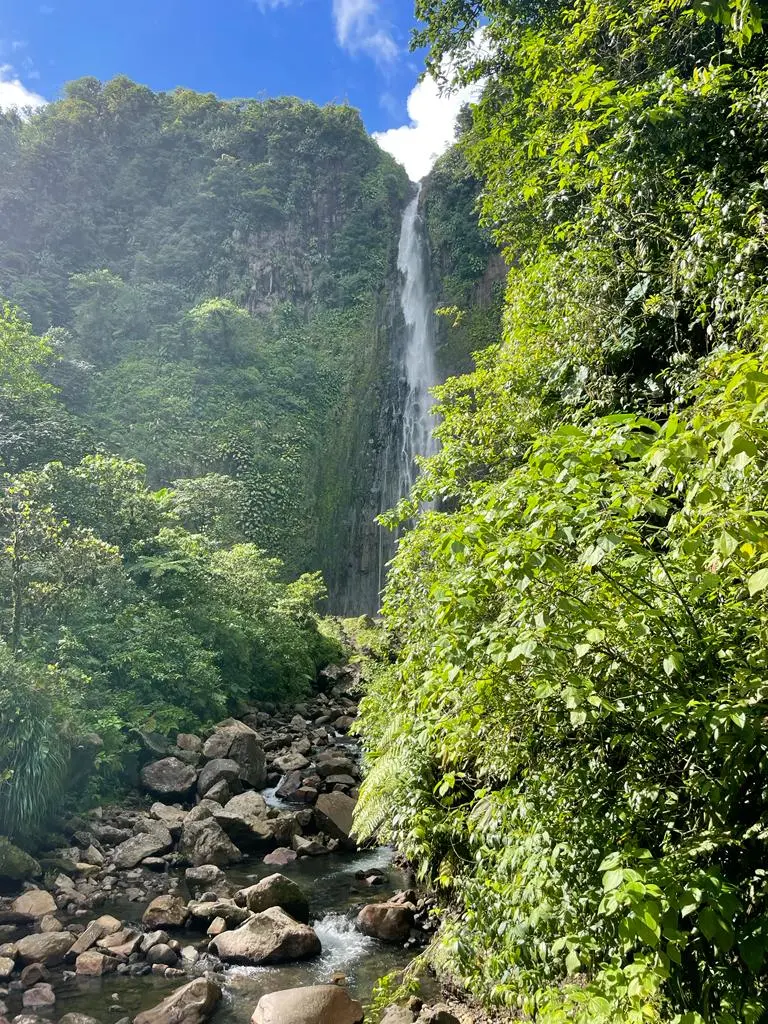
    The three Carbet Falls are located on the lower slopes of Soufrière in Capesterre-Belle-Eau; the first is over 115 meters high, the second 110 meters, and the third 20 meters. The second fall is the most visited; you can reach it from the parking lot in about 20 minutes on a paved path. Since rocks broke loose after an earthquake in 2004, access ends below the fall.
    Open in Google Maps
    National Park

    Cascade aux Écrevisses

    The roughly 8-meter-high waterfall in Petit-Bourg lies directly on the Route de la Traversée. A wide, paved 400-meter round trip path leads along the Corossol River through a humid forest. The basin is a popular swimming spot, but unsupervised; do not cross the river at high water.
    Open in Google Maps
    Attraction

    La Grande Soufrière

    Grande Soufrière is the National Park's highest point at 1,467 meters and an active volcano, last erupting in 1976. The 6 km summit hike starts at the Bains Jaunes parking lot in Saint-Claude, involves approx. 510m elevation gain, taking about four and a half hours. A prefectural decree regulates access: The summit crater area is only accessible with a mountain guide. The sulfur gases are toxic; do not climb over the barriers.
    Open in Google Maps
    Attraction

    Cousteau Reserve and Malendure Beach

    The marine protected area around the Îlets Pigeon off Bouillante is part of the National Park and is named after Jacques-Yves Cousteau, who filmed here. Parrotfish, sea turtles, and gorgonian corals live on the reef. The main access point is Malendure beach; fishing and collecting are prohibited, and you must not touch corals.
    Open in Google Maps

    Coffee, Vanilla and Rainforest

    Cultivation in the HighlandsIn the mountains of Basse-Terre, coffee, cocoa, and vanilla are grown; the tourism office calls the island the cradle of vanilla cultivation on Guadeloupe.DeshaiesThe Botanical Garden in Deshaies once belonged to the comedian Coluche. The Bay of Deshaies was a filming location for the crime series “Death in Paradise.”

    On the Road in Basse-Terre

    Route de la TraverséeThe road crosses the island for about 17 km between Petit-Bourg and Pointe-Noire through the National Park. Without stops, it takes 30 to 45 minutes; with breaks, 2 to 3 hours. No gas stations along the way.Soufrière and IslandsThe Soufrière hike starts at the Bains Jaunes parking lot above Saint-Claude. Ferries to Les Saintes depart from Trois-Rivières. For current safety information, consult the Federal Foreign Office.

    Round trips through this region

    Guadeloupe in ten days: Beaches, Islands and Rainforest

    Guadeloupe in ten days: Beaches, Islands and Rainforest

    This tour connects the beaches of Grande-Terre with the two neighboring islands Marie-Galante and Les Saintes, ending on the green west coast of Basse-Terre. It's perfect for a first trip, allowing time for swimming, hiking, and island life.

    11 Days
    4 stops

    Filo gèn'·CC BY-SA 4.0

    Nearby

    Les Saintes

    Les Saintes

    The Îles des Saintes are a small archipelago south of Basse-Terre, which you can reach by ferry from Trois-Rivières in about 20 minutes. You come for the Bay of Saintes with Fort Napoléon, tranquil swimming coves, and an island almost free of car traffic.Only Terre-de-Haut and Terre-de-Bas are inhabited; Terre-de-Haut is 5.2 km² in size and has around 1,500 inhabitants. Due to low rainfall, people here primarily lived from fishing. The island has an observation mountain called Chameau, and Baie de Pompierre is a sheltered swimming cove.

    Jonathan SALAÜN·CC BY-SA 4.0

    Grande-Terre: Pointe-à-Pitre to Saint-François

    Grande-Terre: Pointe-à-Pitre to Saint-François

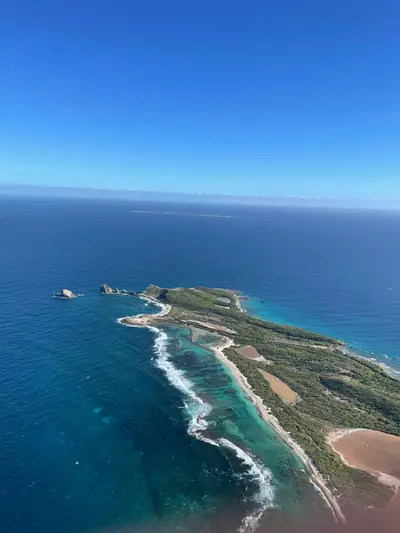
    Grande-Terre is the flat, eastern half of Guadeloupe, featuring Pointe-à-Pitre, its economic center, and the seaside resorts along the south coast. You come for the lagoon beaches behind coral reefs, the Mémorial ACTe, and the rocky coastline at Pointe des Châteaux.Along the south coast, Le Gosier, Sainte-Anne, and Saint-François line up with tranquil lagoons. All the way in the east, the island ends at Pointe des Châteaux, which has been protected as a natural monument since 1997. On the Atlantic and north coasts, the landscape becomes rougher, with limestone cliffs like at Porte d'Enfer near Anse-Bertrand.

    Enrevseluj·CC BY-SA 4.0

    Le Gosier

    Le Gosier

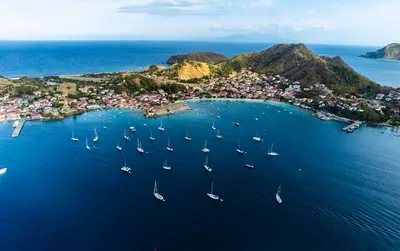
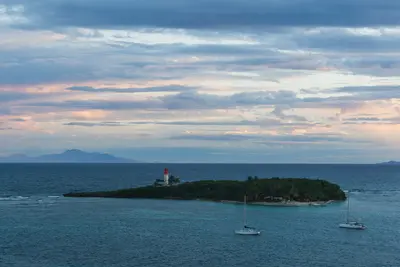
    Le Gosier, bordering Pointe-à-Pitre to the east, is Guadeloupe's largest seaside resort town. You come for the short distances from the airport, the city beach Plage de la Datcha with views of the Îlet du Gosier, and Marina Bas-du-Fort.On a hillside above the coast, the Fort Fleur d'Épée from 1759 recalls the battles with the English. The Îlet, with its lighthouse, lies just a few hundred meters off the beach and is accessible by boat or kayak.

    Alexey Komarov·CC BY-SA 4.0

    Pointe-à-Pitre

    Pointe-à-Pitre

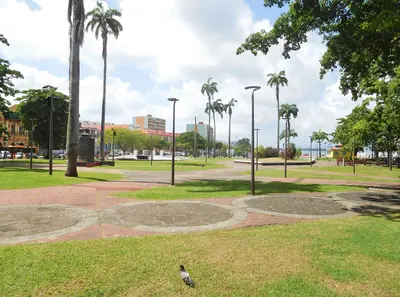
    Pointe-à-Pitre is the economic and cultural hub of Guadeloupe, located in western Grande-Terre where the two main islands meet, just minutes from the international airport. You come for the Mémorial ACTe, the lively markets, and the Creole old town around Place de la Victoire.The municipality is small at 2.7 square kilometers, built on marshland at the edge of a mangrove. From the port, ferries depart for Marie-Galante and Les Saintes, and cruise ships dock at the quay.

    Filo gèn'·CC BY-SA 4.0

    Sainte-Anne

    Sainte-Anne

    Sainte-Anne is the classic seaside resort on Grande-Terre's south coast, approximately 25 kilometers and about a half-hour drive from the airport. You come for the bright beaches, protected by a coral reef from the Atlantic swell, especially the Plage de la Caravelle.In the village, you'll find a daily market by the beach, most lively on Thursday mornings and weekends, and the Notre-Dame church, rebuilt in 1933 according to plans by Ali Tur. A coastal path leads from the village beach to the quieter Plage de Bois Jolan.

    Filo gèn'·CC BY-SA 4.0

    Your next steps

    Basse-Terre and National Park is in Guadeloupe. Ways to carry on from here.

    • More in Guadeloupe

      Highlights, areas, routes and the best time to travel for all of Guadeloupe.

      Guadeloupe travel guide
    • Round trips with Basse-Terre and National Park

      One route passes through Basse-Terre and National Park, with stops, nights and a map.

      See the round trip
    • Plan a trip with Basse-Terre and National Park

      The Guide asks about season, length and who is coming, and suggests a trip with Basse-Terre and National Park.

      Plan the trip

    Sources & method

    • Photos: Wikimedia Commons. Each photo carries its credit.
    • Place data such as addresses and ratings comes from Google Maps.
    • The content is based on web research from public, traceable sources. How the content is made · The role of AI