From Athens, you drive in just over two hours to the mountain village of Arachova on Mount Parnassus and further to nearby Delphi with its Sanctuary of Apollo. Finally, head down to the Gulf of Corinth to Galaxidi, a quiet port town with old captain's houses.
8 Days / 7 Nights
April to June & September
RV Friendly
4 stops
Why This Route?
For all wanting to link antiquity, mountains and coast at a relaxed pace over short distances.
Hidden Gems
Hosios Loukas Monastery, about half an hour from Arachova
Tholos at the Sanctuary of Athena Pronaia below Delphi, almost empty early in the morning
Nautical Museum of Galaxidi
Itinerary
Stop 1 • 2 Nights
Athen
City
Rich in culture and history. Perfect for an exciting city trip and Culinary highlights.
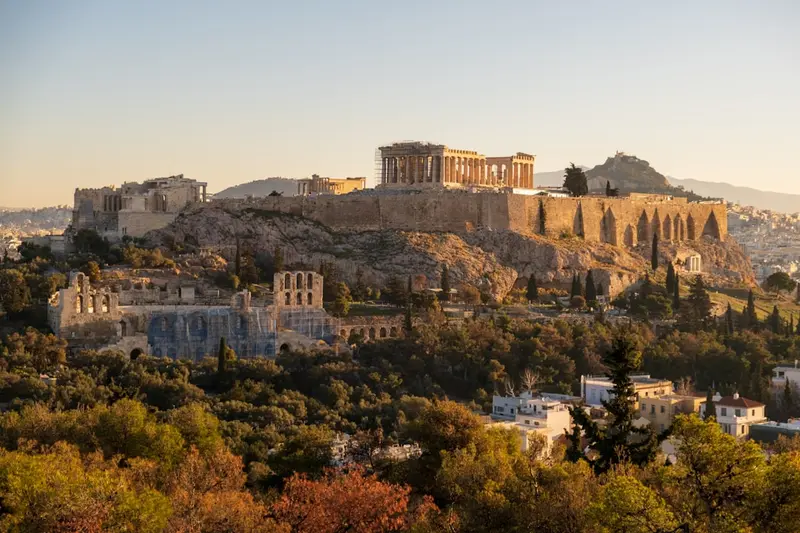
Athens is a city that doesn't keep its 3,400 years in a museum, but lives them daily: Beneath the Acropolis lie districts full of tavernas, record shops, and rooftop bars. If you only seek antiquity, stay two days. If you want to get to know the city, you need four.
12 Sights
6 Restaurants
Culture and History
Athens has been inhabited for over 3,000 years. In the 5th century BC, under Pericles, it gave rise to Attic democracy, tragedy as a theatrical form, and the buildings of the Acropolis. Philosophers like Socrates, Plato, and Aristotle taught in the city.Antiquity and ByzantiumThe Acropolis, with the Parthenon, Propylaea, and Erechtheion, combines Doric and Ionic architectural styles. From the Byzantine era come small domed cruciform churches like Kapnikarea and Panagia Gorgoepikoos, which today stand amidst commercial buildings.Capital since 1834When Athens became the capital of the new state in 1834, it was a small town. Under King Otto, Neoclassical buildings such as the University, Academy, and National Library emerged, designed among others by the Hansen brothers. Today, the Acropolis Museum and the National Archaeological Museum display the ancient finds.
For adventure seekers. Perfect for unwinding and relaxation and Perfect for an exciting city trip.
Arachova is a mountain village on the southern slopes of Mount Parnassus, about ten kilometers east of Delphi. In winter, it serves as the main base for the Parnassos ski center, attracting many guests from Athens on weekends. During the rest of the year, it primarily accommodates visitors to Delphi.The village is known for woven goods such as carpets and blankets, and for its Formaela cheese, which holds a protected designation of origin. Away from the main road, steep alleys and stairs wind between stone houses up to the clock tower and the church of Agios Georgios. In spring and autumn, hiking trails on Mount Parnassus begin here.
6 Sights
5 Restaurants
History and Culture
The Battle of ArachovaDuring the Greek War of Independence, rebels led by Georgios Karaiskakis defeated an Ottoman force near Arachova in 1826. Photos and documents in the town's Folklore Museum commemorate the battle.Architecture and CraftsThe townscape is characterized by stone houses with tiled roofs, descending in terraces down the hillside, interspersed with steep, cobbled alleys and stairs. A landmark is the Clock Tower perched on a rocky outcrop above the rooftops. Arachova is known for its woven goods; colorful rugs, blankets, and textiles are sold in many shops along the main street. The sheep's cheese Formaela holds a protected designation of origin.The Feast of Saint GeorgeThe patron saint of the town is Saint George, whose feast day on April 23rd is Arachova's most important annual event. The celebrations at Agios Georgios Church include traditional costumes, dances, and ancient customs.
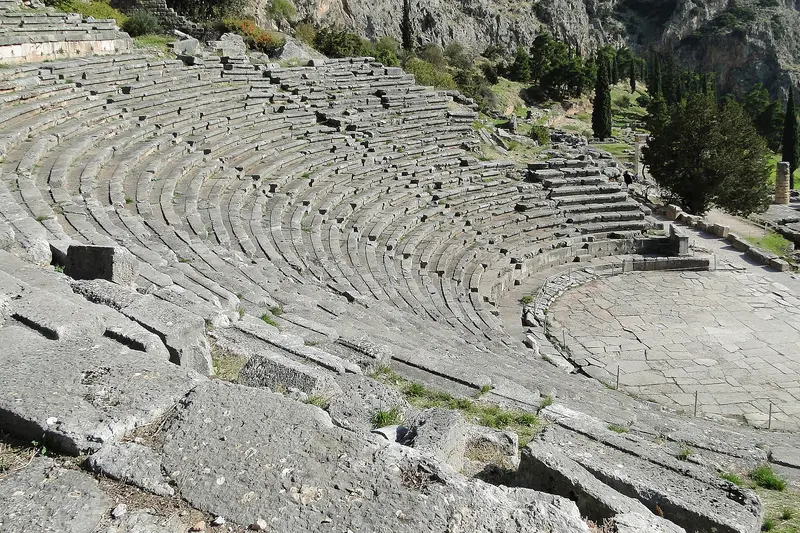
Delphi lies on the southern slope of Mount Parnassus, about two and a half hours' drive northwest of Athens. In antiquity the Sanctuary of Apollo and its oracle was one of the most important cult centres in Greece; today it is a UNESCO World Heritage Site. The Sacred Way leads past treasuries to the Temple of Apollo, with the theatre and stadium above, overlooking the Pleistos valley. The museum holds the bronze Charioteer of Delphi. Come early in the morning or late in the afternoon and wear sturdy shoes, as the site is steep and uneven.
8 Sights
4 Restaurants
Oracle, games and excavation
From the 8th century BC, the Sanctuary of Apollo on the southern slope of Mount Parnassus was one of the most important cult centres of the Greek world. Cities and rulers consulted the Pythia here before founding colonies or going to war. According to myth, the Omphalos stone at Delphi marked the centre of the world.Buildings and gamesAlong the Sacred Way, cities such as Athens and Siphnos built treasuries for their offerings. The theatre and stadium hosted the Pythian Games, held every four years from 582 BC and including music and poetry as well as athletics. Together with the Olympic, Isthmian and Nemean Games they were one of the four Panhellenic Games.Decline and rediscoveryThe oracle ended with the ban on pagan cults under Emperor Theodosius I at the end of the 4th century AD. The village of Kastri grew over the ruins until French archaeologists began excavating in 1892 and the village was moved. Delphi has been a UNESCO World Heritage Site since 1987.
Galaxidi is a small port town on the north coast of the Gulf of Corinth, about 30 kilometers southwest of Delphi. In the 19th century, it was one of Greece's most important shipping towns, and in the 1860s and 1870s, its merchant fleet comprised over 400 sailing ships. The stone captain's houses from this period still define the townscape today.You come to Galaxidi for a quiet evening at the harbor after visiting Delphi, for the Maritime Museum, and for walks between the two harbors and through the pine forest opposite. On Kathara Deftera, Clean Monday at the beginning of Orthodox Lent, the flour battle Alevromoutzouroma attracts many visitors.
6 Sights
4 Restaurants
History and Culture
Antiquity and Middle AgesIn ancient times, Chaleion, a city in western Lokris, was located where Galaxidi now stands. In the Middle Ages, the town was the most important port on the Gulf of Itea, alongside Krissa.The Age of Sailing ShipsGalaxidi experienced its heyday in the 19th century as a ship-owning town. In the 1860s and 1870s, its merchant fleet comprised over 400 ships, built in its own shipyards on the Chirolakas. The shipowners did not make the transition to steam shipping after 1890, and prosperity declined. From this golden age date the captain's houses and the collection of the Nautical and Historical Museum, founded in 1928 at the suggestion of doctor Efthymios Vlamis, which boasts the largest collection of ship paintings in Greece.The Flour BattleOn Kathara Deftera, Clean Monday at the beginning of Orthodox Lent, Galaxidi celebrates the Alevromoutzouroma: Participants, dressed in old clothes, head to the harbour and throw coloured flour at each other until supplies run out. The custom has existed in this form since the mid-19th century, its origin remains unclear.