Fernweh: Home
    ExploreTravel GuidesPlan a tripMy tripLast visited
    de|en
    All Places & RegionsAll highlightsAbout FernwehFAQPrivacy PolicyImprint
    ExploreTravel GuidesPlan a tripMy tripLast visited
    • Neighborhoods & highlights
    • Walking tours
    • Eat & drink
    • Food culture
    • Culture
    • Getting around
    • Accommodation
    • Plan trip
    • Nearby
    Delphi

    Greece

    Delphi

    CityCulture

    Delphi lies on the southern slope of Mount Parnassus, about two and a half hours' drive northwest of Athens.

    by Felix Gillen

    1. Home
    2. Destinations
    3. Greece
    4. Central Greece area
    5. Delphi
    Delphi lies on the southern slope of Mount Parnassus, about two and a half hours' drive northwest of Athens. In antiquity the Sanctuary of Apollo and its oracle was one of the most important cult centres in Greece; today it is a UNESCO World Heritage Site. The Sacred Way leads past treasuries to the Temple of Apollo, with the theatre and stadium above, overlooking the Pleistos valley. The museum holds the bronze Charioteer of Delphi. Come early in the morning or late in the afternoon and wear sturdy shoes, as the site is steep and uneven.

    Sights in Delphi

    Discover the most important sights and attractions

    Apollontempel in Delphi

    1Apollontempel in Delphi

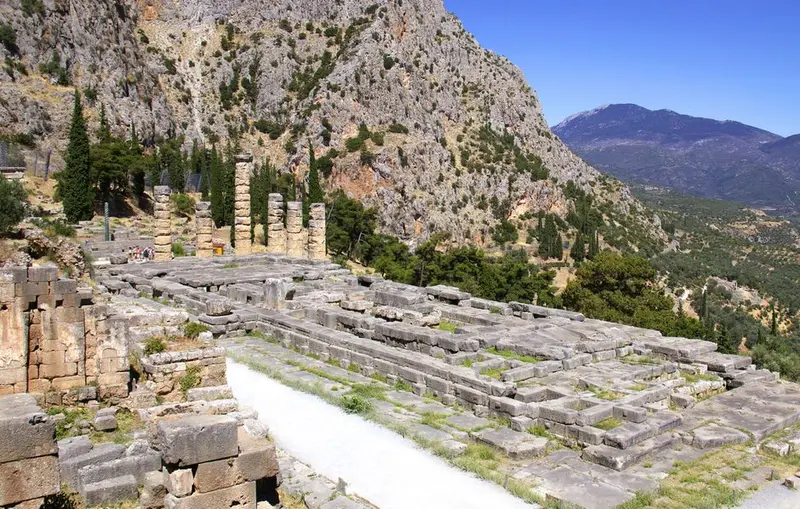
    The Temple of Apollo was the sanctuary's heart; inside, the Pythia, priestess of Apollo, delivered oracles. Today's visible remains are from the third building on this site, erected after a 373 BC earthquake and completed around 330 BC. It was a Doric peripteral temple with six by fifteen columns. Preserved are the foundations, the large terrace, and some re-erected columns. Below is the Polygonal Wall, its stones covered with hundreds of inscriptions for the manumission of slaves. The Sacred Way zigzags from the entrance, past the treasuries, up to the temple.
    Open in Google Maps
    Stadium of Delphi

    2Stadium of Delphi

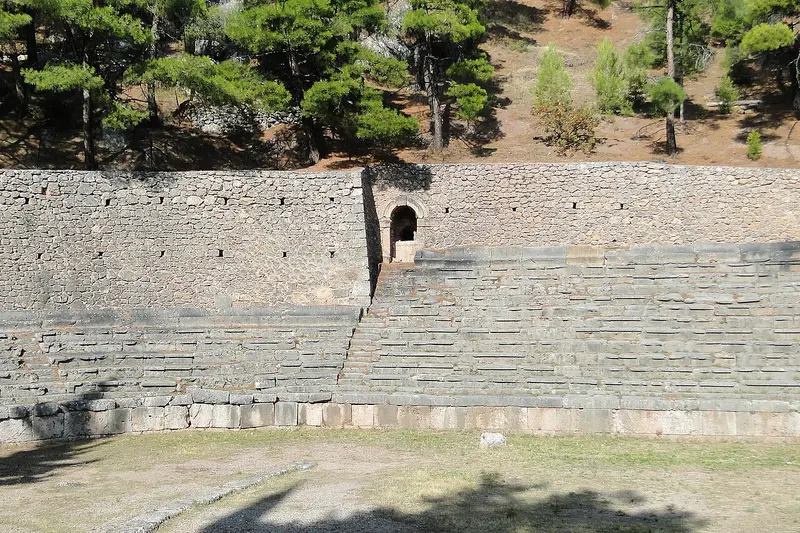
    The stadium is located at the highest point of the sanctuary, above the theatre. Here, the athletic contests of the Pythian Games took place, held every four years in honour of Apollo, encompassing sports, music, and poetry. The track measures approximately 178 metres, and the stone starting blocks are preserved at both ends. Stone seating for approximately 6,500 spectators was laid out by Herodes Atticus in the 2nd century AD. A steep path leads up from the theatre in a few minutes.
    Open in Google Maps
    Schatzhaus der Athener

    3Schatzhaus der Athener

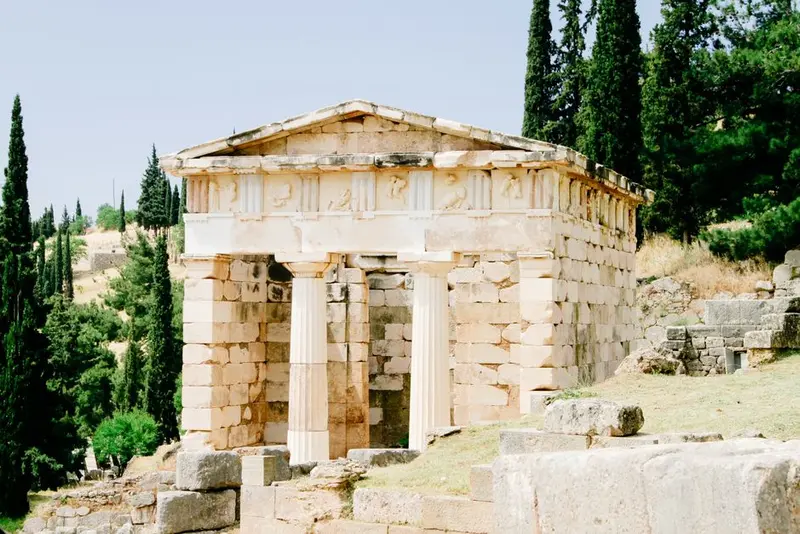
    The Athenian Treasury stands at a bend in the Sacred Way and was used to store votive offerings from the city of Athens. According to ancient tradition, this small Doric structure of Parian marble was financed from the spoils of the Battle of Marathon in 490 BC, though its precise dating remains debated by scholars. French archaeologists reassembled it from its original blocks between 1903 and 1906. The metopes depicting the deeds of Herakles and Theseus are displayed in the museum, while casts are fitted onto the structure. Numerous inscriptions are carved into its walls, including two hymns to Apollon with musical notation.
    Open in Google Maps
    Korykian Grotto

    4Korykian Grotto

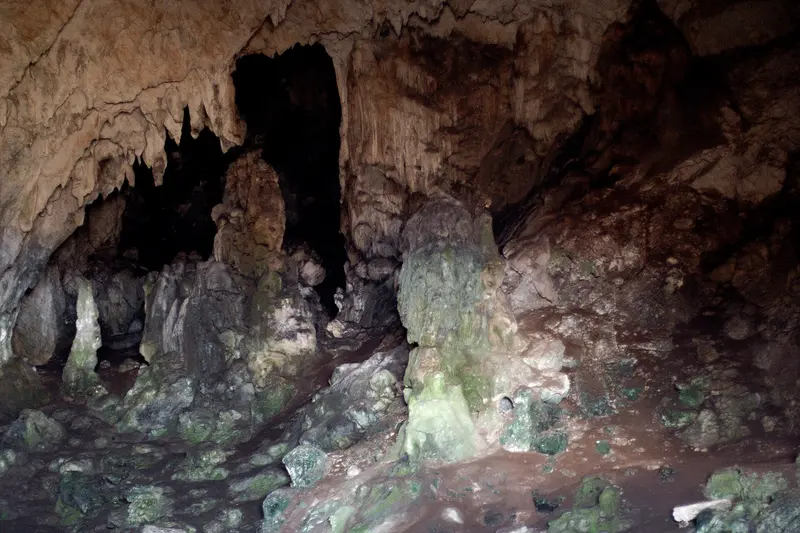
    The Corycian Cave, popularly known as Sarantavli, is located high above Delphi on the edge of the Parnassus Plateau. In antiquity, it was dedicated to Pan and the Nymphs; excavations uncovered thousands of terracotta figures and astragali, or gaming knucklebones, as votive offerings. According to Herodotus, the inhabitants of Delphi fled here during the Persian invasion of 480 BC. The cave consists of a large hall with stalactites and stalagmites and is unlit; a lamp is necessary. From Delphi, an old path leads up in several hours; the journey is shorter via a track from the plateau followed by a footpath.
    Open in Google Maps
    Kastalische Quelle

    5Kastalische Quelle

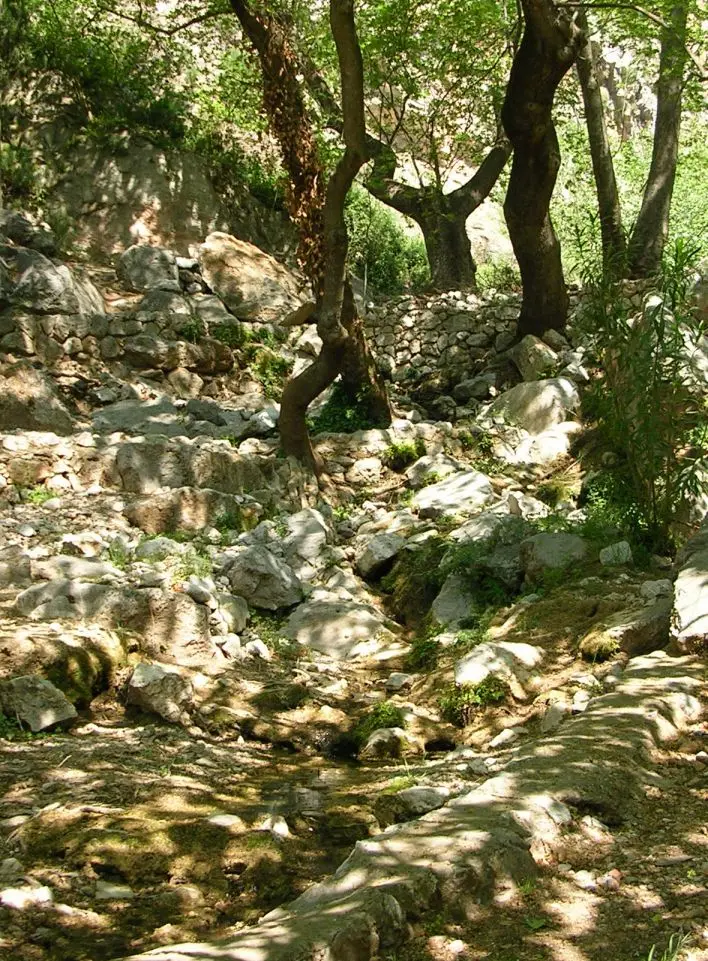
    The Castalian Spring rises in the gorge between the two cliffs of the Phaedriades, east of the Sanctuary of Apollo on the road to Arachova. Pilgrims and priests purified themselves here before consulting the Oracle. Two spring complexes have been preserved: an archaic basin from the 6th century BC and a younger spring house carved directly into the rock with niches for votive offerings, dating from the Hellenistic-Roman period. In later times, the water was considered a source of poetic inspiration.
    Open in Google Maps
    Theater of Delphi

    6Theater of Delphi

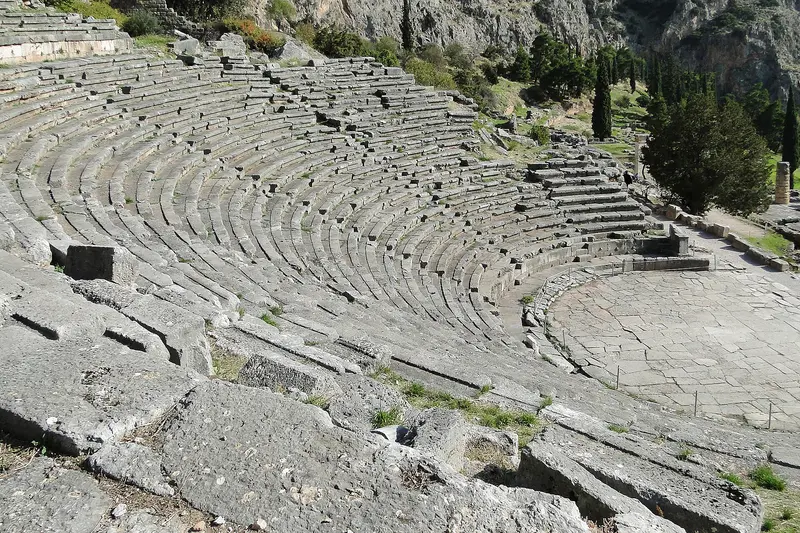
    Above the Temple of Apollo lies the Theatre, dating back to the 4th century BC in its original form, later rebuilt multiple times, including in the 2nd century BC with funds from King Eumenes II of Pergamon. Its 35 rows of seats accommodated around 5,000 spectators, and performances and singing took place here during the musical competitions of the Pythian Games. From the upper tiers, you overlook the Temple and the Pleistos Valley. The path leads further up to the Stadium.
    Open in Google Maps

    City walks in Delphi

    Curated walking tours through the city's highlights, handpicked by experienced travel journalists.

    Delphi: In the Footsteps of the Oracle – A Walk Through the Ancient World

    Experience the magical aura of ancient Delphi on this roughly 2-hour walk. From the lively new town the path leads to the sacred sites where the oracle once made her prophecies. Immerse yourself in history, mythology and a breathtaking landscape.

    ~2 Std.
    Open in Google Maps
    Stops (6)

    Food & Drink

    1

    Athanasios & Kon/Nos Mamarelis O.E.

    A dining establishment on the western outskirts of modern Delphi, operated under the Mamarelis family name. The Sanctuary is just under a kilometer away, along the main road.
    Show on Google Maps
    2

    Tavern DION

    The Taverna Dion is located in the modern town of Delphi, a few minutes' walk from the center. The menu features Greek taverna dishes, grilled dishes, and oven dishes.
    Show on Google Maps
    3

    In Delphi Restaurant

    The In Delphi Restaurant is located in the modern town of Delphi, a few hundred meters west of the sanctuary. It serves Greek cuisine with Mezedes, grilled and oven-baked dishes.
    Show on Google Maps
    4

    Taberna Ta Skalakia

    The tavern Ta Skalakia is located in the modern town of Delphi. The name means 'small stairs,' referring to the steps that connect the village's streets running parallel along the hillside. The cuisine is Greek, offering tavern classics and salads.
    Show on Google Maps

    Food and Drink in Delphi

    Delphi thrives on day tourism; many eateries cater to bus groups. Walk one street over or drive to neighboring Chrissó for usually better and cheaper food. Parnass cuisine includes goat, pulses, wild herbs, and cheese, plus olive oil from the Amfissa plain directly below.

    Formaella

    The sheep and goat cheese from nearby Arachova bears a Protected Designation of Origin and features on almost every menu, usually as saganaki with lemon. It is firm, salty, and served hot.

    Goat and Lamb of Parnassus

    Goat is stewed here or baked with potatoes in the oven and often features as a daily special rather than on the menu. Ask about what's cooking in the pot; that's usually the better choice.

    Amfissa olives and olive oil

    From the olive groves between Delphi and Itea come large, dark table olives with a protected designation of origin. In Delphi and Chrissó, several shops sell oil and olives directly from the producers.
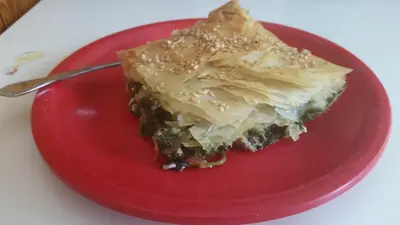
    Hortopita

    Hortopita

    The pita with wild greens, leeks, and feta is an everyday item in the mountain villages, often sold by weight. Village bakeries generally have it from the morning.

    Valley View Taverns

    Die Lokale entlang der oberen Dorfstraße haben Terrassen über dem Olivental bis zum Golf von Korinth. Für die Zeit um Sonnenuntergang lohnt es sich, früh da zu sein oder zu reservieren.

    Oracle, games and excavation

    From the 8th century BC, the Sanctuary of Apollo on the southern slope of Mount Parnassus was one of the most important cult centres of the Greek world. Cities and rulers consulted the Pythia here before founding colonies or going to war. According to myth, the Omphalos stone at Delphi marked the centre of the world.Buildings and gamesAlong the Sacred Way, cities such as Athens and Siphnos built treasuries for their offerings. The theatre and stadium hosted the Pythian Games, held every four years from 582 BC and including music and poetry as well as athletics. Together with the Olympic, Isthmian and Nemean Games they were one of the four Panhellenic Games.Decline and rediscoveryThe oracle ended with the ban on pagan cults under Emperor Theodosius I at the end of the 4th century AD. The village of Kastri grew over the ruins until French archaeologists began excavating in 1892 and the village was moved. Delphi has been a UNESCO World Heritage Site since 1987.

    Getting around

    Getting thereWithout a car, you reach Delphi on KTEL Fokidas intercity buses from Athens' Liossion bus terminal; the journey takes about three hours. By car it takes around two and a half hours. The bus stop is on the main street in the village, and tickets are sold there or by the driver.On siteThe village, the site and the museum are on the same road and within walking distance. Inside the site the path climbs steeply up to the stadium. The Sanctuary of Athena Pronaia lies about one kilometre further along the road towards Arachova, with no pavement. For trips to Arachova, Galaxidi or Hosios Loukas Monastery you need a car or taxi.

    Accommodations in Delphi

    Find perfect stay in Delphi

    Booking.com* (Affiliate link)
    Search Hotels
    Agoda* (Affiliate link)
    Search Hotels
    Airbnb
    Vacation Rentals

    * Affiliate link: if you book through it, we earn a small commission. The price stays the same for you.

    Campgrounds in Delphi

    Find perfect campground in Delphi

    Search via Google Maps
    Campgrounds nearby (15km)
    Camping.info
    Find Campgrounds
    Park4Night
    RV Parks & Camping

    Plan your trip to Delphi

    Save places, build a route and plan your city trip, all in one place.

    1. 1
      Sunrise over alpine peaks and a sea of clouds
      1234

      Round trip

      12 days · 4 stops

      Saved

      Pick a route

      Pick a ready-made one or save places and plan your own.

      Open bookmarks
    2. 2

      Trip to Delphi

      Live
      • 1Apollontempel in Delphi3 days
      • 2Stadium of Delphi4 days
      • 3Schatzhaus der Athener5 days
      Budget

      Plan your trip

      The planner sorts stops, days and budget. Plan together in real time.

      Start trip planning
    3. 3
      9:41 No signal
      Delphi
      Available offline

      Use it on the road

      Download the guide to your phone and use it on site, even offline.

    Nearby

    Arachova

    Arachova

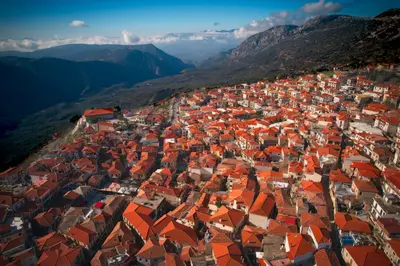
    Arachova is a mountain village on the southern slopes of Mount Parnassus, about ten kilometers east of Delphi. In winter, it serves as the main base for the Parnassos ski center, attracting many guests from Athens on weekends. During the rest of the year, it primarily accommodates visitors to Delphi.The village is known for woven goods such as carpets and blankets, and for its Formaela cheese, which holds a protected designation of origin. Away from the main road, steep alleys and stairs wind between stone houses up to the clock tower and the church of Agios Georgios. In spring and autumn, hiking trails on Mount Parnassus begin here.
    Galaxidi

    Galaxidi

    Galaxidi is a small port town on the north coast of the Gulf of Corinth, about 30 kilometers southwest of Delphi. In the 19th century, it was one of Greece's most important shipping towns, and in the 1860s and 1870s, its merchant fleet comprised over 400 sailing ships. The stone captain's houses from this period still define the townscape today.You come to Galaxidi for a quiet evening at the harbor after visiting Delphi, for the Maritime Museum, and for walks between the two harbors and through the pine forest opposite. On Kathara Deftera, Clean Monday at the beginning of Orthodox Lent, the flour battle Alevromoutzouroma attracts many visitors.
    Thermopylae

    Thermopylae

    At **Thermopylae**, in 480 BC, a Greek force under the Spartan King Leonidas held back Xerxes' Persian army for three days. Back then, a narrow coastal pass ran here between the Kallidromo Mountains and the sea; today, due to the Spercheios River's deposits, the coast is several kilometers away.Little remains of the pass itself on the terrain. Visitors who stop here will see the Leonidas Monument, the Kolonos Hill (site of the last stand), and the information center explaining the vanished landscape. The stop is easily integrated into a trip between Athens and Northern Greece.
    Central Greece area

    Central Greece area

    Central Greece, in Greek Sterea Ellada, stretches from the Gulf of Corinth, over Mount Parnassus, to the Malian Gulf. Between Delphi's Oracle Sanctuary, Thermopylae Pass, and the mountain villages of Evrytania, lies a landscape many travellers merely pass through en route north. Those who stop find ancient sites without crowds and a mountain range snowy in winter.
    Corinth

    Corinth

    Corinth is situated on the Isthmus, the narrowest point between the Peloponnese and the Greek mainland, and thus controlled traffic between two seas for centuries. The ancient city was destroyed by Rome in 146 BC and re-established as a colony a century later; it was here that the Apostle Paul preached. The Temple of Apollo, the Acrocorinth fortress, and the canal opened in 1893 represent three very different eras in one place.

    Sources & method

    • Photos: Wikimedia Commons, Unsplash, Pexels. Each photo carries its credit.
    • The content is based on web research from public, traceable sources. How the content is made · The role of AI