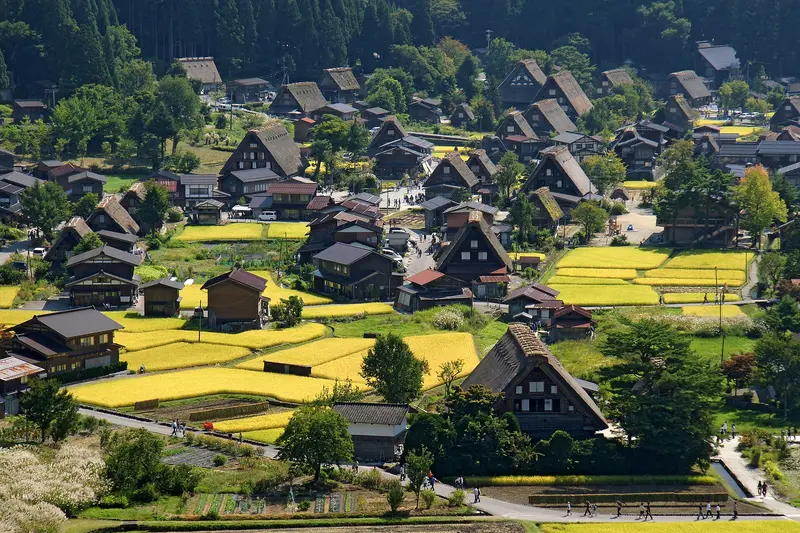
From Tokyo, you travel by train or direct bus in five to six hours to Takayama, and then by bus via the thatched-roof village of Shirakawa-go to Kanazawa. The Hokuriku Shinkansen takes you back to Tokyo in about two and a half hours.
8 Days / 7 Nights
April–Juni und Dezember–Februar für Schnee
3 stops
Why This Route?
For travelers who want to experience crafts, Edo-period wooden architecture, and mountain landscapes off the Golden Route.
Hidden Gems
Higashiyama Walking Course in Takayama, a tranquil path along ancient temples and shrines
Shiroyama Viewpoint above Ogimachi village in Shirakawa-go
Nagamachi, the Samurai district in Kanazawa with the Nomura Family House and its small garden
Itinerary
Stop 1 • 3 Nights
Tokyo
Region
Route highlight
Tokyo is Japan's capital and one of the world's largest metropolitan areas. Between skyscraper districts like Shinjuku and Shibuya are the Meiji Shrine, Sensō-ji in Asakusa, and narrow Izakaya alleys, where old Edo is still palpable. The prefecture also includes forested Tama Region mountains to its west, and the Izu and Ogasawara Islands out in the Pacific.
5 Sights
3 Restaurants
Tokyo's Cultural Heritage and Modernity
Tokyo, originally known as Edo, is a city that blends its deeply rooted traditions with groundbreaking modernity. From 1603, it served as the seat of the powerful Tokugawa Shogunate and rapidly grew into one of the world's largest metropolises. The Meiji Restoration of 1868 transformed Edo into the imperial capital of Tokyo, ushering in an era of rapid modernization and Western influences.Despite destructive events such as the Great Kanto Earthquake in 1923 and the devastation of World War II, the city has consistently reinvented itself. Its architecture is a fascinating blend of historic sites like the Senso-ji Temple in Asakusa and futuristic skyscrapers that define today's cityscape.Cultural distinctiveness manifests in diverse local traditions, from the delicate tea ceremony and Ikebana to the powerful performances of Kabuki theater and the Sumo ring. These practices are carefully preserved, offering deep insights into Japanese aesthetics and the significance of harmony and respect.
Rich in culture and history. Perfect for unwinding and relaxation and Culinary highlights.
Visit this picturesque mountain town with its beautifully preserved Edo-period streets, traditional wooden buildings, and unique Gassho-zukuri architecture.
From Tokyo, the Shinkansen and Hida limited express or a direct bus take five to six hours to Takayama. Start early for the Asa-ichi morning market and the sake breweries.
5 Sights
4 Restaurants
The cultural heritage of Hida Takayama
Hida Takayama entwickelte sich während der Sengoku-Zeit als bedeutende Burgstadt und kam 1692 unter direkte Kontrolle des Tokugawa-Shogunats, was die Stadt maßgeblich prägte. Diese Ära förderte die Entstehung einer herausragenden Holzhandwerkskunst, bekannt als Hida no Takumi. Die gut erhaltenen Kaufmannshäuser im Stadtteil Sanmachi Suji und das historische Takayama Jinya, ein ehemaliges Regierungsgebäude der Edo-Zeit, sind herausragende Beispiele dieser charakteristischen Holzarchitektur.Ein Höhepunkt des kulturellen Lebens ist das Takayama Matsuri, eines der schönsten Festivals Japans. Es wird zweimal jährlich gefeiert und präsentiert prächtige Festwagen (Yatai) mit kunstvollen Karakuri-Puppen, die die technische Finesse der Hida-Handwerker eindrucksvoll demonstrieren. Neben der Schreinerkunst ist Takayama auch für seine traditionellen Lackarbeiten, insbesondere das Hida Shunkei Nuri, und die lokale Keramik bekannt.
Rich in culture and history. Perfect for an exciting city trip and Perfect for unwinding and relaxation.
Kanazawa lies on the coast of the Sea of Japan and is known for its well-preserved Edo-period districts. Right next to the castle park lies the Kenroku-en, one of the "Three Great Gardens of Japan". Teahouse districts like Higashi Chaya and the Samurai district Nagamachi showcase traditional wooden houses and narrow alleys. At Ōmichō Market, you'll experience the local fish and agricultural culture, while the 21st Century Museum of Contemporary Art exhibits contemporary art. Kanazawa was spared from air raids during World War II, which is why many historic buildings and craft traditions like gold leaf production have been preserved. In autumn, when the leaves change color, Kenroku-en is particularly worth seeing. In some historic Chaya houses, you can participate in a tea ceremony.
The direct bus to Kanazawa stops in Shirakawa-go, so you can visit the village with its thatched-roof houses on the way. The Hokuriku Shinkansen takes about two and a half hours back to Tokyo.
4 Sights
5 Restaurants
Cultural Heritage and Arts
Kanazawa, having remained untouched by the bombings of World War II, preserves to this day a rich cultural and historical identity deeply rooted in the Edo period. Under the rule of the powerful Maeda clan of the Kaga domain, the city developed into one of Japan's most significant cultural centers, comparable to Kyoto and Edo. This era shaped Kanazawa as a stronghold of arts and crafts.The city is renowned for its unique architecture, including the magnificent Kenroku-en Garden, considered one of Japan's most beautiful, as well as the preserved samurai residences in the Nagamachi district and historical teahouse districts like Higashi Chaya. Traditional crafts such as gold leaf production, for which Kanazawa produces almost all of Japan's supply, and the intricate Kaga Yuzen silk dyeing remain vibrant today. These unique features reflect the city's artistic heritage and uninterrupted cultural development.