From Calgary, it's ~90 minutes to Banff, with four nights for hiking Lake Louise and Moraine Lake. Then the Icefields Parkway passes the Columbia Icefield to Jasper. On the 230+ km Parkway, only Saskatchewan River Crossing has a gas station.
12 Days / 11 Nights
June–September
RV Friendly
4 stops
Why This Route?
For nature fans who want to spend time hiking in Banff and Jasper.
Hidden Gems
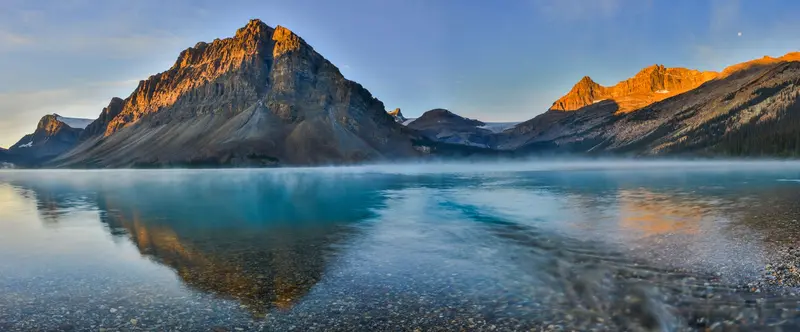
Bow Lake on the Icefields Parkway at sunrise
Mistaya Canyon on the Icefields Parkway, a short walk to a deeply carved gorge
Pyramid Lake near Jasper, quieter than Maligne Lake
Itinerary
Stop 1 • 1 Night
Calgary
City
Calgary is the largest city in Alberta and is located where the prairie transitions into the foothills of the Rocky Mountains. The city is known for the Calgary Stampede in July and, with its airport, is the main gateway to Banff, which lies approximately 130 km to the west.
4 Sights
3 Restaurants
Culture & History
Calgary, a city renowned for its dynamic blend of Western heritage and modern urbanity, offers a rich insight into Canada's history and a vibrant cultural scene. The city's roots are deeply embedded in Indigenous history, long before European settlers reached the area.Indigenous Roots and FoundingThe area of present-day Calgary is the traditional territory of the Blackfoot Confederacy, which includes the Siksika, Kainai, and Piikani, as well as the Tsuut'ina Nation and the Stoney Nakoda First Nations. These cultures shaped the landscape for thousands of years.The city was founded in 1875 as a post of the North-West Mounted Police (NWMP) to maintain order and suppress the whisky trade.In 1876, Colonel James Macleod (NWMP) named the city Calgary, after Calgary Bay on the Isle of Mull in Scotland.The arrival of the Canadian Pacific Railway (CPR) in 1883 marked the beginning of rapid growth, establishing Calgary as an important center for ranching and agriculture.Wild West HeritageCalgary is inextricably linked to its history as a cowboy and ranching metropolis, a heritage still palpable and celebrated annually.The first Calgary Stampede took place in 1912 and grew into one of the largest rodeos and outdoor spectacles in the world, attracting millions of visitors annually.This event is a tribute to the pioneering era and ranching traditions, featuring rodeos, chuckwagon races, concerts, and agricultural exhibitions.Visit the Heritage Park Historical Village to immerse yourself in the past and experience historic buildings, steam trains, and an authentic frontier town.Modern Culture and Art SceneBeyond its historical charm, Calgary has evolved into a significant center for contemporary art and culture, encompassing a variety of expressive forms.The Arts Commons is a cultural complex in the heart of the city, housing theaters, concert halls, and art galleries, and home to many performing arts.Discover the Glenbow Museum, showcasing the art, culture, and history of Western Canada and its Indigenous peoples. Note that the museum is currently being renovated and is expected to reopen in 2027.The city is home to a growing number of independent galleries, live music venues, and festivals that extend beyond the Stampede, offering a diverse program throughout the year.Calgary's architecture displays an interesting blend of historic sandstone buildings, such as the Old City Hall, and modern skyscrapers that define its skyline.
Perfect for an exciting city trip. For adventure seekers and Perfect for unwinding and relaxation.
A vibrant mountain town in the heart of Banff National Park, serving as a central hub for outdoor adventures, shopping, and relaxation.
9 Sights
5 Restaurants
Culture, Art, and History in Banff
Banff's cultural identity is deeply rooted in its genesis as Canada's first national park and the influence of the Canadian Pacific Railway. Founded in 1885 around the discovery of the Cave and Basin Hot Springs, Banff rapidly developed into an exclusive destination celebrating the majestic mountain landscape. Long before European settlement, however, this area was home to Indigenous peoples, including the Stoney Nakoda, Siksika, and Tsuut'ina, whose deep knowledge of the land and their traditions forms a fundamental, often overlooked part of its cultural heritage.The town's architecture is significantly shaped by the "Parkitecture" style, characterized by the use of local materials like wood and stone, blending harmoniously into the alpine environment. Prominent examples include the historic Fairmont Banff Springs Hotel, an imposing railway hotel, and the Banff Park Museum, Canada's oldest natural history museum. Cultural specifics include the strong connection to nature and outdoor sports, reflected in numerous traditions and events. The importance of the arts is underscored by institutions like the Banff Centre for Arts and Creativity, which attracts international artists and offers festivals and workshops year-round, inspired by the surrounding landscape.
For adventure seekers. Perfect for unwinding and relaxation.
The Icefields Parkway (Highway 93 North) stretches 232 kilometers, connecting Lake Louise in Banff National Park with the town of Jasper. The road passes over 100 glaciers, turquoise lakes like Bow Lake and Peyto Lake, and the Columbia Icefield, making it one of North America's most renowned scenic routes.
4 Sights
1 Restaurant
History of the Road
For a long time, indigenous peoples and later fur traders used the valleys as a thoroughfare, and mountain guides like Bill Peyto led expeditions towards the Columbia Icefield from the late 19th century onwards. Road construction began in the 1930s as an employment program during the Great Depression; in 1940, the gravel track was opened. The Parkway received its current paved alignment in 1961.
Perfect for an exciting city trip. For adventure seekers and Perfect for unwinding and relaxation.
Jasper is the only town in the national park of the same name, the largest in the Canadian Rockies and part of the UNESCO World Heritage site. The small town originated as a railway station and is quieter than Banff. In July 2024, a wildfire destroyed about a third of the buildings in the town; reconstruction is underway, and some trails and facilities in the surrounding area were temporarily closed – check Parks Canada's current advisories before your visit.
6 Sights
5 Restaurants
Jaspers' Cultural Heritage
Jasper, deeply rooted in the Canadian Rocky Mountains, boasts a rich history that extends long before its establishment as a national park town. The area is traditional territory of the First Nations and Métis, whose presence and cultural heritage shaped the landscape and early explorations. European fur traders and explorers followed in the early 19th century, before Jasper National Park was founded in 1907.Jasper's architecture often reflects the rustic style of earlier national park buildings, featuring wooden beams and stone that blend harmoniously into the alpine environment. Local traditions are closely tied to nature and the park's conservation, while modern art and culture find expression in the community through galleries and seasonal events. The preservation of wilderness and respect for Indigenous history are central cultural pillars of the town.