The route leads to regions few Thailand travelers see: jungle and wildlife in Khao Yai National Park, the temple city of Nan in the north, and the islands off Trang. Khao Yai and Nan are over 600 road kilometers apart; a flight from Bangkok to Nan is quicker. From Nan, you fly via Bangkok to Trang, and a boat from Pak Meng Pier takes you to Koh Kradan.
18 Days / 17 Nights
November–Februar
5 stops
Why This Route?
For the curious: less-visited regions and finally a small island without roads.
Hidden Gems
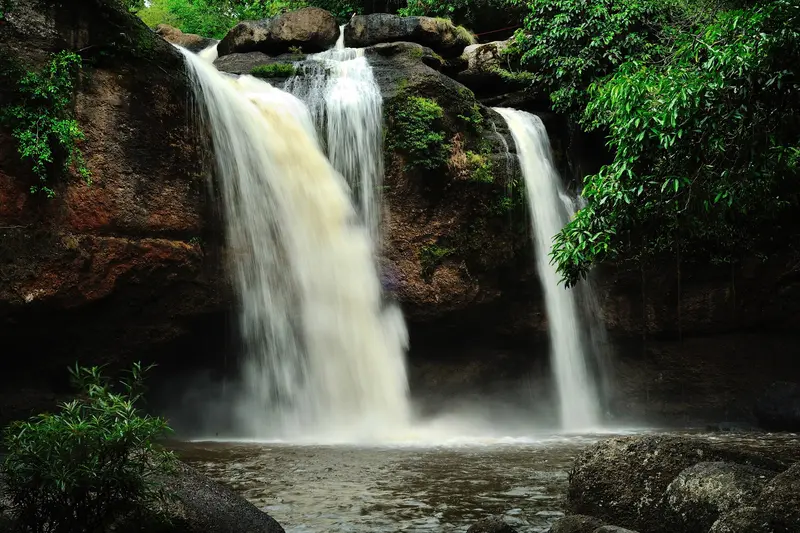
Haew Suwat Waterfall in Khao Yai
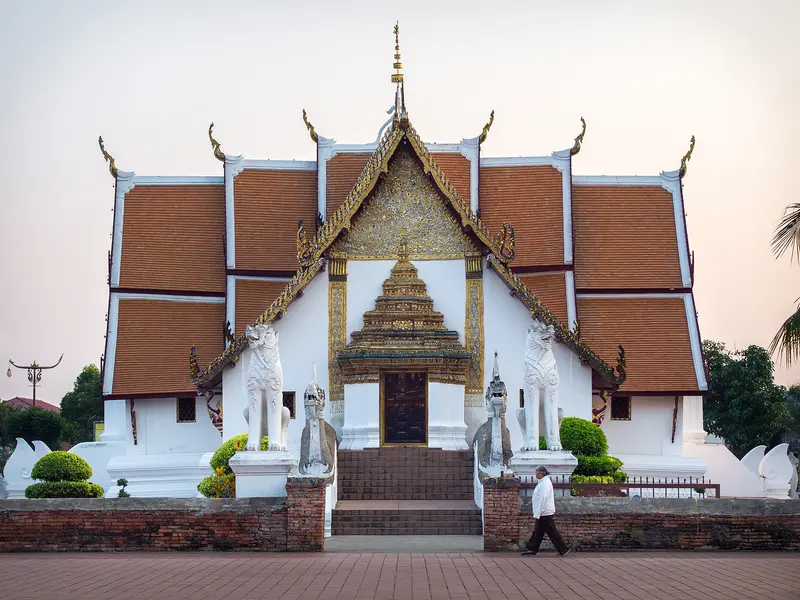
Murals at Wat Phumin in Nan
Emerald Cave on Koh Mook off Trang, only reachable by swimming through a rock tunnel
Itinerary
Stop 1 • 2 Nights
Bangkok
City
Perfect for an exciting city trip. Rich in culture and history and Culinary highlights.
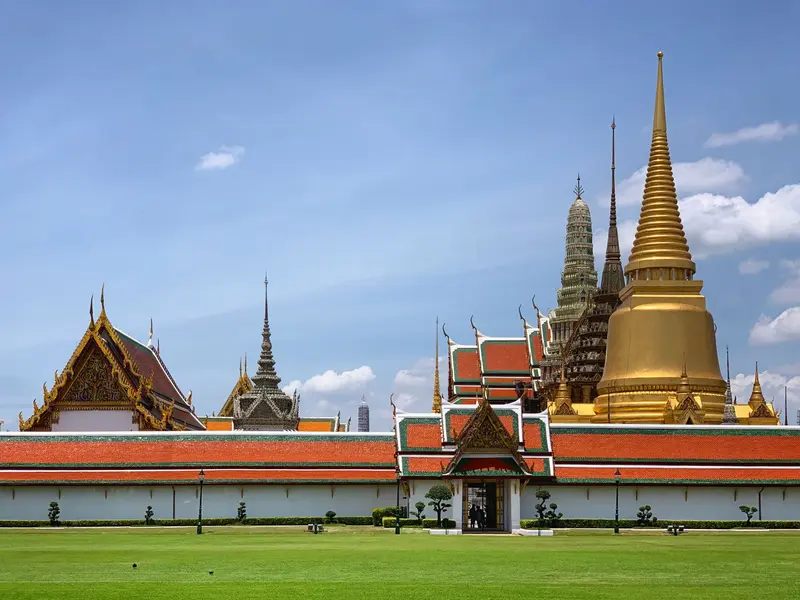
Bangkok is Thailand's capital and by far its largest city, where Buddhist temples, street food, and high-rise districts lie closely side by side. Along the Chao Phraya River stand the Grand Palace with the Emerald Buddha, Wat Pho with its 46-meter-long Reclining Buddha, and opposite, Wat Arun. Markets like the Chatuchak Weekend Market and the street food of Yaowarat showcase daily city life, while Sukhumvit and Siam are known for shopping malls and nightlife. The most pleasant time to visit is from November to February. You can avoid traffic jams with the Skytrain (BTS), Metro (MRT), and river boats.
10 Sights
3 Restaurants
History and Culture
History and CultureAfter the destruction of Ayutthaya in 1767, the capital was initially in Thonburi on the west bank. King Rama I relocated it in 1782 to Rattanakosin Island on the east bank; the erection of the City Pillar on April 21, 1782, is considered the founding date of Bangkok as the capital. From this period date the Grand Palace and Wat Phra Kaeo with the Emerald Buddha. Older are Wat Pho, which Rama I had rebuilt from 1788, and Wat Arun on the west bank, whose grand prang was completed in 1851.Buddhism shapes daily life: In the early morning, monks walk through the neighborhoods on their alms rounds, and many people bring offerings to temples and shrines. The monarchy enjoys high reverence; you'll see images of the royal family everywhere; insults to the royal house are punishable by law. During Songkran in April, entire streets turn into water fights.
For adventure seekers. Perfect for unwinding and relaxation.
Khao Yai National Park was Thailand's first national park in 1962 and is part of the Dong Phayayen-Khao Yai Forest Complex, a UNESCO World Heritage site. Covering 2,168 square kilometers, it is the country's third-largest and spans four provinces: mountainous terrain with evergreen rainforest, grasslands, and streams.Best known are the Haew Suwat and Haew Narok waterfalls, the latter currently closed. Marked hiking trails begin at the visitor center; for longer routes through the forest, you need a guide.The main reason to visit is wildlife viewing: wild elephants, white-handed gibbons, macaques, sambar deer, and several hornbill species. Observation towers near salt licks and meadows, such as at Nong Phak Chi, are best early morning and at dusk. Guided spotlighting drives are offered in the evenings.Elephants regularly cross the roads: keep your distance, stay in your vehicle, do not honk. Accommodation is available at campsites and in park-managed bungalows. Access points are in the north near Pak Chong and in the south near Prachinburi.
Rich in culture and history. Perfect for an exciting city trip.
Nan is a quiet provincial capital on the Nan River in eastern Northern Thailand, in a province bordering Laos. Until the 14th century, Nan was its own principality. The city is known for the murals in Wat Phumin, which is right next to the Nan National Museum, and for the surrounding mountainous landscape.
3 Sights
Culture and Everyday
Nan's long independence has shaped it to this day. In the 14th century, smaller principalities merged to form Nanthaburi. In 1558, the Burmese took control and abducted many inhabitants. After 1786, a local dynasty with extensive self-governance ruled again, until Nan recognized Bangkok's full sovereignty in 1931.The city's most famous artworks are the murals in Wat Phumin, painted by Tai-Lue artists in the late 19th century. A scene depicting a man whispering something into a woman's ear has become a symbol of the city.In the temples, the usual rules apply: shoulders and knees covered, shoes off, no flash when photographing the murals.
Trang is a provincial capital on the Andaman coast in southern Thailand and thrives less on tourism than on trade, rubber, and agriculture. Many residents have Chinese roots, evident in the rows of shophouses, the shrines, and especially the cuisine.In Thailand, the city is known for its breakfast: From early morning, dim sum eateries open, featuring Mu Yang, grilled pork with crispy skin. Those who want to try this must get up early.For travelers, Trang is primarily a transit hub. The city lies on a branch line of the Southern Railway, which continues to Kantang, and has an airport. From the coastal piers, boats depart for the provincial islands, including Koh Mook with the Tham Morakot cave, Koh Ngai, and Koh Kradan.The island season runs approximately from November to April. The city itself functions year-round.
4 Sights
4 Restaurants
History and Culture
Trang's prosperity is tied to rubber. Phraya Ratsadanupradit, Trang's governor from 1890, is credited with bringing the rubber tree to Thailand. In nearby Kantang stands the country's first rubber tree, and his former residence is now a museum (Tue-Sun 9 am to 4 pm, free admission).Kantang was then the provincial port and a trading hub for spices, textiles, and rubber. In 1913, the railway reached the town; Kantang's wooden train station remains the line's terminus to this day. With trade came many Chinese immigrants, whose cuisine still influences Trang today.
Koh Kradan is a small island located about 10 kilometers off the coast of Trang province. Most of it belongs to Hat Chao Mai National Park. There is no village and no roads, just a handful of accommodations behind the beach and paths through the forest. In 2023, the British website World Beach Guide named Koh Kradan the best beach in the world.The main beach is approximately 2 kilometers long and lies on the east side. You can watch the sunrise from here, and the sunset from the small bay Ao Chong Lom on the west. Directly in front of the main beach begins a coral reef that you can snorkel without a boat.There are no ATMs or shops; meals are eaten in the restaurants of the accommodations. Bring cash from the mainland. The island is on the island-hopping route between Koh Ngai, Koh Mook, and Koh Libong; the Tham Morakot cave on Koh Mook can be easily combined. The season runs approximately from November to April, outside of which many businesses close.