ExploreTravel GuidesPlan a trip
    de|en
    All Places & RegionsAbout FernwehFAQPrivacy PolicyImprint
    ExploreTravel GuidesPlan a trip
    • Neighborhoods & highlights
    • Eat & drink
    • Food culture
    • Culture
    • Nightlife
    • Getting around
    • Accommodation
    • Plan trip
    • Nearby
    Chiang Mai
    City

    Thailand

    Chiang Mai

    Chiang Mai is Northern Thailand's largest city and was the capital of the Lanna Kingdom for centuries.

    1. Home
    2. Destinations
    3. Thailand
    4. Nordthailand
    5. Chiang Mai
    Chiang Mai is Northern Thailand's largest city and was the capital of the Lanna Kingdom for centuries. Within the old city's square moat stand dozens of temples made of teak and brick, while the forested mountains of Doi Suthep rise around the city. Here you'll find cooking schools, night markets, a vibrant café scene, and a great starting point for mountain tours.
    Chiang Mai has around 127,000 inhabitants in the city proper and over one million in its metropolitan area. It is Northern Thailand's largest city, located approximately 700 kilometers north of Bangkok at an altitude of about 300 meters. The heart is the square Old City, enclosed by moats and wall remnants, home to most temples, guesthouses, and massage studios. East of it, the business district extends to the Ping River, with the Night Bazaar and Warorot Market; to the west is the Nimmanhaemin district, with cafes and bars, and behind it, Doi Suthep rises. You can explore the Old City on foot or by bicycle; for longer distances, take a red Songthaew or use a ride-hailing app.

    Sights in Chiang Mai

    Discover the most important sights and attractions

    Wat Phra Singh
    Place of Worship

    1Wat Phra Singh

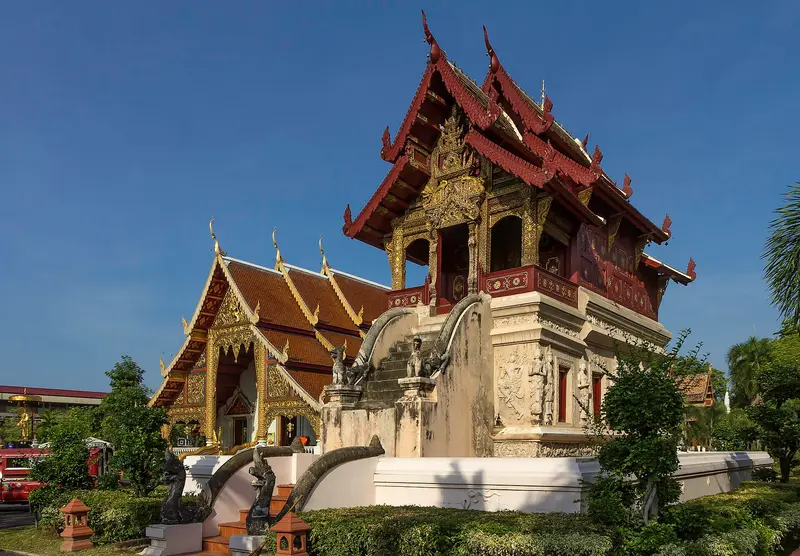
    King Phayu had the Old City's most significant temple built in 1345. Within the small Viharn Lai Kham, dating from the early 19th century, stands the revered Buddha figure Phra Buddha Sihing, surrounded by Lanna-style murals depicting the tales of Sang Thong and Suwannahong.
    Open in Google Maps
    Wat Chedi Luang
    Place of Worship

    2Wat Chedi Luang

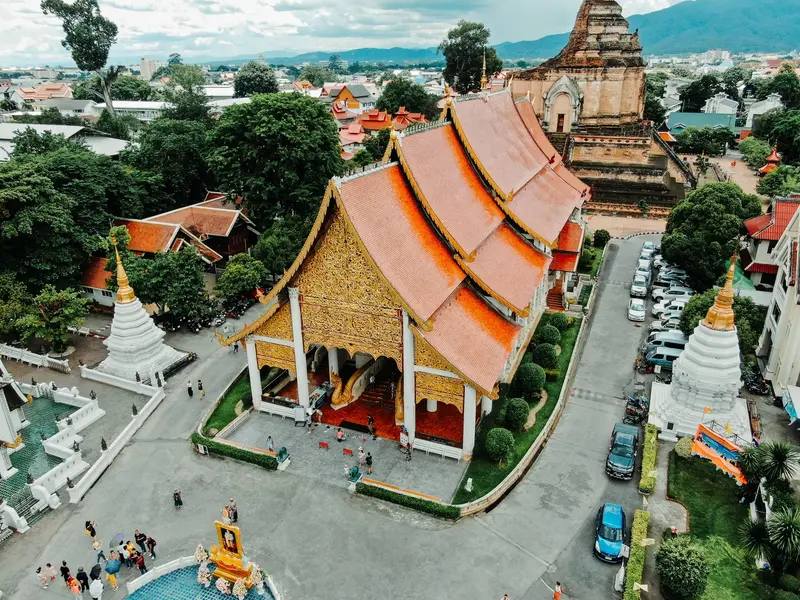
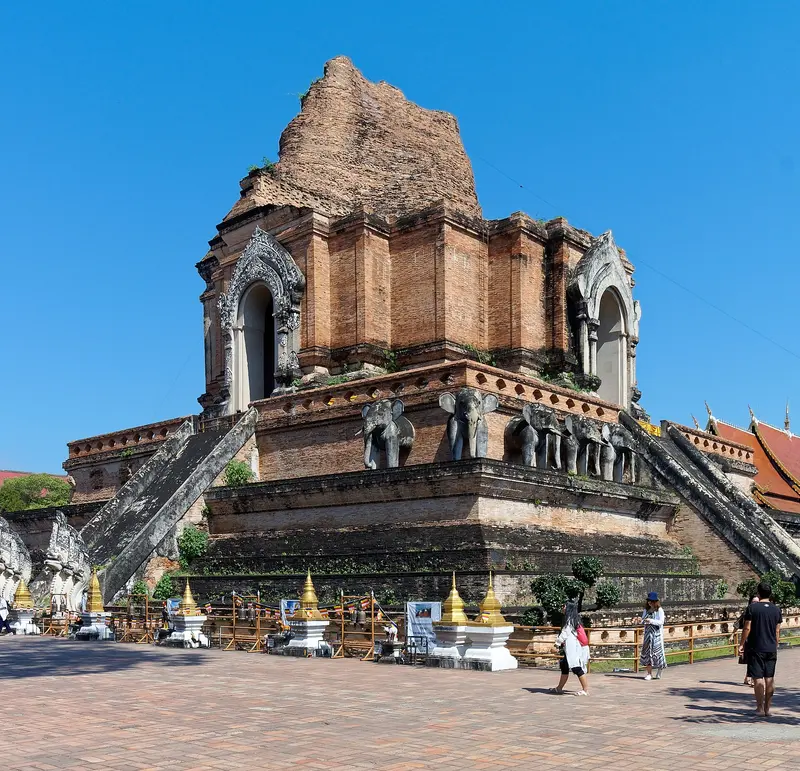
    The construction of the great Chedi commenced in the 14th century and was brought to completion by the mid-15th century. During an earthquake in 1545, the upper approximately 30 meters collapsed, leaving it a ruin ever since. Between 1468 and 1551, the Emerald Buddha, which is venerated today in Bangkok, was housed in its eastern niche. Also situated on the premises is the city pillar known as Sao Inthakhin.
    Open in Google Maps
    Wat Chiang Man
    Place of Worship

    3Wat Chiang Man

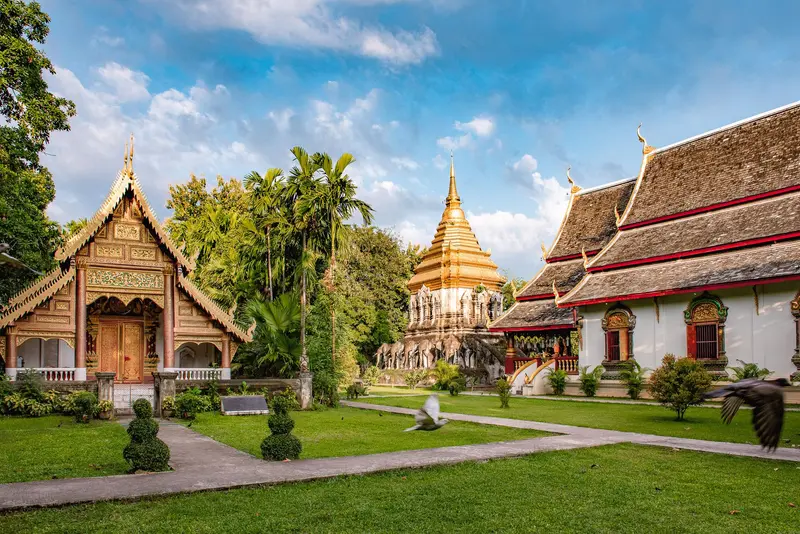
    The city's oldest temple was founded in 1297 by King Mengrai, who pitched his camp here while he had his new capital built. The Chedi Chang Lom, the complex's oldest structure, is supported by 15 life-size elephants made of brick and stucco. In the newer hall, the just ten-centimeter-tall crystal Buddha Phra Sae Tang Khamani is housed.
    Open in Google Maps
    Wat Phra That Doi Suthep
    Place of Worship

    4Wat Phra That Doi Suthep

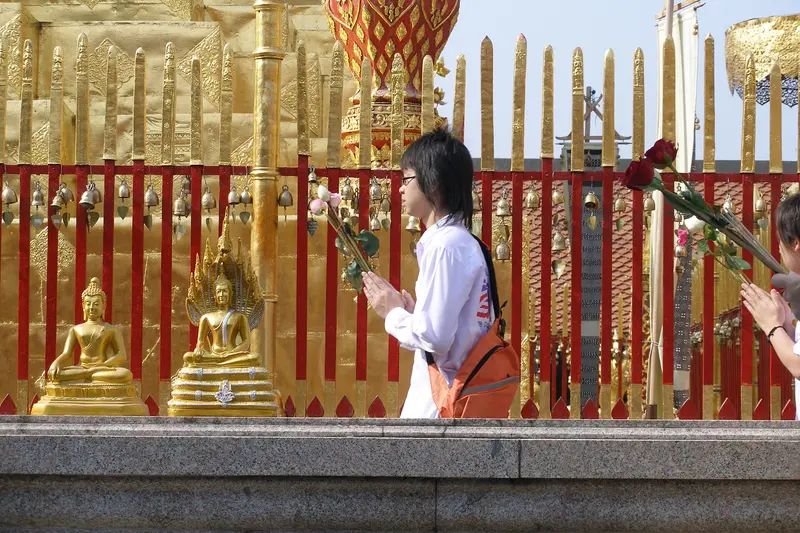
    Chiang Mai's main temple lies west of the city on its house mountain. A Naga-railed staircase leads to the golden Chedi; from its terrace, you'll enjoy clear views of the Ping Valley. It dates from the 14th century and is an active pilgrimage site. The Monk's Trail offers an alternative ascent on foot.
    Open in Google Maps
    Place of Worship

    5Wat Suan Dok

    King Kuena had the temple built west of the old city around 1371. In the northwest of the grounds stand 105 whitewashed burial chedis containing the ashes of the rulers of Chiang Mai from the Chet-Ton Dynasty and their families. A campus of a Buddhist university is located on the premises; from Monday to Friday, 4 to 7 PM, you can chat with monks during Monk Chat.
    Open in Google Maps
    Place of Worship

    6Wat Umong

    A forest temple at the foot of Doi Suthep with brick tunnels, said to have been built for a meditating monk. Amidst tall trees, a pond, and plaques with Buddhist teachings, it's significantly calmer than the Old City.
    Open in Google Maps

    Restaurants in Chiang Mai

    1

    Khao Soi Khun Yai

    Small eatery in the Old Town on Sri Poom Road, just behind the northern moat. Served are Khao Soi with chicken or beef and Tom Yam noodles, with pickled mustard greens, shallots, and lime.
    Show on Google Maps
    2

    Huen Phen

    Old Town restaurant with Northern Thai cuisine, famous for its Khao Soi, spicy Northern Thai sausage, and various curries. Lunch is served in a simple canteen area, while evenings are spent in a dining room filled with antiques, Buddha figures, and plants. It's often busy in the evenings, so a reservation is recommended.
    Show on Google Maps
    3

    SP Chicken

    Small eatery in the Old Town in the Phra Singh quarter, specializing in Gai Yang: small grilled chickens, filled with roasted garlic. Served with various Som Tam variations and two dipping sauces.
    Show on Google Maps
    4

    Tong Tem Toh

    An open, lively spot in Nimmanhaemin Soi 13 with Northern Thai cuisine. Known for its appetizer platter with Nam Prik Num, Nam Prik Ong, Sai Ua, and pork rind, plus Gaeng Hang Lay and Larb Kua. For dinner, a queue forms from around 6 PM; earlier or after 8:30 PM it's quicker.
    Show on Google Maps
    5

    Khao Soi Mae Sai

    Simple noodle eatery northwest of the Old City in Chang Phueak. Chicken Khao Soi comes in a sweet, coconut-rich broth; clear pork noodle soup is also available. Lunchtime queues form, so arrive early.
    Show on Google Maps

    Food and Drink

    Khao Soi

    The city's signature dish is the curry noodle soup, with coconut milk, soft and fried egg noodles. The most famous stalls are north of the Old Town, typically closing early afternoon.

    Khantoke meal

    A traditional Lanna meal served on a low round table with several small bowls, such as Gaeng Hang Lay, Nam Prik Ong, and sticky rice. Today it is primarily served in the evenings with dance performances.

    Market

    Warorot Market for spices, Sai Ua, and dried specialties; in the evening, the market at the North Gate (Chang Phueak) for street food, including the famous pork leg rice.

    Cooking classes

    Chiang Mai is one of the centers for Thai cooking classes. Many schools pick you up, begin with a market visit, and cook on a farm on the city's outskirts.

    Coffee

    Nimmanhaemin and Old Town's cafe scene uses Arabica from the northern mountains; many roasteries name the source village.

    Lanna Heritage & City Life

    Lanna Heritage and City LifeKing Mengrai founded Chiang Mai in 1296 as the capital of the Lanna Kingdom. Many of its temples, with their stepped roofs, Naga staircases and wood carvings, date from this era or were rebuilt in its style. After two centuries of Burmese rule, the city fell under Siamese influence in the late 18th century, fully joining Thailand only in 1939.Today, Chiang Mai is a university city and handicraft hub, with workshops for silver, lacquerware, wood and paper umbrellas along the road to San Kamphaeng. On Sunday evenings, Ratchadamnoen Road becomes the Walking Street Market; Saturdays, Wualai Road. In November, the city celebrates Yi Peng with paper lanterns; April features Songkran's multi-day water fights around the city moat.

    Nightlife

    1

    The North Gate Jazz Co-Op

    Small jazz bar right at the North Gate of the Old Town with live music on most evenings. Tuesdays there's an open jam session where local and travelling musicians play; guests often stand out onto the street.
    Show on Google Maps
    2

    Warm Up Cafe

    Large club on Nimmanhaemin Road, popular with young Thais and students. In multiple areas, live bands play Thai rock and pop, while in another area, DJs spin electronic music.
    Show on Google Maps

    On the Road in Chiang Mai

    Getting There and AroundThe international airport is only about three kilometers from the Old City, with flights to Bangkok taking around one hour. The train station in the east of the city is the terminus of the Northern Line; the overnight train from Bangkok takes 11 to 13 hours. Long-distance buses depart from Arcade Bus Terminal.Songthaews: red shared taxis with no fixed schedule; state your destination and agree on the price before boarding.Apps: Grab and Bolt show the price upfront.Bicycle and Scooter: easily usable in the Old City; for scooters, you need a motorcycle license.Doi Suthep: red shared Songthaews depart from Chang Phueak Gate or near the zoo.

    Accommodations in Chiang Mai

    Find perfect stay in Chiang Mai

    Booking.com* (Affiliate link)
    Search Hotels
    Agoda* (Affiliate link)
    Search Hotels
    Airbnb
    Vacation Rentals

    * Affiliate link: if you book through it, we earn a small commission. The price stays the same for you.

    Plan your trip to Chiang Mai

    Save places, build a route and plan your city trip, all in one place.

    1. 1
      1234

      Round trip

      12 days · 4 stops

      Saved

      Pick a route

      Pick a ready-made one or save places and plan your own.

      Open bookmarks
    2. 2

      Trip to Chiang Mai

      Live
      • 1Wat Phra Singh3 days
      • 2Wat Chedi Luang4 days
      • 3Wat Chiang Man5 days
      Budget

      Plan your trip

      The planner sorts stops, days and budget. Plan together in real time.

      Start trip planning
    3. 3
      9:41 No signal
      Available offline

      Use it on the road

      Download the guide to your phone and use it on site, even offline.

    Nearby

    Doi Inthanon National Park

    At 2,565 meters, Doi Inthanon is Thailand's highest mountain. Located about 60 kilometers southwest of Chiang Mai, the national park encompasses cloud forest, waterfalls like Mae Klang and Wachirathan, and Karen and Hmong villages. About five kilometers below the summit, on the main road, stand the two royal Chedis, built for the 60th birthdays of King Bhumibol and Queen Sirikit.

    Lampang

    Lampang is located approximately 100 kilometres southeast of Chiang Mai on the Wang River. The city is known for its horse-drawn carriages, which have been traversing its streets since 1916, and for its teakwood shophouses from the era when Lampang was a centre for the timber trade. Several Burmese-style temples also date from this period. Approximately 15 kilometres southwest lies Wat Phra That Lampang Luang, one of the most important Lanna temple complexes.
    Nordthailand

    Nordthailand

    Northern Thailand combines mountain landscapes, centuries-old Lanna culture, and a dense temple landscape. In terms of climate, cuisine, and spoken language, the region differs significantly from the rest of the country – the Northern Thai dialect, Kam Mueang, is not easily understood by Central Thai speakers.Here you'll find cities with historic old towns and monastic complexes, interspersed with extensive national parks featuring mountain forests and hill tribe villages in the highlands. Handicrafts, weaving, and markets play a larger role than beach tourism.The cool season from November to February is considered the most pleasant time to travel; in the highlands, temperatures drop noticeably at night. From March through April, the region regularly experiences smoke pollution from agricultural fires – during these weeks, visibility suffers, and air quality can be poor.
    Pai

    Pai

    Pai is a small town in the mountains of Northern Thailand, known for its relaxed atmosphere and the valley landscape. Northern Thai daily life meets a vibrant backpacker scene here.Among the most famous attractions are the Pai Canyon with its narrow earthen ridges and the Wat Phra That Mae Yen, to whose white Buddha 353 steps lead up. The Pam-Bok Waterfall and the hot springs in the area can also be combined well into a single day.In the evenings, the main street transforms into a Walking Street with street food and stalls. The cool dry season from November to February is the most pleasant time to visit. You can explore the surroundings most flexibly by scooter, but the winding mountain road to Chiang Mai requires driving experience.
    Mae Hong Son

    Mae Hong Son

    Mae Hong Son, often called the "City of Three Mists", is located in the mountains of Northern Thailand near the Burmese border. Here, you'll find a relaxed atmosphere, shaped by the culture of the Shan (Tai Yai), which is reflected in its architecture and way of life.The dominant landmark is the temple Wat Phra That Doi Kong Mu, which sits on a hill above the city and offers panoramic views of the valley and Jong Kham Lake. On the lake's shore lie the twin monasteries Wat Jong Kham and Wat Jong Klang with their Burmese-inspired wihans and wood carvings.In the evenings, the night market on the lakeshore comes alive, where you'll find local specialties and handicrafts. The cool season from November to February is considered the best time to visit: pleasant temperatures and morning mist over the valley. Bicycles or scooters are suitable for excursions into the surrounding area, and several nearby mountain villages offer insights into the way of life of the local hill tribes.