ExploreTravel GuidesPlan a trip
    de|en
    All Places & RegionsAbout FernwehFAQPrivacy PolicyImprint
    ExploreTravel GuidesPlan a trip
    Doi Inthanon National Park
    National Park

    Thailand

    Doi Inthanon National Park

    At 2,565 meters, Doi Inthanon is Thailand's highest mountain. Located about 60 kilometers southwest of Chiang Mai, the national park encompasses cloud forest, waterfalls like Mae Klang and Wachirathan, and Karen and Hmong villages.

    1. Home
    2. Destinations
    3. Thailand
    4. Nordthailand
    5. Doi Inthanon National Park
    At 2,565 meters, Doi Inthanon is Thailand's highest mountain. Located about 60 kilometers southwest of Chiang Mai, the national park encompasses cloud forest, waterfalls like Mae Klang and Wachirathan, and Karen and Hmong villages. About five kilometers below the summit, on the main road, stand the two royal Chedis, built for the 60th birthdays of King Bhumibol and Queen Sirikit.

    Restaurants in Doi Inthanon National Park

    Accommodations in Doi Inthanon National Park

    Find perfect stay in Doi Inthanon National Park

    Booking.com* (Affiliate link)
    Search Hotels
    Agoda* (Affiliate link)
    Search Hotels
    Airbnb
    Vacation Rentals

    * Affiliate link: if you book through it, we earn a small commission. The price stays the same for you.
    Nearby

    Chiang Mai

    Chiang Mai

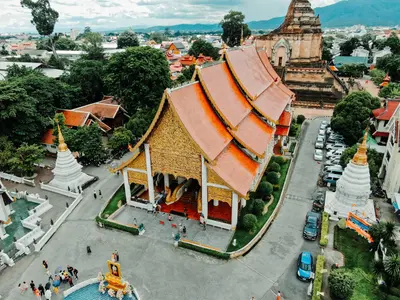
    Chiang Mai is Northern Thailand's largest city and was the capital of the Lanna Kingdom for centuries. Within the old city's square moat stand dozens of temples made of teak and brick, while the forested mountains of Doi Suthep rise around the city. Here you'll find cooking schools, night markets, a vibrant café scene, and a great starting point for mountain tours.
    Pai

    Pai

    Pai is a small town in the mountains of Northern Thailand, known for its relaxed atmosphere and the valley landscape. Northern Thai daily life meets a vibrant backpacker scene here.Among the most famous attractions are the Pai Canyon with its narrow earthen ridges and the Wat Phra That Mae Yen, to whose white Buddha 353 steps lead up. The Pam-Bok Waterfall and the hot springs in the area can also be combined well into a single day.In the evenings, the main street transforms into a Walking Street with street food and stalls. The cool dry season from November to February is the most pleasant time to visit. You can explore the surroundings most flexibly by scooter, but the winding mountain road to Chiang Mai requires driving experience.
    Mae Hong Son

    Mae Hong Son

    Mae Hong Son, often called the "City of Three Mists", is located in the mountains of Northern Thailand near the Burmese border. Here, you'll find a relaxed atmosphere, shaped by the culture of the Shan (Tai Yai), which is reflected in its architecture and way of life.The dominant landmark is the temple Wat Phra That Doi Kong Mu, which sits on a hill above the city and offers panoramic views of the valley and Jong Kham Lake. On the lake's shore lie the twin monasteries Wat Jong Kham and Wat Jong Klang with their Burmese-inspired wihans and wood carvings.In the evenings, the night market on the lakeshore comes alive, where you'll find local specialties and handicrafts. The cool season from November to February is considered the best time to visit: pleasant temperatures and morning mist over the valley. Bicycles or scooters are suitable for excursions into the surrounding area, and several nearby mountain villages offer insights into the way of life of the local hill tribes.

    Lampang

    Lampang is located approximately 100 kilometres southeast of Chiang Mai on the Wang River. The city is known for its horse-drawn carriages, which have been traversing its streets since 1916, and for its teakwood shophouses from the era when Lampang was a centre for the timber trade. Several Burmese-style temples also date from this period. Approximately 15 kilometres southwest lies Wat Phra That Lampang Luang, one of the most important Lanna temple complexes.
    Nordthailand

    Nordthailand

    Northern Thailand combines mountain landscapes, centuries-old Lanna culture, and a dense temple landscape. In terms of climate, cuisine, and spoken language, the region differs significantly from the rest of the country – the Northern Thai dialect, Kam Mueang, is not easily understood by Central Thai speakers.Here you'll find cities with historic old towns and monastic complexes, interspersed with extensive national parks featuring mountain forests and hill tribe villages in the highlands. Handicrafts, weaving, and markets play a larger role than beach tourism.The cool season from November to February is considered the most pleasant time to travel; in the highlands, temperatures drop noticeably at night. From March through April, the region regularly experiences smoke pollution from agricultural fires – during these weeks, visibility suffers, and air quality can be poor.