Fernweh: Home
    ExploreTravel GuidesPlan a tripMy tripLast visited
    de|en
    All Places & RegionsAll highlightsAbout FernwehFAQPrivacy PolicyImprint
    ExploreTravel GuidesPlan a tripMy tripLast visited
    • Neighborhoods & highlights
    • Eat & drink
    • Food culture
    • Culture
    • Getting around
    • Accommodation
    • Plan trip
    • Nearby
    Mae Hong Son

    Thailand

    Mae Hong Son

    CityCulture

    Mae Hong Son, often called the "City of Three Mists", is located in the mountains of Northern Thailand near the Burmese border.

    by Felix Gillen

    1. Home
    2. Destinations
    3. Thailand
    4. Nordthailand
    5. Mae Hong Son
    Mae Hong Son, often called the "City of Three Mists", is located in the mountains of Northern Thailand near the Burmese border. Here, you'll find a relaxed atmosphere, shaped by the culture of the Shan (Tai Yai), which is reflected in its architecture and way of life.The dominant landmark is the temple Wat Phra That Doi Kong Mu, which sits on a hill above the city and offers panoramic views of the valley and Jong Kham Lake. On the lake's shore lie the twin monasteries Wat Jong Kham and Wat Jong Klang with their Burmese-inspired wihans and wood carvings.In the evenings, the night market on the lakeshore comes alive, where you'll find local specialties and handicrafts. The cool season from November to February is considered the best time to visit: pleasant temperatures and morning mist over the valley. Bicycles or scooters are suitable for excursions into the surrounding area, and several nearby mountain villages offer insights into the way of life of the local hill tribes.

    Sights in Mae Hong Son

    Discover the most important sights and attractions

    1Mae Hong Son Gate

    Attraction in 7XM6+445.
    Open in Google Maps

    2Chong-Chai Reservoir

    Attraction in Unnamed Road 7WHQ+5G6.
    Open in Google Maps

    3Wat Phra That Doi Kong Mu

    Mountain temple above the city, the landmark of Mae Hong Son. Two white chedis stand on the ridge; from the terrace, you see the valley, the airfield, and in morning fog, only clouds. Accessible on foot via stairs or by scooter via the road.
    Open in Google Maps

    4Wat Jong Klang

    Open in Google Maps

    5Wat Jong Kham

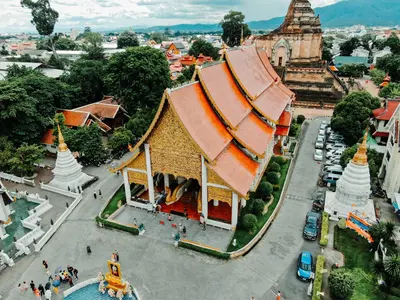
    Right next to Wat Jong Klang, with tiered Tai-Yai roofs. The two monasteries reflect in the lake in the evening and are the city's most photographed sight.
    Open in Google Maps

    6

    This small lake is the town's heart. Evenings see street food and craft stalls along its banks; by day, a short stroll circles the water.
    Open in Google Maps

    Essen & Trinken

    1

    Som Tam Pa Ui

    Restaurant in 8X36+4VG.
    Show on Google Maps
    2

    Kuaitiao 10 Baht Pa Dolly

    Restaurant in 7XX7+VVG.
    Show on Google Maps
    3

    SAKi CURRY

    Restaurant in Siri Mongkol Rd.
    Show on Google Maps
    4

    Grandma Chang Rice Noodle Shop

    Restaurant in 7XX7+VVG.
    Show on Google Maps
    5

    Ran Khwan Khao

    Restaurant in 10.
    Show on Google Maps

    Dining and Drinks

    The cuisine in Mae Hong Son is Northern Thai with a distinct Shan and Burmese influence. Sticky rice often replaces jasmine rice, fermented soybeans and peanuts appear more frequently than coconut milk, and many dishes are milder than in the south. You'll find the widest selection at the morning market and in the evenings at the stalls by Jong Kham Lake.

    Khao Soi

    Curry noodle soup with soft and crispy egg noodles, served with shallots, pickled mustard greens, and lime. In Northern Thailand, a breakfast and lunch dish, rarely dinner.

    Tua Nao

    Fermented soybeans, processed into a paste or roasted as dried slices. A staple Shan ingredient that gives many curries and dips here their earthy base note.

    Khanom Chin Nam Ngiao

    Rice noodles in a soup of tomatoes, pork, and the red flowers of the Kapok tree. A Northern Thai dish rarely found in Central Thailand.

    Kaeng Hang Le

    Slowly braised pork curry with ginger, tamarind, and turmeric, Burmese-influenced and without coconut milk. Often cooked for festivals and in monasteries.

    Jong-Kham Lake Night Market

    Lakeside food stalls with grilled skewers, papaya salad, rice dishes, and desserts. The stalls open in the late afternoon and close earlier than in larger cities.

    Culture and History

    Mae Hong Son was founded in the 19th century as a camp for elephant capture and was long oriented more towards Burma than Bangkok. The defining ethnic group are the Shan, called Tai Yai in Thailand, whose settlement area extends beyond the current border.This is evident in the monasteries. Wat Jong Klang and Wat Jong Kham by the lake have tiered sheet metal and wooden structures instead of curved tiled roofs, with glass paintings that came from Burma. In daily life, Shan is often spoken.The most famous festival is Poy Sang Long, the novice ordination of young Shan boys in spring. The children are dressed as princes and carried through the town on the shoulders of relatives before they enter the monastery for a few weeks. It is a family celebration; photograph with discretion.

    Exploring Locally

    The center is small: From the lake to the market, the bus station, and most guesthouses, it's just a few minutes on foot. For the surrounding area, it's best to rent a scooter.The airport is on the outskirts and is served from Chiang Mai. By road, there are two routes: in the north via Pai and Soppong, in the south via Mae Sariang. Both are very winding and take several hours; minibusses and buses run daily.Together, these two roads form the Mae Hong Son Loop, a circular route of about 600 kilometers via Chiang Mai, Pai, Mae Hong Son, and Mae Sariang. It is popular among motorcyclists, with tight bends and steep inclines.Songthaews run irregularly to the villages, especially in the mornings. For Pang Ung or Ban Rak Thai, a private vehicle is more practical.Current information on safety and health, including road traffic and border areas, can be found at the Federal Foreign Office.

    Accommodations in Mae Hong Son

    Find perfect stay in Mae Hong Son

    Booking.com* (Affiliate link)
    Search Hotels
    Agoda* (Affiliate link)
    Search Hotels
    Airbnb
    Vacation Rentals

    * Affiliate link: if you book through it, we earn a small commission. The price stays the same for you.

    Plan your trip to Mae Hong Son

    Save places, build a route and plan your city trip, all in one place.

    1. 1
      Sunrise over alpine peaks and a sea of clouds
      1234

      Round trip

      12 days · 4 stops

      Saved

      Pick a route

      Pick a ready-made one or save places and plan your own.

      Open bookmarks
    2. 2

      Trip to Mae Hong Son

      Live
      • 1Mae Hong Son Gate3 days
      • 2Chong-Chai Reservoir4 days
      • 3Wat Phra That Doi Kong Mu5 days
      Budget

      Plan your trip

      The planner sorts stops, days and budget. Plan together in real time.

      Start trip planning
    3. 3
      9:41 No signal
      Mae Hong Son
      Available offline

      Use it on the road

      Download the guide to your phone and use it on site, even offline.

    Nearby

    Pai

    Pai

    Pai is a small town in the mountains of Northern Thailand, known for its relaxed atmosphere and the valley landscape. Northern Thai daily life meets a vibrant backpacker scene here.Among the most famous attractions are the Pai Canyon with its narrow earthen ridges and the Wat Phra That Mae Yen, to whose white Buddha 353 steps lead up. The Pam-Bok Waterfall and the hot springs in the area can also be combined well into a single day.In the evenings, the main street transforms into a Walking Street with street food and stalls. The cool dry season from November to February is the most pleasant time to visit. You can explore the surroundings most flexibly by scooter, but the winding mountain road to Chiang Mai requires driving experience.
    Doi Inthanon National Park

    Doi Inthanon National Park

    Doi Inthanon, at 2,565 meters, is Thailand's highest mountain. The national park of the same name was established in 1972, covers around 480 square kilometers, and is located approximately 60 kilometers southwest of Chiang Mai.A road leads to the summit, passing waterfalls like Mae Klang, Wachirathan, and Siriphum, as well as the two royal Chedis. At the top, the Ang-Ka Path leads over wooden boardwalks through mossy cloud forest; a bit lower, the Kew-Mae-Pan Path offers expansive views. Karen and Hmong people live in several villages within the park.At the summit, it is significantly cooler than in the valley; in January, the average is about 6 degrees Celsius, and on some nights, temperatures fall below zero. Bring a warm jacket.
    Chiang Mai

    Chiang Mai

    Chiang Mai is Northern Thailand's largest city and was the capital of the Lanna Kingdom for centuries. Within the old city's square moat stand dozens of temples made of teak and brick, while the forested mountains of Doi Suthep rise around the city. Here you'll find cooking schools, night markets, a vibrant café scene, and a great starting point for mountain tours.
    Nordthailand

    Nordthailand

    Northern Thailand combines mountain landscapes, centuries-old Lanna culture, and a dense temple landscape. In terms of climate, cuisine, and spoken language, the region differs significantly from the rest of the country – the Northern Thai dialect, Kam Mueang, is not easily understood by Central Thai speakers.Here you'll find cities with historic old towns and monastic complexes, interspersed with extensive national parks featuring mountain forests and hill tribe villages in the highlands. Handicrafts, weaving, and markets play a larger role than beach tourism.The cool season from November to February is considered the most pleasant time to travel; in the highlands, temperatures drop noticeably at night. From March through April, the region regularly experiences smoke pollution from agricultural fires – during these weeks, visibility suffers, and air quality can be poor.
    Lampang

    Lampang

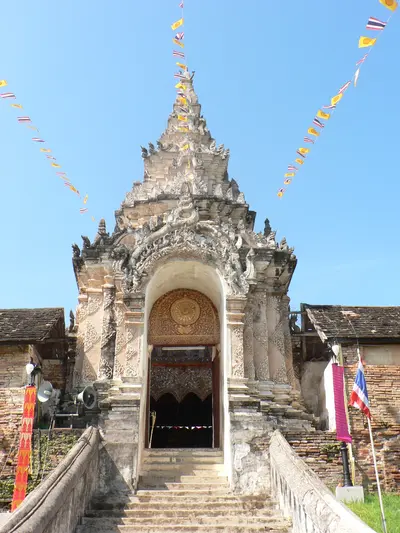
    Lampang is located approximately 100 kilometres southeast of Chiang Mai on the Wang River. The city is known for its horse-drawn carriages, which have been traversing its streets since 1916, and for its teakwood shophouses from the era when Lampang was a centre for the timber trade. Several Burmese-style temples also date from this period. Approximately 15 kilometres southwest lies Wat Phra That Lampang Luang, one of the most important Lanna temple complexes.

    Sources & method

    • Photos: Unsplash. Each photo carries its credit.
    • The content is based on web research from public, traceable sources. How the content is made · The role of AI