Fernweh: Home
ExploreGuideDestinationsMy tripsMy trip
de|en
All Places & RegionsRound tripsNight trains in EuropeAll highlightsAbout FernwehFAQPrivacy PolicyImprint
Download on the App StoreGet it on Google Play
ExploreGuideDestinationsMy tripsMy trip
    • Neighborhoods & highlights
    • Recommendations
    • Walking tours
    • Tours
    • Eat & drink
    • Culture
    • Getting around
    • Accommodation
    • Plan trip
    • Nearby
    Jaipur

    Marcin Białek / Wikimedia Commons / CC BY-SA 4.0, mod.

    India

    Jaipur

    City

    Jaipur, the capital of Rajasthan, is located about 270 to 310 road kilometers southwest of Delhi and forms the Golden Triangle with Delhi and Agra.

    by Felix Gillen

    1. Home
    2. Destinations
    3. India
    4. Rajasthan
    5. Jaipur
    Jaipur, the capital of Rajasthan, is located about 270 to 310 road kilometers southwest of Delhi and forms the Golden Triangle with Delhi and Agra. The pink-painted Old City, the Amer Fort-Palace, and the Jantar Mantar observatory make it the classic starting point for any Rajasthan trip.Maharaja Sawai Jai Singh II founded the city in 1727, relocating his capital here from Amer due to population growth and water scarcity. The grid street plan follows the Prastara Plan of Vastu Shastra; the main axes were designed as bazaars, and large squares, known as Chaupars, emerged at the intersections. The Old City has been on the UNESCO World Heritage list since 2019.The city received its pink hue in 1876 when Maharaja Ram Singh had it painted for the visit of the Prince of Wales. Plan at least two full days: one for Amer, Jaigarh, and Nahargarh in the hills, and one for the Old City and museums.
    India travel guidePlan a trip with Jaipur

    Contents

    • Neighborhoods & highlights
    • Recommendations
    • Walking tours
    • Tours
    • Eat & drink
    • Culture
    • Getting around
    • Accommodation
    • Nearby

    Sights in Jaipur

    Discover the most important sights and attractions

    Amer Fort

    Jakub Hałun / Wikimedia Commons / CC BY-SA 4.0, mod.

    Castle

    1Amer Fort

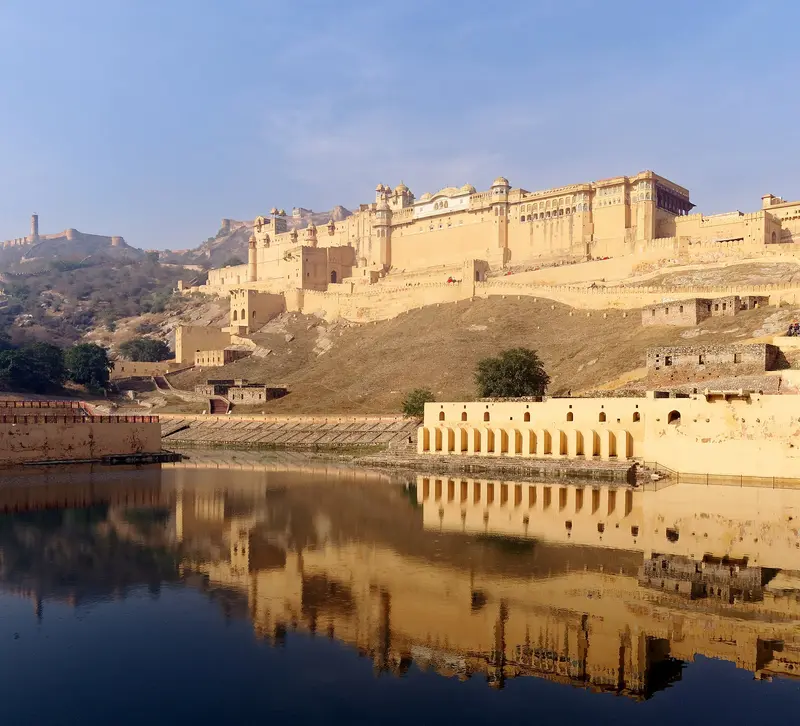
    Maharaja Man Singh I. had the palace fortress built in 1592 from pale yellow and pink sandstone; Mirza Raja Jai Singh I. added structures and gardens in the 17th century, blending Rajput and Mughal court styles. Highlights include the Diwan-e-Aam, the Hall of Public Audiences, and the Sheesh Mahal, whose walls and ceilings are adorned with thousands of tiny mirrors. Amer has been part of the UNESCO site Hill Forts of Rajasthan since 2013. Hours: Rajasthan Tourism states 8:00 AM to 5:30 PM, Incredible India 9:00 AM to 6:00 PM; entry for foreigners is 1,000 Rupees from January 1, 2026. In the evenings, there is a light and sound show; times vary seasonally.
    Open in Google Maps
    Hawa Mahal

    Chainwit. / Wikimedia Commons / CC BY-SA 4.0, mod.

    Castle

    2Hawa Mahal

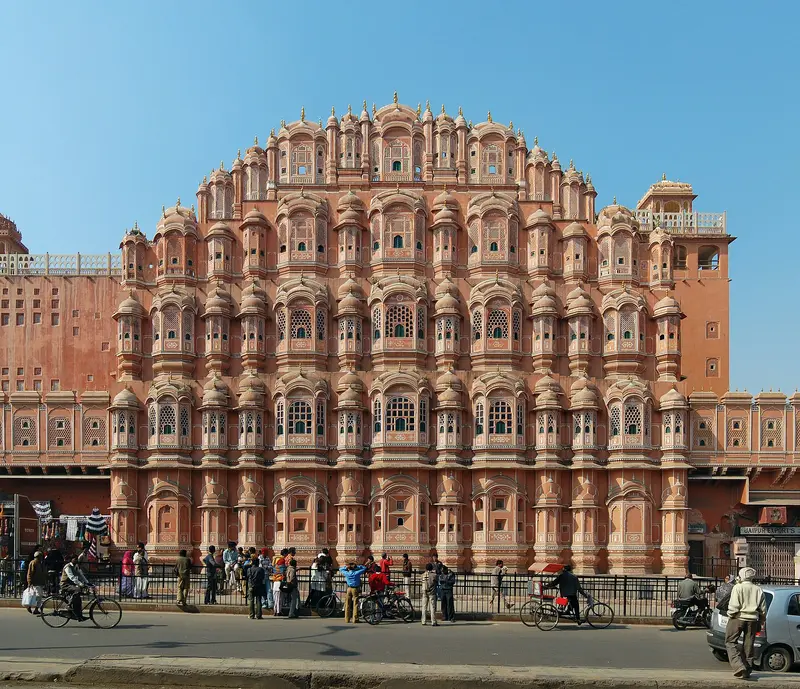
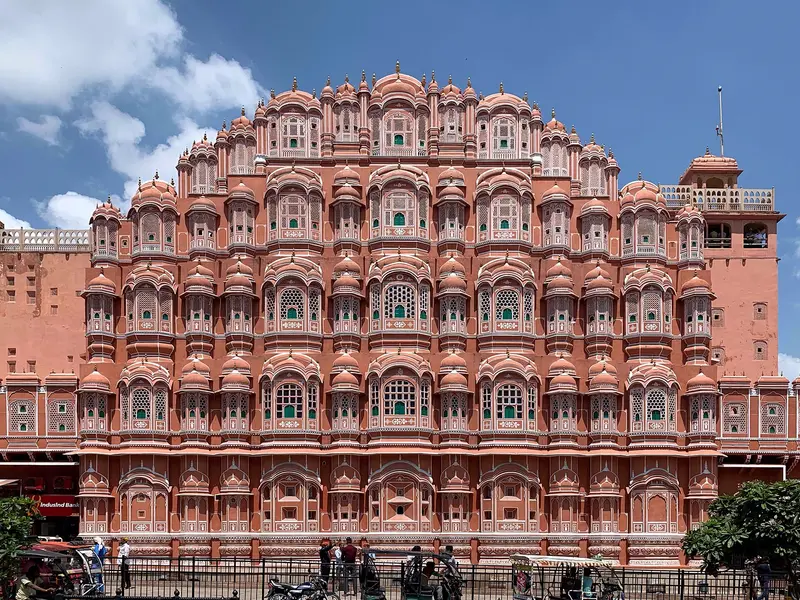
    The Palace of Winds was built in 1799 under Maharaja Sawai Pratap Singh, following plans by Lal Chand Ustad. Its five-story facade, with 953 latticed bays, allowed the women of the court to observe street life and processions without being seen. Hours: according to Incredible India, 9:00 AM to 4:30 PM; admission for foreigners from January 1, 2026, 600 Rupees. The facade is most beautiful in the morning light, viewed from the street.
    Open in Google Maps
    City Palace

    Jakub Hałun / Wikimedia Commons / CC BY-SA 4.0, mod.

    Museum

    3City Palace

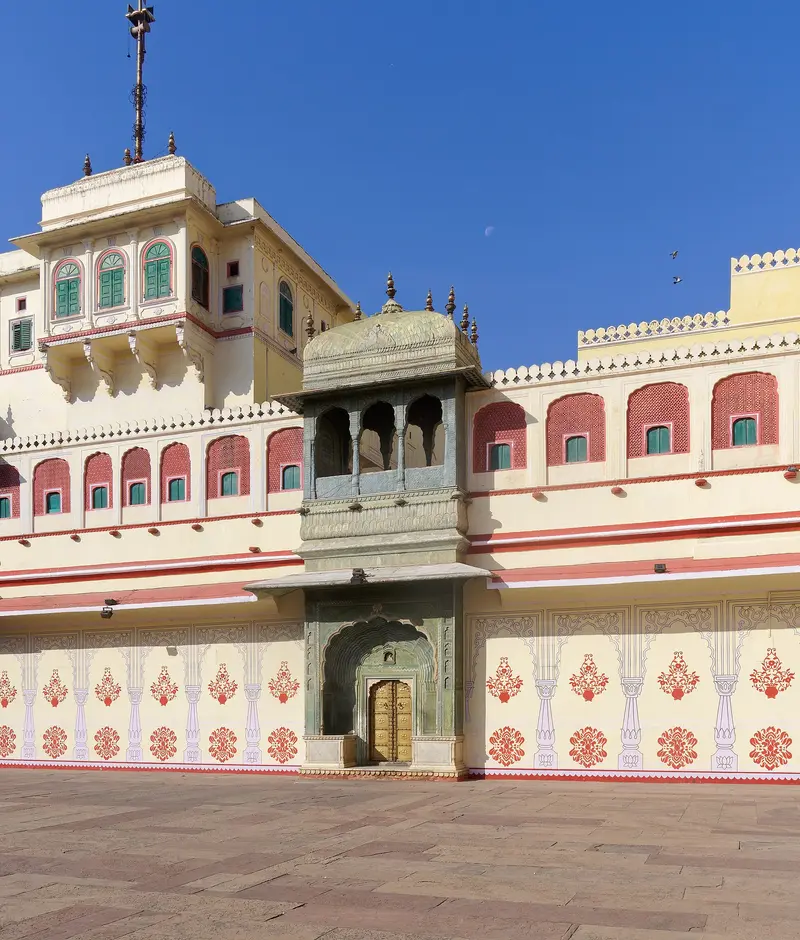
    The City Palace in the heart of the Old City was begun by Jai Singh II and expanded by later rulers, featuring a blend of Rajput and Mughal architecture. Inside the Mubarak Mahal, the Maharaja Sawai Man Singh II Museum displays robes, weapons, and paintings; the Pritam Niwas Chowk courtyard features four gates representing the seasons. The princely family still resides in the Chandra Mahal to this day. Practical Info: According to Incredible India, the museum is open from 9:30 AM to 5:00 PM; a separate combi-ticket covering Jaigarh and the Gaitore Cenotaphs is valid for two days. Please check the current price on-site.
    Open in Google Maps
    Jantar Mantar

    Jakub Hałun / Wikimedia Commons / CC BY-SA 4.0, mod.

    Attraction

    4Jantar Mantar

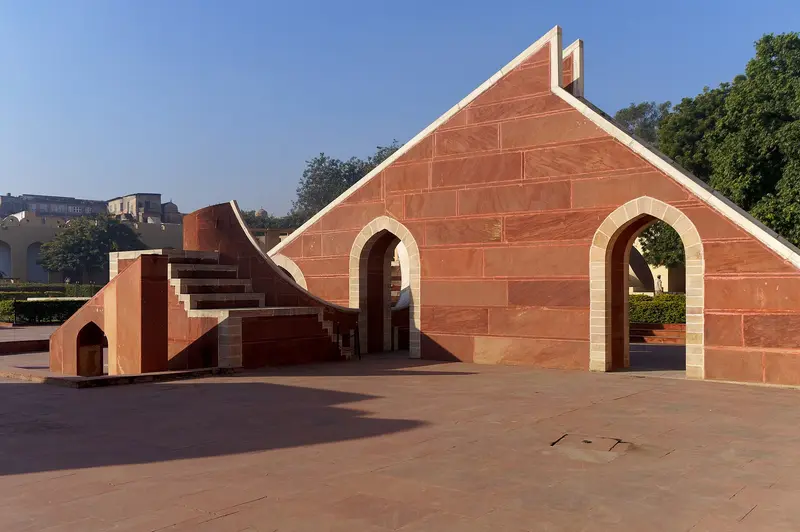
    The astronomical observatory was built between 1728 and 1734 under Jai Singh II and is the largest of his five observatories. UNESCO lists around 20 major fixed instruments, some the largest of their kind; among them is the world's largest stone sundial. It has been a World Heritage site since 2010. Practical Info: Admission for foreigners from January 1, 2026, 600 Rupees. Visit on a sunny day; only then can the dials be read.
    Open in Google Maps
    Nahargarh Fort

    Jakub Hałun / Wikimedia Commons / CC BY-SA 4.0, mod.

    Castle

    5Nahargarh Fort

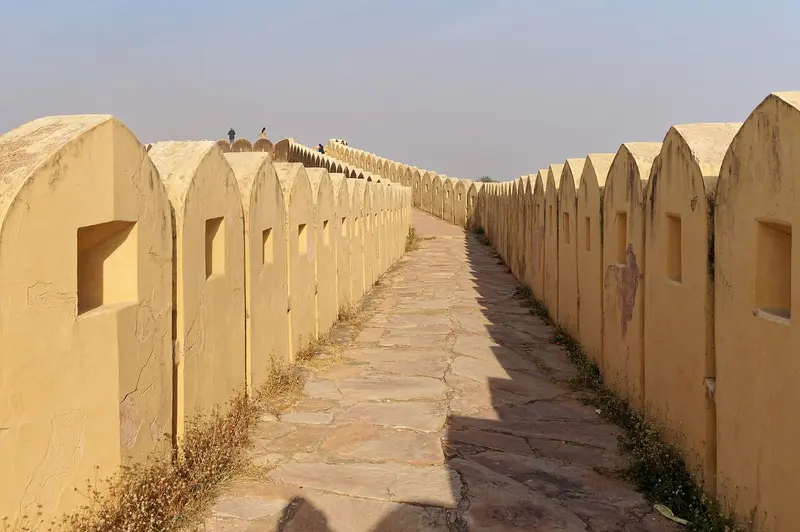
    The fortress on the ridge above the city was built in 1734 and extended in 1868. It was part of the city's defense, is connected to Jaigarh, and offers views over Jaipur and the Jal Mahal; a sculpture park is housed in the Madhavendra Bhawan. Practical: Admission for foreigners from January 1, 2026, 600 rupees. The fortress is popular at sunset.
    Open in Google Maps
    Museum

    6Jaigarh Fort

    Jai Singh II. commissioned the Cheelka Teela fortress in 1726 as protection for Amer, 400 meters below. Here stands the Jaivana cannon, (Incredible India) the largest cannon on wheels. Hours (Incredible India): 9:30 AM to 5:00 PM; entry included in the City Palace combo ticket.
    Open in Google Maps

    City walks in Jaipur

    Curated walking tours through the city's highlights, handpicked by experienced travel journalists.

    Through the Pink City
    Walking tour through the walled Old City of Jai Singh II., a UNESCO World Heritage site since 2019, along the bazaar axes and to the court buildings. Best in the morning, when Jantar Mantar gets sun. Roughly estimated around 3 kilometers and 1 to 1.5 hours of pure walking time without sightseeing.
    Open in Google Maps
    Stops (7)

    Tours & experiences in Jaipur

    Search tours for Jaipur on GetYourGuide* (Affiliate link)On GetYourGuide, with reviews from other travellers

    * Affiliate link: if you book through it, we earn a small commission. The price stays the same for you.

    Restaurants in Jaipur

    1

    LMB (Laxmi Misthan Bhandar)

    Traditional vegetarian restaurant since 1954 in the Old City's Johari Bazaar, offering Rajasthan-Thali, Kachoris, Paneer Ghevar, and the saffron dessert Kulfa at the sweet counter.
    Show on Google Maps
    2

    Suvarna Mahal

    Upscale restaurant in Rambagh Palace on Bhawani Singh Road with dishes from the royal kitchens of Rajasthan and Punjab, including Laal Maas and Dhundhar Murg; evenings offer a Thali with Kebabs, Gatte, and Malpua.
    Show on Google Maps
    3

    Bar Palladio

    Bar and restaurant in Kanota Bagh on the grounds of the Narain Niwas Palace, in blue-painted rooms, with Italian dishes such as homemade pasta and classic cocktails.
    Show on Google Maps
    4

    Spice Court

    Restaurant on Jacob Road in Civil Lines with Rajasthani meat cuisine, such as Junglee Maas and Keema Baati.
    Show on Google Maps
    5

    Tapri Central

    Teahouse in C-Scheme on Prithviraj Road, overlooking Central Park, with many tea varieties, iced tea, and snacks like Samosas and Pav Bhaji.
    Show on Google Maps

    The Planned Capital

    Foundation and City PlanAccording to Rajasthan Tourism, Vidyadhar Bhattacharya planned Jaipur as India's first planned city. UNESCO highlights the grid pattern, following the rules of Vastu Shastra, whose main streets still form the city's typical bazaars today.Court, Astronomy, and CraftsJai Singh II was a learned prince; his observatory Jantar Mantar is the largest of five he had built. Jaipur is renowned for gemstones, jewelry, and hand-block printing on fabric; Johari Bazaar is the classic address for jewelry and textiles.FestivalsAround January 14th, the Kite Festival fills the sky above the city, in spring Gangaur processions move through the old town, followed by Teej during the monsoon.

    Arrival and Info

    Getting ThereJaipur International Airport in Sanganer offers domestic flights to Delhi, Mumbai, Jodhpur, and Udaipur, among others, as well as international connections to Dubai and Singapore. The Vande Bharat Express reaches Jaipur from Delhi in about 3.5 hours, the Shatabdi Express in 4 to 5 hours. By road, it's 5 to 6 hours via NH48.Getting AroundThe Old City is best explored on foot. For Amer, Jaigarh, and Nahargarh (11 to 15 kilometers outside), you'll need a taxi, rickshaw, or driver.Practical TipsAs of January 1, 2026, Amer Fort costs 1,000 rupees, while Hawa Mahal, Jantar Mantar, Albert Hall Museum, and Nahargarh each cost 600 rupees for foreigners. A combined pass for all state-run monuments and museums in Rajasthan costs 5,500 rupees and is valid for 10 days; it's only worthwhile if you visit multiple cities. City Palace and Jaigarh are not included but have their own combined ticket. Start early morning in Amer; many markets are closed on Sundays.With Kids: Nahargarh Biological Park (closed Tuesdays) and the evening musical fountain at Jawahar Circle are good additions. Low Budget: Galta Ji, Panna Meena ka Kund, and Patrika Gate have no admission fee.

    Accommodations in Jaipur

    Find perfect stay in Jaipur

    Booking.com* (Affiliate link)
    Search Hotels
    Agoda* (Affiliate link)
    Search Hotels
    Airbnb
    Vacation Rentals

    * Affiliate link: if you book through it, we earn a small commission. The price stays the same for you.

    Plan your trip to Jaipur

    Save places, build a route and plan your city trip, all in one place.

    1. 1
      Sunrise over alpine peaks and a sea of clouds
      1234

      Round trip

      12 days · 4 stops

      Saved

      Pick a route

      Pick a ready-made one or save places and plan your own.

      Open bookmarks
    2. 2

      Trip to Jaipur

      Live
      • 1Amer Fort3 days
      • 2Hawa Mahal4 days
      • 3City Palace5 days
      Budget

      Plan your trip

      The planner sorts stops, days and budget. Plan together in real time.

      Start trip planning
    3. 3
      9:41 No signal
      Jaipur
      Available offline

      Marcin Białek / Wikimedia Commons / CC BY-SA 4.0, mod.

      Use it on the road

      Download the guide to your phone and use it on site, even offline.

    Nearby

    Ranthambore

    Ranthambore

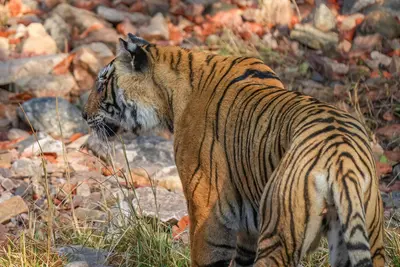
    Ranthambore National Park, near Sawai Madhopur in eastern Rajasthan, is one of India's most renowned locations for spotting tigers in the wild. Its dry forests shelter lakes, ruins, and Ranthambore Fort, which is a UNESCO World Heritage site.The protected area began as the Sawai Madhopur Game Sanctuary in 1955, became part of Project Tiger in the 1970s, and was designated a national park in 1980. Including the adjoining Kailadevi and Sawai Man Singh sanctuaries, it covers approximately 1,334 square kilometres, with the core zone spanning about 275 square kilometres.Make sure to plan more than one safari to increase your chances of a tiger encounter, and allocate an additional half-day for the fort.

    Giles Laurent·CC BY-SA 4.0

    Pushkar

    Pushkar

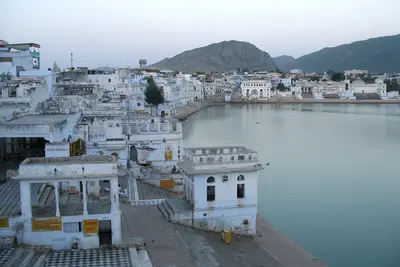
    Pushkar is a small pilgrimage town in Central Rajasthan, about 14 kilometers from Ajmer, centered around a sacred lake. It is home to one of India's few temples dedicated to the creator god Brahma, and once a year, the Pushkar Mela transforms the town into a huge cattle market.Around the semi-circular lake, approximately 52 ghats lead to the water, where pilgrims bathe and pray. Above the town, the Savitri Temple crowns the Ratnagiri Hill. As a pilgrimage site, Pushkar is considered a vegetarian town.One to two days are sufficient to experience the ghats, the Brahma Temple, and the ascent to the Savitri Temple. During the Mela, the town and accommodations are very crowded; according to the announcement, the Pushkar Camel Fair 2026 will take place from November 17th to 24th.

    Vyacheslav Argenberg·CC BY 4.0

    Fatehpur Sikri

    Fatehpur Sikri

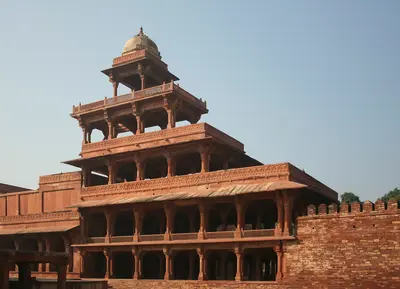
    Fatehpur Sikri, 36 to 40 kilometers west of Agra in Uttar Pradesh, is the abandoned planned city of the Mughal Emperor Akbar. The red sandstone palaces, courtyards, and grand mosque are among India's most impressive Mughal structures and have been a UNESCO World Heritage site since 1986. Akbar had the "City of Victory" built starting in 1571 on a ridge, in honor of the Sufi saint Salim Chishti. It served as capital for only about ten years; in 1585, the court moved to Lahore. The architecture combines Persian, Hindu, and Jain forms. Allow at least half a day. The complex consists of the Mosque Quarter, with Buland Darwaza and Salim Chishti's tomb (freely accessible), and the ticketed Palace Quarter.

    Diego Delso·CC BY-SA 4.0

    Rajasthan

    Rajasthan

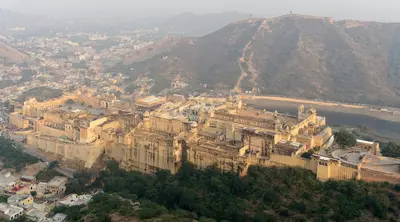
    Rajasthan is India's largest state by area and is located in the northwest of the country, southwest of Delhi. Here, a succession of fortresses, palaces, and bazaar cities define the image of India: from the Pink City Jaipur to golden-yellow Jaisalmer on the edge of the Thar Desert.Covering approximately 342,239 square kilometers, Rajasthan surpasses every other Indian state. The west is occupied by the Thar Desert, also known as the Great Indian Desert; the Aravalli Range, one of the world's oldest fold mountains, traverses the country, with Mount Abu (1,722 meters) as the state's only hill station. The cities bear color names: Jaipur is the pink, Jodhpur the blue, Udaipur the white, and Jaisalmer the golden city.For a first trip, the route of Jaipur, Pushkar, Jodhpur, Jaisalmer, and Udaipur is recommended, supplemented by the Ranthambore Tiger Park. Six hill forts of the state have been jointly listed as Hill Forts of Rajasthan on the UNESCO World Heritage List since 2013, the Old City of Jaipur since 2019, the Jantar Mantar Observatory since 2010, and the Keoladeo Bird Park near Bharatpur also.

    Jakub Hałun·CC BY-SA 4.0

    Agra

    Agra

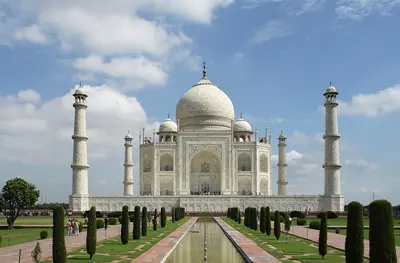
    Agra, in the state of Uttar Pradesh, around 200 kilometers southeast of Delhi, is the city of the Taj Mahal. Besides the famous tomb, attractions include the Agra Fort, the delicate Tomb of Itimad-ud-Daulah, and Akbar's Mausoleum in Sikandra, plus Fatehpur Sikri as a day trip. Agra was the capital of the Mughals before Delhi. Akbar built his fortress here between 1565 and 1573, and his grandson Shah Jahan had the Taj Mahal built starting in 1632 for his deceased wife Mumtaz Mahal. Many monuments are located on the banks of the Yamuna and can be easily combined in one day. Agra is a feasible day trip from Delhi by express train, but an overnight stay is worthwhile for the sunrise at the Taj. Note: The Taj Mahal is closed on Fridays.

    Yann; edited by Jim Carter·CC BY-SA 4.0

    Your next steps

    Jaipur is in India. Ways to carry on from here.

    • More in India

      Highlights, areas, routes and the best time to travel for all of India.

      India travel guide

    Sources & method

    • Photos: Wikimedia Commons. Each photo carries its credit.
    • Place data such as addresses and ratings comes from Google Maps.
    • The content is based on web research from public, traceable sources. How the content is made · The role of AI