Fernweh: Home
ExploreGuideDestinationsMy tripsMy trip
de|en
All Places & RegionsRound tripsNight trains in EuropeAll highlightsAbout FernwehFAQPrivacy PolicyImprint
Download on the App StoreGet it on Google Play
ExploreGuideDestinationsMy tripsMy trip
    • Places & highlights
    • Eat & drink
    • Culture
    • Getting around
    • Accommodation
    • Nearby
    Fatehpur Sikri

    Diego Delso / Wikimedia Commons / CC BY-SA 4.0, mod.

    India

    Fatehpur Sikri

    Point of Interest

    Fatehpur Sikri, 36 to 40 kilometers west of Agra in Uttar Pradesh, is the abandoned planned city of the Mughal Emperor Akbar.

    by Felix Gillen

    1. Home
    2. Destinations
    3. India
    4. Agra
    5. Fatehpur Sikri
    Fatehpur Sikri, 36 to 40 kilometers west of Agra in Uttar Pradesh, is the abandoned planned city of the Mughal Emperor Akbar. The red sandstone palaces, courtyards, and grand mosque are among India's most impressive Mughal structures and have been a UNESCO World Heritage site since 1986. Akbar had the "City of Victory" built starting in 1571 on a ridge, in honor of the Sufi saint Salim Chishti. It served as capital for only about ten years; in 1585, the court moved to Lahore. The architecture combines Persian, Hindu, and Jain forms. Allow at least half a day. The complex consists of the Mosque Quarter, with Buland Darwaza and Salim Chishti's tomb (freely accessible), and the ticketed Palace Quarter.
    India travel guidePlan a trip with Fatehpur Sikri

    Contents

    • Places & highlights
    • Eat & drink
    • Culture
    • Getting around
    • Accommodation
    • Nearby

    Sights in Fatehpur Sikri

    Discover the most important sights and attractions

    Buland Darwaza

    A.Savin / Wikimedia Commons / FAL

    Attraction

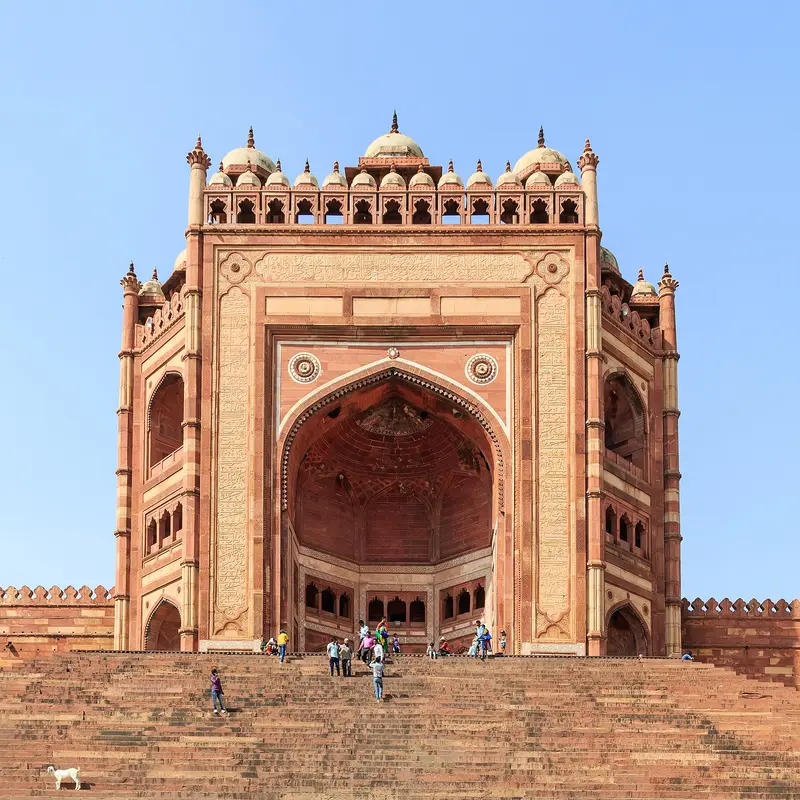
    1Buland Darwaza

    The monumental Victory Gate forms the main entrance to the mosque courtyard; a 13-meter-high grand staircase leads up to it. Sources vary on its occasion and exact height. Practical info: within the freely accessible mosque complex.
    Open in Google Maps
    Mosque

    2Jama Masjid (Fatehpur Sikri)

    Completed 1571-1572 as the first structure on the ridge, the Friday Mosque is one of India's largest. Its vast courtyard also holds tombs of royal women. Note: active place of worship, dress code, shoes off; the Dargah in the courtyard stays open longer than the palace district.
    Open in Google Maps
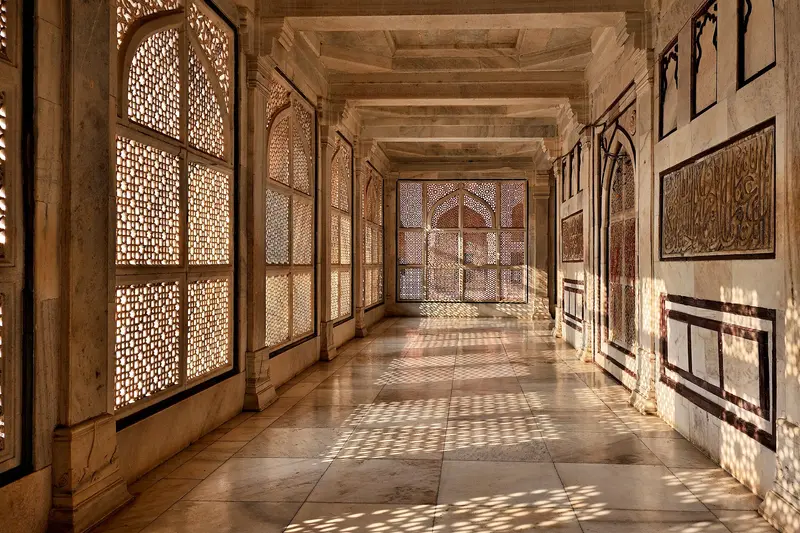
    Tomb of Salim Chishti

    Sharvarism / Wikimedia Commons / CC BY-SA 4.0, mod.

    Historic Landmark

    3Tomb of Salim Chishti

    The white marble tomb of the Sufi saint, for whom Akbar founded the city, is in the courtyard of the Jama Masjid. Its sculptures were created 1580-1581, further adorned in 1606. Note: open access; head covering and modest dress.
    Open in Google Maps
    Attraction

    4Diwan-i-Khas

    The Hall of Private Audience comprises a single vaulted room with a richly carved central pillar. From it, four bridges lead to the corners, where, tradition holds, Akbar’s four ministers stood. Practical: in the palace complex, ASI ticket.
    Open in Google Maps
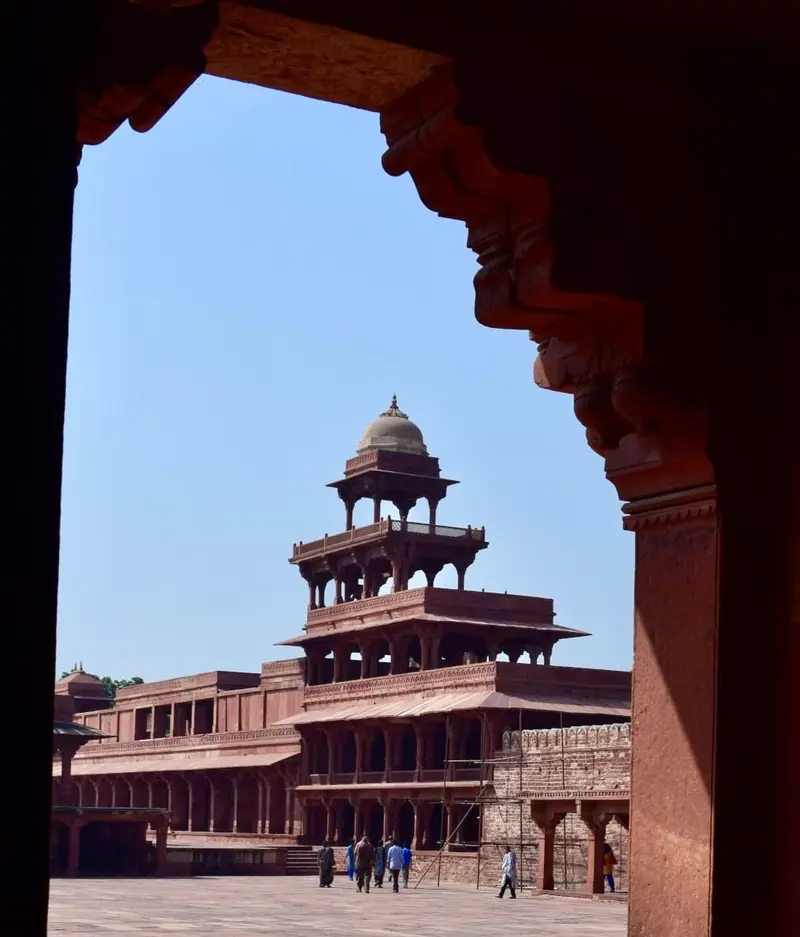
    Panch Mahal

    Mr. Debapriya Hore / Wikimedia Commons / CC BY-SA 4.0, mod.

    Historic Landmark

    5Panch Mahal

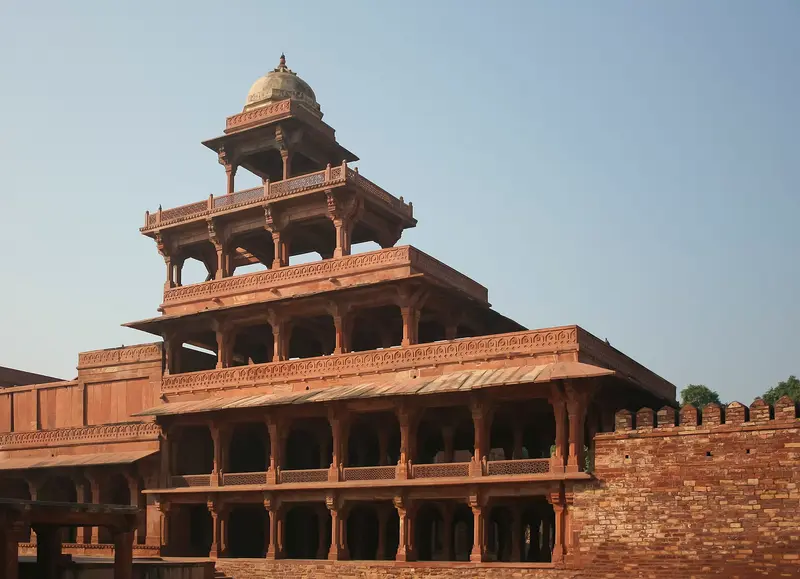
    The five-story pavilion consists solely of columns and is built in the style of a Persian wind tower (Badgir). It was connected to the emperor's private chambers via corridors. Practical info: within the palace complex, ASI-Ticket.
    Open in Google Maps
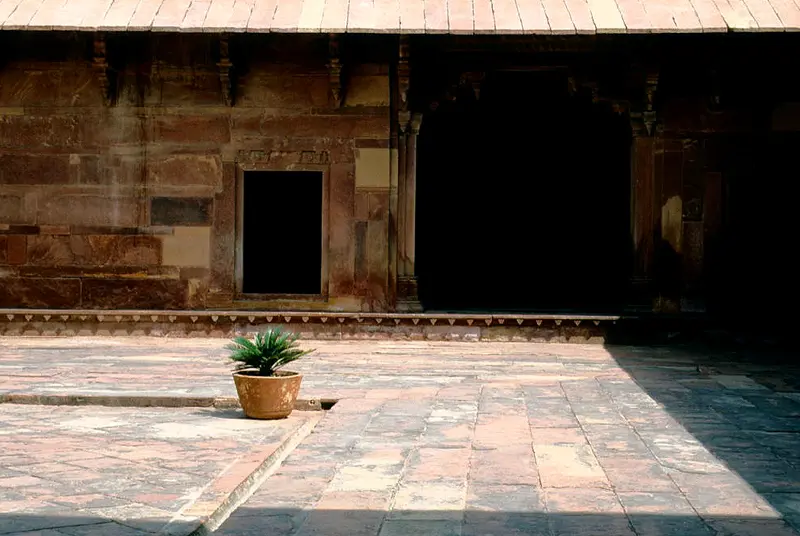
    Palace of Jodha Bai

    LBM1948 / Wikimedia Commons / CC BY-SA 4.0, mod.

    Historic Landmark

    6Palace of Jodha Bai

    The largest and most important building of the palace complex is named after Akbar's Rajput wife. Hindu columns merge with Islamic domes; to the east stands a nine-meter-high gate. Info: In palace complex, ASI ticket.
    Open in Google Maps

    Restaurants in Fatehpur Sikri

    Akbar's City of Victory

    Establishment and Purpose Akbar built Fatehpur Sikri mainly between 1571 and 1573, with the entire complex finished by 1585. The Jama Masjid on the ridge was completed first, from 1571 to 1572. After about ten years as capital, Akbar moved his court to Lahore in 1585. The Sufi Saint The city was built in honor of the Sufi saint Salim Chishti. His white marble tomb in the courtyard of the Jama Masjid was adorned with sculptures between 1580 and 1581, and further decorated in 1606. Pilgrims still visit today. Architecture of Synthesis Palaces like the Jodha Bai Palace combine Hindu columns with Islamic domes. The five-story Panch Mahal consists only of columns and is modeled after a Persian wind tower.

    Arrival and Guide

    Getting ThereFatehpur Sikri is 36 to 40 kilometers west of Agra on the road to Fatehpur Sikri (NH 21), according to the district administration; tajmahal.gov.in states approximately 37 kilometers. Regular UPSRTC buses depart from Idgah bus station in Agra; a taxi is more convenient. Private vehicles park at the foot of the hill, and authorized electric buses will take you to the entrance.On SiteThe mosque complex, including Buland Darwaza, Jama Masjid, and Salim Chishti's Tomb, is accessible without a ticket, with longer hours. For the palace complex, featuring Diwan-i-Khas, Panch Mahal, and Jodha Bai's Palace, you will need an ASI ticket.Practical TipsOpening Hours: Sunrise to sunset, approximately 6 AM to 6 PM, daily.Entry Fee: Foreigners 610 Rs (600 Rs on Fridays), Indians and SAARC/BIMSTEC citizens 50 Rs, under 15 free; additionally, foreigners pay an ADA toll fee, valid for multiple monuments on the same day (as of November 2026).Guides: Licensed guides are available at the ticket counter. Do not engage with touts at the bus stop; agree on price and route in advance.Dress Code: In Jama Masjid and the Tomb, cover shoulders and knees, and remove shoes.Best Time to Visit: Morning or late afternoon, when domes and towers are backlit.

    Accommodations in Fatehpur Sikri

    Find perfect stay in Fatehpur Sikri

    Booking.com* (Affiliate link)
    Search Hotels
    Agoda* (Affiliate link)
    Search Hotels
    Airbnb
    Vacation Rentals

    * Affiliate link: if you book through it, we earn a small commission. The price stays the same for you.

    Nearby

    Agra

    Agra

    Agra, in the state of Uttar Pradesh, around 200 kilometers southeast of Delhi, is the city of the Taj Mahal. Besides the famous tomb, attractions include the Agra Fort, the delicate Tomb of Itimad-ud-Daulah, and Akbar's Mausoleum in Sikandra, plus Fatehpur Sikri as a day trip. Agra was the capital of the Mughals before Delhi. Akbar built his fortress here between 1565 and 1573, and his grandson Shah Jahan had the Taj Mahal built starting in 1632 for his deceased wife Mumtaz Mahal. Many monuments are located on the banks of the Yamuna and can be easily combined in one day. Agra is a feasible day trip from Delhi by express train, but an overnight stay is worthwhile for the sunrise at the Taj. Note: The Taj Mahal is closed on Fridays.

    Yann; edited by Jim Carter·CC BY-SA 4.0

    Ranthambore

    Ranthambore

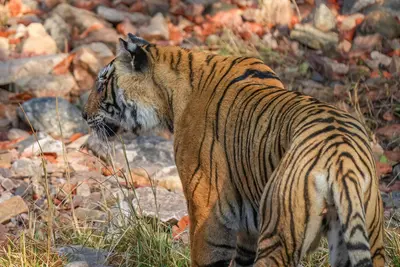
    Ranthambore National Park, near Sawai Madhopur in eastern Rajasthan, is one of India's most renowned locations for spotting tigers in the wild. Its dry forests shelter lakes, ruins, and Ranthambore Fort, which is a UNESCO World Heritage site.The protected area began as the Sawai Madhopur Game Sanctuary in 1955, became part of Project Tiger in the 1970s, and was designated a national park in 1980. Including the adjoining Kailadevi and Sawai Man Singh sanctuaries, it covers approximately 1,334 square kilometres, with the core zone spanning about 275 square kilometres.Make sure to plan more than one safari to increase your chances of a tiger encounter, and allocate an additional half-day for the fort.

    Giles Laurent·CC BY-SA 4.0

    New Delhi

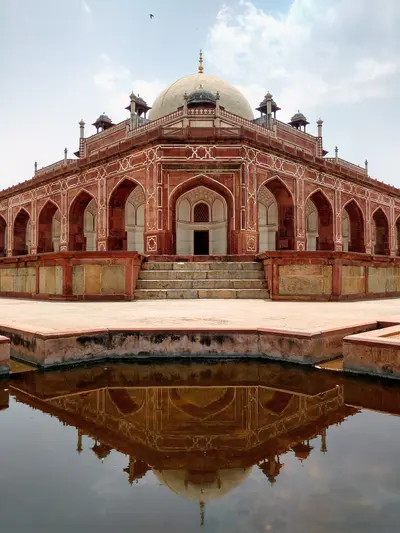
    New Delhi is the capital city planned by the British in the early 20th century, featuring wide avenues, government buildings, and parks, making it the political heart of India. You come here for the India Gate, the Presidential Palace, and Humayun's Tomb, considered a precursor to the Taj Mahal. The grand ceremonial avenue Kartavya Path connects the India Gate with Rashtrapati Bhavan, the President's official residence. Around Connaught Place are the Sikh Temple Bangla Sahib and the stepwell Agrasen ki Baoli; further south, the tombs in Lodhi Garden, the Sufi shrine of Nizamuddin, and Humayun's Tomb, a UNESCO World Heritage site since 1993. A full day is enough for the highlights; with the National Museum and Rashtrapati Bhavan, you'll need two.
    Delhi

    Delhi

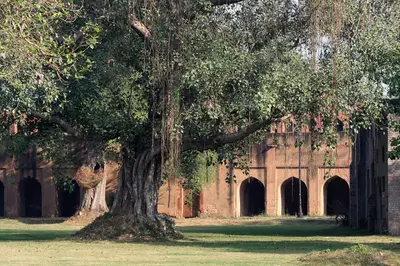
    Delhi is India's capital and for most travelers the gateway to North India: you'll land here, and the classic routes to Agra and Rajasthan start here. The city combines the Mughal metropolis of Shahjahanabad, the British planned city of New Delhi, and centuries-old Sultanate structures in the south. Beyond Old and New Delhi, the city's south is particularly worthwhile: The Qutb Minar complex from the early 13th century is a UNESCO World Heritage site, and in Mehrauli Archaeological Park and around the Hauz Khas water reservoir, Sultanate-era ruins lie amidst greenery. Modern sacred buildings like the Bahai Lotus Temple and the Hindu temple complex Akshardham showcase an entirely different side of the city. Plan at least three full days for Delhi: one for Old Delhi, one for New Delhi with Humayun's Tomb, and one for the south with Qutb Minar and Mehrauli. The Metro connects almost all attractions.

    Naveen R Gowda·CC BY-SA 4.0

    Old Delhi

    Old Delhi

    Old Delhi, the former Mughal capital Shahjahanabad in northern Delhi, is a dense tangle of bazaars, mosques, temples, and gurdwaras. If you want to see the Red Fort, the Jama Masjid, and the food stalls around Chandni Chowk, this is the right place. Shah Jahan had the city laid out between 1638 and 1649; in 1648, it officially received its name. The main artery, Chandni Chowk, stretches from the Red Fort to the Fatehpuri Mosque, with the Khari Baoli wholesale spice market located at its western end. Since its redevelopment in 2021, the section has been closed to cars during the day, making walking significantly more enjoyable. For Old Delhi, you'll need at least half a day, preferably a full day. Current security information, including for the Old City, can be found at the Federal Foreign Office.
    Jakub Hałun·CC BY-SA 4.0

    Your next steps

    Fatehpur Sikri is in India. Ways to carry on from here.

    • More in India

      Highlights, areas, routes and the best time to travel for all of India.

      India travel guide
    • Plan a trip with Fatehpur Sikri

      The Guide asks about season, length and who is coming, and suggests a trip with Fatehpur Sikri.

      Plan the trip

    Sources & method

    • Photos: Wikimedia Commons. Each photo carries its credit.
    • Place data such as addresses and ratings comes from Google Maps.
    • The content is based on web research from public, traceable sources. How the content is made · The role of AI