Fernweh: Home
ExploreGuideDestinationsMy tripsMy trip
de|en
All Places & RegionsRound tripsNight trains in EuropeAll highlightsAbout FernwehFAQPrivacy PolicyImprint
Download on the App StoreGet it on Google Play
ExploreGuideDestinationsMy tripsMy trip
    • Overview
    • Places in the region
    • Culture
    • Getting around
    • Nearby
    Rajasthan

    Jakub Hałun / Wikimedia Commons / CC BY-SA 4.0, mod.

    India

    Rajasthan

    Region

    Rajasthan is India's largest state by area and is located in the northwest of the country, southwest of Delhi.

    by Felix Gillen

    1. Home
    2. Destinations
    3. India
    4. Rajasthan
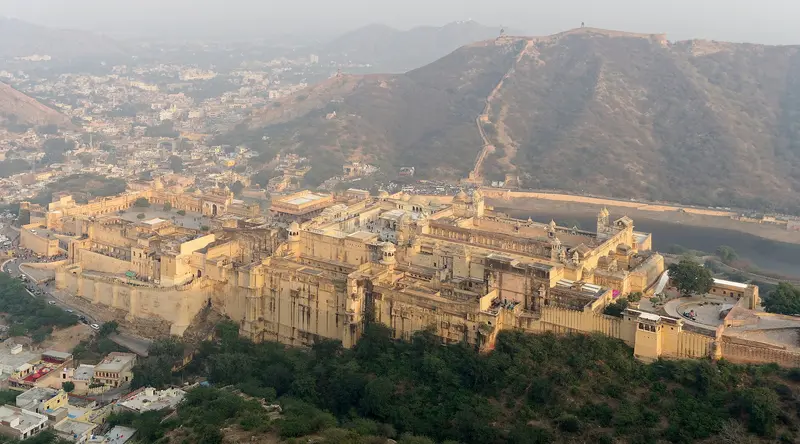
    Rajasthan is India's largest state by area and is located in the northwest of the country, southwest of Delhi. Here, a succession of fortresses, palaces, and bazaar cities define the image of India: from the Pink City Jaipur to golden-yellow Jaisalmer on the edge of the Thar Desert.Covering approximately 342,239 square kilometers, Rajasthan surpasses every other Indian state. The west is occupied by the Thar Desert, also known as the Great Indian Desert; the Aravalli Range, one of the world's oldest fold mountains, traverses the country, with Mount Abu (1,722 meters) as the state's only hill station. The cities bear color names: Jaipur is the pink, Jodhpur the blue, Udaipur the white, and Jaisalmer the golden city.For a first trip, the route of Jaipur, Pushkar, Jodhpur, Jaisalmer, and Udaipur is recommended, supplemented by the Ranthambore Tiger Park. Six hill forts of the state have been jointly listed as Hill Forts of Rajasthan on the UNESCO World Heritage List since 2013, the Old City of Jaipur since 2019, the Jantar Mantar Observatory since 2010, and the Keoladeo Bird Park near Bharatpur also.
    India travel guidePlan a trip with Rajasthan

    Contents

    • Overview
    • Places in the region
    • Culture
    • Getting around
    • Nearby
    Forts, palaces, and bazaar cities between the Thar Desert and Aravalli Range: Jaipur, Udaipur, Jodhpur, Jaisalmer, and Pushkar form the classic route, plus the Ranthambore Tiger Park.
    Ranthambore

    Giles Laurent / Wikimedia Commons / CC BY-SA 4.0, mod.
    Place 1 of 4

    Ranthambore

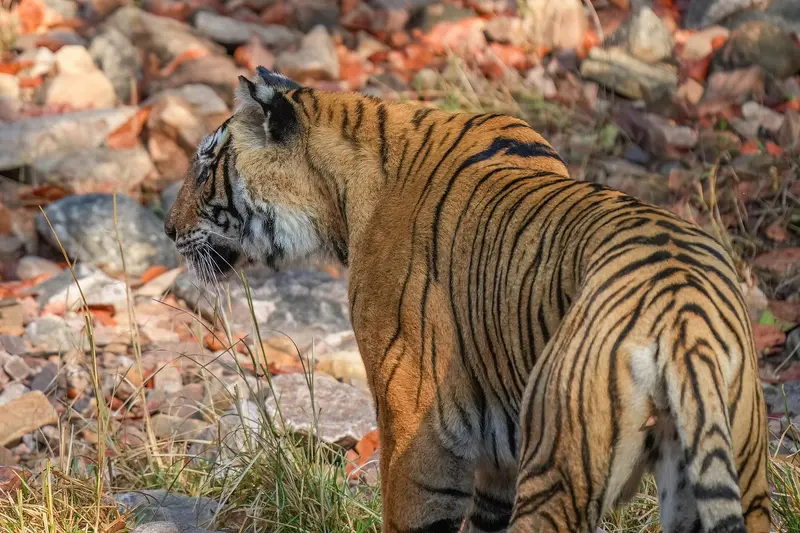
    Ranthambore National Park, near Sawai Madhopur in eastern Rajasthan, is one of India's most renowned locations for spotting tigers in the wild. Its dry forests shelter lakes, ruins, and Ranthambore Fort, which is a UNESCO World Heritage site.

    Discover
    Jaipur

    Marcin Białek / Wikimedia Commons / CC BY-SA 4.0, mod.
    Place 2 of 4

    Jaipur

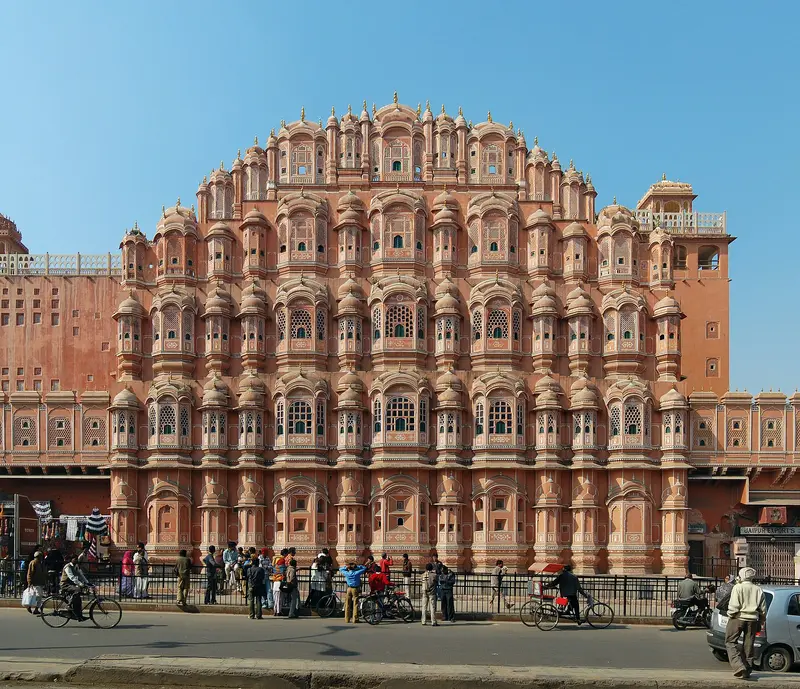
    Jaipur, the capital of Rajasthan, is located about 270 to 310 road kilometers southwest of Delhi and forms the Golden Triangle with Delhi and Agra.

    Discover
    Jaisalmer

    Clément Bardot / Wikimedia Commons / CC BY-SA 4.0, mod.
    Place 3 of 4

    Jaisalmer

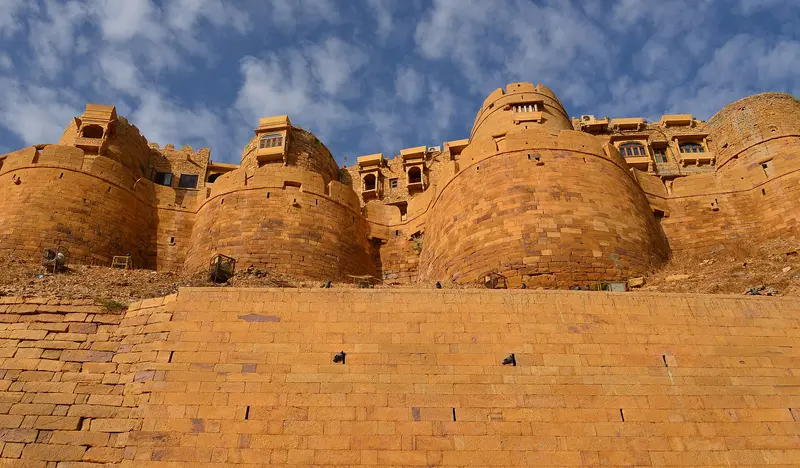
    Jaisalmer, located in the far west of Rajasthan amidst the Thar Desert, is the state's golden city: its fort, havelis, and alleys are built from yellow sandstone. It is home to Rajasthan's only inhabited fort, and the Sam dunes are about 40 kilometers away.

    Discover
    Pushkar

    Vyacheslav Argenberg / Wikimedia Commons / CC BY 4.0, mod.

    Place 4 of 4

    Pushkar

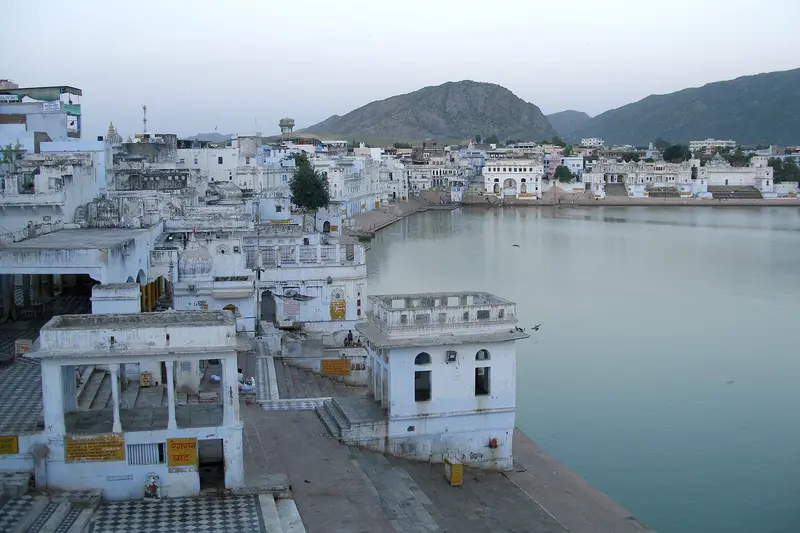
    Pushkar is a small pilgrimage town in Central Rajasthan, about 14 kilometers from Ajmer, centered around a sacred lake.

    Discover

    More places in Rajasthan

    Udaipur

    Jakub Hałun·CC BY-SA 4.0

    Udaipur

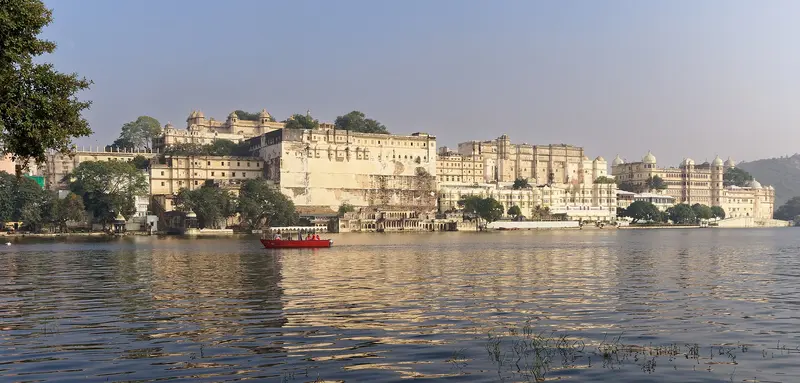
    Udaipur, located in southern Rajasthan amidst the Aravalli Hills and several lakes, was once the capital of the Mewar dynasty. The City Palace overlooking Lake Pichola, the island palaces, and the old town's alleys make this white city the most tranquil of Rajasthan's major destinations.Maharana Udai Singh II started the City Palace in 1559; his successors expanded it into a city within a city until 1949. Surrounding Lake Pichola are ghats, havelis, and temples; to the north lie Fateh Sagar and the Saheliyon ki Bari garden; and on a hill to the west is the Monsoon Palace.Two days are enough for the palace, a boat trip, the old town, and an evening at Bagore ki Haveli; with a third day, Sajjangarh and Shilpgram can be added.
    Jodhpur

    flashing Moment·Pexels

    Jodhpur

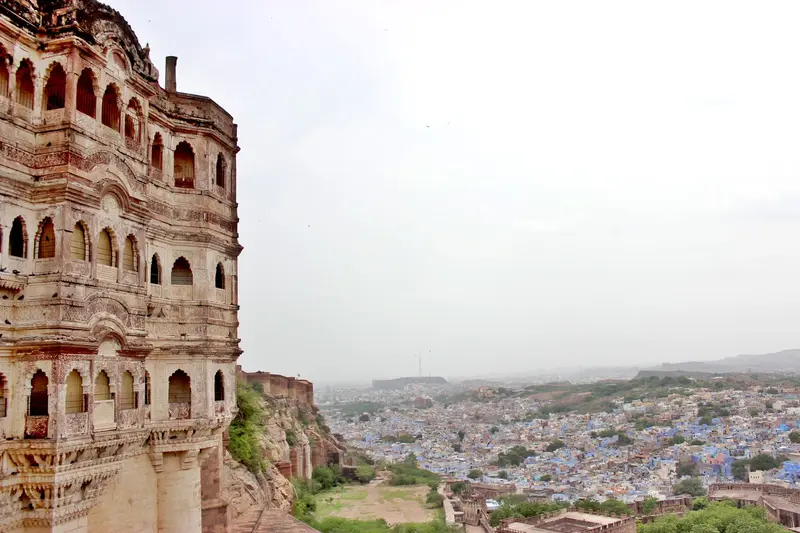
    Jodhpur, in western Rajasthan, on the edge of the Thar Desert, is dominated by Mehrangarh Fort, high on a rock above the blue old city. The fort, with its palaces and the Mehrangarh Museum Trust's museum, makes a worthwhile stop on the way to Jaisalmer.Rao Jodha of the Rathore clan founded the city in 1459, relocating Marwar's capital from nearby Mandore. Beneath the fort are the bazaars around the Clock Tower, the marble cenotaph Jaswant Thada, and the Rao Jodha Desert Rock Park; the 20th-century Umaid Bhawan Palace dominates the city's other end.One and a half to two days are sufficient for the fort, old city, and Mandore. Plan the morning for Mehrangarh and the late afternoon for the Rock Park, when the light softens.

    Land of Kings

    Rajputana and the Princely StatesBefore British rule, the region was called Rajputana, the land of the Rajput princes. The present-day federal state was formed on March 30, 1949, from the merger of 22 kingdoms and principalities. UNESCO describes the hill forts as a testament to the Rajput states that flourished from the 8th to the 18th century; many still have operational water storage systems.Festivals and CuisineAmong the most famous festivals are the Pushkar Camel Fair, the Kite Festival around January 14th in Jaipur, Gangaur in spring, and Teej during the monsoon. Typical dishes include Dal Baati Churma (lentils with baked wheat dumplings and sweet crumbly dough), Laal Maas (spicy lamb curry), Ghevar (sweet pastry), and Mirchi Vada (fried chili).

    On the Road in Rajasthan

    TrainAll major cities (Jaipur, Ajmer for Pushkar, Jodhpur, Jaisalmer, Udaipur, Sawai Madhopur for Ranthambore) are connected to the Indian Railways network. The Vande Bharat Express takes around 3.5 hours from Delhi to Jaipur, while the Shatabdi Express takes 4 to 5 hours. For longer stretches like Jodhpur to Jaisalmer, night trains are common; book tickets early via IRCTC.Road and DriverFor round trips, many travelers hire a car with a driver, as places like Kuldhara, Bada Bagh, or the dunes near Sam are difficult to reach without your own vehicle. On the road from Delhi to Jaipur, expect 5 to 6 hours on the NH48; with the new section of the Delhi-Mumbai-Expressway, it should be about 3 to 3.5 hours. State and private buses connect the cities.Practical InformationAs of January 1, 2026, a combined pass will be available for all state monuments, museums, and galleries: 5,500 rupees for foreigners, valid for 10 days. Many markets in Jaipur are closed on Sundays. Current safety advice, including for the border area with Pakistan in the west of the state, can be found at the Auswärtiges Amt.

    Nearby
    Fatehpur Sikri

    Fatehpur Sikri

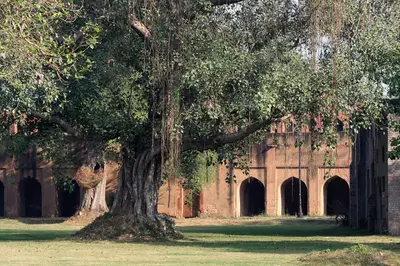
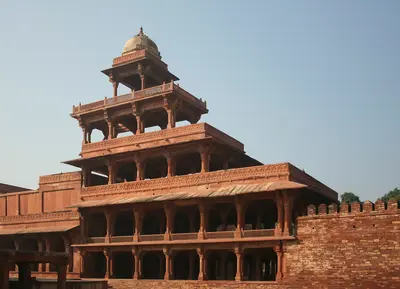
    Fatehpur Sikri, 36 to 40 kilometers west of Agra in Uttar Pradesh, is the abandoned planned city of the Mughal Emperor Akbar. The red sandstone palaces, courtyards, and grand mosque are among India's most impressive Mughal structures and have been a UNESCO World Heritage site since 1986. Akbar had the "City of Victory" built starting in 1571 on a ridge, in honor of the Sufi saint Salim Chishti. It served as capital for only about ten years; in 1585, the court moved to Lahore. The architecture combines Persian, Hindu, and Jain forms. Allow at least half a day. The complex consists of the Mosque Quarter, with Buland Darwaza and Salim Chishti's tomb (freely accessible), and the ticketed Palace Quarter.

    Diego Delso·CC BY-SA 4.0

    Delhi

    Delhi

    Delhi is India's capital and for most travelers the gateway to North India: you'll land here, and the classic routes to Agra and Rajasthan start here. The city combines the Mughal metropolis of Shahjahanabad, the British planned city of New Delhi, and centuries-old Sultanate structures in the south. Beyond Old and New Delhi, the city's south is particularly worthwhile: The Qutb Minar complex from the early 13th century is a UNESCO World Heritage site, and in Mehrauli Archaeological Park and around the Hauz Khas water reservoir, Sultanate-era ruins lie amidst greenery. Modern sacred buildings like the Bahai Lotus Temple and the Hindu temple complex Akshardham showcase an entirely different side of the city. Plan at least three full days for Delhi: one for Old Delhi, one for New Delhi with Humayun's Tomb, and one for the south with Qutb Minar and Mehrauli. The Metro connects almost all attractions.

    Naveen R Gowda·CC BY-SA 4.0

    New Delhi

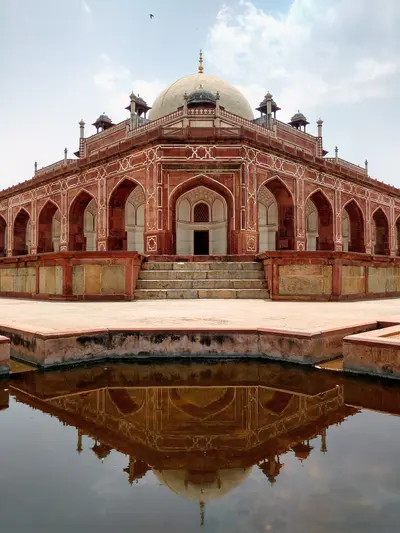
    New Delhi is the capital city planned by the British in the early 20th century, featuring wide avenues, government buildings, and parks, making it the political heart of India. You come here for the India Gate, the Presidential Palace, and Humayun's Tomb, considered a precursor to the Taj Mahal. The grand ceremonial avenue Kartavya Path connects the India Gate with Rashtrapati Bhavan, the President's official residence. Around Connaught Place are the Sikh Temple Bangla Sahib and the stepwell Agrasen ki Baoli; further south, the tombs in Lodhi Garden, the Sufi shrine of Nizamuddin, and Humayun's Tomb, a UNESCO World Heritage site since 1993. A full day is enough for the highlights; with the National Museum and Rashtrapati Bhavan, you'll need two.
    Old Delhi

    Old Delhi

    Old Delhi, the former Mughal capital Shahjahanabad in northern Delhi, is a dense tangle of bazaars, mosques, temples, and gurdwaras. If you want to see the Red Fort, the Jama Masjid, and the food stalls around Chandni Chowk, this is the right place. Shah Jahan had the city laid out between 1638 and 1649; in 1648, it officially received its name. The main artery, Chandni Chowk, stretches from the Red Fort to the Fatehpuri Mosque, with the Khari Baoli wholesale spice market located at its western end. Since its redevelopment in 2021, the section has been closed to cars during the day, making walking significantly more enjoyable. For Old Delhi, you'll need at least half a day, preferably a full day. Current security information, including for the Old City, can be found at the Federal Foreign Office.

    Jakub Hałun·CC BY-SA 4.0

    Agra

    Agra

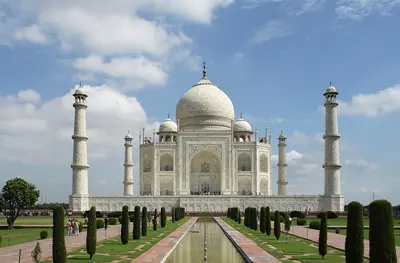
    Agra, in the state of Uttar Pradesh, around 200 kilometers southeast of Delhi, is the city of the Taj Mahal. Besides the famous tomb, attractions include the Agra Fort, the delicate Tomb of Itimad-ud-Daulah, and Akbar's Mausoleum in Sikandra, plus Fatehpur Sikri as a day trip. Agra was the capital of the Mughals before Delhi. Akbar built his fortress here between 1565 and 1573, and his grandson Shah Jahan had the Taj Mahal built starting in 1632 for his deceased wife Mumtaz Mahal. Many monuments are located on the banks of the Yamuna and can be easily combined in one day. Agra is a feasible day trip from Delhi by express train, but an overnight stay is worthwhile for the sunrise at the Taj. Note: The Taj Mahal is closed on Fridays.

    Yann; edited by Jim Carter·CC BY-SA 4.0

    Your next steps

    Rajasthan is in India. Ways to carry on from here.

    • More in India

      Highlights, areas, routes and the best time to travel for all of India.

      India travel guide
    • Plan a trip with Rajasthan

      The Guide asks about season, length and who is coming, and suggests a trip with Rajasthan.

      Plan the trip

    Sources & method

    • Photos: Wikimedia Commons. Each photo carries its credit.
    • The content is based on web research from public, traceable sources. How the content is made · The role of AI