Fernweh: Home
    ExploreTravel GuidesPlan a tripMy tripLast visited
    de|en
    All Places & RegionsAll highlightsAbout FernwehFAQPrivacy PolicyImprint
    ExploreTravel GuidesPlan a tripMy tripLast visited
    Fürstenstein Castle (Zamek Książ)
    Lukaszmalkiewicz.pl / Wikimedia Commons / CC BY-SA 4.0

    Poland

    Fürstenstein Castle (Zamek Książ)

    Point of Interest

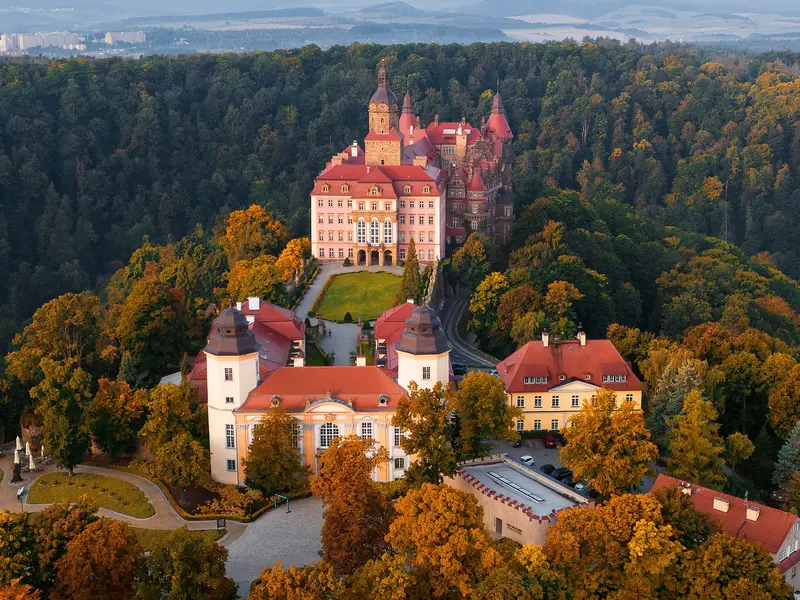
    Schloss Fürstenstein (Zamek Książ) is, after Marienburg and Wawel, the third largest castle in Poland. It thrones on the northern edge of Waldenburg (Wałbrzych) on a rock above the deep gorge of the Polsnitz (Pełcznica).

    by Felix Gillen

    1. Home
    2. Destinations
    3. Poland
    4. Lower Silesia
    5. Fürstenstein Castle (Zamek Książ)
    Schloss Fürstenstein (Zamek Książ) is, after Marienburg and Wawel, the third largest castle in Poland. It thrones on the northern edge of Waldenburg (Wałbrzych) on a rock above the deep gorge of the Polsnitz (Pełcznica).The building combines medieval, Renaissance, Baroque, and Neo-Renaissance styles: Its core dates back to a castle of Duke Bolko I of Schweidnitz from the late 13th century; during the renovation from 1909 to 1923, a new wing and the 47-meter-high main tower were added. A visit includes the state rooms, the terraced gardens, the underground passages from World War II, the stud farm, and the palm house. Around the castle extends a landscape park, which you can explore on forest paths.

    Sights in Fürstenstein Castle (Zamek Książ)

    Discover the most important sights and attractions
    Książ Stud Farm (Stado Ogierów)
    Point of Interest

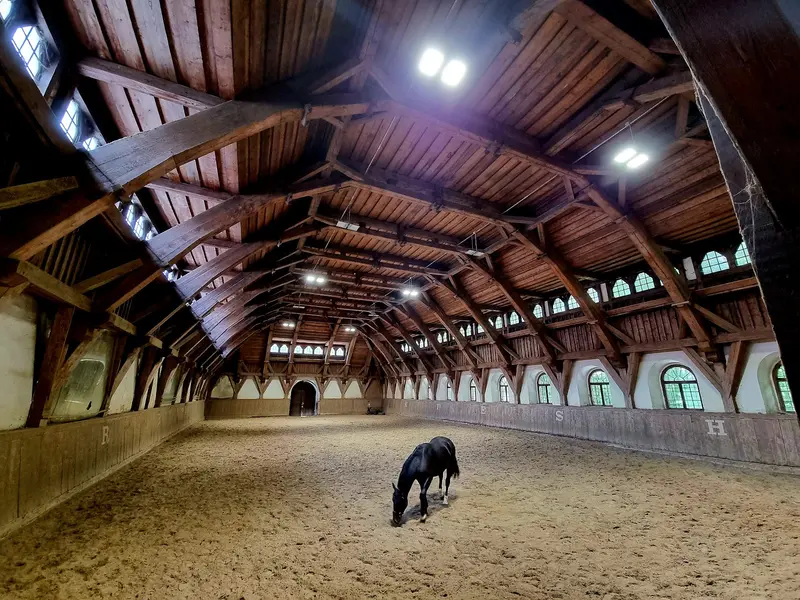
    1Książ Stud Farm (Stado Ogierów)

    The castle's stud farm is about 900 meters from the castle, a roughly 10-minute walk. It is included in the All Day Ticket and a combi-ticket with the castle and palm house.
    Open in Google Maps
    Palm House (Palmiarnia)
    Attraction

    2Palm House (Palmiarnia)

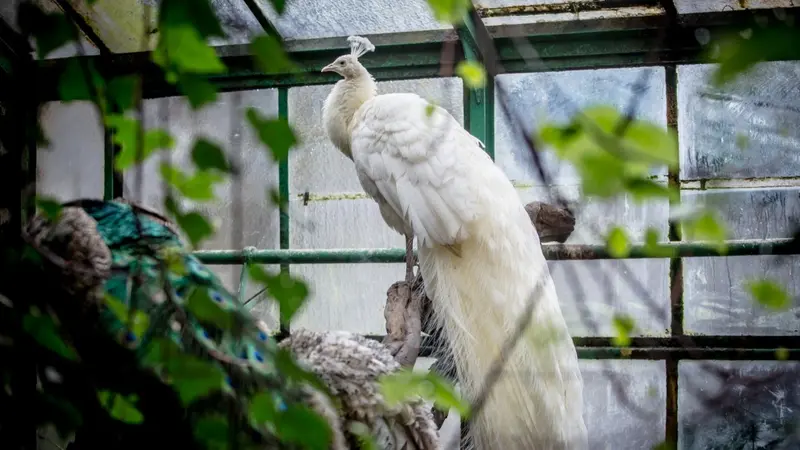
    The glass and brick greenhouse belongs to the castle, but is located approximately 2 km away at ul. Wrocławska 158, about 25 minutes on foot. You can see tropical plants, cacti, bamboo, and bonsais. It is included in most of the castle's combo tickets.
    Open in Google Maps
    Underground Passages (Podziemia)
    Museum

    3Underground Passages (Podziemia)

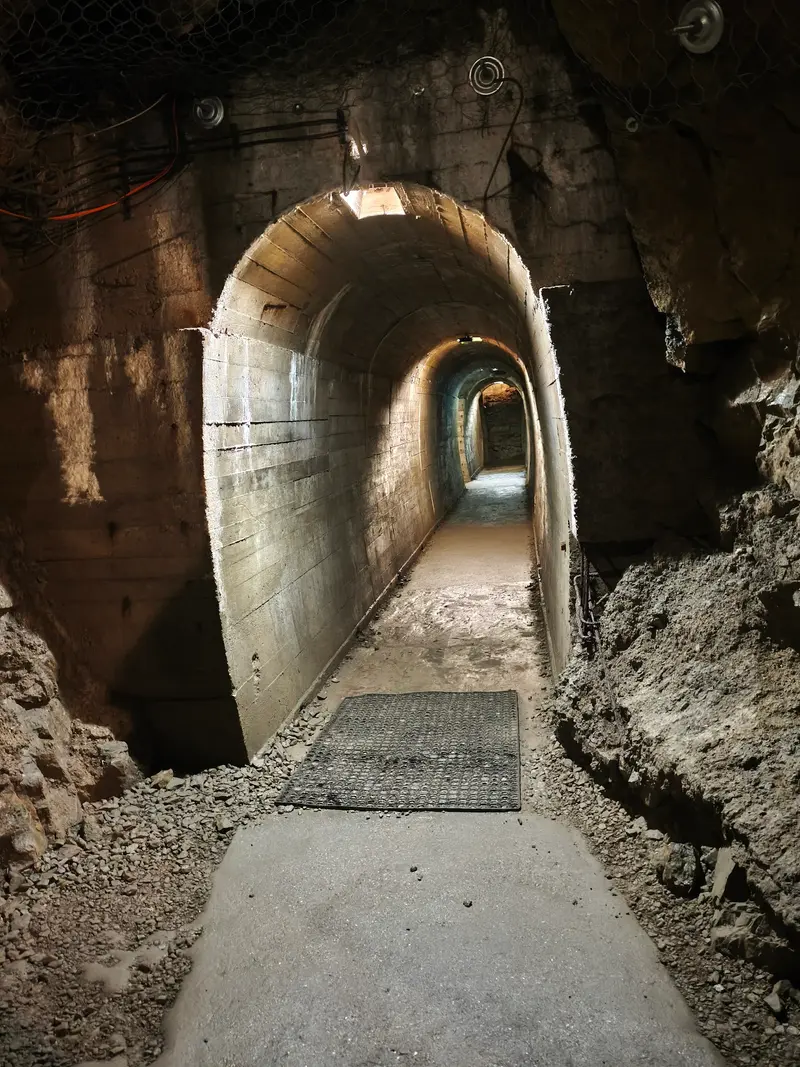
    Under the castle, prisoners from KZ Groß-Rosen and forced laborers, starting 1943 under Project Riese, drove a two-level tunnel system 53 meters beneath the courtyard into the rock. Since 2018, a section is accessible with Polish-language tours (approx. 35 mins, approx. 6°C); another hosts a geophysical observatory of the Polish Academy of Sciences. Children under four are not admitted.
    Open in Google Maps

    Restaurants in Fürstenstein Castle (Zamek Książ)

    1

    Biblioteka

    Located in the castle's former gatehouse, in the erstwhile library, the restaurant is accessed via a stone spiral staircase. The Guide Michelin 2026 has newly awarded it a Bib Gourmand for modern and regional cuisine at fair prices.
    Show on Google Maps

    Heritage

    From the Piasts to the HochbergsDuke Bolko I of Schweidnitz had the castle built in the late 13th century. From 1509, the Hochberg family took over the castle and expanded it over centuries. The Maximilian Hall dates from this period.Project Riese and Post-War PeriodIn 1941, the Nazi state confiscated the castle, and in 1943, it became Reich property. As part of Project Riese, prisoners from the Gross-Rosen concentration camp and forced laborers had to drive a two-level tunnel system into the rock beneath the castle, destroying many interior rooms. In 1945 and 1946, Soviet troops occupied the castle and further devastated it. Since 1991, the castle has belonged to the city of Wałbrzych, which has been restoring it step by step.

    Visit, Tickets & Getting Here

    Opening Hours and TicketsCastle and Palm House open daily from 9 AM in October 2026. Until Oct 18, weekdays close 6 PM, weekends 7 PM; thereafter 5 PM. Castle access only with combi-ticket and audioguide (incl. German). As of May 2026, Castle & Palm House: 72 Złoty (reduced 62); All Day Ticket, Terraces, Passages, Palm House, Stud Farm, Mausoleum: 104 Złoty (reduced 94). Terraces open Apr 1 – Sep 30; Mausoleum Apr 1 – Oct 15. Underground Passages: Polish-speaking guided tours only, at fixed times. Tickets online at bilety.ksiaz.walbrzych.pl; current times at ksiaz.walbrzych.pl.DirectionsCastle address: ul. Piastów Śląskich 1, Wałbrzych. Palm House separate: ul. Wrocławska 158. Both best reached by car.

    Accommodations in Fürstenstein Castle (Zamek Książ)

    Find perfect stay in Fürstenstein Castle (Zamek Książ)

    Booking.com* (Affiliate link)
    Search Hotels
    Agoda* (Affiliate link)
    Search Hotels
    Airbnb
    Vacation Rentals

    * Affiliate link: if you book through it, we earn a small commission. The price stays the same for you.

    Campgrounds in Fürstenstein Castle (Zamek Książ)

    Find perfect campground in Fürstenstein Castle (Zamek Książ)
    Search via Google Maps
    Campgrounds nearby (15km)
    Camping.info
    Find Campgrounds
    Park4Night
    RV Parks & Camping

    Nearby

    Lower Silesia

    Lower Silesia

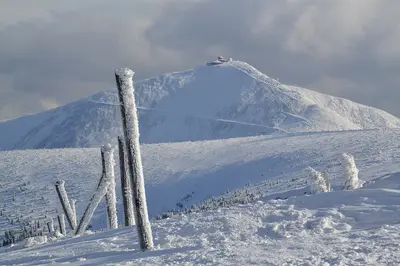
    Lower Silesia (Dolny Śląsk) in southwestern Poland borders Saxony and the Czech Republic. Approximately 2.9 million people live on its roughly 19,900 km², with Breslau (Wrocław) as its capital and largest city. To the south, the Sudetes Mountains rise, featuring the Giant Mountains, whose highest peak, Schneekoppe (Śnieżka), reaches 1603 meters. Northward, the land transitions into the flat Silesian Lowland along the Oder River.Throughout history, the region alternated between Bohemia, the Habsburgs, and Prussia, finally becoming part of Poland after 1945. Castles, churches, and historic towns bear witness to this past: the Churches of Peace in Schweidnitz (Świdnica) and Jauer (Jawor), the stately homes in the Hirschberg Valley, and Fürstenstein Castle near Waldenburg (Wałbrzych).
    Krummhübel (Karpacz) and Giant Mountains

    Krummhübel (Karpacz) and Giant Mountains

    Krummhübel (Karpacz) is located in the Giant Mountains, by the Lomnica river, at the foot of Sněžka (Śnieżka). At 1603 meters, Sněžka is the range's highest peak and lies on the Czech border. With just over 4,000 residents, the town is one of Lower Silesia's key holiday resorts, perfect for summer hiking and winter skiing.Karpacz stretches up the valley. The lower part holds the town center with churches, town hall, and museums. Further up is Brückenberg (Karpacz Górny), home to the Norwegian Wang Stave Church. Above the town, the Giant Mountains National Park (Karkonoski Park Narodowy) offers trails to Sněžka.Plan a full day for the ascent; check weather and lift operations beforehand, as ridge conditions can change rapidly.
    Breslau (Wrocław)

    Breslau (Wrocław)

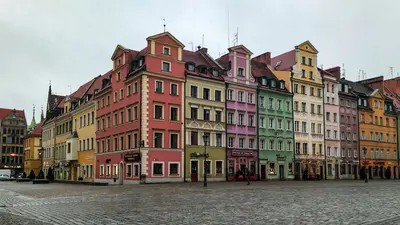
    Breslau (Wrocław) is, with around 673,000 inhabitants, Poland's third-largest city and the capital of Lower Silesia. The city lies on the upper Oder River and spans about twelve islands, connected by 100 to 300 bridges, depending on how they are counted. Around the year 1000, a bishopric was founded here, and in 1261, Wrocław was granted Magdeburg Law. In 2016, it was a European Capital of Culture.The heart of the Old Town is the Market Square (Rynek) with its Gothic Town Hall, surrounded by burgher houses and churches. North of the Old Town, bridges lead to Cathedral Island (Ostrów Tumski), the oldest part of the city, featuring a cathedral and churches. To the east, in Scheitniger Park, stands the Centennial Hall, which has been a UNESCO World Heritage site since 2006.As you stroll through the city, you'll repeatedly encounter small bronze gnomes on house walls, lampposts, and stairs. The first figure commemorates the anti-communist Orange Alternative movement; meanwhile, there are now more than 1,000 of them. You should plan at least two to three days for your visit to the city.
    Görlitz

    Görlitz

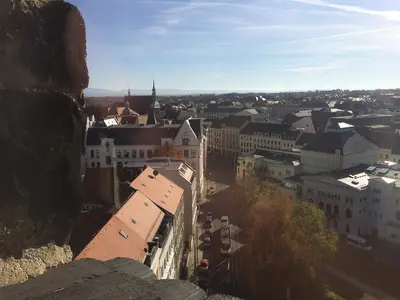
    Görlitz on the Lusatian Neisse is Germany's easternmost city. Since 1945, the river has formed the border with Poland; its eastern districts are now the independent Polish city of Zgorzelec, reachable on foot via the Altstadtbrücke.During World War II, Görlitz remained almost entirely spared from destruction, and its historic Old Town, including Untermarkt and Obermarkt, is consequently well-preserved. This makes the city a popular and frequently used film set.
    Saxon Switzerland / Bastei

    Saxon Switzerland / Bastei

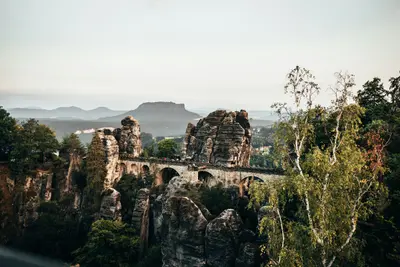
    Saxon Switzerland, the German part of the Elbe Sandstone Mountains, is located southeast of Dresden on both sides of the Elbe. Its bizarre rock formations are largely within the Saxon Switzerland National Park, established in September 1990, prior to German reunification. Climbing adheres to the Saxon Rules and is only allowed on designated climbing peaks.The most famous viewpoint is the Bastei near Rathen, which rises 194 meters above the Elbe. It is freely accessible year-round and at any time. Upriver on the Elbe, Königstein Fortress proudly sits atop its mesa, one of Europe's largest mountain fortresses.

    Sources & method

    • Photos: Wikimedia Commons, Google Maps. Each photo carries its credit.
    • Place data such as addresses and ratings comes from Google Maps.
    • The content is based on web research from public, traceable sources. How the content is made · The role of AI