Fernweh: Home
ExploreGuideDestinationsMy tripsMy trip
de|en
All Places & RegionsRound tripsNight trains in EuropeAll highlightsAbout FernwehFAQPrivacy PolicyImprint
Download on the App StoreGet it on Google Play
ExploreGuideDestinationsMy tripsMy trip
    • Overview
    • Places in the region
    • Culture
    • Getting around
    • Nearby
    Sauerland

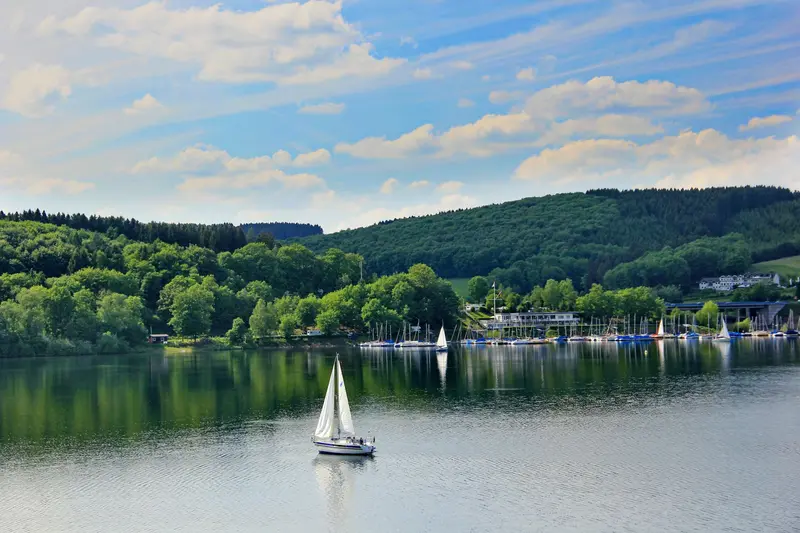
    Photo by Ömer Saridas on Pexels

    Germany

    Sauerland

    RegionNature

    The Sauerland region in the southeast of North Rhine-Westphalia is a low mountain range with over 2,700 peaks higher than 400 meters, reservoirs like Bigge- and Möhnesee, and the Rothaarsteig long-distance hiking trail.

    by Felix Gillen

    1. Home
    2. Destinations
    3. Germany
    4. Sauerland
    The Sauerland region in the southeast of North Rhine-Westphalia is a low mountain range with over 2,700 peaks higher than 400 meters, reservoirs like Bigge- and Möhnesee, and the Rothaarsteig long-distance hiking trail. According to NRW Tourism, in winter it boasts one of the largest ski areas north of the Alps.
    Germany travel guideRound trips in GermanyPlan a trip with Sauerland

    Contents

    • Overview
    • Places in the region
    • Culture
    • Getting around
    • Nearby
    HikingThe Rothaarsteig trail runs for 154 kilometers from Brilon to Dillenburg; with variants, it totals 221 kilometers. Its highest point is the Langenberg at 843.2 meters, and along the way lie the Bruchhauser Steine, the WaldSkulpturenWeg, the Kyrillpfad, and the Wisent-Wildnis.Lakes and CavesBiggesee: Excursion destination with the Skywalk Biggeblick.Möhnesee: largest reservoir in the Sauerland.Atta-Höhle: Stalactite cave in Attendorn.

    Sights in Sauerland

    Discover the most important sights and attractions

    Attraction

    Atta Cave, Attendorn

    Quarry workers discovered the stalactite cave on July 19, 1907; NRW Tourism identifies it as Germany's largest contiguous cave system. Tours last approx. 40 minutes at a constant 9°C; tickets available at the box office only. Closed Nov 24 - Dec 25. In late autumn, open weekends only.
    Open in Google Maps
    Historic Landmark

    Möhnesee

    The Möhnetalsperre is the largest dam in the Sauerland and is also known as the Westphalian Sea. The Bismarck Tower by Lake Möhne is currently closed to visitors.
    Open in Google Maps
    Museum

    Altena Castle

    In the castle above Altena, according to NRW Tourism, the world's oldest youth hostel was founded; today it houses medieval collections and a World Youth Hostel Museum.
    Open in Google Maps
    Point of Interest

    Bald Asten and Asten Tower

    Kahle Asten near Winterberg, over 840m, is one of North Rhine-Westphalia's two highest mountains. The Astenturm with its weather station is, per Sauerland-Tourismus, a Sauerland landmark, nearby a hotel, restaurant, and café.
    Open in Google Maps

    Culture in Sauerland

    Hills and CastlesOver 2,700 elevations in the Sauerland are higher than 400 meters. At Burg Altena, the world's oldest youth hostel was established.Michelin-Starred CuisineIn Schmallenberg, Hofstube Deimann holds a star in the Guide Michelin 2026.

    On the Way in Sauerland

    More than 20 locations along the Rothaarsteig are accessible by train, for example, via Kassel to Brilon-Wald and Olsberg, via Bestwig and Brilon from the direction of Düsseldorf and Hamburg, or via Siegen from Cologne.With the SauerlandCard, you travel for free on buses in the Sauerland.In winter, the Sauerland is a winter sports area, around Winterberg and the Kahler Asten.

    Nearby

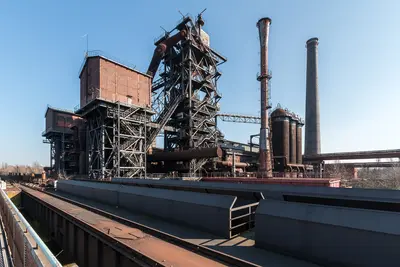
    Zollverein Coal Mine

    Zollverein Coal Mine

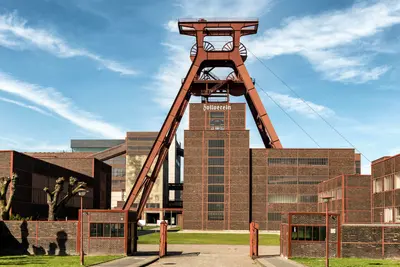
    The Zollverein Coal Mine in Essen-Stoppenberg, along with the Zollverein Coking Plant, has been a UNESCO World Heritage site since December 14, 2001. Its landmark is Shaft XII, which architects Fritz Schupp and Martin Kremmer designed in the New Objectivity style and which went into operation on February 1, 1932. Coal production ended on December 23, 1986, and the coking plant ran until 1993.In the former coal washery, the Ruhr Museum has been presenting the region's history since 2010. In the old boiler house, remodelled by Norman Foster and Heinrich Böll, the Red Dot Design Museum is located.

    Wolfgang Weiser·Pexels

    Ruhr Area

    Ruhr Area

    The Ruhr Area is home to around 5.1 million people across 11 independent cities and 4 districts, including Duisburg, Essen, Bochum, and Dortmund. For over a century, coal and steel shaped the region, and in December 2018, Prosper-Haniel in Bottrop, Germany's last hard coal mine, ceased operations.Today, its industrial history is a major travel theme. The Route of Industrial Heritage connects the most important sites, especially the Zollverein Coal Mine Industrial Complex in Essen, a UNESCO World Heritage site since 2001. At Landschaftspark Duisburg-Nord, you can climb a blast furnace, and from Gasometer Oberhausen, you look out over the western Ruhr Area from a height of 117 meters. In 2010, the Ruhr Area was the European Capital of Culture.
    Dietmar Rabich·CC BY-SA 4.0

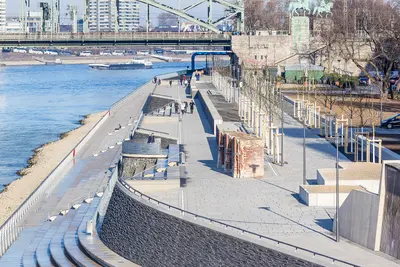
    Deutz

    Deutz

    Deutz is on the Rhine's right bank, opposite the Old Town. You cross from the Cathedral via the Hohenzollern Bridge's pedestrian and cycle path. Around 310, Emperor Constantine built the Divitia fort here to protect a Rhine bridge. The formerly independent town was incorporated into Cologne in 1888. Today, Koelnmesse (first halls 1922) and the Lanxess Arena define the district.At the Rheinboulevard, opened 2015, sit directly by the water facing the Old Town. North of it, the Rheinpark adjoins, and the KölnTriangle's 29th floor offers city views. Köln Messe/Deutz station serves many trains and tram lines 1, 3, 4, and 9.

    Raimond Spekking·CC BY-SA 4.0

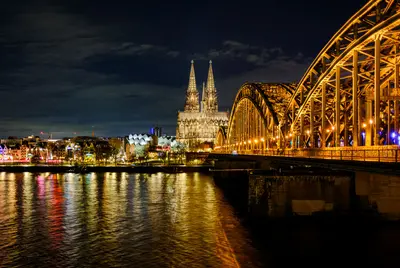
    Cologne & Rhineland

    Cologne & Rhineland

    In the Rhineland, some of Germany's most vibrant cities line the river. Cologne, with its Cathedral (a UNESCO World Heritage site since 1996) and twelve Romanesque churches, is the hub; upstream lies Bonn, Beethoven's birthplace and, until 1999, the seat of the Bundestag and government. Downstream follows Düsseldorf, the state capital of North Rhine-Westphalia.To the west, on the border with Belgium and the Netherlands, lies Aachen with Charlemagne's Cathedral, which became the first German monument on the World Heritage List in 1978. The cities are closely connected by rail, and an old rivalry runs between Cologne and Düsseldorf, most clearly evident in their beer: Kölsch here, Altbier there.

    Yassen Kounchev·Pexels

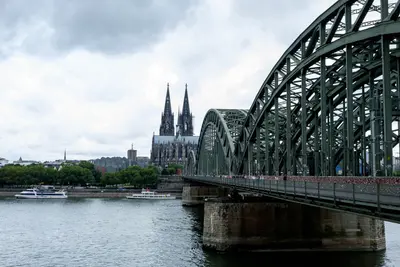
    Cologne

    Cologne

    With over a million inhabitants, Cologne is Germany's fourth-largest city and the center of the Rhineland. Its landmark is the Cathedral (Dom), which was built from 1248 to 1880 and whose spires rise a good 157 meters. Since 1996, it has been a UNESCO World Heritage site and preserves the relics of the Three Magi.Around the Dom, you'll find twelve Romanesque churches, museums like the Museum Ludwig with one of the world's largest Picasso collections, and the Old Town by the Rhine with its breweries. There, you drink Kölsch from a tall, slender glass, served by a Köbes. Between Weiberfastnacht (Women's Carnival) and Ash Wednesday, the city is dominated by Carnival.

    Mayumi Maciel·Pexels

    Your next steps

    Sauerland is in Germany. Ways to carry on from here.

    • More in Germany

      Highlights, areas, routes and the best time to travel for all of Germany.

      Germany travel guide
    • Round trips in Germany

      Ready-made routes through Germany, with stops, nights and a map.

      See the routes
    • Plan a trip with Sauerland

      The Guide asks about season, length and who is coming, and suggests a trip with Sauerland.

      Plan the trip

    Sources & method

    • Photos: Pexels. Each photo carries its credit.
    • Place data such as addresses and ratings comes from Google Maps.
    • The content is based on web research from public, traceable sources. How the content is made · The role of AI