Fernweh: Home
    ExploreTravel GuidesPlan a tripMy tripLast visited
    de|en
    All Places & RegionsAll highlightsAbout FernwehFAQPrivacy PolicyImprint
    ExploreTravel GuidesPlan a tripMy tripLast visited
    • Neighborhoods & highlights
    • Walking tours
    • Eat & drink
    • Food culture
    • Culture
    • Getting around
    • Accommodation
    • Plan trip
    • Nearby
    San Gimignano

    Italy

    San Gimignano

    CityCulture

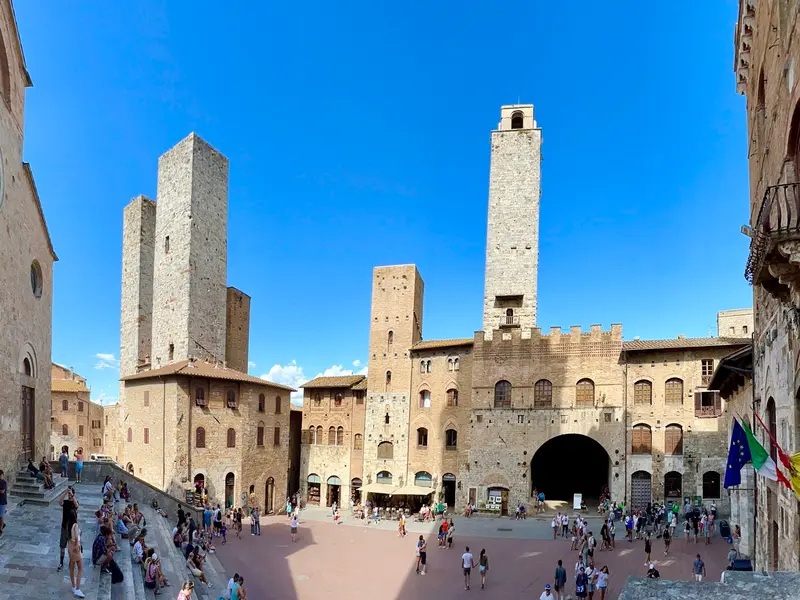
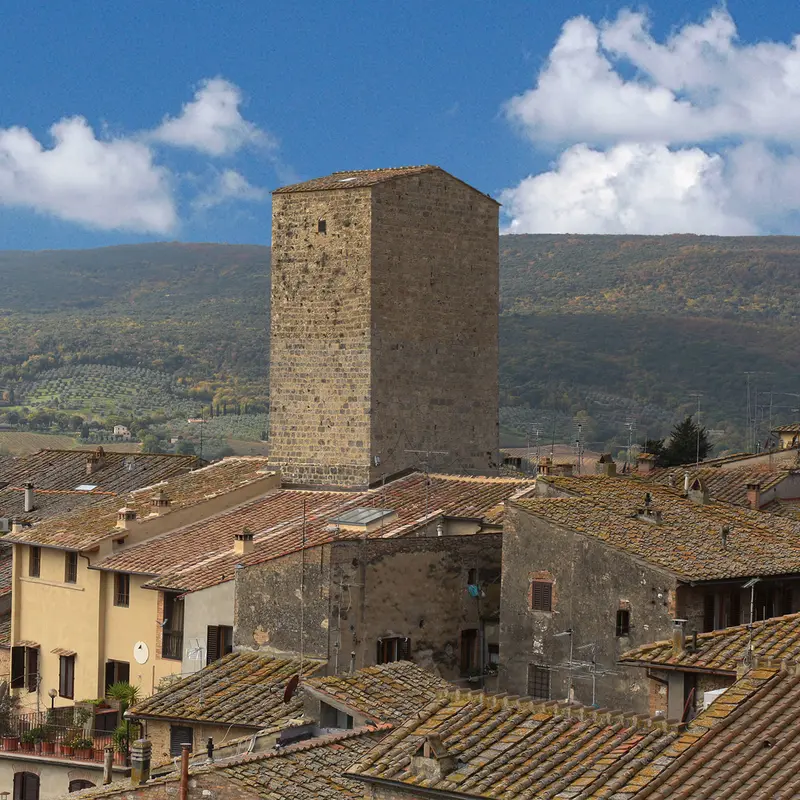
    San Gimignano is situated on a hill in the Valdelsa, Siena province. Of the 72 family towers that once stood, 14 still stand today, shaping its skyline.

    by Felix Gillen

    1. Home
    2. Destinations
    3. Italy
    4. Tuscany
    5. San Gimignano
    San Gimignano is situated on a hill in the Valdelsa, Siena province. Of the 72 family towers that once stood, 14 still stand today, shaping its skyline. It has been a UNESCO World Heritage site since 1990. Its heart is formed by Piazza della Cisterna with its fountain, and Piazza del Duomo with the Collegiata and town hall. During the day, the town is very crowded; it's quieter early morning and evening.

    Sights in San Gimignano

    Discover the most important sights and attractions

    SanGimignano1300
    Museum

    1SanGimignano1300

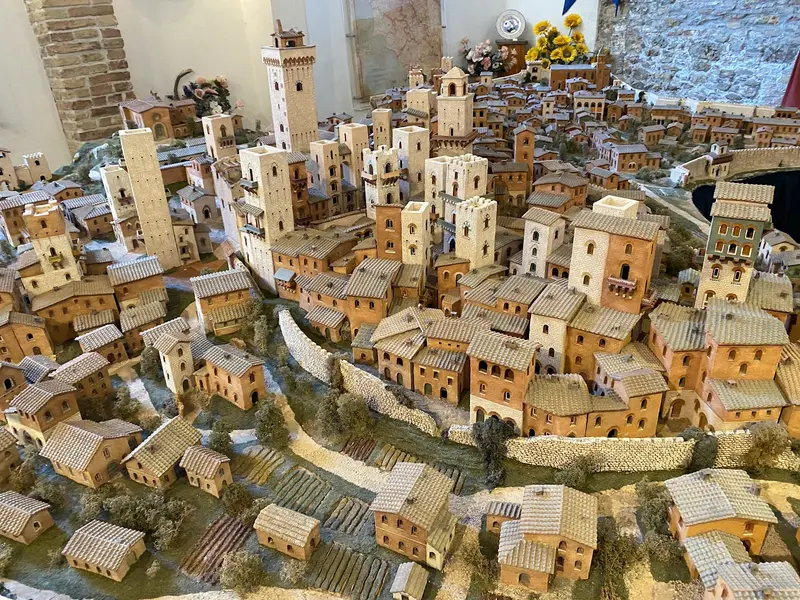
    A large model shows San Gimignano as it looked in the Middle Ages with its numerous towers. A good introduction before the city tour.
    Open in Google Maps
    Galleria continua
    Gallery

    2Galleria continua

    Gallery for contemporary art in a former cinema in Via del Castello. Founded in 1990, it now has locations in Beijing, Paris, Rome, Havana, and São Paulo, among others. Its exhibitions offer a stark contrast to the medieval surroundings.
    Open in Google Maps
    Palazzo Comunale and Torre Grossa
    Museum

    3Palazzo Comunale and Torre Grossa

    The Town Hall on Piazza del Duomo houses the Pinacoteca and the Dante Hall, named after Dante Alighieri, who was an envoy in San Gimignano on May 8, 1300. Among the exhibits is the Maestà by Lippo Memmi from 1317. The Torre Grossa from 1311, at approximately 54 meters, is the city's tallest tower; access to the top is through the Town Hall.
    Open in Google Maps
    Torre e Casa Campatelli
    Museum

    4Torre e Casa Campatelli

    One of the preserved family towers with its adjoining residence, where the Campatelli family lived from the early 19th century. The rooms are preserved with their original furnishings from the 19th and early 20th centuries. Under the roof, a film tells the history of the city. Lydia Campatelli bequeathed the house to the FAI in 2005, the Italian National Trust.
    Open in Google Maps
    Sant'Agostino
    Church

    5Sant'Agostino

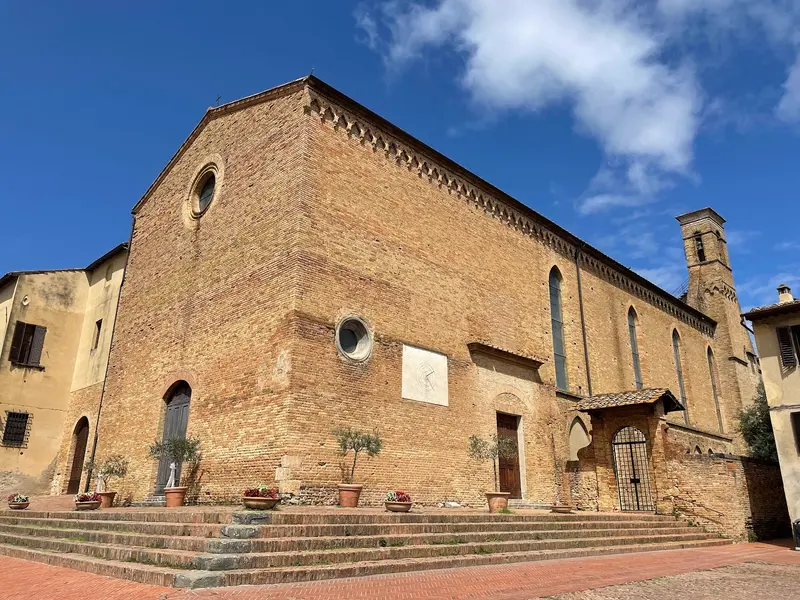
    The Augustinerkirche at the northern end of the Old Town is the city's second largest church after the Collegiata. In the choir, Benozzo Gozzoli painted a fresco cycle in the 1460s with 17 scenes from the life of Saint Augustine. Admission is free.
    Open in Google Maps
    Rocca di Montestaffoli
    Park

    6Rocca di Montestaffoli

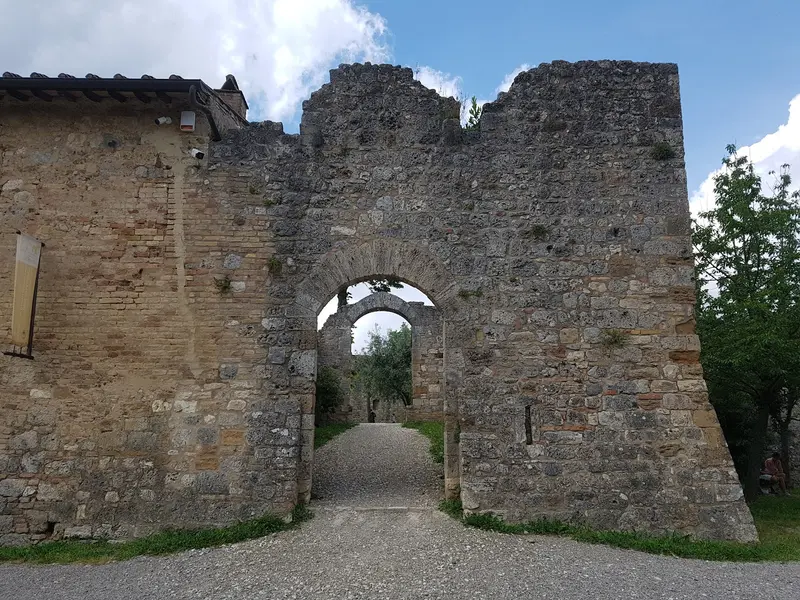
    Remains of the 14th-century fortress at the city's highest point, razed in the 16th century. Today, the site, known as Parco della Rocca, is a small park with views over the city's rooftops and towers and the hills of Valdelsa.
    Open in Google Maps

    City walks in San Gimignano

    Curated walking tours through the city's highlights, handpicked by experienced travel journalists.

    San Gimignano: A Journey Through Time to Towers and Tuscan Views

    Discover San Gimignano, the town of beautiful towers, on a two-hour walk. Stroll through medieval lanes, marvel at splendid squares and enjoy breathtaking views over the Tuscan countryside. Immerse yourself in the history and charm of this UNESCO World Heritage Site.

    ~2 Std.
    Open in Google Maps
    Stops (7)

    Food & Drink

    1

    Ristorante Fuoriluogo

    Small restaurant on the northern edge of the old town near Sant'Agostino. The menu is short and seasonal, featuring Tuscan dishes in a contemporary style. There are only a few tables, book ahead.
    Show on Google Maps
    2

    Cum Quibus - Ristorante Toscano

    Restaurant on Via San Martino in the northern old town. The kitchen offers modern Tuscan dishes and tasting menus with wine pairing; in good weather, you can sit in the courtyard. Prices are high, reserve ahead.
    Show on Google Maps
    3

    La Vecchia Nicchia Enoteca Bruschetteria

    Small enoteca on Via San Martino serving bruschetta, charcuterie and cheese boards, and open wines, including Vernaccia di San Gimignano. Perfect for a simple lunch or an evening snack.
    Show on Google Maps

    Food and Drink

    The cuisine of San Gimignano is Tuscan, with game, pasta, and local products.

    Vernaccia di San Gimignano

    Dry white wine from the eponymous grape variety, the first Italian wine to be awarded DOC status in 1966.

    Saffron of San Gimignano

    Saffron with Protected Designation of Origin, produced exclusively within the municipality and usually sold in small portions.

    Culture and History

    City on the Via FrancigenaSan Gimignano was located on the Via Francigena, the pilgrim route to Rome. Trade in saffron and Vernaccia brought wealth, and the city reached its peak in the 13th century. Rival families built residential towers, some up to 70 meters high. The plague of 1348 killed about half the inhabitants; afterwards, the weakened city submitted to Florence.FrescoesThe Collegiata's interior is adorned with 14th and 15th-century frescoes, including scenes from the Old and New Testaments and a Last Judgment by Taddeo di Bartolo. Domenico Ghirlandaio painted in the Chapel of Saint Fina. In Sant'Agostino, you'll find Benozzo Gozzoli's Augustinian Cycle.Saffron and VernacciaSaffron from San Gimignano holds a Protected Designation of Origin (DOP). Vernaccia di San Gimignano was the first Italian wine to receive DOC recognition in 1966.

    Exploring San Gimignano

    On FootThe Old Town is small and can be explored quickly on foot. The paths are cobbled and partly steep.BusSan Gimignano does not have a train station. From Florence, take the bus to Poggibonsi and change there for the bus to San Gimignano; allow about two hours.CarThe Old Town is closed to cars. Large car parks are located around the walls, such as P1 Giubileo and P2 Montemaggio.

    Accommodations in San Gimignano

    Find perfect stay in San Gimignano

    Booking.com* (Affiliate link)
    Search Hotels
    Agoda* (Affiliate link)
    Search Hotels
    Airbnb
    Vacation Rentals

    * Affiliate link: if you book through it, we earn a small commission. The price stays the same for you.

    Campgrounds in San Gimignano

    Find perfect campground in San Gimignano

    Search via Google Maps
    Campgrounds nearby (15km)
    Camping.info
    Find Campgrounds
    Park4Night
    RV Parks & Camping

    Plan your trip to San Gimignano

    Save places, build a route and plan your city trip, all in one place.

    1. 1
      Sunrise over alpine peaks and a sea of clouds
      1234

      Round trip

      12 days · 4 stops

      Saved

      Pick a route

      Pick a ready-made one or save places and plan your own.

      Open bookmarks
    2. 2

      Trip to San Gimignano

      Live
      • 1SanGimignano13003 days
      • 2Galleria continua4 days
      • 3Palazzo Comunale and Torre Grossa5 days
      Budget

      Plan your trip

      The planner sorts stops, days and budget. Plan together in real time.

      Start trip planning
    3. 3
      9:41 No signal
      San Gimignano
      Available offline

      Use it on the road

      Download the guide to your phone and use it on site, even offline.

    Nearby

    Tuscany

    Tuscany

    Tuscany is located in central Italy between the Apennine Mountains and the coast of the Ligurian and Tyrrhenian Seas. The region has almost 3.7 million inhabitants, and its capital is Florence. It is home to eight UNESCO World Heritage Sites: the historic centres of Florence, Siena, San Gimignano and Pienza, the Piazza del Duomo in Pisa, the Val d'Orcia, the Medici Villas and Gardens, and Montecatini Terme as part of the Great Spa Towns of Europe.Besides the art cities, wine regions like Chianti Classico, Montalcino, and Montepulciano shape the area, and in the south, the Maremma with its coast, thermal springs, and tufa towns. For the rural areas, you usually need a car.
    Chianti Classico

    Chianti Classico

    Chianti Classico is the wine region between Florence and Siena, approximately 70,000 hectares of hilly terrain, of which only about a tenth is planted with vines. It fully encompasses the municipalities of Greve, Castellina, Radda and Gaiole in Chianti, and partially also Barberino Tavarnelle, San Casciano Val di Pesa, Castelnuovo Berardenga and Poggibonsi. The distinguishing mark of the wine is the black rooster, the Gallo Nero. Many wineries offer tastings and guided tours, usually by prior appointment.
    Siena

    Siena

    Siena grew on three hills, its main streets converging in a depression where the Piazza del Campo now lies. A UNESCO World Heritage site since 1995, its Old Town largely retains its 12th to 15th-century Gothic character. On the Campo stand the Palazzo Pubblico and Torre del Mangia; the Cathedral, with its marble floor, is nearby. Twice yearly, on July 2nd and August 16th, the Palio takes place on the Campo.
    Florence

    Florence

    Florence, Tuscany's capital, birthplace of the Renaissance. The Duomo (Brunelleschi's Dome), Palazzo Vecchio, Uffizi, and Ponte Vecchio over the Arno are tightly grouped. Michelangelo's David is in the Galleria dell'Accademia. Across the river, Oltrarno features Palazzo Pitti, the Boboli Gardens, and artisan workshops. A UNESCO World Heritage site since 1982, the Old Town is easily explored on foot. Florence is roughly 1.5 hours from Rome by high-speed train. You should reserve tickets for Uffizi, Accademia, and Duomo Dome in advance.
    Pisa

    Pisa

    Pisa lies on the Arno, about ten kilometers from the Tyrrhenian Sea coast. In the Middle Ages, the city was one of Italy's maritime republics. From this era dates the ensemble on Piazza del Duomo, also known as Piazza dei Miracoli, comprising the Cathedral, Baptistery, Camposanto, and the Leaning Tower, a UNESCO World Heritage site since 1987. Beyond this, the university and the Arno's riverside streets define the cityscape.

    Sources & method

    • Photos: Unsplash, Google Maps. Each photo carries its credit.
    • Place data such as addresses and ratings comes from Google Maps.
    • The content is based on web research from public, traceable sources. How the content is made · The role of AI